Thank you for visiting our pages. You may add to this guestbook. Please share your comments or photos or links for posting on our Guestbook Page here: egl.comments@gmail.com Please submit related comments. Spam will not be posted.
Entries dated August 31, 2008 and before have been archived HERE .
This site is dedicated to the memory of the Jewish population who perished during the Holocaust.
My name is Dasha Dolgova, I’ve found your website and discovered the page dedicated to Dolgow family from Volozhin
My grandfather Rafael Dolgow was born in Volozhin in 1918, his family - mother Tzipoire, father Alter-Moshe, 2 sisters Zelde and Rohl, brother Avrom-Michl, with his wife Reizl and baby Chasya have been killed in the Holocaust in Volozin ghetto and Naliboki. I don’t have much information about them, grandpa never talked about his late family, maybe you’ve stumbled across them and have any data?
<tamarkomem@gmail.com>
Date: Wed, May 11, 2022 at 2:52 AM
Subject: Help needed
To: <egl.comments@gmail.com>
Hi Eilat,
I heard about your project and I hope it is ok that I am addressing you like so,
I was wondering if you might be able to help me trace photos, documents or any other form of information regarding my late grandmother.
Her name was Luba Joffis (later Pikus and finally Fish). She was born in Kaunas in 1921 and went to the Commerce Gymnasium. Her life was full of struggle, as of most of her generation, but I am trying to gather all the information and tell her story. Is there any way I can trace down info about her during the time she went to the Gymnasium? I would love to find pictures of her or any other document.
Hope you are the right address and that it is ok that I am writing to you,
any advice or connection would be a gift.
Thank you,
Tamar Komem
My mother came from Wolkowysk. My grandfather Beryl Chasanovitch had a store in the town. He was murdered in front of the store in the early 1940s. My mother's two brothers, their wives and children were murdered in concentration camps. Below is a photo, taken in 1938, of my grandfather in from of his business -
Beryl Chasanovitch.
Thank you so much for the information about;
1. Frieda Wachstock
born 16 march 1934, in Borgerhout (Anvers), Belgium.
2, Esther Wachstock
was born in the same place, either 10 january 1932 or Sept. 24, 1932.
Their brother, 3. Bernard-Willem ( Dov Zeev in Hebrew) Wachstock
born 1st of June 1928 ? in Anvers also.
There is one of their brothers who survived ( Yekutiel Zalman Salomon )He had 2 children and many grandchildren.
Here is what I know (we would love to have the picture you found) Emile-Emmanuel Fitoussi is Yekutiel Zalman Salomon Wachstock's first cousin once removed's husband.
Yekutiel Zalman Salomon Wachstock
→ Frumet Wachstock
his mother → Jekutiel Zalman Rakower
her father → Itamar Ben Hur
his son (nee Rakower) → Ezra Ben-Hur
his son → <private> Fitoussi (Ben-Hur)
his daughter → Emile-Emmanuel Fitoussi
her husband
Emile-Emmanuel Fitoussi
Current Location:
NYC, New York, United States
Added by:
Started family tree January 11, 2013
Frumet Wachstock (Rakower)
Gender:
Female
Birth:
1894
Kraków, Kraków County, Lesser Poland Voivodeship, Poland
Death:
1942 (48) (Perished in the Holocaust)
Immediate Family:
Daughter of Jekutiel Zalman Rakower and Golda Rakower
Wife of Joshua Wachstock
Mother of Yekutiel Zalman Salomon Wachstock; Dov Ze'ev Wachstock; Esthere Wachstock and Tamar Frieda Wachstock
Sister of Chaim Rakower
Half sister of Itamar Ben Hur; Hanna Grosman and Dov Zeev Alter Rakowe
Fruma Vakshtok nee Rakover was born in Krakow Poland to Yekutiel and Khava. She was a nurse and married to Yehoshua. . During the war she was in Belgium.
Fruma was murdered in the Shoah.
This information is based on a Page of Testimony submitted by her brothers' grandson Avraham Cohen
Joshua Wachstock (Wachsstock)
Gender:
Male
Birth:
June 09, 1897
Kraków, Kraków County, Lesser Poland Voivodeship, Poland
Death:
1942 (44) (Perished in the Holocaust)
Immediate Family:
Son of Lazar Wachsstock and Sara Rechel Wachsstock
Husband of Frumet Wachstock
Father of Yekutiel Zalman Salomon Wachstock; survived Dov Ze'ev Wachstock Perished in 1943 - Auschwitz,) Esthere Wachstock and Tamar Frieda Wachstock
Brother of Chana Wachsstock; Matilda Frumet Rakower; Chaja Wachsstock; Ryfka Freund; Temora Freida Freidman; Dovid Chaim Wachsstock and ???? ???? ???????
Yekutiel Zalman Salomon Wachstock
Gender:
Male
Current Location:
Antwerpen, Belgium
Birth:
Immediate Family:
Son of Joshua Wachstock and Frumet Wachstock
Husband of Lily Wachsstock
Father of Eddy (Ephraim Joshua) Wachsstoch and Francine Scharf
Brother of Dov Ze'ev Wachstock; Esthere Wachstock and Tamar Frieda Wachstock
Added by:
Sarah Daniele Mostovicz on September 29, 2007 Sarah Daniele Mostovicz is Yekutiel Zalman Salomon Wachstock's grandson's wife's aunt.
Managed by:
Eilat Gordin Levitan (Gordin) and 7 others
Eddy (Ephraim Joshua) Wachsstoch
Gender:
Male
Current Location:
Israel
Birth:
August 1959
Immediate Family:
Son of Yekutiel Zalman Salomon Wachstock and Lily Wachsstock
Husband of Miriam Haya Wachstock
Father of Eitan Wachsstoch; Ouri Wachsstoch; <private> Wachstock; Eyal Wachsstoch; <private> Wachstock; <private> Wachsstoch and <private> Wachsstoch « less
Brother of Francine Scharf
Added by:
Sarah Daniele Mostovicz on September 29, 2007
Francine Scharf (Wachstock)
Gender:
Female
Birth:
estimated between 1938 and 1976
Immediate Family:
Daughter of Yekutiel Zalman Salomon Wachstock and Lily Wachsstock
Wife of Benny (Benzion) Scharf
Mother of Phillipe (Dov Zev) Scharf and Caroline (Esther Matilda) Scharf
Sister of Eddy (Ephraim Joshua) Wachsstoch
Added by:
Sarah Daniele Mostovicz on September 29, 2007
Nira Lea Wasserman is Yekutiel Zalman Salomon Wachstock's first cousin.
They might be connected in other ways.
Show Me
Nira Lea Wasserman (Ben Hur)
Gender:
Female
Current Location:
Tel Aviv, Israel
Birth:
1939
Jerusalem
Immediate Family:
Daughter of Itamar Ben Hur and Simcha Ben-Hur (Alfia)
Widow of Yaakov Wasserman
From: Laurence Klejman
Date: Mon, Oct 7, 2019 at 11:45 AM
Subject: WACHSSTOCK FAMILY
To: <eilat.gordinlevitan@gmail.com>
Hi ! My name is Ms Laurence KLEJMAN.
I looked at you interesting work on Wachsstock family on GENI.
I am a member of the association CONVOI 77, and we are trying to work with pupils on the biographies of the 1320 persons who were deported from France, Drancy camp to Auschwitz, the 31 July 1944, in the convoi 77. The latest large convoy before Liberation.
https://convoi77.org/#1529224568579-b7834465-d9a4
In this C 77, the two girls Esther et Frieda, who had escaped death in a UGIF Home for children, in Montreuil (near Paris) untill the nazi in charge of the camp, one of the most terrible, Alois Brunner, send the police to "clean up" the Children Home (for orphans, most of them)/
Frieda was born 16 march 1934, in Borgerhout (Anvers), Belgium.
Esther was born in the same place, either 10 january 1932 or Sept. 24, 1932.
Their brother, Bernard-Willem is supposed to be born 1st of June 1928, in Anvers also.
According to the Register of Anvers concerning belongings (store) to people deceased, and so on, in the Diamantary business, Szipa had a business, and his father Lazare, too.
Szipa, or Szyja, is never mentionned as Joshua, and it's with the famliy name RAKOVER except on a Kazerndossin list but with a wrong birthate and place of birth. His wife is mentonned as Frymet Wachsstock, with a other birthdate as known. Are they the same couple, as it seems that these 2 families had cross marriages? Because the child with them is Paula Rakower, born 31 janvier 1933 in Anvers. (
archives Kazerndossin ; Afbeelding Transporlisten bekijken : 25/9/42 XII TRANSPORT)
https://www.google.com/search?q=Frymet+Wachsstock+d%C3%A9port%C3%A9e&safe=off&client=firefox-b-d&sxsrf=ACYBGNRO05W0zIbwXSWydfjdPds_-Dr44g:1570466843351&tbm=isch&source=iu&ictx=1&fir=J9DTAFQUM_GSNM%253A%252CtFOkr_CeSPipmM%252C_&vet=1&usg=AI4_-kRmGXeD-FqyeuuqyNmYQXCwEVi9JQ&sa=X&ved=2ahUKEwjghtHyzIrlAhUBCRoKHX66CaMQ9QEwAHoECAQQBg#imgrc=J9DTAFQUM_GSNM:&vet=1
A glance in the Civil archives of Anvers is necessary, I guess.
About Esther, there is a group photo (@Klarsfeld); you can see it on The Memorial de la Shoah website.
Can you tell me more about Emmanuel Fitoussi who has the Frymet portrait?
Best
Ms Laurence Klejman
From: Doris Greenberg <orthowife@gmail.com
To whom it may concern:
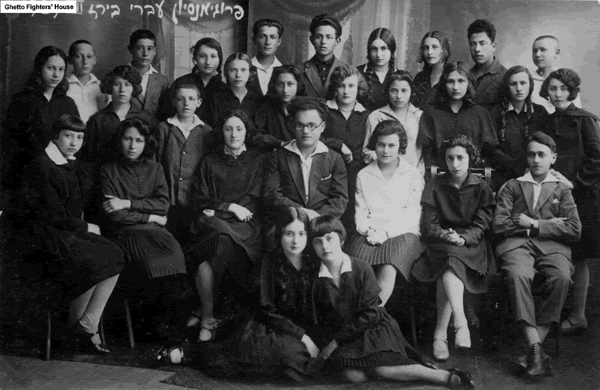
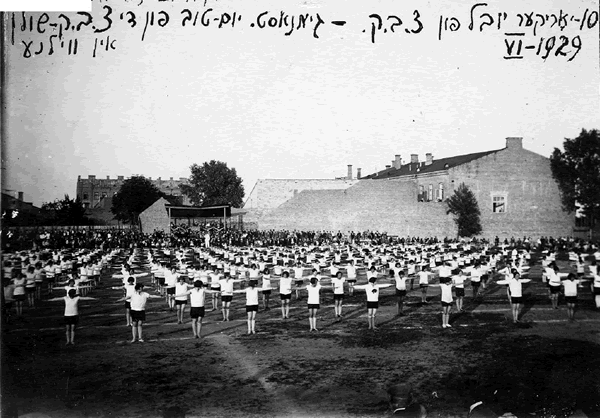
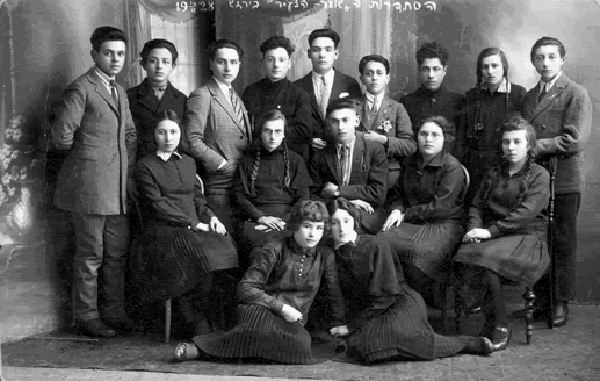
In photo #60 taken in 1929, a photo of a group from the Hebrew Pro-Gymnasia, it says that Batya Friedman is in the photo. I just want to add that my mother, Rachel Vainer is also in that photo. She is on the left sitting on the floor. Do you have any other names of people in the photo. I have some similar photos but can only identify my mother.
Thanks,
Doris Winer Greenberg
From: Norri Leder <norrileder@gmail.com>
Date: Wed, Aug 7, 2019 at 5:44 PM
Subject: Kabatsky
To: <egl.comments@gmail.com>
Hi. My name is Norri Leder. I live in Houston. I’m looking for descendants of Kabatsky’s from Kabrin, Poland/Bellarus. I saw some information about a Hyman Kabatsky who won some chess matches in New York in the 1920s. I am looking for anyone with information about that man.
His name is Hyman Kabatasky. He was the son of Julius and Sarah Kabatsky - of Kabrin. Siblings were Minnie and Irving. I believe Minnie married a man named Zachary Meadow.
Many thanks for any help you can provide. I’m new to this but am hopeful I can fill in some spots on my family tree.
Norri Leder
From: Vitoria Raskin <vitoria.raskin@mpt.mp.br>
Date: Sun, Aug 4, 2019 at 9:09 AM
Subject: Dnipro Jewish cemetery
To: egl.comments@gmail.com <egl.comments@gmail.com>
Hello!
My name is Vitória Raskin from Brazil. Ive heard that my great great grandfather died in Dnipro in 1920. His name os NAFTALi HERSCH RASKIN. Leibl.
Can you Tell me If he us buried there? Any other information?
Thank you Very much!!!
Vitória
5551992138020
From: Francoise Deville <devillefac@icloud.com>
Date: Sun, Jul 7, 2019 at 6:43 AM
Subject: Searching for informations on Zimmerman in Bolechow Galicia
To: <egl.comments@gmail.com>
Hello,
Do you have any informations on a Zimmerman Family : he was a trader and lawyer and married to Rosa Yager from Bolechow (Galicia actual Ukainia) and had 2 children : Yulek and Klara (Dusia) only survivor?
Bes regards
Françoise Deville
From: John panzer <pnzer23@hotmail.com>
Ignacy Neuer Panzer
Birth Lwow March 14, 1923
Death place and date unknown - early 1945 possibly Slovaquia
Attended Gymnasium #2 (German Gymnasium)
Son of Jacob Neuer Panzer and Lea Lempert
Brother of David Neuer Panzer (1926-2003)
From: shimonuv <shimonuv@gmail.com>
Date: Mon, Jul 15, 2019 at 2:04 PM
Subject: Information request from Israel on Bakalchuk and Zimmerman families
Hello Eilat,
My name is Shimon Bakalchuk and I am the son of Esther Bakalchuk of the Zimmerman family.
Esther is the daughter of Chana and Shimon Arie Zimmerman and sister of Yerachmiel (Misha) Zimmerman.
Misha's daughter, Yaffa, told me that she was in touch with you and that you could help me to get the information I was looking for for my two families in Bakalchuk and Zimmerman.
She also told me that you are a relative of us -a third or fourth cousin.
I also understand that you once wanted details about our family. So what I can help - I will do so willingly.
My father's family in Bakalchuk was originally from Pinsk, and they moved to Mikashevitz.
Thanks in advance and I'd be happy to be in touch.
The picture is from Yad vashem report;
Yisrael Bobrov ( on the left) was born in Pinsk in 1886
to Mordekhai and Lea. He was a builder and married to
Dvora.
Prior to WWII he lived in Pinsk During the war he was in
Pinsk. Yisrael was murdered/perished in 1941 in Pinsk,
at the age of 55.This information is based on a Page of Testimony (displayed here) submitted in 1999 by, Elka Bobrov
nee Belous of Herzelia, Israel. His son Zalman also gave a report toYad Vashem for his father.
I am related by a marriage to another Israel Bobrow. He is my mother's first cousin wife's first cousin once removed.
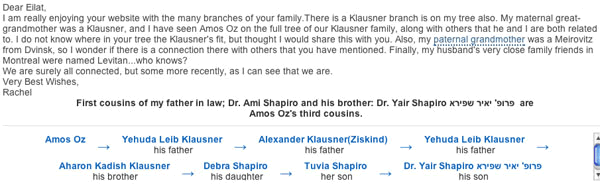
Rachel Gordin
my mother → Meir Gurevich
her father → Natan Avraham Gurevich
his brother → Gershon Gorev
his son (my mother's first cousin) → Hasia Gorev
his wife →Etl Bachmat
her mother → Isroel Elia Dreyer
her father → Sophie (Sara Genia) Bobrow
his sister → Israel Bobrow
her son
Israel Bobrow
Gender:
Male
Birth:
estimated between 1872 and 1932
Latvia
Immediate Family:
Son of Solomon Bobrow and Sophie (Sara Genia) Bobrow
Brother of David Bobrow; Becky Gabie; Joseph Bobrow; Morris Bobrow and Abe Bobrow
Added by:
Myrna Margo on September 21, 2008
Managed by:
Myrna Margo (Leibov)
On Sun, Jun 30, 2019 at 9:17 AM Richard H. Katz <rcats@ieee.org> wrote:
Hi Eilat,
Congratulations! This website is a wonderful resource.
I am working on and extended family genealogy in Ancestry.com and Myheritage.com. I have a question about Pinsk go to #pnsk-83.
Yisrael Bobrov in this picture was the son on my Great-Grandmother Sara Leah Shapiro's sister Lea. Can I use the picture I. My Family trees? If yes, I would like to give credit to you and who ever originally provided it. Can you tell me where the picture came from?
Best Regards
Rich Katz
Torrance, CA USA
From: Kevin Brownstein <kevin.brownstein@gmail.com>
Date: Fri, Jul 5, 2019 at 9:52 AM
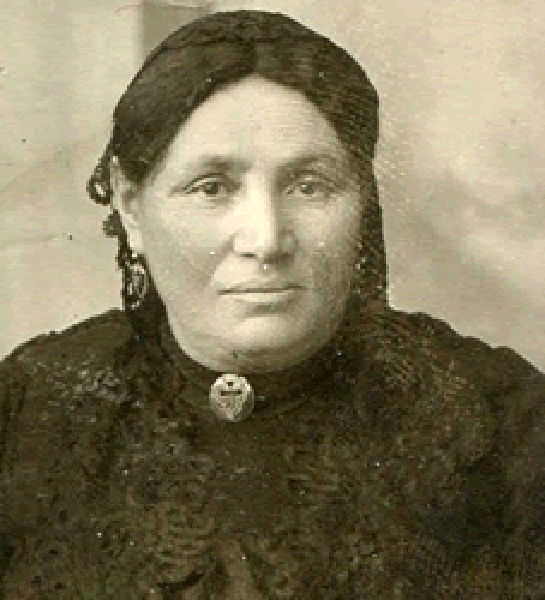
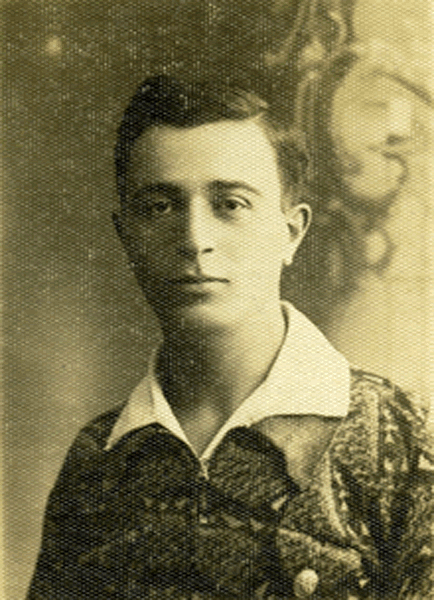
My great-grandmother, Rebecca Levitan immigrated from Krekenava to the US around 1900. Attached is a picture of my great-grandmother and a picture she kept with her family pictures that we are unable to identify. It looks very much like other pictures on your website. Likely it is from between 1915-1920. If anyone recognizes anyone from their family photos or can identify the studio, I would appreciate it.
Thank you again for making this information available to appreciate and remember.
Kevin
From: Marla Lambert <mlamb701@g .com>
Date: Fri, Jun 14, 2019 at 5:25 AM
Subject: Krakow-
To: <egl.comments@gmail.com>
Good Morning,
I just stumbled upon this website. Thank you for the wonderful pictures.
My paternal family comes from Krakow. I recently visited in April, but did not
have much luck obtaining information. My grandmother was born Lea Goldberger
but changed her name to Leonora when she came to the U.S. My relative
I was able to recently locate in the Krakow Street Directory of 1907.
I have some information from a few of the family members, but am always looking for more.
My family lived at 250 Josefa St. Krakow.
Marla Lambert
From: Galinsky, Victoria <vgalinsky@kmsb.com>
Date: Tue, May 7, 2019
Subject: TEITZ (DUITCH) PHOTOS Please add to website!!
To: egl.comments@gmail.com <egl.comments@gmail.com>
MOSHE TAITCH (DUITCH) from Poland.
MOSHE and IDA SHERMAN TEITZ (DUITCH) had a son named Jacob that moved to Chicago and married Jesse Monpiel from France . They had four children . Helen Teitz (Duitch) married Louis Galinsky. Isaac and Sarah Galinsky from Vilna, Lithuania arrived in the United States in 1910. Louis Galinsky was born in Baltimore, MD and married Helen Teitz (Duitch).
Victoria Galinsky
Local Sales Assistant
Cell 520-401-9533
Vgalinsky@kmsb.com
Galinsky
Helen Teitz
Louis & Helen Galinsky
Moshe Taitch
Teitz (Duitch)
teitz-duitch brothers
Kovno family picture from 1932
B. Matthew Neiburger
mneiburger@aol
<montclairtrees@icloud.com>
Hi, do you know what this is a pic of?
Thank you,
Scott Kevelson
On Thu, May 23, 2019 at 3:32 AM <hellesoe@post3.tele.dk> wrote:
Dear Sir,
Searching on the internet for old maps of Postawy I found your home page.
I am trying to write a history about a Danish soldier who lost his live on the 23rd of March 1916 in a place called Hindenburg Wäldchen at Postawy.
I think the name of this location only existed for a short time and maybe only on German maps
Are you able to point out the place for me on a map ?
If so, I would be very thankful
Persondata Nis Christiansen Lenger
Born: 02/09-1890, Fröslee, Handewitt
Died 23/03-1916, Hindenburg Wäldchen, Postawy, Rusland
Proffession Hufner
Place of living: Jelsskov, Jels Sogn
Wife: Gift 1908 i Jels med Kjestine Marie Hellesøe
Children (før krigsafslutningen): Efterlod sig 3 børn, født 1909-1914
Enhed(er): Landwehr-Infanterie-Regiment Nr. 84, 1. Kompagnie
Rang: Überzähliger Gefreiter
Mai Britt og Johannes Hellesøe
Gyvelvej 24
6740 Bramming
22677027 - 20707514
There are 3 Yad Vashem reports by family members living in Israel for Shlomo Slifkin who perished with his wife Rachel and his 4 children ( one named Shalom) . There is also a picture with a few of the children. All the reports for Slifkin from Riga all are related to each other;
Results for:
Schlomo
Slifkin
Riga, Latvia
Page of Testimony
murdered
Rachel
Slifkin
1910
Riga, Latvia
Page of Testimony
murdered
Aharon
Slifkin
1935
Riga, Latvia
Page of Testimony
murdered
Sara
Slifkin
1937
Riga, Latvia
Page of Testimony
murdered
Avinoam Zusman
Slifkin
1917
Riga, Latvia
Page of Testimony
murdered
Noach
Slifkin
Riga, Latvia
Page of Testimony
murdered
Shalom
Slifkin
Riga, Latvia
Page of Testimony
murdered
Shalom Shlomo
Slifkin
Riga, Latvia
Page of Testimony
murdered
Noakh
Slifkin
Riga, Latvia
Page of Testimony
murdered
Shalom
Slifkin
Riga, Latvia
Page of Testimony
murdered
Sara
Slifkin
Riga, Latvia
Page of Testimony
murdered
Slomo
Slipkin Slifkin
1908
Riga, Latvia
Page of Testimony
murdered
There is a long list for Slivkin from Latvia which seems to be the same family Since Shlomo and his wife Rachel appear here as Slivkin. For Slivkin; Gershon Slivkin was born in Rez?kne, Latvia to David and Sara. He was a bookkeeper and married to Masha. Prior to WWII he lived in Riga, Latvia. During the war he was in Riga, Latvia.
Gershon was murdered in the Shoah.
This information is based on a Page of Testimony (displayed here) submitted by his daughter, Sara Zara Slivkin, Berta Gamper
Khasya Fanya Feiga Kheifetz nee Slivkin was born in Rez?kne, Latvia in 1918 to Gershon and Masha. She was a bookkeeper and married to Isaak. Prior to WWII she lived in Riga, Latvia. During the war she was in Riga, Latvia.
Khasya fanya feiga was murdered in the Shoah.
This information is based on a Page of Testimony (displayed here) submitted by her sister, Sara Zara Slivkin
Do you know if the following that I found on the webpage is the same as the relatives I am looking for:
Schlomo Slifkin was born in Riga, Latvia to Yitzkhak and Doba. He was married to Rachel and had 4 children. Prior to WWII they lived in Riga, Latvia.
Schlomo and Rachel were murdered in the Shoah.
This information is based on a Page of Testimonysubmitted by his relative, Naftali Gribov
I am looking for Shabsa Slivkin born 1890 to Israel Leib Slivkin and Doba Sheva (Minkin) Slivkin in Dwinsk, Riga, Latvia. Do you have any other info on any Slivkins or Minkins?
Thank you.
Jill Workman
From: lada yevgrashina <yevgrashina@mail.ru>
Good day
My grandfather Meltzer Mikhail Lvovich was born in Smorgon (ex-Lithuania, now Belarus) on September 15, 1915. He was last child in big family (15 children, inkl. Berta, Eva, Tsilya, Grigoriy). I am looking for my relatives.
Could you help me, please
I contacted you a few months ago regarding my husband’s mother’s family, who resided in Birzai, Lithuania. His grandfather’s name was Sharye Shuster, his grandmother’s was Mary Wolf Shuster. They had 7 children- Chaya Dvora, Genendel, Honda, Sholom Benjamin, Kive, Leah & Ada. Mary, Leah and Ada persisted when the Jews of the town were brought into the woods and shot. Genendel and Hinda immigrated to Sao Paulo, Brazil. The other 3 siblings ended up in the USA after spending 20 plus years in Havana, Cuba. I could not find this family in your records. Is there anywhere else I can look?
Alice Heller
Russell A Maurer <litvaksig@lyris.jewishgen.org>
Feb 16, 2019, 11:00 PM
I am pleased to announce that Batch 4 of the Vilnius household
registers is now available to qualified donors. The registers
were created between 1919 and 1940 when Wilno (Vilnius) city and Wilno
voivodeship were part of Poland. The registers contain detailed
information about everyone who lived in Wilno at that time, as well as
for many visitors. They will potentially hold discoveries for anyone
whose family was in that general area, which today includes parts of
Lithuania, Belarus, and northeast Poland.
As this is a very large project that will go on for years, we are
releasing data in batches of about 5000 lines. Batch 4 includes
six large apartment buildings located at Mala Stefanska 19, Wielka
Stefanska 5 and 14, and Zawalna 10/3, 15, and 16. To
help you determine if this batch is relevant to your research, we
provide surname information below. In addition, we are
offering a "batch preview", a bare-bones version of the batch
spreadsheet containing the full name and year of birth (or
age) of each person. The preview may be downloaded from the VHR homepage,
https://www.litvaksig.org/research/special-projects/vilnius-household-registers
With this release, we are also debuting a new tool, a Vilnius
interactive map (linked on the VHR home page). This tool will
facilitate correlating Polish-era and modern street names. We thank
Jay Osborn for creating this map tool for us.
Researchers wishing to access the full batch 4 spreadsheet will need
to make a qualifying donation (minimum $50) to the
VHR project. This can be done by selecting Vilnius household registers
within the Special Projects option on the LItvakSIG
donation page,
https://www.litvaksig.org/membership-and-contributions/join-and-contribute/
Please mention the batch you want in the donation note. We will then send
you a download link for the batch you have requested.
Any inquiries related to VHR should be directed to me at
vhrproject@litvaksig.org
Russ Maurer
VHR project coordinator, LitvakSIG
SURNAMES:
The most frequently mentioned surnames in batch 4 (40 or more mentions
each) were LEWIN, ALPEROWICZ, MINKOWICZ, MATLOWSKI, GURWICZ, ZAJDSZNUR,
KOWARSKI, BERKMAN, CHOLEM,and BROJDO.
Here is the full list of surnames for this batch in alphabetical order.
I want to share a story about DNA connection with unknown relatives which I should have realized months before who they are. I noticed a third cousin predicted DNA connection with a Morris Reich and his son Steven (1.89% and 1.68%) . On the list of last names they shared with me Horowitz/ Gurevitz (Mordechi Gurevich, my maternal grandfather"s last name which is a common name) I wrote to the father with my details and he never replied. I compared the 2 to my brother's DNA and he shared little with them. I decided that it is an Endogamy case and gave up. Months later a second cousin of mine (Sharon nee Herbert took the DNA test (her grandmother Sima was a sister of my Horowitz/ Gurevitz grandfather Meir Gurevich) When comparing matches with her I noticed the Reich father and son had slightly above 2.0% with her. I wrote her that we should investigate it because it looks like a good match. I wrote to the son and got a reply that it must be his grandmother who is Horovitz/ Gurevitz. Shortly After Chaim Herbert, the father of my second cousin, got his results and he was above 3% match to the father. I knew that I must solve it. I looked again at their information. Do I know of any Reich beside the well known politician Robert Reich and the well known modern musician Steven Reich? ( my match posted 1990 as the year he was born so he was much to young) ....Yes, it came to me; Chaia Esther Reich, a holocaust survivor who was my grandfather's first cousin. 20 years ago I spoke with her many times about our family in Kurenets. I even have her profile on Geni with her son's and grandson's correct names. Now we are connected by email and I shared the Geni tree and more. Why did it take me months? I assumed that I will never know the connection because 1. My brother had Just a tiny match with his second cousin once removed and even smaller match with his 3rd. cousin. 2. I sent clear information to the father and he did not replay. Reading it for one second would have make it clear to him that we are related via Kurenets and Gurevich the birth place and the birth name of his mother. http://www.jewishgen.org/yizkor/kurenets/kur020.html
Rabbi Yakov Landau, Av Beit Din of B'nei B'rak Israel, Former Rabbi of Kurenets wrote about the family;
"Reb Mordechai Horwitz Gurevich was known in town as Mordechai Frada's (his wife was Frada daughter of Yehuda (ben Meir) Alperovich). He was the son of a Hasidic Jew Zalman Uri Gurevich who visited Tzemach Tzedek and the name of his father was Avraham Elia. By the order of Tzemach Tzedek he became a shohet. Even in his last days (ca. 1920) he served as a shohet in a community near Kurenets. His eldest son was also a shohet. His name was Chaim Israel Gurevich (perished in the holocaust in Kurenets). His son Mordechai, on the other hand, had a business selling iron but his soul burnt with the holy fire. In the middle of market day when his store would be filled with Christian buyers, he would leave the store and run to pray with the community in the synagogue. Every evening he would come to our minyan to study.
When Reb Mordechai Gurevich was young he went to study in the town of Labadowa, and was very influenced by Levik Labadower, who was very pure. He made a few visits with his friends at that time to the Koidanov Rebbe, but when he became middle aged, he turned to Lubavitch Hasidut and became a very devout Lubavitcher. He would pray for a long time on the Sabbath, finishing a long time after the rest of the community. A few times he went to the Admor of Lubavitch even when he was living in Rostov on the River Don. In his older years he was blessed to go to Eretz Israel. This took place about 20 years ago (ca. 1933). He settled in B'nei Brak, and after his wife Freda passed away, he moved to a kibbutz near Petah Tikva (Givat Hashlosha) and lived next to his daughter Batia Bender. Every day he would walk to Petah Tikva to study Gemara together with the Rabbi and a few of his friends. He studied the Mishna intensely, and his deepest desire was to learn all the Mishna 101 times. I am sure that he achieved his goal since he was constantly reciting the Mishna. About two years ago (ca. 1952), he passed away.
Mordechai Gurevich
Birth:
18, 1873
Kurenets
Death:
1954 (80)
Israel
Immediate Family:
Son of Zalman Uri Gurevich and Sarah Gurevitz
Husband of Frada (Freidel) Gurevich
Father of Natan Avraham Gurevich; Meir Gurevich; Batia Bender; Sima Lerman Herbert; Luba Bar-Dan and 1 other
Brother of Chaim Yisroel Gurevich; Leba Shafer; Yaakov 'Yankel' Spektor; Perla Gurevich and Chana Alperovitz
Chaim Yisroel Gurevich (Horowitz)
Birth:
1855
Kurenets
Death:
September 09, 1942 (87) (murdered by the Nazis with wife and daughter)
Immediate Family:
Son of Zalman Uri Gurevich and Sarah Gurevitz
Husband of Toibe Raizel Gurevitz and Cheyena Devorah Briskin Gurevitz
Father of Isaac Horowitz; Rachel Gurevitz; Abraham Elia Horwitz; Joshua Heshel Gurevitz; Samuel Horwitz/ Gurevitz; Maxwell HURWITZ Gurevitz; Leah Benes and Chaya Esther Reich« less
Brother of Leba Shafer; Mordechai Gurevich; Yaakov 'Yankel' Spektor; Perla Gurevich and Chana Alperovitz
Dear Eilat,
I was looking at your wonderful web pages, initially to look for my mother’s father’s family in Kaunas. But then I noticed the page on Spilka. My mother’s mother’s last name was Spilkes (variously spelled for a while when they got here) from Mogilev-Podolsky, Ukraine. Her mother was Chane Satz and her father was Joine/Julius Spilkes. All the various parts of my great-grandparents’ families lived in M-P, over the river in Bessarabia, but also in Brody, Galicia and the general area around L’vov. In fact, one of my great-grandmother’s brothers was born in Brody (and moved to Vienna). Other names were Gass, Treibich, Blaustein (received our ticket money for Treibich’s), Kogan, Broker (apparently with widely varying spellings, esp. in the Brody area), and others, including Hurwitz, Deitsch, Tannenbaum, and Winokur. I’m asking about Spilkes/Spilka because in Brody it appears as both and it’s not a very common name. I read the very interesting story about the woman in Massachusetts. My mother’s family emigrated primarily to Philadelphia, where there were a lot of people from Mogilev-Podolsky.
I once found an article on the internet about a rabbi in Paris (I can’t remember his name exactly but it was something like Eisenberg or Seidenberg?) with one of the Spilkes’s with him. I can’t find it any more.
Searching for Spilkes in old sources in Philadelphia largely brings up many copies of an article about my grandmother’s aunt Sima’s wonderful wedding to another person who was also deaf (in 1897, this was very unusual). But I’m having trouble finding much else. If you have any idea about Spilkes vs. Spilke, Spilka, etc. I’d be interested. My great-grandfather usually signed in Hebrew when he first got here, often as Shpilkes or a variant. I realize it’s just the difference between one pin and more than one pin.
Many thanks and I hope this isn’t too confusing. I should be writing my syllabi for classes. Jeanne Swack
Congrats, this is a wonderful site
I saw death lists but I cant access from your home page
Best regards
Hernan Kopf
Dear Hernan,
Which death lists are you having troubles with? From the all Lithuania Database https://www.litvaksig.org/about-litvaksig/? The Yad Vashem ? other lists?
Yes, I approve.
-----
Hello,
My name is Harriet Bennish and I would like permission to use the photo of Sonya Madeisker that you have on your website for an educational program I am presenting.
Please respond with your approval.
Sincerely,
Harriet Bennish
#mmdskr-1:
Sonya Madesker, a resistance leader in Vilna. 1914- 1944
#mmdskr-2:
Sonya (Sheyna) Madeisker, a Jewish partisan leader. Sonya was born in Vilna in 1914 to well known teachers Hessel and Helena,
She was a communist activist in Vilna during the Polish rule (before the outbreak of World War II) She served eight years in prison for such activities
During the German occupation she was imprisoned in the Vilna ghetto. She became a leading activist in the anti-Nazi underground. Served as a liaison with the anti-Nazi underground outside the ghetto. Exit the forest and joined the partisan fighting was denied to due to her important activity. In May 1944 was found by the Gestapo, while she was in the apartment of a communist activist in the city. Her attempt to commit suicide failed , she was just wounded was captured and was closed in the cellars of the Gestapo, where she was interrogated under torture. Finally she was execution. After her death, military ribbons by the Government of Poland and Lithuania by the Soviet government.
#mmdskr-3:
Rivka Madeisker/ Madesker, member of the Jewish underground in the Vilna and Bialystok ghettos.
Rivka Madeiskar, born in 1922, was a member of Ha - Shomer ha - Tsa'ir and took part in the Bialystok ghetto uprising. After that she lived as a Pole, under the assumed name of Marysia Madejska, on the "Aryan" side of Bialystok, and served as a courier with the partisans. She was arrested by Ukrainian SS men after having been informed on. She was charged with providing aid for a wounded Jew in hiding. Rivka Madeiskar was tortured to death; she died on December 3, 1943
On Fri, Feb 1, 2019 at 6:51 PM Harriet Bennish <harrietbennish@gmail.com> wrote:
Hello,
My name is Harriet Bennish and I would like permission to use the photo of Sonya Madeisker that you have on your website for an educational program I am presenting.
Please respond with your approval.
Sincerely,
Harriet Bennish
Thank you for all your good work. My grandmother’s family were Shmuklers from Ivye; she, her parents, and 6 siblings immigrated to Cleveland Ohio (not all together) between 1900 and 1905 (some changed their name to Smukler, others to Smookler). I would love to learn more about those who stayed in Ivye or left at other times for other places.
Best wishes,
Lori Cole
From: Bernie <bjgcpa@aol.com>
Date: Tue, Dec 25, 2018 at 6:42 AM
Subject: Gitlitz Family
To: <egl.comments@gmail.com>
I would like to post this question on your website. Are any of your website visitors who named Gitlitz or Gitlin and family is from the city of Vilna or from the towns surrounding Vilna in the Vilna district also Kohanim? If so please email me at bjgcpa@aol.com. I am Looking for relatives I am not aware of with common ancestry to find and share family history
Bernard Gitlitz
From: J Luria <justinluria@gmail.com>
Date: Thu, Jan 3, 2019 at 9:33 AM
Subject: Luria-- Dolhinow, Doksicy
To: <egl.comments@gmail.com>
Hello,
I came across your website (http://www.eilatgordinlevitan.com/index.html), and you are doing great work! My name is Justin Luria. I am descended from a family that came from Dolhinow and Doksicy.
Your webpage has many pictures of people and daily life, which reminded me of a book about my family's history. (https://www.worldcat.org/title/here-to-stay-seven-generations-of-a-russian-jewish-family-1823-1988/oclc/866410939). I have a copy, which contains a few families from the area from 1823 onwards (Luria, Shofnis, Rubin, Freedman). If you are interested in scanning/uploading images, I have a copy that I can loan to you. If not, a link to the book may be of interest to any genealogists out there.
Thank you for your hard work,
Justin
From: A. Ben-Ami <dufs44@bezeqint.net>
Date: Mon, Jan 14, 2019 at 9:49 AM
Subject: Weksler - Radio in Lodz Ghetto
To: <egl.comments@gmail.com>
Shalom:
This picture shows a man using a commercially built electronic test
instrument for radio equipment. The caption says it is assumed to be a
picture of Szaga Weksler listening to radio. I think that it is a
picture of Wiktor Rundbaken, who was a radio technician, testing a radio
rather than Szaga Weksler listening to radio.
Thank you
Aryeh Ben-Ami 4Z5DF
From: Ruth & Bruce Lynn <lynn33@rcn.com>
Date: Sun, Jan 13, 2019 at 12:50 PM
Subject: FEIGEL family from Postavy
To: <egl.comments@gmail.com>
I just happened across your website, and it’s very impressive.
My husband’s grandmother, Ida (Chaia Gittel) FEIGEL (changed to FOGEL in the US) LIN (changed to LYNN in the US), came from Postavy, Riga, and Vilna. She was born in Postavy. They emigrated to the Chicago area.
Her father’s name was Isaac/Isaak/Yitzchak/Itzhak or possibly Aizik FEIGEL, and his wife was Sarah. He was born in Vilna or Riga.
Her brothers were Henach/Henry, Leo/Labl, and Josef. I’m not sure whether they were born in Vilna, Riga, or Postavy. Henry emigrated to Chicago.
Please let me know if any of these names sound familiar.
Thanks.
Ruth Nadelman Lynn
Lexington, MA
From: Svetlana Tumanov <sve.tumanova@yandex.com>
Date: Mon, Nov 5, 2018 at 2:02 PM
Looking for relatives and descendants of my Dvinsk family, my mother Zila DRITZ (1925-93 Winnipeg), daughter of Boruch Meyer Dritz, son of Meyer Dritz, son of Boruch Dritz, all born in Dvinsk and died in Ruga in the 18th century. Who were their wives? What are the names of our jewish mothers?
My GD Boruch was married to Hasja, the twin sister of Lea, who were neé Gurvich/Hurwitch/Gurevich(?) from Dvinsk. Supposedly, the family had a bakery & a taylor shop in the city.
Their mother emigrated to the US in 1905-10. In the last weeks, my cousin Bernie in Dallas & I, after an intensive search are delighted to find a DRITZ dynasty of my GD Boruch's four siblings, who moved to the US. But we know nothing about the Gurvich branch of the family or prior.
In the hope that our GGF & GGM have taken with them to the US siblings of Hasja and Lea, or at least to find the roots of our Grandma Gurvich family, as well as Dritz, prior to Boruch, born 1890 in Dvinsk.
Thank you very much.
From: Isak Gath <isak@bm.technion.ac.il>
Date: Mon, Dec 3, 2018 at 2:00 AM
Shalom Eilat
I was wondering if you had any material regarding a Chait family living in Seta (Keidan or Ukmerge Uyezd) prior to approximately 1850. They are listed in the revision lists, Shimen-Lozer Chait and his wife Gitel, nee Poltzky. They later moved to Panevezyz. They had 3 sons (Yizchak-Yaakov, Moshe-Leib and Yidel-Monish). Shimen-Lozer Chait died around 1867-1869. His widow, Gitel, remarried a widower from Panevezys , Leib (Arie or Yehuda) Hilman. In 1870 they went to Palestine and lived in Jerusalem where Hilman was head of a Yeshiva. Strangely, the 3 boys of Gitel (Plotzky-Chait-Hilman) and their descendants were known in Palestine not as Chait but as Yudelevitch. All the above is documented (revision lists, All Lithuanian list, Montefiori listings etc). Do you find any connection to your Chait family? By the way, most of the rest of the Plotzky family from Panevezys and Vilnius left during the 2nd half of the 19th century for South Africa.
Regards
Itzik Gath
Prof. Isak Gath MD, DIC, DSc
Faculty of Biomedical Engineering Tel. Office +972-4-8294115
Technion Israel Institute of Technology \
32000 Haifa, Israel
Dear Prof. Gath,
Our Chait family lived in Pasvalys (my great grandfather; Yehuda, son of Abraham Chait. He passed away in Tel Aviv in 1933) and Birzai at the end of the 19th century. Birzai had a large number of Chait family members. I don't know if they were all related. Between 1900 to the early 1930s almost our entire family left Lithuania and Latvia. Some came to Baltimore ( Mendel Max Chait changed his last name to Highstein and my grandmother's brother; Abe changed his last name to Hyatt). Others went to Palestina/ Eretz Israel and became Chayut. 2 great grandchildren of Max Chait Highstein and five grandchildren and great gtandchildren of Yehuda Chait took DNA tests with 23 and me or Family tree DNA. we all matched each other and also the Sandler/ Silbert family from the area of Pasvalys as strong relation.
We also know of some relation to the Hilman family http://www.eilatgordinlevitan.com/kurenets/k_pages/hillman.html
I study the Jewish history of the town of V/Wileyka http://www.eilatgordinlevitan.com/vileyka/vileyka.html, and especially the Koidinovs Hasidic sect who lived there.
I would be very happy to receive any material related to document photographs and the like.
Sincerely
Shalom Erlich, Bnei Brak
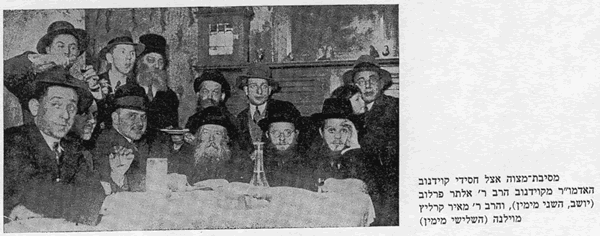
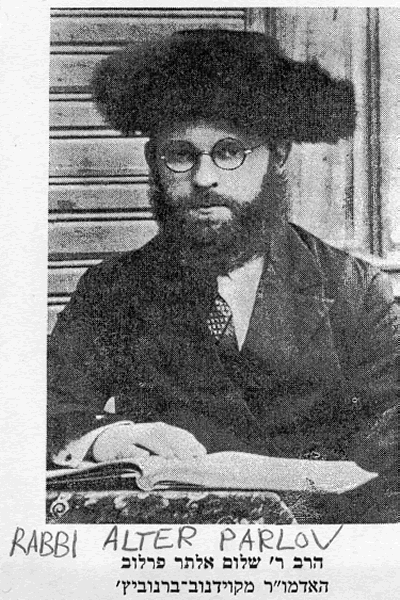
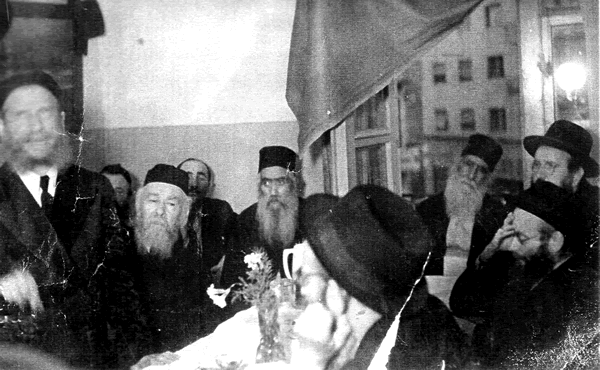
Israel Please see picture at Old Scenes #7 click to enlarge from the Vileyka Yizkor book http://www.eilatgordinlevitan.com/vileyka/vil_pix/vils_7_b.gif It is of Rabbi Alter Parlov ( Sitting second from the right) and rabbi Meir Karlitz ( Sitting third from the right) visiting Vileyka for a Mitzvah party with the local Koidnov Chasids
Rabbi Shalom Alter Parlov;
From: Yechiel Szeintuch <dovsadaninst@mail.huji.ac.il>
Date: Mon, Dec 3, 2018 at 2:32 AM
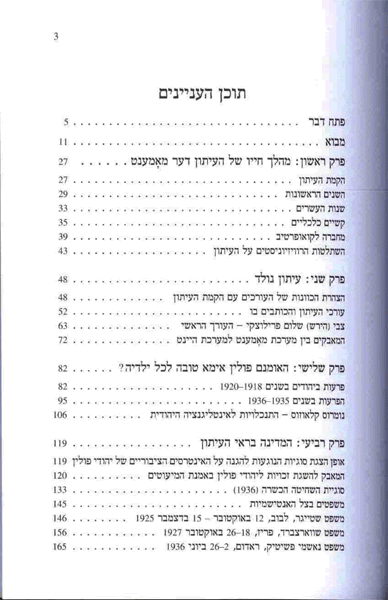
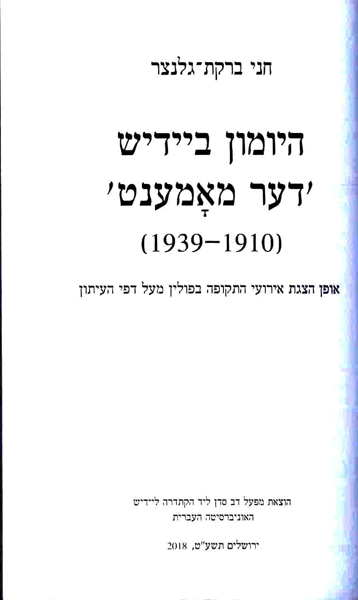
The Dov Sadan Publishing Project presents a new book published
recently: The Yiddish Daily 'Der Moment', by Dr. Hani Bareket-Glanzer
To order a copy please contact: dovsadaninst@mail.huji.ac.il
From: Barry Tarshis <cbt@tarshis.ca>
I was interested in the Tarshish Family page, but unfortunately only one picture is visible. The links to the others don’t work. My great, great-grandparents came from Zasliai, possibly moving to Kaunas. My great-grandparents immigrated to the US in the 4th quarter of the 19th century.
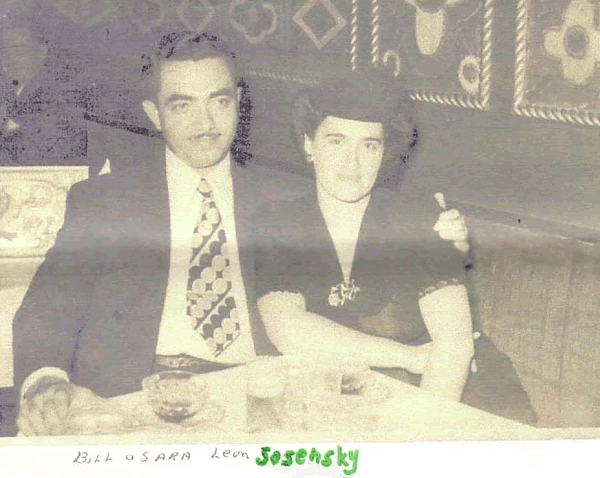
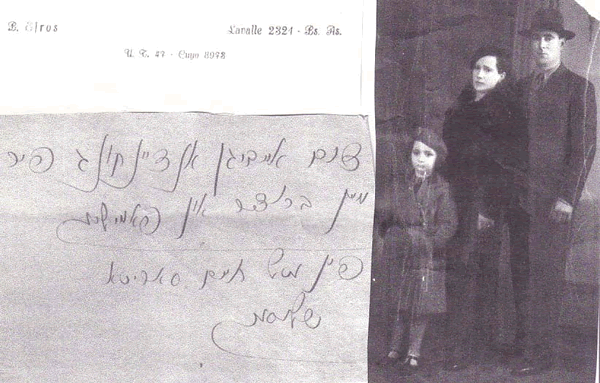
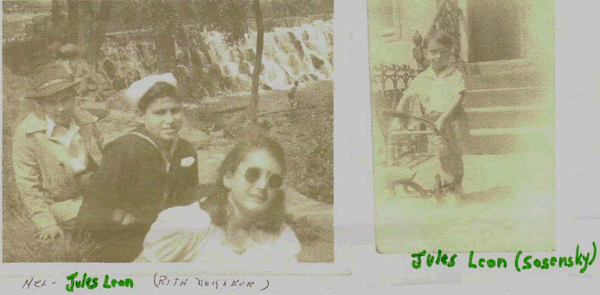
William and Sara Leon (Sosensky) Sara (Levine) they are my deceased Mother/father law they had two sons Jules and Mel (both deceased)
Williams brother's family, David Sosensky perished in a gulag prison
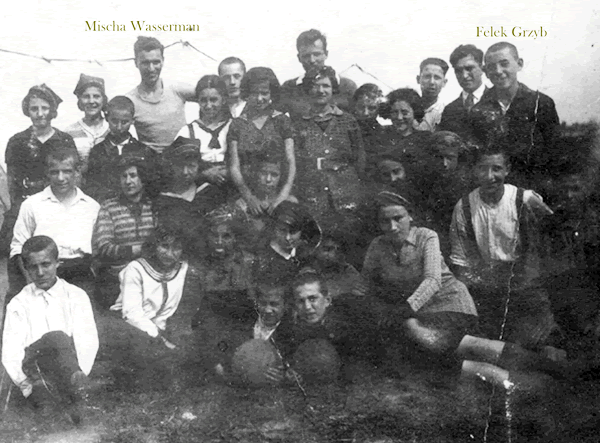
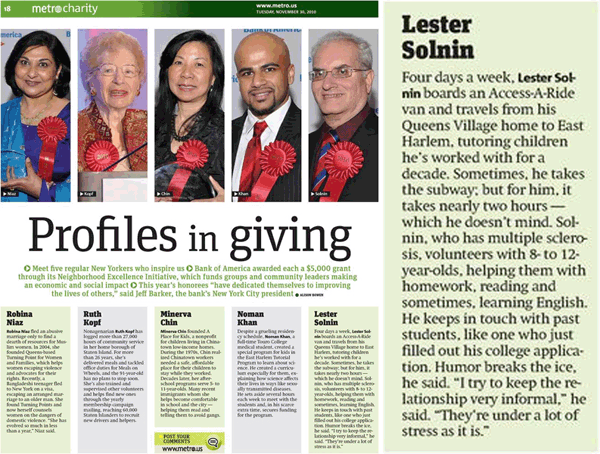
Solnin (nee Sosensky Scolnik) family Joey, and Selma Lester Solnins's family and Joey is first cousin to William and Sara Leon
Note: William and Sara were first cousins and yes it was legal to marry back then
Boy in the sailor suite is Jules Leon (nee Sosensky) My husband (Deceased)
Leons/Sosensky were also cousins with skolnick and Guerwitz Im not sure of spelling but they lived in Bangor, Maine i believe I remember an aunt Mary and Uncle Zalman
Marian Leon
From: Lisa Chasan-Taber <lct@schoolph.umass.edu>
Date: Sun, Sep 9, 2018
Subject: Gawuryn (Gavurin) family from Slonim
Dear Eilat Gordan Levitan:
I am researching my Great Great Grandfather, Kalman Gawuryn (also spelled Gavurin) who was born around 1830 in Slonim. He was the son of Hirsh (Girsh) Gawuryn (b 1782) who was the son of Leyba Gawuryn. Gavurin cousins in Slonim included: Nevakh, Yudel, Abram, Wulf, Itzka, Shlema,, Yankel, Nakhman, Pinchus, Khatzkel, Gdalia, Morduch, and Movsha. They were all living in Slonim around 1850.
I am wondering if you have any information on this family and/or if others are researching them?
Dear Lisa,
Sadly I found many in the Yad Vashem list.96 Results for: Last / Maiden Name = Gavurin I am pasting some from Slonim and near by towns
Sara Gavurin nee Reizin was born in Jeziernica, Poland in 1881 to Shlomo and Malka. She was a housewife and married to Gdaljau. Prior to WWII she lived in Slonim, Poland. During the war she was in Slonim, Poland.
Esther Ajnsztejn nee Gavurin was born in Poland in 1909 to Avraham and Khaia. She was married. Prior to WWII she lived in Poland. During the war she was in Bialistok, Poland.
Esther was murdered in the Shoah.
This information is based on a Page of Testimony submitted by her sister, Lea Lev
Shmuel Gavurin was born in Slonim, Poland. He was a merchant and married to Rivka nee Lider. Prior to WWII he lived in Slonim, Poland. During the war he was in Slonim, Poland.
Shmuel was murdered in the Shoah.
This information is based on a Page of Testimony submitted by his cousin, Dvora Golomb Lider Of Kibutz kfar Aza (she gave a phone number)
Rivka Gavurin nee Lider was born in Slonim, Poland. She was a merchant and married. Prior to WWII she lived in Slonim, Poland. During the war she was in Slonim, Poland.
Rivka was murdered in the Shoah.
This information is based on a Page of Testimony (displayed here) submitted by her cousin, Dvora Golomb Lider
Yosef Gavurin was born in Slonim, Poland to Shmuel and Rivka. He was a physician. Prior to WWII he lived in Slonim, Poland. During the war he was in Slonim, Poland.
Yosef was murdered in the Shoah.
This information is based on a Page of Testimony (displayed here) submitted by his cousin, Dvora Golomb Lider
Sara Gavurin nee Reizin was born in Jeziernica, Poland in 1881 to Shlomo and Malka. She was a housewife and married to Gdaljau. Prior to WWII she lived in Slonim, Poland. During the war she was in Slonim, Poland.
Sara was murdered in the Shoah.
This information is based on a Page of Testimony (displayed here) submitted by her niece, Yisrael Volfovitz
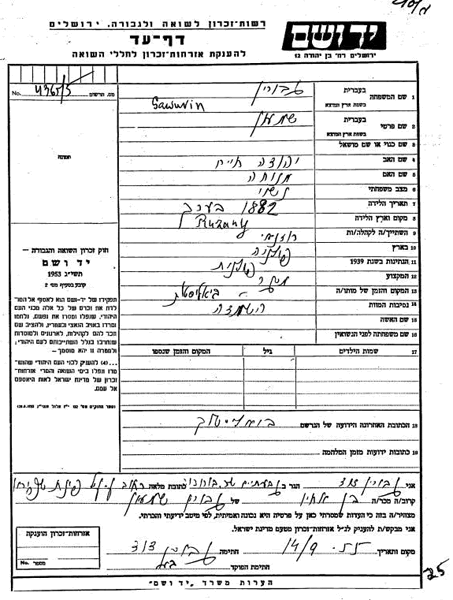
Shimon Gawurin was born in Ruzany, Poland in 1882 to Khaim and Menukha. He was a merchant and married. Prior to WWII he lived in Ruzany, Poland. During the war he was in Bialystok, Poland.
Shimon was murdered in the Shoah.
This information is based on a Page of Testimony (displayed here) submitted by his nephew, David Gavurin
Khava
Gawurin
1900
Ruzany, Poland
Page of Testimony
murdered
(next to Slonim)
Samuil Semion Gavurin was born in Bialystok, Poland in 1886. He was a mechanic and married to Teiba. Prior to WWII he lived in Bialystok, Poland. During the war he was in Bialystok, Poland.
Samuil semion was murdered in the Shoah.
This information is based on a Page of Testimony (displayed here) submitted by his granddaughter, Irena Sivitzki
Yisrael Gawurin was born in Ruzany, Poland in 1902 to Tzvi and Moshe. Prior to WWII he lived in Ruzany, Poland.
Yisrael was murdered in the Shoah.
This information is based on a Page of Testimony (displayed here) submitted by his brother, David Gavurin
Tzvi Hirsh Gawurin was born in Ruzany, Poland in 1872 to Yehuda and Menukha. He was a metalworker and married. Prior to WWII he lived in Ruzany, Poland. During the war he was in Ruzany, Poland.
Tzvi was murdered in the Shoah.
This information is based on a Page of Testimony (displayed here) submitted by his son, David Gavurin
From: Julia Shaer <julabear@gmail.com>
Hello
My name is Julia Shaer (mother abrahams, related to Schapiro)
I have found my great Grandfather's details of when he came to South Africa, Leib Schapiro -
"44 Schapiro,Leib ...wolk, 1902 19y Passenger Record Text Manifest Scanned Manifest "
Here: http://www.eilatgordinlevitan.com/vileyka/vil_pages/vil_gb_archive.html
I see it comes from a scanned manifest. Do you happen to know where I can get a scan of this?
Thank you in advance
Julia
Dear Julia,
Go to https://stevemorse.org/ and try to find the information.
--Since the name is common there are almost 200 records; Just the first 20 here
All results for Leib Schapiro
Results 1-20 of 196
RecordsCategories
1920 United States Federal Census1920S
Record information.
Name
Lieb Schapiro
Birth
Austria
Arrival
1889
Residence
1920 Manhattan Assembly District 6, New York, New York, USA
U.S. Naturalization Record Indexes, 1791-1992 (Indexed in World Archives Project)CITIZENSHIP RECORDS
Record information.
Name
Leib Schapiro
Birth
abt 1900
Civil
12 Jul 1937
Residence
California
U.S. Naturalization Record Indexes, 1791-1992 (Indexed in World Archives Project)CITIZENSHIP RECORDS
Record information.
Name
Leib Schapiro
Civil
23 Sep 1931
Residence
New York
U.S. Naturalization Record Indexes, 1791-1992 (Indexed in World Archives Project)CITIZENSHIP RECORDS
Record information.
Name
Leib Schapiro
Birth
Austria abt 1870
Civil
19 Dec 1904
Arrival
1890
Residence
New York
1900 United States Federal Census1900S (DECADE)
Record information.
Name
Leib Schapiro
Birth
1877 Russia
Arrival
1898
Residence
1900 Manhattan, New York, New York, USA
U.S. Passport Applications, 1795-1925BORDER CROSSINGS & PASSPORTS
Record information.
Name
Leib Schapiro
Birth
Kozama, Galicia, Austria 26 Dec 1870
Residence
New York City, New York
Record information.
Name
Leib Schapiro
Residence
1940 San Francisco, California, USA
Web: Minnesota, Naturalization Index, 1849-1985CITIZENSHIP RECORDS
Record information.
Name
Leib Schapiro
Residence
Ramsey, Minnesota, USA
California, Death Index, 1940-1997DEATH, BURIAL, CEMETERY & OBITUARIES
Record information.
Name
Leib Schapiro
Birth
Other Country 30 Aug 1899
Death
4 May 1977 San Francisco
Global, Find A Grave Index for Burials at Sea and other Select Burial Locations, 1300s-CurrentDEATH, BURIAL, CEMETERY & OBITUARIES
Record information.
Name
Leib Schapiro
Birth
1887
Death
1944
U.S., Social Security Death Index, 1935-2014DEATH, BURIAL, CEMETERY & OBITUARIES
Record information.
Name
Leib Schapiro
Birth
11 Sep 1899
Death
May 1977 San Francisco, San Francisco, California, USA
Civil
California
Other
San Francisco, San Francisco, California, United States of America
New York, New York, Extracted Death Index, 1862-1948DEATH, BURIAL, CEMETERY & OBITUARIES
Record information.
Name
Leib J Schapiro
Birth
abt 1876
Death
14 Mar 1942 Kings, New York, USA
England & Wales, Civil Registration Death Index, 1837-1915DEATH, BURIAL, CEMETERY & OBITUARIES
Record information.
Name
Leib Schapiro
Birth
abt 1835
Death
Jan 1910 Whitechapel, London
New York, New York, Marriage License Indexes, 1907-1995MARRIAGE & DIVORCE
Record information.
Name
Leib Schapiro
Spouse
Tirtza Lieberman
Netherlands, Civil Marriage Index, 1795-1950MARRIAGE & DIVORCE
Record information.
Name
Leib Schapiro
Netherlands, Civil Marriage Index, 1795-1950MARRIAGE & DIVORCE
Record information.
Name
Leib Schapiro
Netherlands, Civil Marriage Index, 1795-1950MARRIAGE & DIVORCE
Record information.
Name
Leib Schapiro
Netherlands, Civil Marriage Index, 1795-1950MARRIAGE & DIVORCE
Record information.
Name
Leib Schapiro
Other
R O Jones
Birth
abt 1869
Departure
2 Mar 1905 Liverpool, England
Destination
Halifax, Canada
Results 1-20 of 196
From: Maria Amalia Robbin <marobbin@marwwtrading.com>
Date: Mon, Sep 24, 2018 at 9:21 PM
Subject: looking for my Jewish Family
My name is Maria Amalia Robbin. I was just looking at your website and I am hoping you can help me.
My paternal grandfather, Michel Rabinovitch was Jewish and his mother was from Rudamina and his father from Minsk.
The family emigrated to Paris from Russia I believe before the Russian Revolution in 1917 (I have no clue what year they moved but somehow I think it was before the Revolution). My great grandparents and their children were:
David Mikhelevich Iloselevich Rabinovitch: Born in Russia July 1, 1874 died in Paris 18th of March 1939 (his parents were Mikhel Yosel Rabinovitch and Rebeca Matalon)
Soraya Rasey Lazarevna Rabinovitch (nee Aron) born in Luthuania January 9/1882 died in Paris February 3/1931 (her parents were Lazare Aron and Mussia Began)
They married on June 3, 1988 in Vilna. Their children were:
Mura Rabinovitch born in Vilna, Lithuania February 22/1900 died in Paris March 13/1950
Michel Rabinovitch born in Minsk, Belarus July 20/1905 died in Basle, Switzerland May 17, 1950 (that’s my grandfather)
All of the above family members are burried in the Cimetere de Bagneux in Paris.
There is one child who I don't know her birth date or death date and I wonder if she was born in Paris. Her name was Marie Rabinovitch. She married someone by the name of Marx because there are some letters from her that come as Marie Marx but they are sent from London in 1950.
When my grandfather Michel died, my grandmother never spoke of him again. Therefore, since my father was 6 years old at the time, he basically didn’t remember his father. My parents now have died as well as my uncle and therefore, I am doing this research completely on my own.
I am trying to decipher the Paris archives to see if I find information there and see if there are records of when they emigrated and also if Marie was born there (the only problem is that my French is not the best!).
I am sure that I must have some living relatives.
Do you have any ideas? Can you guide me/help me?
Thank you very much!
Maria Amalia Robbin
From: Susan Schonfeld <sxschon@icloud.com>
Date: Wed, Sep 26, 2018 at 4:50 PM
Hillel Gurevich of Dvinsk
Any information on my great grandfather from Dvinsk He was married to Rachel
I saw your website about the Teitz Family. Do you know my dad Jimmy Galinsky? My great Grandfather was Jacob Duitch. His name was changed on Ellis Island from Teitz to Duitch.
Jacob Duitch married a woman from Chicago named Jessica Monpiel (Mansfield) and they had four children. He is not in the picture from Poland attached because he was in America when this was taken ….
Victoria Galinsky
Vgalinsky@kmsb.com
Thank you for the reply. We have no specific information, only that my ancestor Morris Smazhanovits arrived in the US from Grodno in the 1880's.
According to the Dictionary of Jewish Surnames, the family name Smazonovich (and spelling variants) is found exclusively in the towns of Volkovysk and environs, which is a town that was in Poland at the time that Morris Smason emigrated, but is now in Belarus. The district town was Grodno, and there was a building owned by a Smazanovich from 1893 to 1915 based on local city directories, but no resident named Smazanovich was listed during that period.
I am interested in any information about anyone with the same last name.
On Wed, Oct 24, 2018, 12:54 PM eilat gordin <egl.comments@gmail.com> wrote:
From: Avi Smason <smason.avi@gmail.com>
Date: Sun, Oct 7, 2018 at 9:57 PM
Subject: GRODNO - Rare photograph of a relative
To: <egl.comments@gmail.com>
I was very surprised to come across the name "Misha Smazhanovits" in the caption of photo #grd-40 at the site below.
Do you have any information about the source of this photo?
Many thanks,
Avi Smason
Israel
(Left to right) Fima Malets, Shapiro, and Misha Smazhanovitsh, posing outdoors.
Dear Avi,
The picture is either from Yivo in New York or from the ghetto fighters in Israel. Could you tell me something about your relative?
From: Alison Marshall <alison.marshall5@btinternet.com>
Date: Fri, Aug 24, 2018 at 5:44 AM
Subject: Request for further information
To: <egl.comments@gmail.com>
Dear Eilat Gordon Levitan
Thank you for your excellent website, which is a mine of information. However, I am seeking some follow up details and there are some unclear references. I wonder if you can help me.
On this page http://www.eilatgordinlevitan.com/krakow/krkw_pages/krkw_archives.html there is a half page or so of writing headed ‘Sephardic Families in Poland’. I am very interested in specifically the second paragraph –
During the 17th century, some Italian-Jewish physicians migrated to southern Poland. One, Chaim Felix Vitalis, a graduate of Padua University (Trunk 1952:56), was possibly a Sephardic Jew. Some Jews from Italy and other Mediterranean countries who lived in Poland undoubtedly were of Ashkenazic origin. For example, in the 17th century, David Morpurgo is found in Krakow (Balaban 1912:182); his name was derived from the German town of Marburg (JE 9:30). Joseph Solomon Delmedigo (1591-1655), an Ashkenazic scholar from Crete, lived for some years in Lublin. In 1597 in the town of Przeworsk in southern Poland, Abraham Italius was appointed rabbi (Horn 1970 (2):23). Since a Sephardic Jew was unlikely to have become rabbi of an Ashkenazic community, this Jew, whose name clearly indicates his Italian origin, must have been Ashkenazic. Another medical doctor, Moses Montalto, died in Lublin in 1637 (Trunk 1952:21); his name was derived from the town of Montalto in Italy. He was a son of a cousin of the Marrano physician Amatus Lusitanus (1511-68), who originally had come from Portugal (Shatzky 1957:76). Moses Montalto played an important role in the life of Lublin's Jewish community. His son, Eliahu Montalto, was also a prominent doctor. Fortis de Lima was another Sephardic family that became famous in Poland. In Jewish sources, that name appears as qzc (Halperin 1945:277), the Hebrew translation of the Latin fortis, meaning strong. Isaac Fortis was an important physician in southern Poland during the first part of the 18th century. His son, Majer, was appointed rabbi in Moþciska (EnJ 6:1055, 1056). In some Polish sources, Majer's surname is spelled Fortesz (Horn 1984:1:20).
The reason for my interest is that I think I may be related to the Fortis de Lima family. My grandfather was Professor Meyer Fortes, the well-known anthropologist and we are also related to Abe Fortas (my grandfather’s first cousin), who was legal adviser to President Lyndon Johnson and a Supreme Court Justice. The family name is known to be Sephardic and the story we have is that they spent some time in Italy, after leaving Portugal, which fits with what I have read about the Fortises in your book. My great great grandfather (also called Meyer and with a surname Russified to Fortus) was born in Odessa in approximately 1832 and he lived with his uncle, who was a Rabbi.
So all this fits, but to prove the link I need to get from Poland in 1720 to Odessa in 1832! I am struggling to find the references, particularly Horn 1984 and EnJ 6. Can you advise what this might be? I think EnJ might be Encyclopedia Judaica, but I am not quite sure how I find that particular page online.
Or can you suggest any other lines of enquiry that may help?
Many thanks.
Best wishes
Alison
Dr Alison Marshall
+44 7702 358110
From: Esther Werdiger <ewerdiger@tabletmag.com>
Date: Wed, Aug 15, 2018 at 9:39 AM
Subject: Permissions for bialystok photos
To: <egl.comments@gmail.com>
Hi! Tablet Magazine is looking for some Bialystok Ghetto Uprising images for a story running this week. Would we be able to use any of photos here? http://www.eilatgordinlevitan.com/bialystok/bialystok.html
Thank you!
Esther
--
Esther Werdiger
Art Director, Tablet Magazine
212-920-3672
tabletmag.com
From: Amanda Lanceter <ALanceter@mjhnyc.org>
Date: Fri, Aug 24, 2018 at 9:02 AM
Subject: Seeking permission to use image
To: egl.comments@gmail.com <egl.comments@gmail.com>
Good morning,
My name is Amanda Lanceter, and I am the Senior Manager for Curriculum and Instruction in the Education department at the Museum of Jewish Heritage – A Living Memorial the Holocaust in New York.
We are developing a free Holocaust curriculum for teachers in middle and high schools, and are hoping to use one of your images, which we found via the Jewish Partisan Educational Foundation, as part of one of the student activities, which will be available in print and online. We were advised by our colleague at JPEF to contact you to obtain permission. The photograph we wish to use is available at the following link: http://www.jewishpartisans.org/sites/default/files/styles/partisans_desktop_image/public/node/media_image/G_CZE_partisasnOutsidehq_web_0.jpg?itok=OucxFTxb
Thank you for your consideration,
Amanda Lanceter
Senior Manager for Curriculum and Instruction
Museum of Jewish Heritage
A Living Memorial to the Holocaust
Edmond J. Safra Plaza |36 Battery Place | New York, NY | 10280
646.437.4295 ~ alanceter@mjhnyc.org
Visit us at mjhnyc.org
From: Norri Leder <norrileder@gmail.com>
Date: Tue, Sep 4, 2018 at 7:52 AM
Subject: Looking for Kabatsky from Kabrin
To: <egl.comments@gmail.com>
Hi there. My name is Norri Leder and i live in Houston.
I'm from a Kabatsky family of Kabrin that settled in Atlanta in the early 1900s. I recently discovered another branch of our family that came and settled in Brooklyn - sons of my great grandfather's brother Hillel. A search turned up your site with a listing about a Hyman Kabatsky who played in some high stakes chess matches in the 1920s. I believe Hyman was a relative of mine - the grandson of Hillel Kabatsky.
When I went to your site I had trouble locating what was pulled up in the search. I'm wondering if you have any way I could more effectively search the site or find the person who posted the information.
Thanks in advance for any help you can provide,
Norri Leder
Dear sir!
Photo; vilna_ym-37
I think that it's Isser Ben-Zvi. Look Wiki. He was 21 years old in 1934. ?? was the one of leaders of Gordonia in Vilno in the 1930s.
He later came to Israel.
Isser Ben Zvi was born as Isser Goznowski in 1913 in Vilna to Avraham Guznowski and Lina (from the Menzet family). Isser was educated in Vilna in a Hebrew elementary school and later completed a Jewish high school. He was a leader of the Gordonia movement in Poland and a member of the He - Chaluts movement in Vilnius In 1934 he immigrated to Israel and joined the Degania Bet group where he married his wife and in 1944 moved with his family to Kibbutz Maaleh Hahamisha where they were until 1949. At the end of World War II he discovered that his parents and two of his brothers were lost in the Holocaust. A sister and brother who survived the war moved to Russia.
The "Irgun Ha -
In August 1945, Ben-Zvi was sent to Poland on behalf of the Mosad for Aliyah Bet of the Haganah in order to institutionalize the Bricha. Together with him were Zvi Netzer and Yohanan Cohen. Ben Zvi lived in Poland until 1947, when he introduced himself as a survivor of a camp called Shimon who returned to his native Poland.
The "Haganah"
From 1947 to May 1948 he was a member of the National Command of the Haganah under the command of Israel Galili.
public activity
1948 Appointed member of the first Israeli Olympic Committee (chaired by Abba Hushi and Nahum Chet).
From 1949 to 1950 he was on a mission to Eastern Europe on behalf of the Political Department of the Research Department of the Foreign Ministry, headed by Reuven Shiloah.
1950 to 1954 General Secretary of the Hapoel [2] organization.
1954-1955 Served as head of the Youth and Nahal Division of the Ministry of Defense.
From 1962 to 1965 he was appointed Bank Hapoalim representative in Latin America.
From 1967 to 1970 served as representative of the Jewish Agency in Latin America
His private life
In 1936 Ben Zvi married Ada Oppenheim (born 1912). During the time they lived in Degania, the couple had three children (Avraham, Azaria and Shulamit). He died in 1971 and was buried in the Holon cemetery. His wife Ada died in 2000.
external links
Isser Ben Zvi at the Bericha site
David Tidhar (ed.), "Isser Ben Zvi", Encyclopedia of the Pioneers of the Yishuv and its Builders, vol. 7 (1956), p. 2863
Gideon Raphael Ben-Michael, the "Irgun HaBiricha" after the end of the Second World War, on the website of the H. Eibeshitz Institute for Holocaust Studies in Haifa
Isser Ben Zvi on the website of the Hevra Kadisha Society in Tel Aviv
Dear Madam,
I got your address by Susan Edel from the Magen David Adom who helped me in my search.
My grandfather Henri Esterovitch came to France in the 1920s and was deported and died in Auschwitz in February 1944. I found in old documents that he had a brother Notel Esterowicz who lived in Vilnius.
On the Internet I found that the whole family who lived in Poland had been deported and killed in the Glubokoye ghetto in 1942-1943, I did not find the exact date.
I found on Wikipedia the history of this ghetto and I would like if possible to have more information about my family members in Glubokoye. It is for me a duty of memory. By the Memorial of the Holocaust in Paris, I was able to retrace the story of my grandfather from the Drancy camp near Paris when he arrived in Auschwitz. I would like to do the same for my polish family.
I thank you in advance for any help you can give me.
Michel
ps : You will fin a photo of the Notel's family taken in Vinius in 1910
Michel Moncel
Dear Michel,
Your cousins in Israel (Shalom and Rivka the son and daughter of Notel) gave reports to Yad Vashem. I am pasting it here; Note gerszon Esterowicz was born in Wilno, Poland in 1883 to Shlomo and Tzirel (she also perished in the holocaust). He was a merchant and married to Rakhel nee Tzorfat and had 4 children. Prior to WWII he lived in Koziany ( today in Belarus, between 1921 to 1939 Poland), Poland. During the war he was in Koziany
Note gerszon was murdered in the Shoah in the Glubokie ghetto in 1943.
This information is based on a Page of Testimony submitted by his daughter, Rivka Bitzunski of Tel Aviv Vingate Street 27
I created a page for Glubokis with many old pictures including pictures from the ghetto during the war.http://eilatgordinlevitan. com/glubokoye/glubokoye.html
It was the last ghetto still standing in the areain 1943 because the Jews created workshops the Nazis liked. It was kept till 1943 when they killed the Jews and replaced them with Italian workers. I also created a page for http://eilatgordinlevitan. com/kaziany/kaziany.html
Rochel Esterowicz was born in Widz, Poland in 1890 to Yisrael and Khava. She was married to Note. Prior to WWII she lived in Koziany, Poland. During the war she was in Koziany,
Rochel was murdered in the Shoah. in Ghetto Glubokie
This information is based on a Page of Testimony submitted by her daughter, Rivka Butzinski
Rahel Esterovits was born in Widze, Poland in 1879 to Yisrael. She was married to Nutel. Prior to WWII she lived in Koziany, Poland. During the war she was in Glenboko, Poland.
Rahel was murdered in the Shoah.
This information is based on a Page of Testimony submitted by her son, Shalom Esterovitz of Natania, Israel
Notl Esterovlts was born in Poland in 1879 to Aharon and Tzila. He was a merchant. Prior to WWII he lived in Poland. During the war he was in Koziany, Poland.
Notl was murdered in the Shoah.
This information is based on a Page of Testimony submitted by his son, Shalom Esterovitz
Lea Esterovitz was born in Wilno, Poland in 1890 to Szlomo and Tzirel. She was a teacher and single. Prior to WWII she lived in Kimilishki, Poland. During the war she was in Kimilishki, Poland.
Lea was murdered in the Shoah.
This information is based on a Page of Testimony submitted by her niece, Rivka Bitzunski
I see a report for your great grandmother; Cirl Esterowicz was born in Wilna, Poland in 1854. Prior to WWII she lived in Kiemieliskis, Poland. During the war she was in Kiemieliskis, Poland.
Cirl was murdered in the Shoah in 1942 at age 88.
This information is based on a Page of Testimony (displayed here) submitted by her granddaughter, Rivka Bitzunski
Sara Esterowicz was born in Postawy, Poland in 1924 to Szepszel and Zelda. She was a nursery school teacher and single. Prior to WWII she lived in Postawy, Poland. During the war she was in Postawy, Poland.
Sara was murdered in the Shoah.
This information is based on a Page of Testimony submitted by her cousin, Rivka Bitzunski
I created a page for Postavy with maany pictures and much information; http:// eilatgordinlevitan.com/ postavy/postavy.html
Luba Esterowicz was born in Postawy, Poland in 1922 to Szabszel and Zelda. Was a nurse and single. Prior to WWII lived in Postawy, Poland. During the war was in Postawy, Poland.
Luba was murdered in the Shoah in Postavy on June 21 1942.
This information is based on a Page of Testimony submitted by the victim's cousin, Rivka Bitzunski
Chawa Esterowicz was born to Shabtai and Zelda nee Fogel. She was a child. Prior to WWII she lived in Postawy, Poland. During the war she was in Postawy, Poland.
Chawa was murdered in the Shoah.
This information is based on a Page of Testimony by her cousin, Rivka Bitzunski
Rafael Esterowicz was born to Shabtai and Zelda nee Fogel. He was a child. Prior to WWII he lived in Postawy, Poland. During the war he was in Postawy, Poland.
Rfael was murdered in the Shoah at age 12 on november 21 1942.
This information is based on a Page of Testimony by his cousin), Rivka Bitzunski
Chaja zelda Esterowicz nee Fogel was born in Postawy, Poland in 1890 to Rfael and Khava. She was a seamstress and married to Shabtai and had 4 children. Prior to WWII she lived in Postawy, Poland. During the war she was in Postawy, Poland.
Chaja zelda was murdered in the Shoah.
This information is based on a Page of Testimony (displayed here) submitted by her niece, Rivka Bitzunski
From: <woodway@bigpond.net.au>
Date: Mon, Apr 23, 2018 at 11:32 PM
Subject: Your website http://www.eilatgordinlevitan.com/vilna/vilna.html
Hello Eilat,
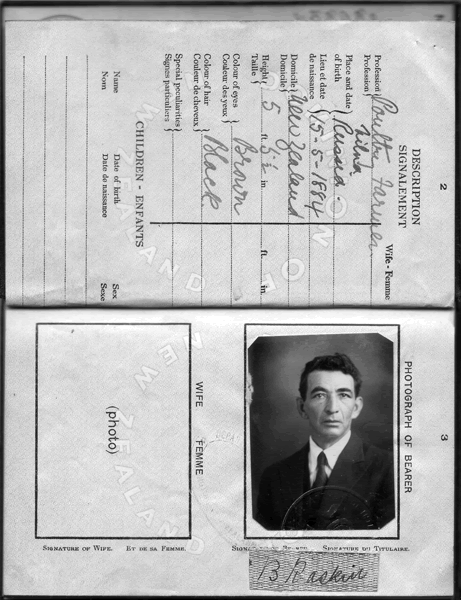
This Passport photo may be of interest for posting on your website.
Bernard Raskin was my grandfather but died in 1943 before I was born in 1947. My brother (Hayden, Cc’d) and I have researched Bernard’s past as best we can and what we have found is on WikiTree at https://www.wikitree.com/wiki/ Raskin-43 - see biographical notes.
The name Raskin does not seem to be in your listings but we believe Bernard’s mother’s maiden name was Shulman.
Best wishes,
Garth Willey
From: Joel Fink <joelrfink@yahoo.com>
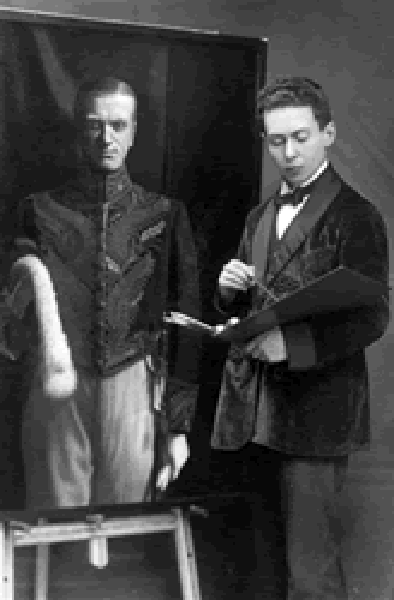
Hi. I am researching an old watercolor by the artist R. David Hillman. Do you know anything about his art? Joel a Fink
David Hillman
Gender:
Male
Birth:
1894
Death:
1974 (80)
Immediate Family:
Son of Rabbi Shmuel Yitzchak Hillman and Chaya Shaina Hillman
Husband of Chana (Annie) Hillman
Father of Ellis Simon Hillman; Harold Hillmanand Mayer (Mickey) Hillman
Brother of Sarah Herzog (Wife of Itzhak Halevi Herzog Chief Rabbi
Mother of Chaim Halevi Herzog the 6th President of Israel )
David Hillman whose stained glass windows are
installed in the Great Synagogue in Jerusalem and the St. Johns Wood
Synagogue just outside of London (1921).
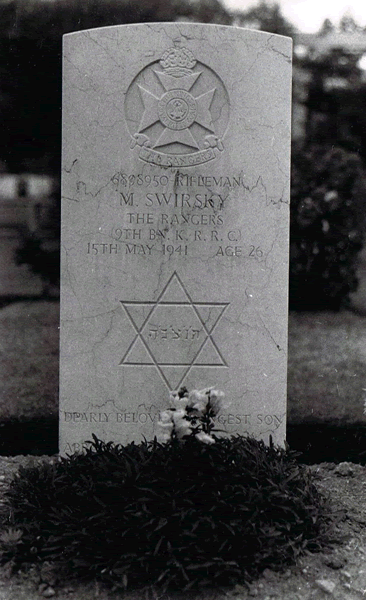
I just came back from a visit to the Shtetl where my grandparents Henoch an Shulamith Swirsky (Z”L, born 1894) came from. The Jewish cemetery there was restored, and there was a plaque there saying the restoration was done by an Abraham Yochelman in 1999. I see on your site that you mention a Yochelman family from Connecticut that has done some memorial restorations in this area. Do you know more about this person? I’d like to thank him!
I found some Swirsky markers in the restored cemetary, for Shimon ben Yehuda Lev Swirsky (d. 1935).
I’ll send you my Adutiskis photos if you’re interested. It was a fascinating visit. The town looks like it hasn’t change much, except that it’s missing its Jews. There are still log-cabin houses that are occupied there.
Happy Shavuot!
--
Robert Swirsky
Yehiel Jochelman
Gender:
Male
Birth:
1841
Immediate Family:
Son of itzik Jochelman
Husband of esther Jochelman
Father of Shimon Yochelman; Nechama Jochelman; Ber - Issak Jochelman; Nechama (Yochelman) Gabay and Menachem Mendel
Added by:
Menachem Sella on September 29, 2009
Managed by:
Menachem Sella
Haim
Yochelman
Gender:
Male
Birth:
estimated between 1847 and 1967
Adutiškis, Šven?ionys District Municipality, Vilnius County, Lithuania
Death:
Shoa
Immediate Family:
Son of Moshe Yochelman and Sara-Lea Yochelman
Brother of Yehudit Yochelman and Hana (Henya) Yochelman
Added April 23, 2015
From: <woodway@bigpond.net.au>
The name Raskin does not seem to be in your listings but we believe Bernard’s mother’s maiden name was Shulman.
Best wishes,
Garth Willey
Bernard Raskin (1884 - 1943)
Born 15 May 1884 in Vilna, Lithuania, Russian Empire? [uncertain]
Son of William Raskin and Anna (Shulman) Raskin
[sibling(s) unknown]
Husband of Dora May (Tyrrell) Raskin — married 1910 in Wellington, New Zealand
DESCENDANTS
Father of Owen Raskin, Percival Raskin and Sonia (Raskin) Astley
Died 9 May 1943 in Levin, New Zealand
Abraham Jochelman was not raised in the old neighborhood; he arrived in New Haven in 1967, long after the area's demise. Yet he is just as impassioned as Mr. Teitelman about preserving the Orchard Street shul. For centuries, Mr. Jochelman said his family lived in a town near Vilnius, Lithuania. During World War II his parents and two brothers, along with some 250 members of his family, were murdered after Lithuanian soldiers rounded up 8,500 Jewish residents, marched them 30 miles east of the city, shot them and threw their bodies into mass graves. Mr. Jochelman, who was 20 at the time, said he was not shot but thrown into one of the graves and covered with dead bodies. He escaped that night along with his brother and some cousins.
''It was 1942, a very cold winter,'' he recalled tearfully while sitting at his kitchen table in the Westville section of New Haven. ''We ran across a frozen river and through the woods. Farmers gave us food along the way. One hundred miles later we made it to my grandfather's.''
Later he said he and his brother were forced into a ghetto where thousands of Jews were murdered along with gypsies and Italian prisoners of war. His brother died in the carnage, Mr. Jochelman said, but he managed to escape to Russia.
After the war he and his wife, Zoia, moved to Poland, then to Israel. In the late 60's they moved to New Haven. Historical records show that of the 250,000 Jews living in Lithuania at the beginning of the war, some 220,000 were murdered by Nazi forces.
In 1992, Mr. Jochelman returned to Vilnius for the first time since the war. He took along his granddaughter, he said, ''because I wanted her to see how it was.'' They began their pilgrimage in Vilnius and drove 150 miles through 20 towns toward the Russian border. He showed a visitor a photograph of the two of them standing at a memorial, where his family was killed.
''When I was a boy all those towns we visited were Jewish and there were shuls in every one of them,'' he said. ''Now most of the Jews have gone and I saw not one shul.''
Upon returning to New Haven, Mr. Jochelman said he resolved to help save the old synagogue on Orchard Street. Not only does it resemble the Eastern European shuls he knew as a boy, he said, ''it is also a symbol of the old people who came before us. We have to keep the shul alive to remember our fathers.''
Dear Eilat Gordan Levitan:
I just came back from a visit to the Shtetl where my grandparents Henoch an Shulamith Swirsky (Z”L, born 1894) came from. The Jewish cemetery there was restored, and there was a plaque there saying the restoration was done by an Abraham Yochelman in 1999. I see on your site that you mention a Yochelman family from Connecticut that has done some memorial restorations in this area. Do you know more about this person? I’d like to thank him!
I found some Swirsky markers in the restored cemetary, for Shimon ben Yehuda Lev Swirsky (d. 1935).
I’ll send you my Adutiskis photos if you’re interested. It was a fascinating visit. The town looks like it hasn’t change much, except that it’s missing its Jews. There are still log-cabin houses that are occupied there.
Happy Shavuot!
--
Robert Swirsky
Haim
Yochelman
Birth:
Adutiškis, Šven?ionys District Municipality, Vilnius County, Lithuania
Death:
Shoa
Immediate Family:
Son of Moshe Yochelman and Sara-Lea Yochelman
Brother of Yehudit Yochelman and Hana (Henya) Yochelman
Added by:
on April 23, 2015
From: ruth weinstein <wein18146@gl.com>
Hello,
lately I found among my father's pictures the picture of this man
The name attached is: Baruch Markman Kurenets
Can you give me more information about him?
My father's name was Jeshua Burg (or Borg) and he was born in Tishovitz, Poland
Thank you for any help,
Ruth Weinstein, Israel
Dear Ruth,
Many years ago (1990s) I spoke to a holocaust survivor from the area of Kurenets. She told me about other holocaust survivors, such as Sonya (nee Dimenstein from Dolhinov and her husband Baruch Markman from Kurenets, who now live in New Haven
Benjamin Baruch Markman
Gender:
Male
Birth:
May 5, 1917
Kurenets, Belarus
Death:
September 8, 2002 (85)
New Haven, New Haven County, Connecticut, United States
Immediate Family:
Son of zeev Volf Markman
Husband of Sonia markman
Father of Wesley Markman and Frances Goldstein
I came across your website while researching my genealogy. My grandmother was Rebecca Harkavy. She was born in Novardok.
I have a number of pictures that you'd probably find interesting.
I'm attaching a picture of my grandmother in front of a grave.
I'm trying to figure out how she's related to the person who died December 17, 1917, according to the gravestone.
Yehuda Rapoport
Seattle, WA
From: Augusta Gross
Hello!
I have seen photos of my grandmother, Augusta Gross, and my cousins, children of Otto Gross on your site. I would be very interested to know more about the source of the photos. I am very appreciative that these photos in general are available online as testament to the vibrant life of the Jews in Cracow before the war. I have other photos of my family. My grandfather, Adolf Gross, was a prominent lawyer and politician, was a member of the Parliament, representing the Jewish community of Cracow for several years. He helped establish a school and housing during his tenure.
Many thanks,
Dr. Augusta Gross
Dear Dr. Augusta Gross,
The photoes are most likely from Yivo. I would love to add your family pictures and information to the site.
I am posting the pictures from the site;
Augusta Gross,
1901
Cracow
The children of Otto Gross, a doctor
Augusta and Adolf Gross pose with their grandchildren, Marguerite and Jan Enkels
Ludwik Gross
You must be the daughter of Ludwik Gross
GROSS-Ludwik, M.D. Passed away on July 19, 1999. Beloved husband of the late Dorothy. Devoted father of Augusta Gross, loving father-in-law of Leslie B. Samuels, dear brother of Felix Gross, loving uncle and cherished by family and friends. Funeral services Thursday, July 22, 12:15PM at ''The Riverside'', 76 Street and Amsterdam Avenue. Contributions in his memory to a worthy cause benefiting research on cancer or AIDS.
GROSS - Ludwik, M.D. The Trustees, Faculty and Staff of Mount Sinai School of Medicine and The Mount Sinai Hospital of Mount Sinai NYU Health deeply mourn the passing of our esteemed colleague, Ludwik Gross, M.D., Research Professor Emeritus in the Samuel Bronfman Department of Medicine, who was associated with Mount Sinai for nearly three decades. Born in Poland, Dr. Gross earned his medical degree in 1929 from the Iagellon University Medical School in Krakow, and following post-graduate hospital training, he began a long and distinguished research career at the Pasteur Institute in Paris. He joined the Institute for Medical Research at Christ Hospital in Cincinnati in 1941, then served with U.S. military medical units in World War II. Following the war, he resumed his research at Memorial Sloan-Kettering Cancer Center, then, the Bronx Veterans Affairs Medical Center. Dr. Gross was internationally renowned for pioneering work that opened the field of investigation of viruses as a possible cause of human cancers, and his textbook, ''Oncogenic Viruses'' became a standard reference work for all investigators in that field. A Fellow of the American College of Physicians, the American Association for the Advancement of Science, the International Society of Hematology, and the New York Academy of Sciences, Dr. Gross was honored with numerous awards, including the WHO United Nations Prize for Cancer Research, the Pasteur Intititute's Silver Medal, and he was nominated for the Nobel Prize. He will be rememberd fondly both for his achievement and his devotion. We extend our sincere condolences to his family. Helene L. Kaplan, Chair, Mount Sinai School of Medicine Stephen M. Peck, Chair, Mount Sinai NYU Health John W. Rowe, M.D., President, Mount Sinai NYU Health Arthur H. Rubenstein, MBBCh, Dean Mount Sinai School of Medicine was born on September 11, 1904 in Kraków, Poland to a prominent Jewish family. He studied for a degree in medicine at the Jagiellonian University. He escaped from occupied Poland in 1940 soon after the 1939 Nazi invasion and travelled to the United States, ultimately serving in the US armed forces during World War II.
After the war, he joined other scientists (notably Rosalyn Yalow, recipient of the 1977 Nobel Prize in Medicine or Physiology) in the "Golden Age" of research at the Bronx Veterans Administration Medical Center, becoming director of the Cancer Research Division. One story claims that this appointment allowed him to move his research mice from the trunk of his car, where he had been carrying out studies, into a fully equipped laboratory.
He died at Montefiore Medical Center on July 19, 1999 of stomach cancer at age 94.[1]
Research work[
Gross was a major proponent of the possibility that some cancers can be caused by viruses and began a long search for viral causes of murine leukemia. In the course of these studies, he isolated the Gross murine leukemia virus strain as well as the first polyomavirus, so named for its proclivity to cause cancers in multiple tissue types. Gross murine leukemia virus is a retrovirus whose counterpart in humans is human T cell lymphotropic virus I (HTLV-I), while murine polyomavirus is closely related to the human Merkel cell polyomavirus that causes most forms of Merkel cell carcinoma. Thus, Gross identified two critical animal viruses that serve as models for viruses causing cancer in humans. His encyclopedic textbook Oncogenic Viruses is still considered a leading source book for early work in the discovery of viruses causing cancer.
Gross died of stomach cancer, a major cancer caused by infection with the Helicobacter pylori which he himself researched. A collection of his personal papers are held at the National Library of Medicine in Bethesda, Maryland.[2]
Scientific awards
• R.R. de Villiers Foundation (Leukemia Society) Award for Leukemia Research (1953)
• Walker Prize of the Royal College of Surgeons of England in London (1961)
• Pasteur Silver Medal of the Pasteur Institute in Paris (1962)
• WHO United Nations Prize for Cancer Research (1962)
• Bertner Foundation Award (1963)
• Special Virus Cancer Program Award of the National Cancer Institute (1972)
• Albert Lasker Award for Basic Medical Research (1974)
• William B. Coley Award (1975)
• Principal 1978 Paul Ehrlich-Ludwig Darmstaeder Prize in Frankfurt
• Griffuel Prize in Paris (1978).
• Elected to the National Academy of Sciences (1973)
• French Legion of Honor (1977).
References
1 ^ Jump up to:a b "Ludwik Gross, a Trailblazer in Cancer Research, Dies at 94". New York Times. Retrieved 2014-09-17. “Dr. Ludwik Gross, who influenced cancer research by showing that viruses could cause cancers in animals, died on Monday at Montefiore Medical Center in the Bronx. He was 94 and lived in the Riverdale section of the Bronx. The cause was stomach cancer, said his daughter, Dr. Augusta H. Gross.”
2 Jump up^ "Ludwik Gross Papers 1908-1999". National Library of Medicine.
External links
• NIH Paper Collection of Ludwik Gross [1]
• Horsfall, F. L. (1962). "Oncogenic Viruses. Ludwik Gross. Pergamon, New York, 1961. Xi + 391 pp. Illus. $12". Science. 135 (3504): 661. doi:10.1126/science.135.3504.661-b.
Eisig Jekele (Adolf) GROSS Jul 26, 1862 (1864 #71) - Dec 27, 1936 Krakow
+ Dwore Gittel SILBIGER Feb 16, 1878 Oswiecim - 1944 Ravensbruck
married Nov 20, 1903 Vienna
5x Maksymilian GROSS Jul 30, 1898 Wieden - after 1916
5o Felicitas GROSS Wieden - after 1950
* Jakob SPERR Krakow
married Prog.Syn 1924 #715
5x Otto GROSS Feb 8, 1902 Vienna
+ Zofia Maria WAJDA Dec 5, 1901
married Jun 29, 1927 Katowice
6x Jan GROSS
6o Malgorzata GROSS
5x Salomon Zygmunt GROSS Jun 11, 1903 Vienna - Dec 11, 1995 Manhattan NY
+ Jadwiga SCHLESINGER May 8, 1905 #376
married Oct 30, 1932 Krakow
+ Hanna SZUMANSKA Mar 24, 1919 - Mar 24, 1973 NY
married 1944-47 Warsaw
6x Jan Tomasz GROSS Aug 1, 1947 Warsaw
+ Irena GRUDZINSKA Dec 15, 1946 Gdynia
2 children
5x Ludwik GROSS Sep 11, 1904 #634 - Jul 15, 1999 Bronx NY
+ Dorothy NELSON ? Apr 22, 1908 - Mar 1987 Bronx NY
some info from michel.rabinovitch3@gmail.com
6o Augusta H GROSS Oct 20, 1944
5x Feliks GROSS Jun 17, 1906 #448 - Nov 8, 2006 Manhattan NY
+ Priva BAIDOFF Jun 19, 1911 Wieliczka - Aug 21, 1990 Manhattan NY
married Prog.Syn 1937 #1010
6o Eva GROSS
* Sheldon FRIEDMAN
5o daughter GROSS Nov 21, 1910 #768 - Nov 21, 1910
5o Wiktoria Maria GROSS Aug 25, 1915 Krakow - after 1950
My grandfather Joseph, dated 1922, which calculates to then age 49 ( born c 1873).
My great grandfather Fishel Khait immigrated to U.S. from Linkuva, Lithuania in roughly the 1880's, then changed his name to Fischel Rosenthal, the name I have always known. His wife was Rakhel , changed to Rachel in U.S
Stan Rosenthal
From: Linda Gardner <lgardner@avatarms.com>
Date: Thu, Jul 5, 2018 at 11:24 AM
Subject: Re: Barmatz
To: "egl.comments@gmail.com" <egl.comments@gmail.com>
I was looking for information on my Great Great Grandparents (Israel and Fedriza Barmatz) and stumbled on this:
I am researching my Mother's family who lived in Brest Litovsk. The surname of the family is BARMATZ (also seen it spelt BARMAC).
My Mother's name is MIRIAM but it was written MIRL and also MIREL in some places.
I have managed to find quite a number of the names of Grandparents and also cousins of my Mother's but every search I do I cannot find any mention of my Mother – her two sister's are mentioned and one brother but I know there were more brothers whose names are also not mentioned.
I would be very happy to know more about my Mother who was born about 1912 (no definite date is known) – her parents names are VOLF AND ESTHER.
If you require any further information I will gladly forward it to you.
Thank you for your kind offer to share this for me.
Kind regards,
Estelle
From: eilat gordin [mailto:egl.comments@gmail.com ]
Sent: Monday, July 31, 2017 6:12 AM
To: Solly&Estelle; Eilat Gordin Levitan
Subject: Re:
Dear estelle,
Please email me the information you want to share. I'll post it!
Thanks
On Sat, Jul 29, 2017 at 8:26 PM, Solly&Estelle <sollyestelle@nirel.org.il> wrote:
Dear Eilat,
I want to post on your page where I saw people requesting help with research for their families but cannot seem to put my message there, so was hoping that I could send you an email to help me with my request.
Thanking you,
Estelle Sher
SAM AND GERTRUDE BARMATZ with family
Sam, Gertrude, Fannie, Jack, Herbert and Loreta Barmatz
Sam_Gussie_Barmatz
I’ve attached photographs of my great grandparents Samuel (Shalom) Barmatz and his wife, Gussie (Gertrude?) They were from Brest-Litovisk (around 1841 is as far back as I can to) Fannie Barmatz is my Paternal Grandmother.
Linda Mushkat Gardner
216-440-0218
Lane Weinman <lanegw@me.com> wrote
Hello,
My family is from Glubokoe, circa 1800 to 1940’s.
Our known and suspected surnames were Vaynman (Weinman or Weiman), Kunkes (Kunkis), Lehman (Layman), and Arons.
I have 2 photographs that were supposedly taken at the Jewish Cemetery in Glubokoe in February of 1934.
Shown is my 2nd great aunt, Malke Vaynman-Arons with the headstone of her father Moshe Vaynman.
The second headstone is that of Moshe’s 1st wife, Basya-Hinda Kunkes, daughter of Kalman.
It was my understanding that the Jewish Cemetery in Glubokoe was destroyed during WWII.
My question is does any part of the cemetery still exist and in what condition?
Where was the cemetery in relationship to the town.
Thank you for any assistance you can provide,
Lane G Weinman
PS: I also have two funeral pictures which were sent to the family in America upon the passing of two unknown relatives. The names of the mourners are listed and known but not the names of the two corpses shown. These photos are from the mid 1920’s and do not related to the headstones shown above.
Dear Lane,
Yes, the Glubokie Jewish cemetery exists. See picture below. I would love to post any picture you have of people connected to Globoke
Recently in the process of working on the inventory of the Jewish cemetery in Glubokoe, one of the oldest tombstones was discovered. The tombstone is for Shneur Zalman and dated 1708. This matseiva is the oldest one among all known burials in the northern part of Belarus.
From: Larry DiGeronimo <larrydige@yoo.com>
Date: Tue, Apr 3, 2018 at 2:46 AM
Subject: Jacob Gornitzky
To: "egl.comments@gmail.com" <egl.comments@gmail.com>
Hello, I stumbled across your web site while researching my ancestry and trying to find any information on my great grandfather, Jacob Gornitzky, born 1874 in Grodno Russia, arrived in the USA in 1905 and married to Bessie Copleman, it looks like you've done some research, I currently know absolutely nothing about this man nor my Jewish ancestry and would certainly appreciate any input you might have on this family.
Please note that the address of the East European Jewish Heritage Project's website has been changed to www.eejhp.org. I will appreciate it if you will change the listing on your site accordingly. If you require any further information about us please do not hesitate to contact us.
Yours sincerly,
Dr Franklin J. Swartz
International Director
East European Jewish Heritage Project
P.O. Box 100
Minsk
220074
Republic of Belarus
www.eejhp.org
Tel: +375 29 699 4016
U.S. Phone: +1 617 500 8443
U.K. Phone: +44 20 8123 8471
Lithuania Phone: +370 6 703 7805
From: Ahuva Traube <ATraube@yeled.org>
Date: Thu, Apr 27, 2017 at 8:38 AM
Hi,
My grandfather (Peretz Yogel)’s family – came from Slonim. I’m looking for any pictures of the Yeshiva that you might have, information on them, and any familial ties they might have had to the Zakheim family?
Thanks,
Ahuva Traube
HI!
My husband and I are planning to visit Glubuckie in August,to connect with my roots, but most importantly, to honor my father's family who perished there as well as the over 10,000 Jews who were massacred at the Glubockie Ghetto during World War II. I understand that the last Jew in Glubockie died a few years ago. In addition, there has been a Glubockie Society of America that led yearly Yartzeit gatherings to say prayers at the three mass grave sites. I believe the last Yartzeit service was held over 20 years ago.
It is now my desire to organize a Yartzeit commemoration in collaboration with the local dignitaries and return to honoring the memory of the Jews massacred. I am happy that I will arrive on the approximate date of the Yartzeit (day of annihilation). The Glubockie Ghetto was actually where Jews from the surrounding areas were first held. My intention is to remember the lives of all the Jews who were massacred. Is there anyone here whose parents were from Glubockie? Is there any interest in organizing a memorial service there this year?
I look forward to hearing from you soon and can be reached via email and phone at lbkosher@gmail.com; 303-494-1638 and 720-422-6776.
Sincerely,
Chany Scheiner (Chanowitz)
Rabbi Pesach and Chany Scheiner, O. 303.494.1638 | E. lbkosher@gmail.com
C: 720 422-6776 Boulderjudaism.com
Serving the Jewish community of Boulder County for 25 years
I believe I have found some errors in your information.
Yerachmiel Berman’s wife, Rachel, listed as an underground fighter in the Kovno Ghetto, did not die during the Holocaust. She was in a camp, and survived in very poor health. She and her husband were active in the Yiddish theatre in Munich in 1946-47. They immigrated to Milwaukee around 1951 and their son now lives in Richmond Virginia.
I believe that Lawyer Oser Finkelstein is listed as dying in the Kovno Ghetto. It is a little confusing for me to read this page, but that’s what I understand. Actually, he died in the 30’s before the war. His daughter, Nina Finkelstein Anshell survived and was a very dear friend of mine. His wife Bertha Levin Finkelstein did die in the Kovno Ghetto.
If you would like any more information, please feel free to contact me. Thanks,
Jo Ann Goldwater
From: prokopowiczmagda <prokopowiczmagda@o2.pl>
Date: Sat, Jul 7, 2018 at 11:59 AM
Subject: Rikudah Potash
To: "egl.comments@gmail.com" <egl.comments@gmail.com>
Dear Eliat,
I'm writing to you on behalf of prof. Joanna Lisek (University of Wroclaw), Bella Szawcman-Czarnota (Midrasz Magazine), and prof. Karolina Szymaniak (University of Wroclaw) - editors and translators of an anthology of Yiddish poets, "Moja dzika koza" [my wild goat]. The book will be published in summer 2018 by Austeria Publishing House, Krakow.
We would like to translate and publish in this anthology poems of Rikudah Potash, an author of poems:
A leydike kavyarnie, in: ead., Vint af klavishn, Lodz 1934
Meshugoim-hoyz, in: ead., Vint af klavishn, Lodz 1934
Hagar, in: ead. Lider, Tel Aviv, 1967
Ovnt in shtot, in: ead., Vint af klavishn, Lodz 1934
Poylishe harbst, in: ead. Vint af klavishn, Lodz 1934
Ikh bin a kenign, in: ead. Vint oyf klavishn, Lodz 1934
Aten, in: ead. Lider, Tel Aviv 1967
Zikhroynes, in: ead. Lider, Tel Aviv 1967
Ikh benk nokh dir, shney, in: ead. Lider, Tel Aviv 1967
Mayn shafe, in: ead. Lider, Tel Aviv 1967
Der mames shikh, in: ead. Lider, Tel Aviv 1967
Ikh bin a kenign, in: ead. Vint oyf klavishn, Lodz 1934
We would be honored if you would allow us to translate and publish these poems in our anthology.
Please let me know if you need any further information or if there are any conditions under which the permission can be given.
I would be extremely grateful for any information.
My email address is: prokopowiczmagda@o2.pl,
and mobile: (Poland) 600 837 111
Best regards,
Magdalena Prokopowicz
From: Bill Peterson <runes1@comcast.net>
Date: Sat, Jun 30, 2018 at 8:42 PM
Subject: Peace & Hope
To: egl.comments@gmail.com
Brothers & Sisters,
Thank you for creating this memorial to those who went before. My note is simply a message of assurance that God is with us.
I was honored in 1979 to participate as an American negotiator with the team which was paired with our counterparts from Israel. A parallel set of teams existed simultaneously with other Americans and their Egyptian counterparts. We met every few weeks over the course of 18 months until we were, at last, able to come to agreement on each of the solutions to the problems which faced us. By May 1980 we were able to turn over our work – called the Camp David Accords – to our national leaders: Menachem Begin, Anwar Sadat, and Jimmy Carter. With confidence of mind, and peace in their hearts, they signed the Sinai Treaty. In that instrument there is hope for all of us.
The Sinai Treaty began with the vision of Anwar Sadat who saw the return of the Sinai as a necessary step. But how to accomplish that? Meeting with Menachem Begin he pled his case – Let me speak to the people of Israel through the Knesset. Begin took a courageous step by supporting Sadat. Together they approached Carter and asked that America serve as a third party guarantor and facilitator. Carter saw the best opportunity for peace in one portion of the Middle East and agreed to their request.
I was the youngest American member. But I felt spiritually moved to be chosen. In June of 1956 I became an adult member of my Methodist church, a Protestant Christian faith. In this small church in the rugged mountains of Pennsylvania at the age of 13 I embraced God and my church embraced me, giving me a Bible inscribed with my name and the date. One night at the age of 36, after a particularly hard day during our Sinai negotiations, I opened my Bible to read a random passage. I noted the inscribed date and was suddenly struck by the realization that on the day I received my Bible Captain Arieh Ben Tov, Israeli Defense Force tank commander, lay dying in the Sinai as the Six Day War raged around him. Bleeding profusely from many wounds, particularly head wounds, he was passed over while the truck sent to rescue those with a chance to survive went on to gather up others. Suddenly the truck was hit by a tank shell killing everybody. Then a helicopter arrived, assessed the scene – and miraculously saw Ben Tov waving his arm asking for help. He was airlifted to a medical center and saved.
Now, 23 years later as an IDF Major General, Arieh Ben Tov was on another Sinai mission, one which might bring lasting peace between Israel and Egypt. The next day I asked for a private moment with him before we began our day’s work. Standing at a seventh floor window looking out over the Potomac River and seeing Washington behind it I gave my Bible to Arieh. My inscription was very brief, expressing my faith in God an my hope in us for a lasting peaceful outcome. A single tear coursed its way down his cheek across nerves deadened from the 1956 combat.
Several months later, our work complete and the treaty document signed, I had a surprise visitor in my office. It was Zev Allon, First Secretary of the Embassy of Israel in Washington, D.C. Zev had been a senior member of the Israeli team. We shook hands and warmly greeted each other. My office colleagues, who were not privy to most of my activities over the previous 18 months, observed this in wide-eyed silence. Then Zev spoke: “This package came for you in last night’s pouch from Tel Aviv.” He handed me a box and urged me to open it. I did, and inside was General Ben Tov’s IDF Torah. It was his gift to me with his inscription: “To Bill, in the spirit of our combined effort.” Followed by EZEKIEL 33 2-6.
On this day, as I write in your guestbook, I urge you to keep the faith. If we can find peace in the Sinai we can make peace anywhere. There is hope for us all under God.
William R. Peterson
Denton, Maryland, USA
From: Daniel Singer <singer2cantor@gmail.com>
Date: Wed, Jul 11, 2018 at 8:14 AM
Subject: Records of Singer from Kovno?
To: egl.comments@gmail.com
Hello, I am researching my Singer family back to Lithuania and Latvia. A critical record I am working back from is found below. Do you have any information that could help me to learn more about Berl and Hindel Singer from Janowo? Yanora? Kovno? Riga? Any response would be greatly appreciated! Thank you! Cantor Daniel Singer
“New York Passenger Lists”—List or Manifest of Alien Passengers for the United States Immigration Officer at Port of Arrival. New York, Dec 21, 1912, Page 14, Line 5: Singer Berl Occupation: [illegible]; Arrival date: 21 Dec 1912; Birth date: abt 1885; Birth location: Russia; Birth location other: yanora (?); Age: 27, male, Hebrew; Port of departure: Bremen; Port of arrival: New York, NY; Ship name: Bulow; Wife: HindelSinger, Jan owo Siedlce Russia; final destination: Brooklyn. (Source: Microfilm, National Archives, Washington, DC, Roll T715, 1897-1957 > 1001-2000 > Roll 1994.
From: 1756yh <1756yh@gmail.com>
Dear Eilat,
I came across your website on Dolhinever Jews. I was wondering if you can guide me. I am searching for information on Yehuda Leib Ruderman (died in dolhinev around 1914) and Shaina Ruderman (nee futerfuss) from dolhinev.
Thank you for your wonderful website,
Jacob Schreiber
From: Anastasia Köhler <Anastasia.Koehler@stiftung-denkmal.de>
Date: Tue, Jul 17, 2018 at 6:21 AM
Subject: Slonim Photos
To: "egl.comments@gmail.com" <egl.comments@gmail.com>
Dear Mr. Gordon Levitan (Ms. Gordin Levitan),
we have already been in touch witch Mr. Zoglin concerning the permission to use photos of Gomel for our website: http://www.memorialmuseums. org/pages/home
Now we would like to include following photos of the memorials and the synagogue in Slonim:
#slnm-ns-5:
#slnm-ns-8:
#slnm-ns-9:
#slnm-ns-11:
#slnm-ns-13:
#slnm-ns-14:
#slnm-ns-16:
#slnm-ns-21:
#slnm-ns-27:
#slnm-ns-33:
http://www.eilatgordinlevitan. com/slonim/slo_pages/slo_new_ scenes.html
We will link your website as the author. If you don’t agree, please write to us.
I came across your website on Dolhinever Jews. I was wondering if you can guide me. I am searching for information on Yehuda Leib Ruderman (died in dolhinev around 1914) and Shaina Ruderman (nee futerfuss) from dolhinev.
My late grandfather Rachmiel Pukin was born in Druja.
It was very interesting to watch the photos from Druja on the site.
As far as I know, his grandfather Leib Pukin was active in the drama circle, and gave money to the local school.
While watching the pictures I was wondering if he appears in any of them, however noone can identify him...
I also know that Leib lived close to the synagogue. his backyard was actually the place where many local jews lost their lives.
Besides that, I know that my grandfather's uncle Beyrakh (Boruch) was killed there with his wife and child.
If you have any other information on my family, I would be glad to know.
Kind regards,
Yan Jonathan Sandler.
Tal-aviv, Israel.
Borukh Pukin was born in 1905 to Leyba. He was a taylor. Prior to WWII he lived in Druya, Poland. During the war he was in Druya, Poland.
Borukh was murdered in the Shoah.
This information is based on a List of persecuted persons found in List of murdered people from Druja, 1941-1942.
Joseph Pukin was born in Druja in 1914 to Leiba and Lea nee Krawetz. He was married to Luba. Prior to WWII he lived in Riga, Latvia. During the war he was in Riga, Ghetto.
This information is based on a List of Jewish residents found in List of names of Jewish residents of Latvia, the result of research by the Center for Judaic Studies at the University of Latvia under the supervision of Prof. Ruvin Ferber and with the cooperation of the Latvia State Historical Archives, 2002.
Brayna Pukin was born in 1937 to Borukh. Prior to WWII she lived in Druya, Poland. During the war she was in Druya, Poland.
Brayna was murdered in the Shoah.
This information is based on a List of persecuted persons found in List of murdered people from Druja, 1941-1942.
Abram Pukin was born in Druja in 1906 to Leiba and Lea nee Krawetz. He was married. Prior to WWII he lived in Riga, Latvia. During the war he was in Riga, Ghetto.
This information is based on a List of Jewish residents found in List of names of Jewish residents of Latvia, the result of research by the Center for Judaic Studies at the University of Latvia under the supervision of Prof. Ruvin Ferber and with the cooperation of the Latvia State Historical Archives, 2002.
Joseph
Pukin
1914
Riga, Latvia
List of residents
not stated
Abram
Pukin
1906
Riga, Latvia
List of residents
not stated
Nachman
Pukin
1895
Riga, Latvia
List of residents
not stated
Abram
Pukin
1906
Riga, Latvia
List of residents
not stated
Nakhman
Pukin
1896
Riga, Latvia
Page of Testimony
murdered
Borukh
Pukin
1905
Druya, Poland
List of persecuted persons
murdered
Borukh Pukin was born in 1905 to Leyba. He was a taylor. Prior to WWII he lived in Druya, Poland. During the war he was in Druya, Poland.
Borukh was murdered in the Shoah.
This information is based on a List of persecuted persons found in List of murdered people from Druja, 1941-1942.
Blyuma
Pukin
1907
Druya, Poland
List of persecuted persons
murdered
Brayna
Pukin
1937
Druya, Poland
List of persecuted persons
murdered
David
Pukin
1870
List of persecuted persons
not stated
Borukh
Pukin
1913
List of persecuted persons
not stated
Lesr
Pukin
1878
List of persecuted persons
not stated
Yeyer
Pukin
1925
List of persecuted persons
not stated
Khaim
Pukin
1919
List of persecuted persons
not stated
Khayka
Pukin
1925
List of persecuted persons
not stated
Lesya
Pukina
1875
List of persecuted persons
not stated
Lipa
Pukina
1911
List of persecuted persons
not stated
Khaya
Pukina
1908
List of persecuted persons
not stated
Page 1 of 1
The Names Database is a work in progress. Feedback, corrections and additions are welcome.Refine
Search WITH US
Nakhman Pukin was born in Druja, Poland in 1896 to Leib and Lea. He was a tailor and married to Ema. Prior to WWII he lived in Riga, Latvia. During the war he was in Riga, Latvia.
Nakhman was murdered in the Shoah.
This information is based on a Page of Testimony submitted by his son, Rakhmiel Pukin
Ema Pukin nee Levenberg was born in Kuldiga, Latvia in 1900 to Leib and Ester. She was a housewife and married to Nakhman. Prior to WWII she lived in Riga, Latvia. During the war she was in Riga, Latvia.
Ema was murdered in the Shoah.
This information is based on a Page of Testimony e) submitted by her son, Rakhmiel Pukin
Yudif Pukin was born in Riga, Latvia in 1931 to Nakhman and Ema nee Levenberg. She was a pupil and a child. Prior to WWII she lived in Riga, Latvia. During the war she was in Riga, Latvia.
Yudif was murdered in the Shoah.
This information is based on a Page of Testimony (displayed here) submitted by her brother, Rakhmiel Pukin
Frida Pukin was born in Riga, Latvia in 1928 to Nakhman and Ema nee Levenberg. She was a pupil and a child. Prior to WWII she lived in Riga, Latvia. During the war she was in Riga, Latvia.
Frida was murdered in the Shoah.
This information is based on a Page of Testimony (displayed here) submitted by her brother, Rakhmiel Pukin
Yudif Pukin was born in Riga, Latvia in 1931 to Nakhman and Ema nee Levenberg. She was a pupil and a child. Prior to WWII she lived in Riga, Latvia. During the war she was in Riga, Latvia.
Yudif was murdered in the Shoah.
This information is based on a Page of Testimony (displayed here) submitted by her brother, Rakhmiel Pukin
Rakhil Pukin was born in Riga, Latvia in 1921 to Nakhman and Ema nee Levenberg. Prior to WWII she lived in Riga, Latvia. During the war she was in Riga, Latvia.
Rakhil was murdered in the Shoah.
This information is based on a Page of Testimony (displayed here) submitted by her brother, Rakhmiel Pukin
I have been reading the story about Kaziany. My Father (born in 1928,
the son of Shlomo Hochman and his wife from the Pukin family of
Glubokie) and his family was from that shetel Kaziany and were with
the partisans in the forests (the father survived with parents, 2
brothers and one sister. In 1946 the family came to America ( the
mother had sisters in the U.S and they helped in order to include them
on the first ship which took survivors to America)
Do you have any knowledge of Lansdsliet Association ?
It's great that the stories are on online.
Dear Sir/Madam,
I am working on project conected to Shtetls in SMORGON area
There are pictures made by German soldier Willy Romer during IWW
He stationed probably in Kreva (they are pictures from Lida)
We want to prepare exhibition these pictures with collaboration Goethe Institute.
However most of the pictures have wrong description and we need help with identification.
I would be garteful for any tips
Kind regards
Marcin Guzek
From: Danny Kaplan <dannykaplan@gl.com>
Date: Wed, Apr 11, 2018 at 12:20 PM
Subject: Kaplan from Minsk
Hi,
I was wondering if you can help me. Im trying to research the Kaplan family. Here is what I know.
My Grandfather Moshe Kaplan (1925-1983) studied in Grodno Yeshiva before joining the Mir Yeshiva in Shanghai later moving to Toronto.
His Father was Abram Kaplan married to aides Kaplan a Jeweler in the Minsk Area. Abraham’s fathers name was Moshe Kaplan.
Moshe had a Brother in Grodno also, named Gershon but never made it to Mir.
Any help or direction would be very helpful.
Thanks
Danny
From: dmatoska <dmatoska@charter.net>
Date: Wed, Feb 28, 2018 at 9:32 AM
Subject: Seek info
To: egl.comments@gmail.com
My grand father wladyslaw matoszko married American Maria schasny
He was a Barron in glembokie(vilno).
Children Jazef, Piotr, and Kazimierz MATOSZKO.
Their property, house Forrest and land was taken away by Russians.
They were loaded on cattle cars and shipped to Siberia concentration camp.
They survived.
I would like to see pictures if my grandfather's land and house if it still exists.
Please let me know if you can help.
Sincerely
David Matoska
Correction please to Rakov and the piece on David Laskin’s Family piece. He mentions three branches, there are actually four.
Yosef HaKohen Kahanovitch, changed to Cohen in USA is the fourth branch. He and His wife moved to Hoboken, NJ. Their House is the house relatives would stop at, including when arriving in America, including their niece, Ida Rosenthal. They had two daughters and a son (Rochel, Chaya Sara and Yosef.) The household was Torah Observant, as am I, their Great Grandaughter, Devorah Bayer) Great Grandpa Yosef parnussah came from being a Sofer and a Melamed His brothers and father were also Sofers. I have Shiur HaShiurim and a hand carved wood spindle that he gave to my Santa, his daughter Chaya Sara for their wedding in 1929?
The Son, HaKohen, became a beloved family doctor in Hoboken, NJ. He died in the 1950s. His wife, Beatrice was niftar in the 1990s. They had two children’s: Marilyn and Yosef.
Marilyn married Frank Seiden and they have a son, Harold and daughter, Jan.
Harold is married with two sons.
Marilyn’s brother Joseph is married to Susan and they have two sons.
When my Great Uncle, Dr Cohen’s Mother was dying from pancreatic cancer, he nursed her. I don’t know what Great Aunt Rachel’s story was. However my Parents met at a Passover Sedar that she held. My Father held her very dear. And my Father, Morton Cohen (Mordy, Mordecai) married Miriam Golda Chaiet in 1952. They have 4 children: Deborah, Diane, David and Danielle. They have a total of 6 Grandchildren and three Great-grandchildren.
I guess that’s a start. Have a zissen a Peasach.
May we blessed to speak and hear only loshon tov, achieve achdus with Kalal Yisroel and HaShem and experience the arrival of Mosheach with alacrity, Chesed and Rachamim. May we be blessed to do HaShem’s ratzon.
Be well,
Devorah Bayer
Gi@bayerfamily.net
“...the Nations tried to destroy us,
but they didn’t realize that
WE ARE THE SEED....”
Stan Rosenthal wrote; I recently found that my great grandfather Fishel Khait immigrated to U.S. from Linkuva, Lithuania in roughly the 1880's, then changed his name to Fischel Rosenthal, the name I have always known. His wife was Rakhel (don't know maiden name), changed to Rachel in U.S. In your post http://www.eilatgordinlevitan. com/kurenets/k_pages/chait. html , there are a great many Khait references (also Chait and other spellings), which possibly would be trails to Fishel's sibs and ascendants, also to Rakhel's maiden name and from there to that whole side of my family. Might you possibly give me some tips on how to proceed from all the information in your post, or even spot the way? I'm finding this to be a task of never-ending discovery, something I'm sure you found long ago. Many thanks for taking the time to respond, never can tell when a new road will appear.
Dear Stan!
I am a great granddaughter of Yudel Chait/ Khait born in Pasvalys or Birzai, Lithuania ( near Linkova) c 1865. My father was his grandson. A first cousin of my father , my brother my daughter and I took a DNA test with 23and me. As more people take the test we can compare and see for relation. It seems that Birzai was the origin of many Chaits in the area of Northern Lithuania. A sister of my great grandmother also married a Chait from Birzai. They came to Baltimore c 1905 and his name was changed to Max Highstein. Two brothers of my grandmother also came to the US. Abe Hait came to Baltimore in 1911. His brother Benny came to the New York area c 1920.
Do you have any pictures you can share?
I am writing to you on behalf of my cousin, Tom Hillman, and myself.
We are descendants of mordechai tzvi hillman and hailed from the Vitebsk region of Byelorus/lithuania.
WE know that our Rav Mordechai Hillman had at least 3 children:
1. akiva (?jacob) hillman married Anna Brenner. He is buried in hurleyville, NY. We are descendants of this line.
2. Lou Hillman m. Johanna Wallenstein (1st wife), Annette Cohen (2nd wife)
3. Harry Hillman
4. Rose Hillman
5, Shoshana Hillman
Does this match up with your Hillman family? My daughter’s bat mitzvah is this coming shabbat and I am very exciting to discuss these possibilities with the family.
I do have my DNA on ged match if anyone might be willing to test against mine.
Thank you kindly,
Stephanie R. Goldberg, MD
Associate Professor of Surgery
Yaacov Hillman
Shmuel Shmelke Hillman
From: Libi Yeheskeli
Date: Wed, Feb 14, 2018 at 6:34 AM
Subject: Esther Gordin
Hi Eilat,
Your website about the Gordins in Riga I saw this picture attached.
This is my great grandmother Esther Gordin. My grandfather is Moshe Gordin.
Can I ask how you came about this picture? So interesting!
Thanks!
Libi
Dear Libi,.
I found the picture in yad Vashem. I also added it to a tree on Geni. I am trying to connect all the Gordins.from Riga. Let me know if I made mistakes
Ester Yente Gordin (Astanovski)
Gender:
Female
Birth:
1870
Death:
1941 (71)
Latvia (murdered by the Nazis)
Immediate Family:
Daughter of Tana Astanovski
Wife of Elkhanan- Hone-aron- Natan Gordin
Mother of Tova Dina Gordin and Moshe Gordin
Sister of Masha Lachman
Esther Gordin was born in Russia (USSR) in 1870 to Tana and Rachel. She was married to Aharon. Prior to WWII she lived in Dagde, Latvia. During the war she was in Dagde, Latvia. Esther was murdered in 1941 in Dagde, Latvia. This information is based on a Page of Testimony (displayed on left) submitted by her son.
From: Yarin Elena <elena5712@yahoo.>
My name is Yarin Elena. I live in Israel. My grandmother is from Vileyka.
We have a book about Vileyka at home, now we found out that there's also a website. We visited this town several years ago, walked through the street where the Jews lived before the war, saw Tarbut Gymnasium, the 3 ghettos, the former prison where in the courtyard they were killed, the local museum where they have the lists of the murdered people with the dates of murder, the Jewish cemetery which is in an awful condition.
I want to ask you,If it's possible, to add the photos of my family to the website.
David Rudnitsky - my greatgrandfather who survived. The photo was made after the war in Moscow where he lived with his daughter Sofia.
Children David Rudnitsky ( photo from Vileyka ): Rosalia ( my grandmother - the oldest one ), Boris ( the 2nd one ), Sofia and Michail ( the youngest one ). They all survived as they left the town before the war to continue their studies at the university either in Poland or Russia.
We also have photos of Zukoborsky and Gutman families - my grandmother's cousins. Some of them survived, the others were killed in Vileyka. If you are interested to add more families, we'll email the materials we have.
Thank you.
Regards,
Elena
From: Cécile Baltz <cecilebaltz.1@g....>
I am researching informations about my grantmother's Minna, (dead 2015), born in Vilnius around 1925, sent at the Mauthausen camp during the war. She immigrated to France in 1949 and never talked about her past.
I have done a FfDNA test and I know that her parents were closely linked with the Ragoler lineage.
There is this photo on your website
#vil_p4-11: Outdoor snapshot of the wife of Rabbi Halpern from St. Louis, Missouri with members of the Ragoler family during Mrs. Halpern's visit from America. 1937.
Rabbi Abraham E. Halpern
BIRTH
1891
Toronto, Toronto Municipality, Ontario, Canada
DEATH
9 Apr 1962 (aged 70–71)
University City, St. Louis County, Missouri, USA
BURIAL
Bnai Amoona Cemetery
University City, St. Louis County, Missouri, USA
PLOT
Section C
Bessie (Pesha Yenta daughter of rabbi Mordechi Shlomo Feinberg Halpern
BIRTH
1892
DEATH
1970 (aged 77–78)
BURIAL
Bnai Amoona Cemetery
University City, St. Louis County, Missouri, USA
PLOT
Section C
Is it possible to know the surnames of the Ragoler family members?
I thank you for your help.
The picture was submitted by the Halpren family of St. Louis to Yivo. In Yad Vashem I found reports;
Zew Ragoler was born in Wilna, Poland. He was about 70 years old. Prior to WWII he lived in Wilna, Poland. During the war he was in Vilnius.
Zew was murdered in the Shoah.
This information is based on a Page of Testimony (displayed here) submitted by his acquaintance, Sara Mina Gurevitz
Henya Henia
Ragoler
Wilna, Poland
Page of Testimony
murdered
Henya henia Ragoler was born in Wilna, Poland to Zeev. She was a sales person. Prior to WWII she lived in Wilna, Poland. During the war she was in Wilna, Poland.
Henya henia was murdered in the Shoah.
This information is based on a Page of Testimony (displayed here) submitted by her acquaintance, Sara Mina Gurevitz
Meyer Ragoler was born in Ariogala, Lithuania in 1903. He was married to Zelda nee Mintz. Prior to WWII he lived in Veliuona, Lithuania. During the war he was in Veliuona, Lithuania.
Meyer was murdered in the Shoah.
This information is based on a Page of Testimony (displayed here) submitted by his wife's wnephew, Khona Polonski
Moshe Ragoler was born in Veliuona, Lithuania in 1938 to Meyer and Zelda nee Miltz. He was a child. Prior to WWII he lived in Veliuona, Lithuania. During the war he was in Veliuona, Lithuania.
Moshe was murdered in the Shoah.
This information is based on a Page of Testimony (displayed here) submitted by his cousin, Khona Polonski
Dear Ms. Eilat Gordin Levitan,
I'm an italian student of history. I'm working on the history of my great-grandfather Michael Finkelstein, trying to discover where he fought during the First World War. I have some pictures from his archive, but it's very difficult to discover something. One of the few things I discovered is a picture (attached) where it's written in the wall "Dr. Leo Duldig". Surfing on the internet I've found the page you created on Geni, and I think you can help me telling me something more on Leo Duldig, if he fought during the war, where, eccetera eccetera.
If you kindly can help me I will be greatfull.
We look forward to hearing from you soon
Best Regards,
Federico Sconocchia Pisoni
Most likely the picture is from Vienna
Leo was born in 1889 in Przemy?l, Przemy?l County, Podkarpackie Voivodeship, Poland. In 1915 he had a daughter. She was born in
Vienna
Irene Helen (Ina) Gutwirth (Duldig)
Birth:
May 12, 1915
Wien, Österreich
Death:
August 11, 1987 (72)
Melbourne, VIC, Australia
Immediate Family:
Daughter of Dr. Leo Duldig and Stephanie Duldig
Wife of Hendrik Gutwirth
Mother of Vivien Ruth Zimmet and Andrew Michael Gutwirth
Sister of Arthur Eduard Duldig
From: Suellen Liker <sueliker@g.com>
To Eilat:
I was perusing the internet today and found this site. Some of my family came from Vitebsk:Levitan, Hoffman, Krivitsky (great grandmother Perel),Alperovitz and many others who are now buried at the Hebrew Cemetery in Kohler, WI just outside of Sheboygan where we all lived.
My mother Mary Levitan Weinstein passed away just one year ago. Her parents were Harry Levitan & Sadie (Shaina) Hoffman Levitan. Her mother, who was my great grandmother was Perel Krivitsky Hoffman. Also the Alperovitz family was related due to a marriage of an Alperovitz to a Levitan. They all ended up in Sheboygan.
Now I will look up Dokshitsy (sp) to see what part of my family came from there.
Thank you for your information,
Suellen Weinstein Liker
sueliker@gmail.com
Joel and Suellen,
Seeing "Sheboygan" "a marriage of an Alperovitz to a Levitan" "Dokshitzy" Made me think of Joel. https://kehilalinks. jewishgen.org/sheboygan/ sheboygan.html
Alperovitz and Krivitsky are names associated with Kurenets.
My grandfather, Eli Epstein, was from Ilya and I am interested to learn more about his family. Do you have any suggestions regarding how I can access to names of people from that town?
Thank you,
Lorne Epstein
Listen to My Radio Show
https://www.mixcloud.com/ LorneEpstein/
Dear Lorne,
Some information about the Epstein family from Ilya;
I received many notes from Annett. I am sharing one here; " My grandparents, who came to America, were Nachama (nee Kopolowitz) and Yitzchak Yosef Epstein from Ilya.
My mother also had a brother AVROHOM BER EPSTEIN, who was a shohet in Dolhinov. He was married to Dvorah , the daughter of a shohet in Dolhinov (very near Ilya). They had four children.
My mother's sisters lived in ILYA. ROCHEL was married to Zeev Wolf Brochin and they had three children. MARA FAYGE was married to Yaakov Broide and had six children.
Annette Blum "
The mother;
Sylvia Shimka Kustoff (Epstein)
Birth:
January 21, 1905
Dolhinov or Ilya
Death:
July 13, 2002 (97)
Bronx, New York, United States
Immediate Family:
Daughter of Yitzchak Yosef Epstein and Nechama Epstein
Wife of Max Kustoff
Mother of Ruth Reizfeld; Pearl Greenbaum and Annette Blum
Sister of AVROHOM BER Epstein; MARA FAYGE Broide and Rochel Brochin
Perished in Ilya; Epstein
? Chana
? Rucha Leah
Epstein Esther
Epstein Shabtai
Szymon Apsztejn was born in Ila, Poland in 1886. He was a merchant and married to Pasha nee Baranovitz. Prior to WWII he lived in Gorodok, Poland. During the war he was in Gorodok, Poland.
Szymon was murdered in the Shoah.
This information is based on a Page of Testimony (displayed here) submitted by his uncle, Gershon Tzofin
Shmuel Epshtein was born in Ilja, Poland in 1920 to Max and Chana. He was a child. Prior to WWII he lived in Ilja, Poland.
Shmuel was murdered in the Shoah.
This information is based on a Page of Testimony (displayed here) submitted by his cousin, Nekhama Hershkovitz Zupraner\Max Epstein was born in 1890. He was married to Chana. Prior to WWII he lived in Ilia, Poland. During the war he was in Ilia, Poland.
Max was murdered in the Shoah.
This information is based on a Page of Testimony (displayed here) submitted by his niece, Nekhama Hershkovitz ZupranerEster Epstein was born in Ilja Area, Poland in 1915 to Max and Chana. She was single. Prior to WWII she lived in Ilja Area, Poland. During the war she was in Ilja, Poland.
Ester was murdered in the Shoah.
This information is based on a Page of Testimony (displayed here) submitted by her cousin, Nekhama Hershkovitz Zupraner
Chona Epstein was born in Ilja, Poland in 1910 to Lea. He was a merchant and single. Prior to WWII he lived in Ilja, Poland. During the war he was in Ilja, Poland.
Chona was murdered in the Shoah.
This information is based on a Page of Testimony (displayed here) submitted by his community member, Yehoshua Lapidot
Rachel Epsztejn was born in Ilja, Poland in 1880. She was a merchant. Prior to WWII she lived in Ilja, Poland. During the war she was in Ilja, Poland.
Rachel was murdered in the Shoah.
This information is based on a Page of Testimony (displayed here) submitted by her community member, Yehoshua Lapidot
Szepsel Shabtai Epsztejn was born in Ilja, Poland in 1906 to Lea. He was a shoemaker. Prior to WWII he lived in Ilja, Poland. During the war he was in Ilja, Poland.
Szepsel was murdered in the Shoah.
This information is based on a Page of Testimony (displayed here) submitted by his acquaintance, Yona Rier
The Central Database of Shoah Victims' names has been upgraded with improv
I am trying to discover more about my relatives who left Bren (the Russia, now Poland) in 1877. There is a ship manifest which shows Isaac Gordon, and his children Moses, Esther and Jonas, departing from Hamburg on November 28, 1877. The ship manifest indicates they are all from Bren. I believe Isaac is my great (x3) grandfather, and Moses is my great-great grandfather.
Any assistance you can provide would be greatly appreciated.
Thank you.
Gregory S. Gordon, Esq.
The Law Office of Gregory S. Gordon, LLC
0133 Prospector Road, Suite 4102
Aspen, CO 81611
From: ivanka <ivanka@interia.pl>
Subject: hello from Poland
hello I recognize my School in Bialystok number 31 in name Henryk Goldshmit (Janusz Korczak). I remember since I was 7 we every year remember in our school of uprising in Bialystoker ghetto and in Warsaw. We sang Shallom Alejhem and it was very important for us to remember.
A ceremony in School No. 31 in Bialystok, Poland.
After World War II
From: Pat Morgan <pat@affordablecollegecommunity.org>
Date: Wed, Jan 31, 2018 at 9:02 AM
Subject: College resources for Jewish students
Would you be open to adding a new resource? Our team at AC Online recently published a great guide to help Jewish students find college resources and scholarships. It details how to find Jewish communities on campus, lists scholarships for Jewish students, and offers advice for dealing with anti-Semitism on campus. Rabbi Bregman helped us craft this guide and provides some advice for attending college. Rabbi Bregman is an internationally recognized Torah scholar, best-selling author, and media personality. You can read more here:
Judaism on Campus: https://www. affordablecollegesonline.org/ college-resource-center/ jewish-student-guide/
I would love to share this guide with your readers. I know your time is valuable so any support you can provide would be very appreciated.
Thanks!
Pat Morgan
Communications
Affordable Colleges Online
About us: Affordable Colleges Online provides community resources and tools related to higher education with an eye on affordability and accreditation. You can write to us at P.O. Box 77022, San Francisco, CA 94107 or visit our privacy policy. If you do not wish to receive affordable college education resources, please visit us here: https://www. affordablecollegesonline.org/ unsubscribe/?email=egl. comments@gmail.com. This message is intended for audiences in the United States only; if this email has reached anyone outside of the United States, please let us know and we will remove you from our sending list.
Henna, wife of Rabbi Berlin 1901 submitted by her great great grandson; Vitaly Greyserman
Esther Berkovna Berlin (1864-1951) lived in Vitebsk from 1880-1917 and Kharkov since1918, was buried in Moscow and was the daughter of a famous rabbi. 1916
Her great grandson; Vitaly Greyserman
--My name is Vitaly Greyserman. I was born 1949 in Leningrad. Since 1990 I live in Haifa. My family tree -
https://www.myheritage.com/site-73621291/greiserman. On the maternal line - my mother, her mother, her mother - ie. my great-grandmother - nee Esther Berkovna Berlin (1864-1951) lived in Vitebsk from 1880-1917 and Kharkov since1918, was buried in Moscow and was the daughter of a famous rabbi. It is also known that there were 5 brothers Berlin and all of them were rabbis from the very famous rabbinical family Berlin. There are her photo and a photo of her mother 1823-1905 the wife of Rabbi Berlin too in Vitebsk. Unfortunately the names are not known. It is also known that in Palestine in 1914 there were no relatives named Berlin.
The stories of my grandmother also met the name Epstein.
If you know something or you are thinking about my ancestors - please write greis@netvision.net.il / greis57@gmal.com
Many thanks, Vitaly Greiserman
Rav Baruch HaLevi Epstein
Also Known As:
"Rav Boruch HaLeivi Epstein the Torah Temima"
Birthdate:
1860
Death:
1941 murdered by the Nazis
Pinsk, Brest Region, Belarus
Immediate Family:
Son of Yechiel Michel HaLevi Epstein "Aruch Hashulchan" and Michlah Epstein
Husband of Wife of R' Baruch HaLevi Epstein
Brother of Batya Miriam (Mirel) Berlin; Jacon Epstein; Meir Berlin; Brina Walbrinska andDaughter of YM Epstein Shachor - Wahrhaftig
It was a great joy for me to recently discover your site, http://www. eilatgordinlevitan.com/grodno/ grodno.html All of my grandparents were either from Grodno or nearby and the wealth of information which you share is deeply appreciated.
Much to my surprise, I found a connection! Photo #grd-49 Moyshe Kosovski is apparently my relative. My mother always spoke of her cousin, Sylvia Sidney and how they played together as children... my mother played the violin and Sylvia would dance to her music. My mother's maiden name was Estelle Singer..her father was William Singer (who left the pogroms of Grodno with his family, first emigrating to London and then years later to New York) and my Mother's mother, Regina Gussie Kaplan, was also from the region and emigrated to New York. Frankly, there is still some confusion as to how my mother and Sylvia were related.. whether from the maternal side, the paternal side, or from Sylvia's stepfather's side.. I do not know, and would love to discover the answer. Coincidentally, my brother once lived across the street from her in Connecticut but was too modest to impose on her and introduce himself.
Additionally, I discovered an entry from Ruth Marcus regarding Sylvia on http://eilatgordinlevitan. com/kurenets/k_pages/kosovsky. html
Ms. Marcus provided a great deal of information on Sylvia, but what truly amazed me was the notation she made on Luther Adler being a cousin to Albert Sabin!!! I was told that my paternal grandfather, Jacob Sabin (who passed before I was born) was an uncle to Albert via his father who was a brother to my grandfather. Family photos of my grandfather bear a strong resemblance to Albert.
I do hope that you can supply this information to Ruth Marcus, and any additional information that you might be able to with me would be treasured.
MY sincere and heart felt thanks for all the wonderful information you so generously share with us all.
Sincerely,
Regina Sabin
Dear Steven,
People share with me their pictures. I do not ask for rights or for them to sign anything. The site is non profit. It is done to preserve the history of those who are no longer with us. You can learn about them without paying any fee or joining any group.
. So far I never had a legal problem. I do not know the rules.
-
From: Steven Christ
#brstn-5
Leonard Bernstein with parents
#brstn-6:
Leonard Bernstein with parents and sister
Mr. Levitan,
Good Morning! My name is Steven Christ and I am a Doctoral Clarinet student at the University of South Carolina! In the fall our combined music programs are performing Leonard Bernstein’s Mass and our class is putting together 3-minute videos on specific topics surrounding Leonard Bernstein and his Mass. My video is how Leonard Bernstein & his father (why they never saw eye-to-eye so to say) and I would like to use the picture you have of young Leonard and his family. I was wondering if you knew anything about the copyright pertaining to that picture? I’d like to use that specific picture (as no pictures like that exist in the public domain), but I don’t know what you did/steps you took to securing a copyright; I’ve never worked on a project that could involve copyright so I’m completely new to this! Any thoughts/suggestions would help a lot!
Hope to hear from you soon,
- Steven
From: Heather Sesnowitz <hsesnowitz@gmail.com>
I was reviewing your wealth of information on Radoshkovichi and found my husband’s 2nd great uncle, Zalman Shulman (grandfather to Arkady Shulman). I am assuming, then, that there is a relation to you? Your page had so much information on it so it was difficult to follow.
From: Desiree Bean <desiree@majesticcharters.com>
Good day
My name is Desiree
I am trying to trace the history of my children's great grandfather.
A few days ago with the help of a Jewish Facebook group, a translation was made of his gravestone inscription for me. I found out that my children's great grandfather Nicolas Liepner's original name was "Nachum" son of Shloma(o) Yaakov. From the gravestone and death notice it is estimated he was born circa 1875.
According to two sources (one being his Rand Pioneer certificate, the other is mentioned at the end), Nicolas came to South Africa circa 1892/94 initially as a tailor. It is rumoured that he may have come to South Africa via Germany, as apparently that is where he worked as a tailor for a Mr Liepner, hence him adopting the surname for professional reasons. Which route he took to get to South Africa is not known. Unfortunately the date of his arrival is also before registers were kept by the Poor Jews Shelter in London, so I am not able to find any record of him there, nor on any online research sites for Lithuanian Jews.
His naturalization document in 1902 states he came from "Poswell", Kovno, Russian Empire. In an entry in the 1916, Who's Who of South Africa -( not the Jewish one) it has the following information:
Name: Nicolas Liepner
Event Type: Birth
Birth Date: 1875
Birth Place: Covno Goberna, Russia
Residence Year: 1916
Occupation: Speculator
Notes: Ashton Buildings, Johannesburg. Post Office Box 4649. Telephone 1952. Telephone and Cables, Liepnernie.
Other: Came to South Africa in 1894; Johannesburg from 1894 to 1899; Cape Town 1899 to 1902; Johannesburg 1902 to 1915. Educated: Riga. Single. Has spent coins
Title: South African Who's Who 1916
Page Number: 395
His will and death notice have no information that could help us either.
The only other information that might be of interest is that he sent both of his son's to Kenya to study and in 1945 his daughter Leila alias Lucille who had polio went to USA for treatment at the Mayo clinic after her 1st divorce. Leila was married 3 times. 1st to Edgar Isidore Edelstein, (one daughter) 2nd to Maurice Shartin (no children) 3rd to Alastair Byde Liebert (one son).
If anyone has connections to this family or can offer any assistance, the family would greatly appreciate it.
Kind regards
Desiree
From: <gen@optonline.net>
In your web pages for Radoshkovichi and Sheinhouse, you show the following entry:
FREDA SHEINHOUSE Request Information (SS-5)
SSN 086-12-9904 Residence: 11577 Roslyn Heights, Nassau, NY
Born 17 Apr 1889 Last Benefit:
Died Jul 1968 Issued: NY (Before 1951)
Actually Sheinhouse is her married name as she was married to Julius Sheinhous {25 May 1884 to 28 Dec 1947}. Her maiden name was Freda Greenhill {17 Apr 1889 to 28 Jul 1968}. Julius was a member of my extended family. He was the son of Louis Sheinhaus & Rose Chodosh, and the grandson of Khaim & Esther Sheinhaus.
If you want further information or you want me to put you in touch with their grandchildren, please let me know.
Best regards,
Stephen A Cohen
Vilieka District Coordinator
From: Pinchos Fridberg <pfridberg@gmail.com>
Date: Thu, Nov 16, 2017 at 11:19 PM
Subject: Fwd: Leyb Stotsky. YÍDISHE GÉSLEKH
I am trying to trace Yoel Gordon, born around 1901 in Dolhinov, son of Hana Gordon. He survived the war and lived in Montreal, Canada. I see you have a lot of Gordon family on your website. Would you know anything about this person?
Many thanks and hoping to hear from you,
Susan Edel, Petach Tikva, Israel
Dear Ruth,
You are welcome to use the picture. It is from the Yizkor book for Volozhin. Sadly all the volozhiners who published the book have passed away. I am sure that they would have been very happy to give you permission.Since I am a relative of some of them and I assisted them with the webpage and the translations I feel that I have the right to let you use the picture.
All the best,
Eilat.
------------------------------------
I am working on a book about the Mir Yeshiva that is for Jewish elementary school children in America.
Josef Bernstein was born in 1900 maybe in Minsk. He was a Tarbut teacher in Smorgon. He was married to Hanna and they had 2 children Moshe born 1925 survived the war came to Israel and was killed in 1948.
Shmuel was born around 1930 did not survived. Hanna and Yosef did not survived.
Yehuda Leib Bernstein that was a rabbi in Birzai. He was the brother of Yosef they had (as far as I know) 2 more brother: Shmuel Eizik that was a Yeshiva student and came to Israel in 1924 and Max that immigrate to the U.S.A in 1907.
They were the children of Chaim Eliezer Bernstein (probably from Minsk) he was a rabbi and came to Israel following his son Shmuel Eizik.
I want to know if there are any members of this family that survived.
I know that there is the family in the USA and I am in touch with them. They are from New Haven, Connecticut.
Chaim Eliezer Bernstein was married to Ester Goldberg. She was the daughter of a very famous rabbi from Smilovichi - Hmagid.
So thank you again and I would like to hear from you if you have any ideas for my searching.
I Am sending you some information about "give face to the fallen"
This is about the brother that was killed in 1929
--------------------------------------------------------------------------
Shalom,
I'll be happy to have any information from you for my pages for Birzai and for Smorgon.
It seems that there were 2 Bernsteins families living in smorgon just before the war;
From Yad Vashem;
Abram Zeidel Bernstein was born in Bialystok, Poland in 1903 to Eliahu and Khana. He was a teacher and married to Rishka. Prior to WWII he lived in Smorgon, Poland. During the war he was in Gluboka, Poland.
Abram was murdered in the Shoah with his wife and 3 children.
This information is based on a Page of Testimony submitted by his brother, Shmuel Branshtein of Kiryat Shalom 67 Tel Aviv ( did you try to get in touch with the family?)
The other family was of Volf and Sara Bernshtein who had a son Moshe.
What was the direct connection of the rabbi to Moshe?
Yehuda Leib Bernshtein was born to Chaim. He was a rabbi of community and married to Liba. Prior to WWII he lived in Birzai, Lithuania. During the war he was in Birzai, Lithuania.
Bernshtein was murdered in the Shoah.
This information is based on a Record of murdered persons, found in O.41.3 - Names of Holocaust victims found in religious books housed in the National Library of Israel, Jerusalem, Shmuel Khaim Katz
Liba Bernshtein was born to Meir. She was married to Yehuda. Prior to WWII she lived in Birzai, Lithuania. During the war she was in Birzai, Lithuania.
Liba was murdered in the Shoah.
This information is based on a Record of murdered persons, found in O.41.3 - Names of Holocaust victims found in religious books housed in the National Library of Israel, Jerusalem, Shmuel Khaim Katz
Moshe Bernshtein was born in Smorgon, Poland in 1920 to Volf and Sara. He was a pupil and single. Prior to WWII he lived in Smorgon, Poland. During the war he was in Smorgon, Poland.
Moshe was murdered in the Shoah.
This information is based on a Page of Testimony submitted by his neighbour, Ala Shak Kvartach https://yvng. yadvashem.org/index.html? language=en&s_lastName= bernstein&s_firstName=&s_ place=smorgon
Sara Feigel Bernshtein was born in Wolozin, Poland in 1891. She was a housewife. Prior to WWII she lived in Smorgon, Poland. During the war she was in Smorgon, Poland.
Sara was murdered in the Shoah.
This information is based on a Page of Testimony submitted by her neighbour, Ela Shek Kvartach
restaurant owned by Vulf (Velvel) Usian. The place was a favorite hangout for the Jewish actors and literary crowd it plays a major part in the stories of Abraham Karpinowitz.
Vulf, his wife Zelda and their younger son Shaia, died in the Shoah, while his older son, Moshe, was in Israel. Moshe passed away in Israel in 1993, and his wife passed away in 2009. They had no children. Velfke was my Great-Grandfather's brother. My Great-grandfather (also Moshe) emigrated to the USA (via South Africa - a long story), and changed his name to Morris Usan.
From: LAUDET <annie.laudet@g.....com>
I am Annie Laudet from France and my family was from Volozhyn. Perhaps you can give me more information about my family. The only information I have been able to recap are the following:
The mother of my grandfather, Rouchia Rubinstein or Rubenstein was born in 1851 I dont know where.
The father of my grandfather Aba Chaim Aaron Melzer was born in 1851 at Volozhyn. His parents were Meyer and Anna Melzer.
My grandfather Chmouil Fishel Melzer was born the 19/07/1882 at Volozhyn his wife Esther Ekeltchik in 1889 at Minsk.They married in 1906 at Minsk.
My grandfather had 3 brothers and a sister :
Salomon was born in 1877 at Volozhyn
Meyer was born the 5th of january 1887 at Minsk
Abraham was born the 6th of july 1890 at Minsk
I know nothing about the sister except she moved in USA
If you see other means to obtain information let me know.
The Yiddish Book Center has the 3 volume set by Leyzer Ran entitled
"Jerusalem of Lithuania" (Yerusholayim de-Lita : ilustrirt un dokumentirt)
available for online reading and download. These books can also be printed
on demand. This set is the first developed as a pictorial history of the
Jewish communwity of Vilna. See the following links:
Right, that's correct. That's the only picture I have of my second great grandparents. Aaron died before his wife and grown children migrated to Newark. One of my mother's cousins lives in the family house, and she has most of the family photos. She posted them on her tree.
I think you may recall that my grandfather was also Aaron Spingarn (named for his grandfather), and my son's middle name is Aaron. One of my mother's first cousins is also Aaron Soingarn (he actually grew up in California, and his brother Neal still lives there). I think the story is that my grandfather was the seventh Aaron Spingarn.
Hi Eilat,
Do you know who I could contact to learn more about Rabbi Mordechai Rosenblatt?
Thanks,
Mark
From: eilat gordin [mailto:egl.comments@gmail.com]
Sent: Monday, September 11, 2017 7:49 AM
To: Jaffe, Mark@CDCR <Mark.Jaffe@cdcr.ca.gov>; ed4eilat <ed4eilat@yahoo.com>
Subject: Slonim archives and guestbook
Rabbi Mordechai Rosenblatt was the head rabbi of Slonim between the years 1905 and 1916. You could read about him in the Slonim Yizkor book. I'll write more later.
Hi,
My husband and I visited Belarus this year as my paternal grandparents, Zendle, came from there (Gorodok , Radokovichi, Belaruchi etc ) I took various photos and made notes. I wondered if this was still a ‘live ‘ site and if you would like a copy of these photos.
As a side issue I have also read part of Carp- Gordons article and he linked a family called Zendle /Zendel with his family. As it has been difficult to find any Zendles I wondered if anyone has any further knowledge of this name .
Many thanks
Rochelle Cooke nee Zendle
<assin.bela@gmail.com>
Date: Sat, Aug 5, 2017
My name is Bela Assinovskaya and I live in Russia. I promised to my grandma Zelda Kagan Assinovskaya to find the part of family which moved to USA in 1900 -1910. My grandmother was born in Smorgon in a very big family with 8 children. Her father Hirsch and grandfather Zalman were Rabbies. According to the data from JewishGen they were ?scribed to Gelvnai but during 50 years the family lived in Smorgon and here all children were born. Besides, my Grandfather David Assinovsky was originated from Smorgon too. During WW! Hirsch Kagan was killed at Pogrom. His wife Liba Kagan Palestine with younger children went to Saint-Petersburg where her dauther Zelda with the family had already lived and where my grandfather David had graduated from SPB University.
Asinovsky family consisted of father Abram, mother Sura and 5 sons , most of descendants live in Israiel. The parents were buried in the Smorgon cemetery. But you know this cemetery was destroyed.
My question is how to connect with Kagan family that presents on your site? Do they have a tree? What is the location of it? What do you know about Smorgon society? I have some photos and many other data but the main task of mine to find our cousins in USA.
Best regards,
Bela
--
Dr. Bela Assinovskaya
Leading Researcher,
Geophysical Survey RAS,
mobile: +7 921 306 01 44
From: Monika W
Subject: sara schonfeld!
My name is Monika.
A Few weeks ago i found picture in my husband grandparents house My husband family origin is from Selbelang (Brandenburg) but since 1850 they live in ?ód? (Lodz).
Family name Gabryel. i love genealogy and old photos :) I don't know who are the 4 people pictured.A few words in Polish "to remember us, we send u a photograph - Seynfeld". On geni i saw Sarah picture. She looks so similar to woman from my picture! Just look.. :)
Greetings from Poland!
Monika
From: Richard Delloff <rich@innocenzi.net>
My father, his brother and my grandparents came from Vilno and
settled in New York. I am looking for any relatives related to Max
and Luba Delloff. The spelling might have been changed, when they
came to the US by boat, from Dellov. My uncle was Irving and my
father was David. They probably came to the US in the 1920. Any
help would be very appreciated.
Regards,
Richard Delloff
Hi! I'm researching the Koen family in Austin, Texas. The patriarch is Joseph 'Joe' Koen who immigrated to Texas from Vilna, Russia, in 1883 or 1884. Note: the 1900 Census has his immigration year as 1884, but, we've found other documents supporting he opened his business in Austin, Texas, in 1883. I'm curious if you have any records of Mr. Koen? I'm particularly curious if he immigrated to the United States by himself as I'm not finding any record of his parents and I'd like to know who they were and what happened to them. I'm also curious the circumstances of his departure from Russia. I appreciate any information you can provide and look forward to hearing from you.
Joseph 'Joe' Koen
Date of birth:
23 December 1859
Place of birth:
Vilna, Russia
Date of death:
5 February 1944
Place of death:
Austin, Texas
Kind regards,
Tiffany McMillan
Hi! I'm researching the Koen family in Austin, Texas. The patriarch is Joseph 'Joe' Koen who immigrated to Texas from Vilna, Russia, in 1883 or 1884. Note: the 1900 Census has his immigration year as 1884, but, we've found other documents supporting he opened his business in Austin, Texas, in 1883. I'm curious if you have any records of Mr. Koen? I'm particularly curious if he immigrated to the United States by himself as I'm not finding any record of his parents and I'd like to know who they were and what happened to them. I'm also curious the circumstances of his departure from Russia. I appreciate any information you can provide and look forward to hearing from you.
Joseph 'Joe' Koen
Date of birth:
23 December 1859
Place of birth:
Vilna, Russia
Date of death:
5 February 1944
Place of death:
Austin, Texas
Kind regards,
Tiffany McMillan
I am researching my Mother's family who lived in Brest Litovsk. The surname of the family is BARMATZ (also seen it spelt BARMAC).
My Mother's name is MIRIAM but it was written MIRL and also MIREL in some places.
I have managed to find quite a number of the names of Grandparents and also cousins of my Mother's but every search I do I cannot find any mention of my Mother – her two sister's are mentioned and one brother but I know there were more brothers whose names are also not mentioned.
I would be very happy to know more about my Mother who was born about 1912 (no definite date is known) – her parents names are VOLF AND ESTHER.
If you require any further information I will gladly forward it to you.
Thank you for your kind offer to share this for me.
Kind regards,
Estelle
From: eilat gordin [mailto:egl.comments@gmail.com ]
Sent: Monday, July 31, 2017 6:12 AM
To: Solly&Estelle; Eilat Gordin Levitan
Subject: Re:
Dear estelle,
Please email me the information you ant to share. I'll post it!
Thanks
On Sat, Jul 29, 2017 at 8:26 PM, Solly&Estelle <sollyestelle@nirel.org.il> wrote:
Dear Eilat,
I want to post on your page where I saw people requesting help with research for their families but cannot seem to put my message there, so was hoping that I could send you an email to help me with my request.
Thanking you,
Estelle Sher
From: David Gordon <david@davidgeorgegordon.com>
Date: Thu, Aug 3, 2017
Hello— my grandfather Samuel Gordon left Vilnius for America in the 1890s. He met his wife-to-be Peshel (Bessie), who was also from a nearby village (Kovno) in Chicago. They were both active members of the Socialist party.
Their parents were Haskel and Gitl Gordon. Alas I have bio information about them
Do you have any ideas of how I can trace their family histories? Any advice would help.
Regards,
David George Gordon, Seattle
On the site for Lebedevo There are many pictures of the Jews who lived there pre 1941 (before the war). http://www.eilatgordinlevitan.com/lebedevo/lebedevo.html
Lebedevo year 1929 Business Directory. Almost all owned by Jews. Cukierman (Zukerman) and Gulob are the most common Jewish names in town;
http://www.eilatgordinlevitan.com/lebedevo/l_pages/lebe_bus_dir_1929.html
The center of the town was where the Jews lived since they owned most of the stores. They way to tell old Jewish homes when a home was not fully remodled is by a sign that there was a door in front. http://www.eilatgordinlevitan.com/kurenets/k_pix/scenes_old/kunitz_big.jpg
From: Y. Ast. <j.astrouski@gmail.com>
Dear Eilat
My name is Yury. I grew up in Belarus, in Molodetchno. I have seen your website about Lebedevo, it is very interesting and I liked to read the stories of these people very much. I’m very interested in Lebedevo because it is a unique place where people of various religions lived together. And I’am also interested, because my grandfather is from the village “Grudki” near Lebedevo. I am interested in history and in genealogy. That’s why I would like to know, whether you have any information about who lived where, which part of town was Jewish, where were the stores and where was the synagogue. Do you have such information?
If you want I could also do something for you, maybe try to find out something you forgot to ask when you were in Lebedevo. In August I’ll go there, so if you have questions I’d be glad to help.
Hope to read from you soon
With all my best wishes
Yury
I came across your website while searching for a family member who lived in Janow near Pinsk. I was wondering if you may have some suggestion as to possible ways to find out more information from Pinsk or Janow archives etc. ( I have visited Yad Vashem, searched jewish gen and other online websites) with no success.
His name was Chil Norymberski. He was born in 1899 in Radom, Poland and escaped army conscription by running away. One of the researchers at Yad Vashem who came from Pjnsk said he probably ran to Pinsk and was resettled in Janow. We have one postcard from him from 1933, which I can attach. We have no information on him, his wife or children. We assume they were killed during the Holocaust.
Any information or leads would be greatly appreciated!
Thank you,
Esther Simon
Dear Esther,
I would love to post a picture of the postcard and any information and pictures you have. Did you try to find more information about others with the same last name?
• 1. NORYMBERSKI, Dawid
? Source: Poland: Register of Jewish Survivors II
• 2. NORYMBERSKI, Seweryn
? Source: Poland: Register of Jewish Survivors II
• 3. NORYMBERSKI, Tadeusz
? Source: Poland: Register of Jewish Survivors II
• 4. NORYMBERSKA, Luba
? Source: Poland: Register of Jewish Survivors II
NORYMBERSKI, FAJGA. Birth date: 13 Sep 1898; Source: Lodz-Names: A Record of the 240,000 Inhabitants of the ?ód? Ghetto ...
. NORYMBERSKI, SZULIM. Birth date: 29 Jan 1935; Source: Lodz-Names: A Record of the 240,000 Inhabitants of the ?ód? Ghetto ...
• NORYMBERSKI, ARON. Birth date: 25 Aug 1914; Source: Preview Lodz-Names: A Record of the 240,000 Inhabitants of the ?ód? Ghetto
From: Gail Zimmerman
Do you know of a village Harawcyzi I believe spelled in Polish?
My husbands great grandfather and all his brothers(sisters) who left in 1907 1908 1909 approximately. they were Jewish but I can’t find this village on a map. Maybe Gorodetz or Horodetz not sure how it translates.
Any help would be appreciated.
Best Regards,
Gail Zimmerman
I have been searching jewishgen and scoured most of the internet, but still cannot say with certainty which “Kosovski” family I come from. My family does have a Moshe (actually Moshe Aharon) that was father to Nochum (aka Nokhum, etc.). Nochum was said to be born in Schuchin, Grodno (from my research), though married in Lita (per his marriage record). He was married to Meyta Sarah Kaplan. Notably Nochum also became sick before his 20s and was given the additional name of Chaim (Nochum Chaim) and often went by Chaim after that. I know that Nochum was a brick layer when he came to the U.S., which is what lead me to believe he may have been one of Moshe (movsha) Kosovski’s children. However, the one thing I know for certain is that our family are cohanim. And I have a mesora that we were the only cohen family in our town by the name of Kosovski (actually we were told we were the “only ones in Grodno...” but Grodno is large). Yet, I saw on a notice of Movsha Kosovski’s death (1937) that it does not indicate he is a Cohen (which would be traditional). This leads me to believe he was not a Cohen, and therefore I am not related through him. I am wondering if you have any other ideas or people you may have come across with a similar background.
Sincerely,
Noah Kay
From: Yitzchok Shteierman
Hello Eilat.
I came across a riveting profile on the Lubavitcher Kramers. I believe they were in Boro Park. There is a tremendous entry on them in "The history of the Jews of Brooklyn"
Eilat,
Do you know anyone who can help me with my family tree? Do you know any other resources where I can learn more about Mordechai and Avrohom Bruk?
Thank you,
Mark
From: Jaffe, Mark@CDCR
Subject: RE: Slonim archives and guestbook
Awesome! Thank you so much! I’m so excited, if you could not tell. : )
From: eilat gordin [mailto:egl.comments@gmail.com]
Sent: Monday, September 11, 2017 7:49 AM
To: Jaffe, Mark@CDCR <Mark.Jaffe@cdcr.ca.gov>; Subject: Slonim archives and guestbook
Rabbi Mordechai Rosenblatt was the head rabbi of Slonim between the years 1905 and 1916. You could read about him in the Slonim Yizkor book. I'll write more later.
Hi,
You have a photograph slonim 52 of my great great great ?great grandfather Mordechai or Mordchele. Can you tell me anything about him and his family? Or do you know anyone who might?
http://www.eilatgordinlevitan.com/slonim/slo_pix/front/111508_02_b.gif
Thanks,
Mark Jaffe, MD
Hello,
Could you possibly send me a better resolution picture # 14 from the Kobylnik website. I think the person standing there with the small baby in white is my grandmother, dr. Natalia Dubowska who had a medical practice in Kobylnik, 1930-40.
I would appreciate your response. Tom Inglot
Tomasz Inglot, Ph.D.
Professor of Political Science
Department of Government
Morris Hall 207A
Minnesota State University
Mankato, MN 56001
email: tinglot@mnsu.edu
From: Otto Bartsch <de.tekenaar@verizon.net>
To whom it may concern in Golshany,
I feel a bit uncomfortable sending these items from our long-ago shared history since I cannot predict the emotions it would elicit here even now. I finally decided to send it because history cannot be changed. If these offend, I apologize to all in your community.
I’m Otto Bartsch, named after my father, who was briefly stationed in Holszany during early June 1944. He sent these two pencil sketches drawn on 5 June 1944 in this envelope to my mother the next day, D-Day, the WW2 Allied invasion of Europe in the west.
When I showed these sketches to a friend in Sebeszh, where my father was stationed in ’43, he sent me photos of the same house and church that my father sketched in ’44, 73 years of history and still the same! I sent copies of my father’s ’42/’43 Sebeszh photos there several years ago, which are now in their local museum.
Best regards from Texas,
Otto Bartsch
<judybickford50@gmail.com>
This is a picture of Shmuel Leib and Chana Sara Levin , daughter of Feiga Liba and Avraham Coplon. Her daughter, Fruma/Fanny Levin Topolsky and first cousin, Slavka Ziskind ( my grandmother ) escorted Feiga Liba to America. The passenger lists and census verify this family story. My grandmother and Feiga Liba are both buried at Beth Israel Cemetary, Schenectady, N.Y.. It is unfortunate that we lost track of Fanny Levin Topolsky. Her parents and brothers perished in the Holocaust. Perhaps someone knows where Fanny's grandchildren are.
Judy Zuravin Bickford <judybickford50@gmail.com>
From: Joan Shrager <jshrager2@comcast.net>
Hello,
I live in Pennsylvania, USA. My grandfather and his family were from Berdichev. He came to America in 1907. His name was originally Meyer Litvok. He was the eldest son of the town’s kosher butcher, Aaron Litvok or Litwak. The family consisted of Yacob (Jack), Mottel (Max), Schmerel, Bassi (Bessie), and Ruchel (Rose). His mother was "Sossa Toube"? Spektor who died at an early age when her children were very small.
Family lore has it that Rabbi Itzhak Elchanon Spektor was my grandfather's mother's father or possibly Uncle.
I am very interested in learning if indeed we are related to Rabbi Spektor as my cousins(children and grandchildren of my grandfather's siblings) and I were told when we were little. Most of us are in our 60's and 70's now and the voices from Berdichev are only in our hearts. I am now past 75 and would love to pass this information on to my sons and grandsons.
I'd be most appreciative if you could point me in a direction.
Thanks,
Joan Shrager
Rabbi Yitzhak Elchanan Spector
MyHeritage Family Trees
Esther Belkin Web Site, managed by Esther Backaleinik Esther Belkin (Contact)
Birth:
1817 - Hrodna, Hrodzyenskaya Voblasts’, Belarus
Death:
Mar 6 1896 - Kovno, Lituania
Parents:
Israel Isser Spektor, Rachel Spektor
Siblings:
Abraham Aaron Spektor, Jacob David Spektor, Yakov David Spektor, Moses Joseph Spektor
Wife:
Sora Raizel Spector Yeserski
Partner:
Spector Davidson
Children:
Haim Arye Aryeh Spector, Rachel Spektor Salzovsky Spector, Freda Leah Saltzer Spektor, Miriam Dvora Federman Spector, Tzvi Hirsch Spektor Spector, Binyamin Spektor Rabinowitz
From: Shirley Sapire <shirlsap@g.....com>
Date: Wed, Jun 21, 2017 at 5:13 AM
Subject: Todres and Chodosh families from Kobylnik.
To: egl.comments@gmail.com
I am looking for any information about the Todres and Chodosh families from Kobylnik. My father was Noach Todres - his parents were Arye Leib Todres and Sarah Chodosh. I have a few photos but would like to have any further information about the families.
Kind Regards,
Shirley Todres Sapire. (Johannesburg, South Africa)
Shane Weksler nee Todres was born in Kobylnik in 1916 to Arie and Sara nee Khadash. She was married to Schneur. Weksler. She perished in the Vilna ghetto another picture of her(she is standing) http://www.eilatgordinlevitan.com/kobylnik/kob_pix/kob_front/030817_21_b.gif
Yehudit nee Todres the wife of Shaul Kaplan perished in the Vilna ghetto. She was born to Arye Leib Todres and Sara nee Chodes
My name is Stuart Katz and I recently delivered DNA samples for myself and my wife, Penny (Schatz) to FTDNA for autosomal DNA analysis under its Family Finder program, the results of which have been uploaded to GEDcom. I am managing this genealogy project for both of us. The big surprise was to learn out that my wife and I share a large number of cMs and are apparently related as a result of endogamy a number of generations ago. Although we are only at the beginning of this search, the common family looks like it may be Alperowitz. In e-mail exchanges with one of my wife’s DNA matches on the Alperowitz branch, I was made aware of your remarkable website and thought I would share with you the enclosed short book prepared by the spouse of my wife’s first cousin, Stephen Alport. The information in it is believed to be accurate. My wife’s (and Stephen Alport’s) great-uncle, Raphael Alperowitz, is featured in the book and also appears on your website under Dolhinov. Feel free to incorporate the book or any of its contents onto your website. If you wish to contact me for any reason, please feel free to reply - and if you have any suggestions as to how I could further explore my wife’s genealogy, I would sincerely appreciate your sharing them with me.
Hi,
I wanted to thank you for your wonderful and informative web pages; I believe that we are distant cousins as my great grandmother was Liesha Gordin, daughter of Moshe and Sara Gurevitch Gordin. All the best,
Judith Greengus
NYC
From: Esther Epstein <estherwasser@me.com>
Date: Fri, Jun 9, 2017 at 1:48 PM
Subject: Alexander Sharon / Krevo
To: egl.comments@gmail.com
I noticed an excerpt from Alexander Sharon stating his wife's family are Abramson from Krevo. My grandmother was an Abramson and my mother was born and lived in Krevo. Could you contact me? Eepstein257@aol.com
BTW I am visiting Krevo on June 16.
Thank you,
Esther Epstein
From: Sara Lebow <slebow@jwa.org>
The Jewish Women’s Archive,a nonprofit historical society, is profiling Dina Abramowics. I found a picture of her
on your site linked here http://www.eilatgordinlevitan.com/vilna/vilna_pix/093004_4_b.gif
and was hoping the Jewish Women’s Archive could use it to accompany our profile of her. If you are the permission holder for this image, would you allow us to use it on our site? We would be happy to include a credit line and link back to your site . Thank
you so much for your time and resources.
Sincerely,
Sara Lebow
Communications Intern
The Yiddish Book Center has the 3 volume set by Leyzer Ran entitled
"Jerusalem of Lithuania" (Yerusholayim de-Lita : ilustrirt un dokumentirt)
available for online reading and download. These books can also be printed
on demand. This set is the first developed as a pictorial history of the
Jewish communwity of Vilna. See the following links:
In the past we corresponded regarding a photo on your site that features my grandfather Herzl Berger as a 17-year-old (1921) in Minsk. Now I see that you are interested also in the yeshiva of Volozhin, so you might be interested in some of the following.
Herzl Berger's father Yitzhak-Yosef and uncle Yehuda-Leib have studied there. Yehuda-Leib was born in 1867 and studied alongside the future Rabbi Kook. Yitzhak-Yosef arrived a few years later, after his elder brother already left. He was given a "sponsor", an elder pupil by the name of Yaakov-Simcha Ritov. They were relatives, and I am trying to figure out how.
Yaakov-Simcha Ritov later became the rabbi of a town called Osipovich. He had many children by two wives. One of them was called Yisrael Ritov. Yisrael was active in organizing the defense of Jews during the civil war of Russia that followed WWI. He made Aliya and headed the "Center of Cooperations" in Israel from 1934 until 1969(!). He also apparently wrote about the history that he participated in, but did not sign his name to at least some of his writing. My (and others') guess is that he wrote two chapters of a memorial book about the nearby city of Babruisk. These chapters deal with his own father, and with Osipovich during the Russian civil war.
He also wrote the historical part of a memorial book dedicated to my grandfather that was published in 1966. So everything that I know about the Ritovs, essentially comes from him. But only he knew what the family relation between us was, and he has been dead for over 30 years.
Yaakov-Simcha Ritov had several grandchildren by the name Yaakov Ritov. One of them is a renouned Statistics professor in the Hebrew U. Another one fought in Israel's Independence War and was awarded the highest commendation for valor.
The Ritovs are somehow connected to the family of Chaim Weizmann*, but I don't recall how. Aluf Ben**, the editor of "Haaretz", is a g-g-son of Yaakov-Simcha Ritov's 2nd wife, and Ben is the one that entered profiles of a part of the Ritov family into Geni.com.
Bye,
Tselly Regev
*Chaim (Charles) Azriel Weizmann, 1st President of Israel is Yaacov Simcha Ritov's daughter's husband's uncle.
Sonia Bomstein (Sorkin)
Gender:
Female
Birth:
1898
Vitsyebsk, Vitebsk province, Belarus
Death:
1981 (83)
Givat Brenner, Israel
Place of Burial:
Tel Aviv, Israel
Immediate Family:
Daughter of Leib Sorkin and Frumah Leah Ritov
Wife of Chaim Bomstein
Mother of Aryeh Sivan; Avner Bomstein; <private> Rudner (Bomstein) and <private> Rudner
1912. David Rabin son of Nissan was my Grandfather from my mother side. He was murdered in Vilnius
Sept 1941 with his family (only my Mother survived because she left Vilnius the day the Nazis invaded Lithuania, June 22, 1941).
Michael Alfes <michael.alfes@gmail.com>
of 1911 - Alfes-Rabin Families where David stands with
both arms crossed on the chest.
Michael Alfes
www.linkedin.com/in/ michaelalfes
Siyum in honor of: Rabbi Yisroel Snow --50th Yahzeit (Ches Elul), Rebitzen Esther Snow --6th Yahrzeit (Zayin Elul) PDF
Meyer Shapiro seated on right, wife Ida. Oldest child standing behind, Reisel Shapiro (my grandmother). Boy on right is Moshe Zimmerman. Three little girls, names unknown. Circa 1910. Bialystok
Susan Becker
Golden, Colorado
sulla4@yahoo.com
http://www.eilatgordinlevitan.com/index_pix_etc/jews_of_russian_empire_denied_permission_to_go_abroad_1916_1917.htm The link includes information about my great grandfather GRINBARG-SULLA. He and all the family perished in Lodz ghetto and we scamble to find information about them. Do you know what this list is about? How it was compiled and how GRINBARG-SULLA was included. Where could we find the origin?
Thank you,
Victor Sulla sulla4@yahoo.com
Dear Victor,
The list is from the first world war for people who attempted to leave the Russian empire but were refused; Last name GRINBARG-SULLA first name Boruch son of Aizik age 34 a refugee from Lodz; belonged to Uman JC, Kiev gub. community on March 31st 1916 from Lodz List of people who could not move abroad
From: Linda Meltzer <lmeltzer@austin.rr.com>
Date: Tue, Feb 28, 2017 at 6:58 PM
Subject: Congregation Sheveth Achim
To: egl.comments@gmail.com
Rabbi Aaron Kurhan was my paternal great grandfather. His daughter Dorothy married Mark Meltzer and they had six children, including my father, Jack Meltzer. The Faimans were my father’s cousins.
My middle son, who like me and several of my Meltzer cousins is attending Brandeis, hopes to become a Rabbi.
-Linda Meltzer
My name is Janet Bradlow. My grandfather, whose name was Boruch Brudno was born in Smorgon, Russia (now Belarus) in 1895. He immigrated to the United States in 1916. He changed his name to Robert Bradlow when he became a citizen in 1924. Boruch had a half-brother named David Adolph (Brudno) Bradlow who was born in 1876 in Smorgon. According to a book written about David Bradlow (“The Story of Bradlows” by Eric Rosenthal), David immigrated to England, then to Dublin and finally to South Africa where he eventually established a major furniture store in Johannesburg. The book states that David’s “father . . . had built and repaired railway stations for the Government, erected bridges and laid roads.” We believe the name of Robert’s and David’s father was Moisei (Moses) Jonah Brudno who was born around 1840 and died in 1926. A son of David Bradlow, Frank Bradlow who was a historian in South Africa, indicated in a family tree that the ancestor of the Bradlow (Brudno) family was Menashe Ben Poirat Ben Joseph (1767 - 1831). Unfortunately, I have not found any source documents to verify this statement.
I came across your website http://www.eilatgordinlevitan.com/kurenets/k_pages/brudno.html. Your website states “The Brudno family was originally from Smorgon (then in the Vilna region), the town where most of the Brudnos originated.” I was wondering if your Brudno family shares a common ancestor with my Brudno family. My father (Leon Bradlow), who will turn 93 on the 21st of this month, is willing to take a Y-Chromosome DNA Test if members of another Brudno family have taken or are willing to take this test.
I am not sure if you are related to the Brudno family or if you prepared the genealogical research. However, if you know of someone in your Brudno family who has taken or is willing to take the Y DNA test, please send an email to me at schmittbradlow@rcn.com. If you do not wish to exchange any information, a negative response to my message would be appreciated.
If you have any questions about me or my family, you can Google search me (Janet Bradlow), my father (Leon Bradlow), David Bradlow and Frank Bradlow. You will find substantial information about us and other family members.
From: Lisa Altshuler <lisa.altshuler@ucsb.edu>
Date: Wed, Mar 8, 2017 at 8:57 PM
Subject: Bronstein
To: egl.comments@gmail.com
Hello,
I have been helping my husband research his family and we have recently stumbled upon information that we were unaware of. My husband's grandmother has on occasion mentioned that she has an uncle named Leon Trotsky. My husband's grandmother was an only child, her birth name was Sarah Bronstein (changed to Sonia Myronoff), mother's name Rachil Bronstein. Her father came to the US in 1922, his name was Boris Bronstein. He changed his name in the US to Boris B. Myronoff, official in 1926, as well as the names of his wife and daughter. He was a pianist and composer both in Russia and the US. Boris has a birthdate of Oct 3 or Oct 17, 1889. He lived in Brooklyn NY when he arrived in the US, possibly with a sister named Fannie. He moved to Los Angeles where he lived the rest of his life, dying in 1976 in a car accident. We are wondering if there is any additional information available on Boris or his possible relationship to Leon Trotsky? My husbands Grandmother and great grandfather did not speak of their life in Russia often and diverted most conversations.
Thanks for any information that you may have.
--
Lisa C. Altshuler
I was contacted by a person from the Merkine Museum in Lithuania. He
wanted some information on my Great Uncle, Elihu David Stone. He sent me
this link to a video that was created back in 2014 that he created. I
don't know if anyone has seen this. It is titled, "Merkine Jewish
community in photographs".
I'm thrilled to be able to announce that the Lida 1903/1905
Family List has been translated.
This translation is a joint project between LitvakSIG and Belarus
SIG and I want to extend a special thank you to Belarus SIG's
Paul Zoglin for his significant role in the translation and
analysis of this list.
While this list will be publicly searchable in the LitvakSIG
All Lithuania Database and the JewishGen Belarus Database
after at least 18 months, it is currently available only to
qualified participants in the LitvakSIG Lida District Research
Group.
To become part of the LitvakSIG Lida District Research Group,
a contribution of $100 US will guarantee you immediate access
to this list and translations of all records from Lida District
towns -- new and old -- through December 31, 2021.
To contribute, go to
https://www.litvaksig.org/ membership-and-contributions/ join-and-contribute/
Click on "Research Groups for Districts and Gubernias" and
choose "Lida District."
Although this is a list of 10,929 Jews who were officially
registered with the Lida Jewish Community, it also contains many
references to people living in more than 150 other towns --
in the Lida District and elsewhere.
A list of the "Other Towns in the Lida 1903_1905 Family List"
and surnames of those residing in them is on the publicly accessible
homepage of our LitvakSIG Lida District Research Group
site at https://lidadistrict. shutterfly.com under "Surname Lists,"
as is a list of all "Surnames in the Lida 1903-1905 Family List"
with the number of times each surname appears, and a list of
"Surnames with Registration Numbers."
This Family List appears to be a complete census of the Jewish
population of Lida before the mass immigration that began around
1905, although some individuals are already noted as living in America
or London. It contains specific birth dates for about 2,000 of the men,
extremely unusual for census/revision/family lists. It also contains
detailed conscription information, with references to the specific
town where the resident was inducted.
A number of entries were added after 1905. In those cases the ages
given would be based on the year the records were added (which should
be indicated).
Make sure you scroll all the way to the right to see all the important
information in this list.
There are three more early 20th century Family Lists in our translation
pipeline --Orlya, Radun and Shchuchin. Needless to say, because of its
size, the Lida 1903/05 Family List was costly to translate, and -- even
with the generous end-of- year donations, we currently are in need of
additional funds. However, I have been able to obtain another matching
grant, so any contribution you can make will be matched one-for-one!
Even though this is a joint LitvakSIG-Belarus SIG project, all
contributions should be made through LitvakSIG by going to
https://www.litvaksig.org/ membership-and-contributions/ join-and-contribute/
The support of researchers from Lida District towns has enabled us to
translate more than 100,000 records of our Lida District families so far.
Thanks to those of you who helped make this possible -- and thanks in
advance to those of you who will help us continue our translations.
Please write me at JRBaston@aol.com if you have any questions about
this list, or about the LitvakSIG Lida District Research Group.
Judy Baston, Coordinator,
LitvakSIG Lida District Research Group
~~~~~~~~~~~~~~~~~~~~~~~~~~~~~~ ~~~~~~~~~~~~~~~~~~~~~~~~~~~~~~ ~~~~~~~
The database and discussion group of LitvakSIG
(litvaksig@lyris.jewishgen.org ) are hosted by JewishGen
LitvakSIG is a non-profit 501(c)3 corporation. Contributions to LitvakSIG
may be made online at https://www.litvaksig.org/ membership-and-contributions/
and are tax-deductible as provided by law. Contributions may also be mailed
to LitvakSIG, Inc., c/o Eden Joachim, 41 Country Club Lane, Pomona, NY
10970. Please specify town(for vital records) or district research group
(and town of interest) for other types of records, and include your e-mail
address with your contribution.
From: <ATTYMIR@aol.com>
Sirs,
My mother was Miriam Kaminski. Upon her first marriage she became Miriam Gumnitz. Upon her second marriage she became Miriam Raub.
My mother's family was from Krevo. My mother was a concentration camp survivor.
The following is a link to my mother's diary in a google doc format:
From: Lisa Newman <lnewman@yiddishbookcenter.org>
Date: Tue, Mar 21, 2017 at 12:55 PM
Subject: Image request/Yiddish Book Center
To: "egl.comments@gmail.com" <egl.comments@gmail.com>
Dear Mr. Leviant,
By way of an introduction, I’m the Director of Communications at the Yiddish Book Center and am in touch to ask about needed permission and hi-resolution image file for a photograph on your website that we’d like to include in Pakn Treger, the Yiddish Book Center’s magazine.
The photograph would be included in a short feature which will include photographs of Yiddish writers in their youth, the photograph will be accompanied by short caption text about the writer.
The image that we’re interested in are:
sutzkever 050606_149_b
Thanks for your help with this request. I look forward to your reply.
Lisa
Lisa Newman
Director of Communications
Yiddish Book Center
1021 West Street
Amherst, MA 01002
413.256.4900 x 114
lnewman@yiddishbookcenter.org
looking for anyone connected to or has knowledge of the weingarten family from kozova. email me. harrissalomon@gmail.com
Harris F.B. Salomon | Atlantic Overseas Pictures Television | 310-359-0713 (Los Angeles) | 646-418-8321 (New York) | 0870-068-4860 (London) | 630-566-7617 (fax) | skype: teleprodcr
From: Cyvann Shwartz <cs.shwartz@gmail.com>
Good evening,
I just saw your website, and saw that you have a great collection of Kaunas's children, early 1930.
My grand-father born in Kaunas in 1928, he was in the "Schwabe" Gymnasium" school.
His name was Shimshon SHWARTZ, do you have more picture of children during the 1936 - 1941 ?
i'm looking for his family, seems to be killed during the war,
thanks,
regards
Cyvann
From: Ahuva Traube
Hi,
My grandfather’s family – Yogel – came from Slonim. I’m looking for any pictures of the Yeshiva that you might have, information on them, and any familial ties they might have had to the Zakheim family?
Thanks,
Ahuva Traube <ATraube@yeled.org>
From: Dana Shavit <shavit.danna@gmail.com>
Date: Fri, Jan 20, 2017 at 10:03 AM
Subject: Gordin Family Info
To: egl.comments@gmail.com
Hi Eilat,
My name is Dana Shavit, I live in Mevasseret Zion, Israel. My Son was researching our family tree with my dad and doing a quick google search I found your site.
My Grandmother has Eva(Chava) Gordin, and the way our branch probably fits in with all the info on your page is in this paragraph (quoting your page...)
"Mendel’s son Aba Gordin survived
and lived in Korsovka. He possessed a Sefer Torah and took upon
himself to organize religious services for the small community that
survived the Holocaust"
To the best of my knowledge Aba Gordin is my grandmother's brother and he lived well into the 1980's. Mendel Gordin in their father, according to the family tree we drew.
I hope this is of interest to you and I will be happy to answer any questions,
Dana Sahvit.
From: Annie <annie@2from.com>
Date: Wed, Jan 25, 2017 at 8:28 PM
Subject: Family history
To: egl.comments@gmail.com
Hello,
I am trying to trace my husband’s family history.
His grandmother was Annie Mikhailovich from Bechonvichy (?) and his grandfather Marks Morosov from Vitebsk. We know his mother died in London in 1912 leaving behind three children and his father emigrated to USA. We do not know when they arrived in England, although we are guessing around 1903.
Is anyone able to help? Also we are not sure of the name spellings as they are spelt in different ways.
Thank you.
Annie Elliott Marr
Katarzyna Rusin <licencje@wuwr.com.pl>
Jan 19
Dear Sir or Madam,
Wroclaw University Press is going to publish a book in the series 'Bibliotheca Judaica', entitled Dzieci modernizmu. ?wiadomo?? i socjalizacja polityczna m?odzie?y ?ydowskiej w II Rzeczypospolitej (The Children of Modernism. The political awareness, culture and socialisation of young Jews in the Second Polish Republic ) by Kamil Kijek.
On the cover of this book the author would like to use a picture form your website:
http://www.eilatgordinlevitan. com/vilna/vilna_pix/schools/ 050606_134_b.gif
May I kindly ask if you are the copyright holder of this photograph and if you have it in high-resolution (300 dpi)? Would you be interested to grant us one-time reproduction permission in print and electronic version of the book and on what terms?
With kind regards,
Katarzyna Rusin
eilat gordin <egl.comments@gmail.com>
Jan 19
to Eilat, Katarzyna
The picture is from http://www.gfh.org.il/eng /?CategoryID=87 you can find the rules here; http://www.gfh.org.il/ eng/?CategoryID=429 as far as i am concern you are welcome to use my pictures.
Katarzyna Rusin <licencje@wuwr.com.pl>
Jan 23
Dear Eilat Gordin Levitan,
Thank you very much for your help. I contacted the museum and obtained the picture in high quality, together with permission to use it.
With kind regards,
Katarzyna Rusin
W dniu 2017-01-19 16:03, eilat gordin pisze:
From: <eepstein257@aol.com>
Date: Wed, Feb 1, 2017 at 12:26 PM
Subject: Luba Persky
To: egl.comments@gmail.com
I would please like to ask you to explain the number 89 on my mother's Yad Vashem entry for her address in Krevo, Belarus. Is that a house number? I am planning on visiting Krevo this summer and am having difficulty finding that address, or if it is an address. Could it be a road? u, Jan 1, 2015 11:05 pm
Holocaust Survivors and Victims Database -- Liba Perska
Thank you so much for any information you can provide.
Esther Wasser Epstein daughter of Luba Persky nee Abramson
From: Joan Shrager <jshrager2@comcast.net>
Date: Mon, Jan 30, 2017 at 7:50 AM
Subject: Possible family connection
To: egl.comments@gmail.com
Hi,
My cousins (all in their 60's and 70's) were told by family members, now deceased, that our grandfathers were directly related to Rabbi Spektor. Our grandfather's mother's name was Shasha Tova Spektor. She married Aaron Schlemi Livak or Litwak. They lived in Berdichev. My grandfather, Sam Meyers or Meyer Litwak, would have been born in about 1888. He emigrated to America in 1907.
I wonder if he was a grandchild or great grandchild of Rabbi Spektor. Do you know?
I have often wondered about this connection and whether in fact it's real.
my father , David Issroff 3rd row down, 5th from right
Who are the teachers? Who are other pupils?
Saul Issroff--
Katarzyna Rusin <licencje@wuwr.com.pl>
5:36 AM (1 hour ago)
Dear Sir or Madam,
Wroclaw University Press is going to publish a book in the series 'Bibliotheca Judaica', entitled Dzieci modernizmu. ?wiadomo?? i socjalizacja polityczna m?odzie?y ?ydowskiej w II Rzeczypospolitej (The Children of Modernism. The political awareness, culture and socialisation of young Jews in the Second Polish Republic ) by Kamil Kijek.
On the cover of this book the author would like to use a picture form your website:
http://www.eilatgordinlevitan. com/vilna/vilna_pix/schools/ 050606_134_b.gif
May I kindly ask if you are the copyright holder of this photograph and if you have it in high-resolution (300 dpi)? Would you be interested to grant us one-time reproduction permission in print and electronic version of the book and on what terms?
With kind regards,
Katarzyna Rusin
From: Judah Arotsky <judah@arotsky.co.uk>
Date: Tue, Jan 17, 2017 at 9:43 AM
Subject: smorgon
To: egl.comments@gmail.com
Hello
My family and I live in London England. My Father's name was Victor (Avigdor) he was born in Smorgon in 1895 and came to Britain in 1898. His father was Abraham Arotsky and mother Rebecca (born Rosenthall). My great grandfather's name was Baruch. I would be grateful for any feedback about possible relatives. You have my permission to add my email address if this would prove helpful
Judah Arotsky, date of birth 6th November 1934
Dear Madam, dear Sir,
I've seen your post about the Kulbak familiy. For our Berlin based independent publishing house "edition.fotoTAPETA" we are preparing a German edition of Moyshe Kulbak's little novel MONTOG. Now, we need a good version of Kulbak's photo, and I would like to ask you, if you remember, where the portrait shown on on your site with the number #kol-7 comes from and if there is a printable file of this photo?
Thank you very much in advance
Best regards
Andreas Rostek
PS. Our internet-site is: http://www.edition-fototapeta. eu/
--
edition.fotoTAPETA
Alt-Moabit 37
10555 Berlin
+49-30-39 84 85 10
www.facebook.com/edition. fototapeta
The Kaunas 1922 census has now been purchased by the Kaunas District
Research Group.
We are now in the process of raising funds for the translation of this
incredible material, which is in Lithuanian, Russian and Yiddish.
This census contains the address on one page, and the family list with
age, occupation, citizenship on another. As well, there are pages with
information about the apartment itself as this was a census of
apartments so there is information about heating, water supply etc.
Fortunately, it is very obvious which people were Jewish as there is
a nationality column. We will be treating this as a family list and
using the revision list template.
If you are interested in this project and are not a part of the Kaunas
District Research Group, please drop me a line.
Ralph Salinger
Coordinator Kaunas District Research Group
salinger@kfar-ruppin.org.il
From: Valerik Punk <valerikpunk@gmail.com>
Date: Sun, Oct 30, 2016 at 1:22 PM
Subject: Wolf Gordin
To: egl.comments@gmail.com
Hello! Can you help me, please? I am making a publication about Wolf (Zeev) Gordin, brother of Abba Gordin. I found a lot of materials, but it date from before 1925. Maybe you have some info about Wolf Gordin after 1925? I know exactly that he were been arrested in 1925, and I found info that he emigrate in USA, but its not true, I guess. Maybe some photos of him? I have nothing.
If you wonder, I can give you a part of dissertation with info about 1925 and a book of Wolf Gordin. So, help me if you can.
Dear Valerik,
You should try to get in touch with the grandchildren of his sister Bluma. Here is some information about his niece;
Esther Raziel-Naor (29 November 1911 – 11 November 2002) was a Revisionist Zionist, Irgun leader and Israeli politician. She was the sister of fellow Irgun leader, David Raziel.
Raziel was born in Smarho? (now in Hrodna Voblast, Belarus) in 1911, a year after her brother, David. Her household spoke Hebrew, as her parents refused to speak the more common Yiddish. In 1914 her family immigrated to Eretz Israel, after her father was offered a Hebrew teacher’s position at the “Tachmoni” school in Tel Aviv. However, when World War I broke out the family was deported by the Ottomans, along with other Russian nationals, to Egypt. She moved back to Russia and returned to Palestine in 1923, after an 8-year absence.[1]
In 1932 she joined Betar and organized the "National Cells". In 1935 she completed the Levinsky Teachers Seminary in Tel Aviv and moved to Jerusalem to work as a teacher, but was fired after being caught wearing a Betar insignia. She returned to Tel Aviv and took a "Lieutenants" course.[2] Irgun activity
In 1936, as the Arab Revolt broke, she joined her brother in the Irgun. She took a first aid course and in August she took participated in a reprisal. In 1939 she was became first broadcaster of the Irgun's underground radio station, Kol Zion Halohemet, as well as a writer for Hamashkif, its newspaper. In 1943 she was selected to be a member of the Irgun's command structure.[2]
On March 4, 1944, the police raided her parents' house and found the radio transmitter. She was arrested along with her husband, Yehuda Naor, and was jailed in Bethlehem (Yehuda was taken to Acre and later deported to Africa, where he stayed for four and a half years, until the establishment of the State of Israel). She was pregnant at the time of her arrest and on August 18, 1944, after a seven month internment, she was released and gave birth shortly after. She was placed under house arrest and was frequently investigated.[2]
On July 22, 1946, following the King David Hotel bombing, she was once again arrested and was sent to the Latrun detention camp, where she remained for several weeks. After her release she remained under strict surveillance and was prevented from continuing her underground activity.[2] Post-independence
After the United Nations Partition Plan for Palestine was accepted on November 29, 1947, she returned to Kol Zion. After the establishment of the State of Israel she joined Herut and was elected for it in 1 through 7 Knessets. Throughout her 25 year service she was a member of the Education and Culture Committee and the House Committee. In the election to the 8 Knesset she was replaced by Geula Cohen.[2]
She died on November 11, 2002, and was buried in Jerusalem.[3] Her son, Aryeh Naor, was Government Secretary under both of Menachem Begin's governments and his wife is Miriam Naor, a Supreme Court judge.
Ester Raziel-Naor (Raziel) MP
Gender:
Female
Birth:
November 29, 1911
Smorgon'
Death:
November 11, 2002 (90)
Israel
Immediate Family:
Daughter of Avraham Mordechai Raziel-Rosenson and Bluma Rosenson/ Raziel
Wife of Yehuda Naor
Mother of Aryeh Naor; David Naor and Efrat Naor
Sister of David Raziel Commander Etzel and Pnina Raziel
His great nephew;
Aryeh Naor
Gender:
Male
Birth:
1940
Immediate Family:
Son of Yehuda Naor and Ester Raziel-Naor
Husband of Miriam Naor
Father of Michael Naor and Naftaly Naor
Brother of David Naor and Efrat Naor
His wife;Miriam Naor (born October 26, 1947) is President of the Supreme Court of Israel. Naor will serve until September 2017, when she reaches the mandatory judicial retirement age of 70.[1]
Born in Jerusalem in 1947, Naor graduated from the Hebrew University’s law school in 1971 and clerked for Supreme Court justice (later Chief Justice) Moshe Landau. She worked on constitutional issues in the State Attorney’s Office under Mishael Cheshin, who would later be appointed Deputy Chief Justice.
In 1980 she won her first judicial appointment to the Jerusalem Magistrate’s Court. Later in the 1990s, she served as one of the judges who eventually convicted Shas chairman Aryeh Deri on bribery charges. She became a permanent justice on the Supreme Court in 2003.
Naor hails from a family rooted in the Revisionist Zionist tradition. Her husband, Aryeh Naor, served as Prime Minister Menachem Begin’s cabinet secretary from 1977 to 1982. Her mother-in-law, Esther Raziel-Naor, was a long-serving member of Knesset for Herut(the precursor to Likud) — from 1949 to 1973. Her son Naftali — whose godfather was Menachem Begin — ran unsuccessfully in Likud primaries.
From: <jfurst@jewishpartisans.org>
Date: Fri, Nov 25, 2016 at 9:54 AM
Subject: Photo Request from Jewish Partisan Educational Foundation
To: egl.comments@gmail.com
Dear Eilat,
The Jewish Partisan Educational Foundation is updating our website and we'd like to update our photo gallery with higher resolution copies of the certain photos which, our records indicate, your organization has kindly provided in the past.
Could you please send us 1000 pixel or wider versions of the following images (also attached)? Thank you very much.
The front page of the May 1st, 1944 Issue of the partisan paper "Silanskaya Gazatta". It reads "Death To The German Occupiers". Members of the partisan brigade Volroshilov Shimon Zimmerman, Riva Gordon Zimmerman and Alexander Bogin all worked on the paper.
A portrait of Zalman Uri Gurevich, drawn in the forest in 1943 by a fellow Jewish partisan Alexander Bogin.
Three Jewish women partisans in the Vilna ghetto after its liberation. Pictured here right to left Zelda Traqger, Ruzka Korczak, and Vita Kempner. Vita Kempner would later marry the Jewish resistance leader Abba Kovner.
A partisan music and dance troupe with Jewish members called Hoopsa Smikum.
A document of serving in partisan unit Tshapajeu of the Brigade Voroshilov. Translated from Russian, it is titled "Belorussian Command of the Partisan Movement". It was issued on November 24th, 1947, to a partisan named Alperovich Morduch. It reads "In response to your letter, I inform you we do not provide copies of documents confirming service in partisan units. We confirm you were in the partisan detachment of the name of Chepayev, of the Brigade of the name of Voroshilov from 29 [month unclear], 1944 until [unclear] 1944 in the capacity of an [unclear]".
Sincerely,
Jonathan Furst, JPEF Director of Education
--
Jonathan Furst
Director of Education
Jewish Partisan Educational Foundation
2245 Post Street, Suite 204
San Francisco, CA 94115
Cell - 415-516-4904
Office - 415-563-2244
Fax - 415-563-2442
jfurst@jewishpartisans.org
Inspiring the next generation, by teaching the history and life lessons of
the Jewish partisans.
Online teacher training at: www.jewishpartisans.org/ elearning
Dear Michael,
I met your father very briefly in Israel a few years ago. He was the first (and only) person that I have ever met who had a story to share about how my zeide, Isaac "Itzel" Kaplinski, a medical doctor who was with the Bielski partisans for part of the war and the Russian partisans for the rest of the war, treated him for tooth ache in the forests. It was a very significant moment for me. Stories about the forests were never shared.
My thoughts and prayers are with you,
All the best,
Ronit Mayer
Our thoughts & prayers are with dear Jack and your family. Jack is An amazing person.
We met Jack in Israel on January 2014 where he met my Father.
There were (probably) the only 2 young ones (my father was 9...) who escaped through the tunnel from the ghetto.
For few hours they spoke (in Yiddish..) on so many thing from Novogrudek to recent days.
Again, Our thoughts & prayers are with dear Jack
Samuel Zusmanovicth.
On Thu, Dec 15, 2016 at 12:55 PM, novogrudek community organization <novogrudek@gmail.com> wrote:
Dear Friends,
My father Jack Kagan is very close to the end of his life. I have been sitting next to him in the hospital in London for four days now watching him struggle and fight against the end. He is now without any life support - totally unplugged. Maybe he is waiting for ??? ?????
I will keep you informed. For those who follow life on FaceBook then I am writing there.
Please send him your prayers
Blessings
Michael
From: Garry Stein <gstein888@yahoo.com>
To: egl.comments@gmail.com
Dear Eilat,
I have been using your site for some time now and wanted to write and thank you. It has been a true blessing to me in my work with Horodok and my Adelman/Edelman relatives.
I wondered if you could help me. I tried writing an email to Yaniv Ejdelman, grandson of Yaacov at rozyaniv@012.net.il and the email bounced. I wonder if you have any up to date information on him or his family.
I have been tracking several Adelman/Edelman lines linked to families in Canton, Ohio, USA. The all came around the same time and many lived next to each other in Canton. I am certain that there is a common relative and this can be tracked by using DNA testing. I am trying to locate direct mail descendants of each line and have such testing done (fairly inexpensive on ancestry). I will also contact Scott Edelman, who is mentioned on your site and whom I have communicated with periodically, and a few others that I am reaching out to.
Thanks so much for your site and appreciate any help you can give.
All the best,
Garry
Garry R. Stein (Hong Kong)
From: Gaye Tannenbaum <gaye.tannenbaum@>
Date: Mon, Nov 14, 2016 at 11:25 AM
Subject: Birth records from Rakov - Vitaly Charny list
To: "eglcomments@gmail.com" <eglcomments@gmail.com>
Good afternoon -
I noticed on your Rakov site a list of surnames from certain Rakov birth records. Among those were two key surnames we are researching in that location: GERSHON (also HERSHON) and GOLDSHTEIN. The list was compiled by Vitaly Charny. As I don't see any of these records on Jewish Gen, I was wondering if there was a project to translate them and post them somewhere.
Best regards,
Gaye Sherman Tannenbaum
Dear Ladies and Gentleman,
I´m a young filmmaker and artist from Austria and work currently on a essayistic film about the history of the city Bialystok.
The film will be a reflection of the past till the nowadays and the question what will come and how we can ready the history of a city for a deeper understanding of political changes in general. Especially when we see the
frightening changes in Europe nowadays. The film brings a lot of things together, like the first Anarchist movement in Bialystok, Jewish Partisan movements, Jewish uprising, Ghetto, the Holocaust, multi ethnical city, Zamenhof,
Dziga Vertov, Anarchist Movement in 2000 to Neonazi Movement. In short hand, it´s a film that reflects changement, resistance and history.
Therefor I researched quite a lot and found the website http://www. eilatgordinlevitan.com/ bialystok/bialystok.html
with a lot of interesting photographs which could be interesting for the film.
From: Edward Bransky <bransky867@gmail.com>
Date: Sun, Nov 27, 2016 at 4:14 PM
Subject: name bransky
To: egl.comments@gmail.com
my last name is Bransky. ancestry. com say that my name originated from a small town named bransk and was of jewish decent but i am a Episcopalian
From: Sandra Levin
Very sad to hear of the death of my relative, Dov Levin. When going
through records on Yad Vashem for family members killed in the
Holocaust, I discovered that Dov Levin had written the pages of
testimony about them. I contacted him and learnt that he had lost his
entire family in the Holocaust including his aunt Chaya who married
into our family who had remained behind in Lithuania. His grandfather,
Dovid Levin also killed in the Shoah was a prominent rabbi in Kovno.
A few years ago he invited me to attend a program at Yad Vashem in his
honor where he dedicated all of his writings and books to Yad Vashem.
Old friends of his, who were partisans with him in Lithuania, were
there and spoke about their experiences. It was very moving and one
woman described how when the fighting ended and they all went back to
the Kovno Ghetto they discovered that all their families and friends
had been killed and suddenly they were all alone.
Here is a link on JewishGen to an article he wrote about his life
and about his experiences as a partisan and how he arrived in Israel:
"With a Rifle in My Hand and Eretz Yisrael in My Heart"
May his memory be for a blessing.
Sandra Josephine Levin - Jerusalem
It is free to post any information or pictures of or about your family. or Jewish history. You can also post questions. Please write me to my main address; eilat.gordinlevitan@gmail.com
On Mon, Dec 19, 2016 at 5:23 AM, Samantha Pierrie <samantha.pierrie@gmail.com> wrote:
Hi,
I was looking to place a guest post on your site.
I was wondering if this was something you offered and if so how much would it cost?
Regards,
Samantha.
I found your name in a document that was sent to me as I was researching the Dinnerstein family. I would like your help to see if my wife's family is related to those in your family.
My wife's father's mother was Gussie Dinnerstein Glickman. She was born in 1892 in Vilna (Vilnius), Lithuania, to Hyman and Rachel Dinnerstein. She immigrated to the United States and married Max Joseph Glickman in 1911 in Pittsburgh. She had two children, Hymen (Doc) Glickman, my wife's father, born in 1912 in Pittsburgh, and Rachel Glickman Silver, born in 1914 in Pittsburgh. After Max's death in 1918, Gussie and the children lived in Jeannette, Pennsylvania, near Pittsburgh. Gussie died in 1968 in Pittsburgh.
Gussie had two siblings. Her sister was Anna Dinnerstein Gross, born in 1877 in Vilna. She married Solomon Gross in 1894, possibly in Lithuania or Poland. She had nine children. The family settled in Jeannette. Anna died in 1931 in Jeannette and Solomon died in 1952 in Jeannette.
Her brother was Barnett (Barney) Dinnerstein. He was born in 1883 in Vilna. He married Chana (Anna) Raskin. They had three children, Hyman Dinnerstein (1909-1954), Samuel (Sholom) Dinnerstein (1910-1959), and Esther Dinnerstein Weltman (1913-2001). They settled in New York. Barnett died in 1950 in New York and Anna died in 1952 in New York.
Anna Gross's daughter, Sarah, married Morris Berger. One of Sarah and Morris Berger's sons, Joseph, married Shirley Dinnerstein, and this implies that there is a connection between my wife's family and another branch of the Dinnerstein family. Shirley was the daughter of Maurice Jonah Dinnerstein, born in 1888 in Ilya, in Poland and presently in Belarus. Maurice Jonah's father was Avrum Yaakov Dinnerstein, born in 1848 in Ilya.
I do know that you have some connection to Ilya and the various communities that I have discovered through researching the family. From Ancestry and other sources, I am beginning to link the various branches to the description in the document. I would like to see if my wife's family is connected to the other relatives and the relatives who are the ancestors of the family. Thank you for your help in this matter.
From: Raphael and Bella Bloom <rbbl@inn.co.il>
Dear Eilat,
I saw the pictures on your site: http://www.eilatgordinlevitan.com/grodno/grodno.html and I wanted to know how I can contact Naomi Barnett about pictures 59 and 60? I am trying to find out information about Rabbi Yitzchak Reitzer who was the Rabbi of Zhetel at the time of the Holocaust and I was wondering if she was related to him.
Thank you very much,
Bella Bloom
Israel
#grd-59:
Nissan (1899-1950) Reizer ( top right) and Ester Wolshtein (1901-1985) were my
parents. My father is pictured here with other members of the Zionist Youth movement in Grodno.
Naomi Barnett. To read about the family go to;http://www.jewishgen.org/Belarus/newsletter/GrodnoFamily.htm
#grd-60:
My father (Nissan Reizer) had several brothers including Jehosua and Avram who
are in the photo.
Naomi Barrnett. http://www.jewishgen.org/Belarus/newsletter/GrodnoFamily.htm http://www.jewishgen.org/Belarus/newsletters/grodno/GrodnoFamily/index.html
Leib Reizer wrote this poignant obituary for his older brother, Nissan, in the “Grodner Opklangen”, Number 16, June 1966, a Yiddish newspaper published in Argentina until 1980. It tells the unusual story of an early emigrant to the Holy Land who left later for New Zealand, seeking safety for his family in the fearful atmosphere of the Hitler-Stalin alliance.
We thank Nissan Reizer’s daughter, Naomi Barnett of Melbourne, Australia, for sharing with us her uncle’s tribute, of which she was unaware for many years. We thank also Leib’s daughter, Betty Broit, for her translation.
My ancestors came from Grodno and Lida areas.
I looked at Lida's pictures, and suddenly I saw 2 pictures that caught my attention: The first is a picture of 3 men standing in the snow.
It says it was during WWI.
My grandfather's cousin showed me 3 weeks ago family pictures from Lida, and this is one of them!
My great great grandfather, Eliyahu Shlomovich, is standing in the middle of the picture.
How did you get this picture?
Another picture, also from Lida, contains 3 young men. I'm not sure, but I think these men were my great grandmother's brothers or my great grandfather's brothers. It's picture number 52.
I would like to use one photo from your page #vilna-69: (about Halle markt) in our publication about Vilnius market history, is it possible to get bigger file for the print? Thank you for the answer.
Best wishes
From: Yoni Gur Arie <yonigurarie7@gmail.com>
Date: Sat, Aug 6, 2016 at 6:15 AM
Photos of my grandfather Haim Ruven Grinhous from Radiskowich
My grandfather was born in 1890 in Radiskowitz and died in 1971. During the Holocaust he lost his whole first family. He was married a second time to my grandmother Marisha Sklut form Horodok that also lost het husband during the Holocaust , I added some of the pictures that left from my family, including some pictures of my first grandfather’s family and his second family, I would like to get some responds if any of you will identify those people
From: Schwartz, Leonard <leonard.schwartz@sap.com>
I read what I believe we're your additional comments to Oder Rabinovitch's email on the Sparber page. I am doing research on my grandfather Jacob Sparber. Unfortunately, my mother was not particularly interested in family history- so I know very little.
Here is what I do know.
I believe he came to New York on the S.S. Finland. Although I could not find a Jacob, I did find a Jankel whose home town was listed as Gluobokie – the same town he indicated on his WW1 draft card. Jankel is on the ship’s manifest as 18. It does not indicate he is married. No idea why it identifies his occupation as sailor. His nearest relative is identified as grandfather David. On his marriage certificate, Isidor is identified as his father, but on a later Social Security application he identifies his father as Isar.
Interestingly enough, Aron is on the Manifest of the S.S. Finland on the exact same date as Jankel. His mother is listed as the nearest relative and the town of origin is Dolinov not Gluobokie but it seems too much a coincidence that both arrived on the same ship, had the same last name are were also from Vilna. Aron also appears on the list of detained Aliens who arrived on that ship. Under disposition it list that he is “To brother Sam.” Sam’s address is given as 135 Monroe Street. (I assume in Manhattan not Brooklyn but there is a Monroe Street in each borough.)
I am guessing from some family photos I found that Jacob had other family in the U.S. – but my mother could not remember. I can provide the few other picture I have or provide access to the Ancestry.com tree. One picture is of Jacob receiving something (a degree?) and has text in Russian below it. I am not sure what the Russian means but am sure it is part of the story! If this makes any connections, I would be most interested in learning more.
Best,
Leonard Schwartz
Solution Lead
DBS NA Solutioning Center
SAP
From: Daniel Ostrowski <dostr@roadrunner.com>
Date: Tue, Sep 20, 2016 at 1:21 PM
To: egl.comments@gmail.com
I was wondering if you might be able to help me. I am doing some research for a friend of mine and I have tracked her family to the village of Krekenava. I noticed that you have some photos of this village and I was wondering if you have any knowledge of family names from there.
The family in question is Wisnewitz and in 1907 Chienna and her older sister (Jrais?) left for America. In 1908 their brother Hirsch left for America. They were all going to their uncle named D. B. Lewin in New York City.
I know that this is a shot in the dark, but I thought that I would try.
Thank you,
Daniel Ostrowski
From: Janet Dorey <janetdorey@>
Date: Sat, Aug 27, 2016 at 5:26 PM
Subject: how do I search your webpage?
Hello
You have a great wealth of information. I applaud the amazing volume.
I remain perplexed how to search it. Do you have any suggestions?
How can arrange for the part of the Ilya Yiskor book written by my father Zuske Gitlitz translated and added to your web site. Please let me know the translation charge and procedure. Call me at if you want to discuss it
Bernard Gitlitz
From: Jon Haydn <jonhaydn@gmail.com>
We have had this wonderful cartoon drawing in our family since the 1950's. It very well may have been purchased (or gifted) in New York City. The signature appears to read Luria but an exhaustive internet search identified another artist.
Any help in identifying this cartoonist will be greatly apreciated :
From: Jonathan Kalmus <jonkalmus@hotmail.com>
Subject: Picture of Ponevezher Rav
To: "egl.comments@gmail.com" <egl.comments@gmail.com>
Hi there,
I found this image on your website, which I wanted to incorporate into a fundraising film for a kollel and teacher training college in London.
Normally using images as a reference in the course of a documentary is free from copyright issues, and also this is educational use, which frees copyright in many countries. But I wanted to understand what, if any, are the rights on this image?
many thanks
Jonathan Kalmus
Quill Films
From: Tobi Love <tobyruth@.....>
Date: Mon, May 30, 2016 at 7:56 PM
Subject: my grandparents
To: egl.comments@gmail.com
I always thought my grandparents came from Kiev but I have recently learned that my grandfather, Chaim Azoff, was born in Derechin in 1892 and my grandmother, Esther Sandler Volin Guberniya (?) . Do you know of any relatives?
Thank you!
Tobi Ruth Love
Eilat Shalom
My name is Becky Peretz and I am a friend of Judy .
I wounder if you will be willing to help trace my family.
I do not have much information, as most of the family was killed in the Holocaust.
I do not know her maiden name/She was born in Krakov
Thanks a lot for willing, I know there isn't much to go by.
Eilat Gordin Levitan <eilat.gordinlevitan@gmail.com>
Jun 1 (1 day ago)
Baruch Skuk was born in Siedlce, Poland in 1891 to Hersh and Feiga. He was a baker and married to Ester nee Spektor and had 5 children. Prior to WWII he lived in Siedlce, Poland.
Baruch was murdered in the Shoah in 1942. with daughters Chana age 15 Sheindel age 13 and Sima age 11
This information is based on a Page of Testimony (displayed here) submitted by his son.
Rakhmiel Skuk Ramat Hataisim 14 Ramat Gan
Ester Skuk nee Spektor was born in Siedlce, Poland in 1893 to Shaul and Mita. She was married to Barukh. Prior to WWII she lived in Siedlce, Poland.
Ester was murdered in the Shoah.
This information is based on a Page of Testimony (displayed here) submitted by her son.
Rakhmiel Skuk
Eitka Skuk was born in Siedlce, Poland in 1914 to Barukh and Ester. She was married to ?. Prior to WWII she lived in Siedlce, Poland.
Eitka was murdered in the Shoah in 1942.
This information is based on a Page of Testimony (displayed here) submitted by her brother.
Rakhmiel Skuk
Shaul Spektor was born in Siedlce, Poland in 1869. He was married to Mita. Prior to WWII he lived in Siedlce, Poland.
Shaul was murdered in the Shoah.
This information is based on a Page of Testimony (displayed here) submitted by his grandson.
Rakhmiel Skuk
--Mita Spektor was born in Siedlce, Poland in 1871. She was married to Shaul. Prior to WWII she lived in Siedlce, Poland.
Mita was murdered in the Shoah.
This information is based on a Page of Testimony (displayed here) submitted by her grandson.
Rakhmiel Skuk
?
Thank you so much.Rakhmiel is my father.Baruch is his father and I'm named after him.
Any information about my mother, Shoshana Skuk?
Becky Peretz
Abraham Eichel (Yechiel) Kruk was born in Zamosc, Poland in 1897 to Leibish and Sara Gitel. He was a merchant and married to Rakhel nee Spodek and had 4 children. Prior to WWII he lived in Zamosc, Poland.
Abraham was murdered in the Shoah in 1942.
This information is based on a Page of Testimony (displayed here) submitted by his daughter.
Shoshana Skuk
Rachel Kruk was born in Krasnobrod, Poland in 1901 to Yitzkhak Spodek . She was married to Avraham. Prior to WWII she lived in Zamosc, Poland. During the war she was in Zamosc, Poland.
Rachel was murdered in the Shoah in 1942.
This information is based on a Page of Testimony (displayed here) submitted by her daughter.
Shoshana Skuk
Yosef Kruk was born to Abraham and Rakhel nee Spodek in 1931. He was a child. Prior to WWII he lived in Zamosc, Poland.
Yosef was murdered in the Shoah.
This information is based on a Page of Testimony (displayed here).
Shoshana Skuk
Gruna Weisman was born in Zamosc, Poland in 1917 to Avraham and Rakhel. She was married to Weibe. Prior to WWII she lived in Zamosc, Poland.
Gruna was murdered in the Shoah.
This information is based on a Page of Testimony (displayed here) submitted by her sister.
Shoshana Skuk
Weibe Weiszman was born in Zamosc, Poland in 1915. he was a carpenter and married to Gruna. Prior to WWII he lived in Zamosc, Poland.
Weibe was murdered in the Shoah.
This information is based on a Page of Testimony (displayed here) submitted by his sister-in-law.
Shoshana Skuk
Could they be related? From Yad Vashem; Bentzion Alter Skok was born in Lukow, Warsaw Poland in 1889 to Yankel and Sara. He was a merchant and married to Malca nee Ieger. Prior to WWII he lived in Otwock, Warsaw district, Poland. During the war he was in Otwock, Poland.
Bentzion was murdered in the Shoah.
This information is based on a Page of Testimony (displayed here) submitted by his son.
Joseph Skuk
ZEJLIG SKOK
Zejlig Skok was born in Otwock, Poland in 1927 to Bentzion and Malka nee Ieger. He was a pupil and a teenager. Prior to WWII he lived in Otwock, Poland. During the war he was in Otwock, Poland.
Zejlig was murdered in the Shoah.
This information is based on a Page of Testimony (displayed here) submitted by his brother, Joseph Skuk
Abram Skok was born in Otwock, warsaw district Poland in 1914 to Bentzion Alter Skok and Malka nee Ieger. He was a shop owner and married to Rivka. Prior to WWII he lived in Otwock, Poland. During the war he was in Romentja Street 6 Otwock, Warsaw district, Poland.
Abram was murdered in the Shoah.
This information is based on a Page of Testimony (displayed here) submitted by his brother.
Yosef Skok Skuk of Naharia, Israel
Rifka Skok was born in Otwock, Poland in 1932 to Abram and Bronia. She was a pupil and a child. Prior to WWII she lived in Otwock, Poland. During the war she was in Otwock, Poland.
Rifka was murdered in the Shoah.
This information is based on a Page of Testimony (displayed here) submitted by her cousin.
Joseph Skok Skuk
Bronia Skok was born in Warszawa, Poland in 1895 to Shlomo. She was a housewife and married to Abram. Prior to WWII she lived in Otwock, Poland. During the war she was in Otwock, Poland.
Bronia was murdered in the Shoah.
This information is based on a Page of Testimony (displayed here) submitted by her nephew.
Yosef Skuk
Bronia Skok was born in Warszawa, Poland in 1895 to Shlomo. She was a housewife and married to Abram. Prior to WWII she lived in Otwock, Poland. During the war she was in Otwock, Poland.
Bronia was murdered in the Shoah.
This information is based on a Page of Testimony (displayed here) submitted by her nephew.
Yosef Skuk
From: Raphael and Bella Bloom <rbbl@inn.co.il>
Date: Thu, Jul 28, 2016 at 2:17 PM
Subject: comments about pictures
To: egl.comments@gmail.com
Dear Eilat,
I saw the pictures on your site: http://www.eilatgordinlevitan.com/grodno/grodno.html and I wanted to know how I can contact Naomi Barnett about pictures 59 and 60? I am trying to find out information about Rabbi Yitzchak Reitzer who was the Rabbi of Zhetel at the time of the Holocaust and I was wondering if she was related to him.
Thank you very much,
Bella Bloom
Israel
From: Yoni Gur Arie <yonigurarie7@gmail.com>
Date: Sat, Aug 6, 2016 at 6:15 AM
Photos of my grandfather Haim Ruven Grinhous from Radiskowich
My grandfather was born in 1890 in Radiskowitz and died in 1971. During the Holocaust he lost his whole first family. He was married a second time to my grandmother Marisha Sklut form Horodok that also lost het husband during the Holocaust , I added some of the pictures that left from my family, including some pictures of my first grandfather’s family and his second family, I would like to get some responds if any of you will identify those people
Hi,
was so interesting to read your page on the Strunsky family and their history. I came upon a family letter from 1923 which nicely describes a time spent at the Strunsky family hotel in NJ.
I am trying to determine the identity of a group of people in a black-and-white photo from the 1930's, taken in Lwow. The only name on the back that I can decipher is "Rochele Pliskin".
My late father Lev (OHS) is in the photo, too. I believe this group of people worked for Josef Bussgang & Sons, Lwow.
Dad emigrated to New York in 1938. See: https://www.youtube.com/watch?v=RsfHPJyDzzw. He was drafted into the US Army in 1942 and won the Silver Star medal for heroism in Germany in 1944. I have attached a photo of him after his unit, the 104th Infantry Division, helped capture Cologne.
Respectfully,
Colonel (Retired) Roy Marokus, MD, MPH
PO Box 3479
Harker Heights, Texas 76548
Cell: (254) 317-7569
I can't say enough about you! Thanks to you, I got to speak to Shepsel Shpringer and his son, Itzhok, "Yitzy." I can't get over the fact that of all my grandfather, Julius Winner (or Vainer), only had ONE relative that survived The Shoah in Europe, and that was Shepsel! As a matter of fact, Julius' father, Godel came to the U.S. to take Julius back and thank the Lord, Julius didn't go! I guess this created a rift at the time, unbeknownst to me!! Bless you, Eilat!!!
--
Phyllis Winstead
I'm a German and I'm working at the History Workshop "Leonid Lewin" in Minsk (http://gwminsk.com), which is situated in one of the very last houses on the territory of the former Minsk ghetto. Our work is devided into 4 main segments: research, documentation and projects about the Holocaust in Belarus and their victims, educational programmes about the Holocaust in Belarus for educators and students, guided tours through the former Minsk ghetto and Trostenez and social work with former victims of the 2nd World War.
One of our projects is to support the people living in Gorodok with the organisation of their annual International Forum of the friends of Gorodok. So it came that I attended the last year's Forum and learned a lot about this former Schtettl. In preparation of this year's Forum I searched the Internet to find more information about this place and I came across your website. There I read that Tierza Amizur-Berman made a film about Gorodok (55 min), also with Russian subtitles. First I thought, the people in Gorodok have it, but all they showed me was the little scenes to be found on the Internet in English.
Unfortunately, I couldn't find any information where and how to get the film. It would help the people, especially the museum to be able to show every interested person what was life in Gorodok like in the past.
Last year we opened a stone in front of the former synagoge in memory of the Jews in Gorodok who lost their lives, in presence of a rabbi from Minsk who was reading a kaddish (in a place without Jews). A woman living in Gorodok who was a child at the time when it happened, told us a little about what she remembered.
Could you please let me know, how to get the film and perhaps also how to get the rights to show pictures from your website. However, I will be frank. People there have no big money, so that they cannot afford bying the rights. They live in rural Belarus and the economic situation is getting worse and worse. What I like about these people is, that they try to keep the memory of the Jewish life alive with the means they have, although there is no Jewish person living there anylonger.
I'm sorry to bother you, but I would like to help them a little further. There is nobody who knows English or Hebrew. Therefore, I think they don't know about the film, the documents you are having.
I look forward to hearing from you or anybody who reads these lines and could help.
I was very happy to find a photo of my great great grandfather on your website
#vilna_p-40:Hirsh Tsukerman, 83 years old, a resident of the Jewish Home for the Aged at 17 Portowa Street.
Do you have any further information when this photo was taken? I am trying to find out what happened to him after 1939. Did he die before the Germans took over Vilna in 1941?
Do you know what happened to the old age home during the war?
I would be most grateful if you could supply me with any further information you may have.
Kind regards
Avrohom Sugarman
The picture is from the Yivo site. You should try to get in touch with them.
From: Amanda Price <luv2dancenow@me.com>
Date: Sat, Jul 9, 2016 at 6:22 AM
Subject: Families Malman and Laner from Kovna
Hello Everyone!
I am researching these two families from Kovna who arrived in England 1870 +.
Ada Laner (aka Lerner, Lion, Lolman, Jacobs) was brought to London by her father after the death of her mother, to be bought up with her elder sisters, Rachel and possibly Leah. Rachel's two children, Dora and Raphael Morris (father Samuel Morris) are staying with a Joseph Malman and family in 1901. The Malmans emigrated to New York but I can find no further information relating to the Morris family.
If anyone has any leads for me, I would be so grateful. Thank you.
From: Amanda Price <luv2dancenow@me.com>
Date: Sat, Jul 9, 2016 at 6:22 AM
Subject: Families Malman and Laner from Kovna
Hello Everyone!
I am researching these two families from Kovna who arrived in England 1870 +.
Ada Laner (aka Lerner, Lion, Lolman, Jacobs) was brought to London by her father after the death of her mother, to be bought up with her elder sisters, Rachel and possibly Leah. Rachel's two children, Dora and Raphael Morris (father Samuel Morris) are staying with a Joseph Malman and family in 1901. The Malmans emigrated to New York but I can find no further information relating to the Morris family.
If anyone has any leads for me, I would be so grateful. Thank you.
Subject: Shneyer
I have been looking at the Eilat Gordin Levitan pages, specifically for Shneyer. Yehuda Leib Gordon was my Grandmother Irene Kotler’s Uncle. Irene Kotler married Theodore Sznejer ( name on Passport which I have). Name in America was spelled Shneyer.
My Great Grandfather Alexsandr Borisovich Sznejer was from Riga, was in the Czar’s Army and lived in St. Petersburg and Kronstadt. My Great Grandmother, Nechama Alterman Sznejer was from Riga and returned there after my Great Grandfather Alexsandr was condemned to death by a firing squad of the Finnish Border Guard around 1917. She had many children, the youngest being William, a newborn. Nechama and her family were murdered in Riga in the 1940’s.
I am looking for any information that you may be able to provide for me. I was able to get some information from the Latvian Archives. I can provide you with photos of my Grandfather’s Passport and some family photos which I have.
I have been at a loss to find any info about my Great Grandfather. Apparently he was in charge of the Hospital at Kronstadt. I remember my Great Aunt, Sara Kotler, telling me that my Grandfather’s childhood was like a scene in the film Doctor Schivago ; That he was priviledged but that all ended when the Czar was assassinated.
Thank you in advance for your help,
Gail Shneyer Nussbaum
grsn@prodigy.net
From: Beatrice Paetzold <paetzold@ibb.by>
Date: Mon, Jun 27, 2016 at 10:54 PM
Dear Eilat,
On 22 June people in Gorodok organized their third Forum Friends of Gorodok. It was an impressing day with speeches, prayers of a priest and a rabbi from Minsk, a veterans choir, planting trees, watching films about places connected with the Holocaust in Belarus, about Leonid Levin, a famous Belarusian architect of famous memorials memorizing the victims of the second world war and listening to a concert with different kinds of music. We also watched a little film about Gordon of the thirties, which can be found on the Internet. I think, one of the highlights was the opening of a sign with dates and photos of historic Gorodok on the main square in front of the museum and not far from the synagogue, which was made and financed by a young man from Minsk. Please find attached a few photos from the opening of this sign.
I don't know if you are on Facebook. There are many more photos of this event.
It would be really wonderful if you could let me know where and how I can get the film with Russian subtitles. But I think this is what the people in Gorodok need.
Warmest regards from Belarus
Beatrice
From: Zach Zlatin <zachary.zlatin@gmail.com>
Date: Thu, Jun 23, 2016 at 5:02 AM
Subject: Descendent of Olkusz/Zarnowiec
To: egl.comments@gmail.com
Hello,
I am currently traveling Poland with a group and I think I would regret not coming to the town or at least getting some kind of information about my family. My great grandfather is Albert Tatarka, and his parents were Elimelech and Leah Tatarka (Majlich and Laja), and Elimelech's parents from Zarnowiec, Shlomo and Chaya Tatarka. I would love to hear some kind of information. Even an address of their home or location of graves of relatives.
Thank you,
Zach Zlatin
From: Gillian Robinson <gillian@secondstorypress.ca>
Date: Tue, Jun 21, 2016 at 8:10 AM
Subject: Obtaining permissions for photo of Mordechai Rosman
To: egl.comments@gmail.com
Good afternoon,
I'm emailing on behalf of Second Story Press Canada--we're a small- to
mid-size publisher based in Toronto that focuses on feminist and social
justice issues, especially books on the Holocaust (memorials, the
survivors' testimonies, etc.) We've previously won the Yad Vashem
International Book Prize for Holocaust Research for our work.
We were hoping to publish a new book on the voyage of the 'Exodus' in
1947, and there's a photo here of Mordechai Rosman:
that would be perfect for the text. Do you know how we would go about
obtaining permission to reprint this photo for our book, and how much it
would cost?
Sincerely yours,
Gillian
--
Gillian Robinson
Editorial and Sales Assistant
Second Story Press
20 Maud Street
Toronto, ON M5V 2M5
My name is Pamela Baker Engberg. My father, Marcus Baker, was born in Vilnius and is the son of Lisa (?Leib?) Beker, who is the aunt that Max Becker contacted in Brooklyn and who was able to sponsor him, Fania, and Henia for immigration. I have been searching for them since my mother showed me letters that Cousin Max wrote to my grandparents (given the American names Lisa and Charles Baker) from the resettlement camp. The letters were first in Yiddish and later in English. Cousin Max, Fanny, and Sonia visited us at our home in Portland, Connecticut when I was young. I think the last time I saw her was at my brother's bar mitzvah, which would have been in 1960 - at least that is the last time I remember seeing Cousin Max. I remember my father wanted him to play the violin - my father played the piano by ear - and he called several people until he found someone who lent us one, and Max played. I remember people saying that he had not played since the war, but being a child then (about 11 ) I don't know if that was true. I left home when I was 18, and did not have contact with anyone except my mother after that.
My father and my brother Jonathan have both died. My mother Luva lives with me now; she is 94. I am 67. I have no children. I would very much like to contact Sonia if that is any way possible. Do you have a way to send my contact information to her?; if she is willing it would be a great blessing if she would allow me to communicate. I need to help my mom find the letters again - they are somewhere in her room! - and I have some photos as well, all of which I want to give her. The most I have been able to determine is that she was living somewhere in Brooklyn Heights in 2015.
My contact information is
Pamela Engberg
Brimfield, MA 01010
pamengberg@charter.net
Thank you so much for the web site. I have been reading and reading, and it is so moving to be able to fill in the gaps between the stories I heard as a child. I cannot express it in words.
Sincerely,
Pamela Baker Engberg
Dear Eilat
I am sorry to bother you as I’m sure you get a lot of emails on this subject, but I have just discovered your website and the incredible wealth of information that you have gained about Riga and its inhabitants. I have recently started to research my family history and have hit a bit of a wall, mainly due to there not being anyone around anymore to ask. My great grandparents apparently came from Riga, all i have are a couple of photos and names. Having had very little luck from the ancestry website, I was wondering if you could advise me on any possible ways of gaining more information, I do understand that most have probably perished in the 1940s.
My great grandparents were named Ellis Cohen and Mary Saul (as far as i know but I’m sure these were the anglicised versions of the names). I have their wedding photo (I have attached to this email) which i think took place in Latvia as nobody seems to know any of the other possible family members in the picture. I have no idea when they came to England but there is a record of Ellis’ naturalisation in 1902.
I have been told that Ellis’s surname could have been Kagan, he was born around 1876. it looks like he had siblings from the wedding photo but all i know is that he was some kind of tailor or garment maker. that is all. Mary Saul, his wife, was possibly born around a similar time. I have a newspaper cutting from a descendent of Mary’s brother, Samuel Saul, who also came to England (this side of the family found out very little too). Again from the wedding photo and another family photo i have also attached it looks like she had more siblings. The photo is a young Mary with her parents, brother Samuel and what looks like a sister and two other brothers.
Wedding photo
Samuel Saul
Mary and her parents and siblings
Mary, her mother and possibly her eldest son Benny
I think at least one of Ellis and Mary’s children were born in Latvia as i cant find all of their birth records. Sarah/Sadie was the eldest born early 1900s, then Rose around 1907, Benny 1909, Tilly 1911, Lottie and Larry/Lewis were the youngest and definitely born in the UK.
Ellis and Mary with their children in the 1920s I presume.
I am sorry to inundate you with information but I thought that if you knew what information I had, then you may be able to advise me better. Thank you for your time, and the very interesting website.
Kind Regards
Berel-Anne Evans
From: LEO B. <leonardob@fibertel.com.ar>
Date: Wed, May 25, 2016 at 4:11 PM
Subject: contact
To: egl.comments@gmail.com
Hello,
My name is Leonardo Bornsztein (Leizer Borstein), my father was Abraham Borstein, who was born in Kosov Poleski in 1930.
He was supposed to be the only survivor of his family. In 1939 his family was killed and he was the only survivor at the age of 9. He spent the war with the partisans.
After the war, he was rescued by the Red Cross and came to live to Argentina at the age of 18, after living two years in the kibutzim in Rome, Italy.
He died in 1986.
The information about him I found in the Museum of Holocaust in Washington DC.
I know his parent´s names were Leizer Borstein and Guitel Natalia Novakworska (sounds like this).
I would like to know there is any information about any relative in your records.
Best regards,
Leonardo Bornsztein
Argentina
IMost likely the family perished in 1942 not 1939. The eastern and northern area of (then) Poland was under Soviet control from 1939 until June of 1941. In Yad Vashem I found; Bobe Winnik nee Bornshtein was born in Kosow Poleski, Poland in 1905. She was a housewife and married to Bentzion. Prior to WWII she lived in Bereza Kartuska, Poland. During the war she was in Bereza Kartuska, Poland.
Bobe was murdered in the Shoah in 1942.
This information is based on a Page of Testimony (displayed here) submitted by her relative.
David Vinik
From: <abarav@aol.com>
Date: Fri, May 13, 2016 at 7:17 AM
To: egl.comments@gmail.com
Dear Sir/Madam,
I was trying to find details of a relative on mine David Levine and have found your website.
Perhaps you could help.-
What i know is that there was a Zalman Levin (perhaps in Kiev at some tome)
who had 11 children.
One was Tuvia Levine (who died in 1922/25) in Russia (Poland) town of Galochov.
Another one was a daugther Fruma Levine-,who married a relative also named Levine;
Another saugther was Moussia Levine who was married to ? and lived in the USA (they had no children)
Another son of Zalman Levin was David Levine who came to Israel in 1925/6
(his descendants are still in Israel).
Do you think there is any link to the Levine mentionned in your website?
Thanks for helping,
Ami Barav
From: LutaG <lutagoldman@gmail.com>
Date: Wed, May 18, 2016 at 6:44 AM
To: egl.comments@gmail.com
My mother was born in Slonim. I was looking at some of the school photos hoping to identify her in some of the photos but it is impossible to do so using the photos in the website.
Is there a way of getting access to a better copy that enables enlargement or zoom to identify individuals?
Thanks
Dear Luta Goldman,
Sorry for making you so unhappy with the site!
Did you click on the pictures to make them larger? you could also find some of the pictures in the Yizkor book for Slonim.
From: <bunianewman@gmail.com>
Date: Fri, May 13, 2016 at 9:06 AM
Gusegai;
Does anybody has information on this ghetto? German government doesn't recognize it as a ghetto but my father told us it was. I need more testimony. Thank you.
From: Caroline F <fiddletwist@gmail.com>
Date: Mon, May 2, 2016 at 7:27 AM
Hello, I am preparing a historical overview for the 85th anniversary of the incorporation of our neighborhood in Baltimore, which was built by the Macht company. You have some very interesting info on your Macht page and I would like to quote from it. May I? And if so, how would you like to be cited - URL only? Your name? Thank you for this great information and I hope to hear from you. This will not be something that is for sale, it will be a little historical free handout at our anniversary program.
Caroline Foty
From: Karolina Zawadka <karolina.zawadka@wp.pl>
Date: Sat, Apr 30, 2016 at 6:20 AM
Hello,
I am a history student at the university of Warsaw and I am currently writing my masters thesis on the subject of the life in the Warsaw ghetto, I would like to ask, if it is possible to use photos that can be found on your website in such a thesis, I don't want to breach any copyrights.
Thank you in advance
This is Robin Mayer and his wife Breindl nee Tzimbl. They were killed in 1942 in an ambush in the forests.
The teacher of Israel Tzimbl (Breindl's grandfather) is seen sitting in the middle
Dear Eilat Gordin Levitan,
I came across the interesting information in your site about rabbi yitskhak Rubinstein from Vilna. I would be very glad to know what is the source of that information. As a teacher of Yiddish literature I found some information about Rabbi Yitskhak Rubinstein related by the late Yiddish writer Chaim Grade, who witnessed at the big Vilna City Shul in 1929, how the Agudt Israel movement opposed him after he was elected Rabbi of the city of Vilna.
The information in your site confirms the story Chaim Grade relates.
Thank you for your interesting site, I would want to know more about it and about the reason you dedicated so much effort to organize it.
Prof Yechiel Szeintuch
Director of the Dov Sadan Publishing Project
The Hebrew University, Jerusalem
From: The Sommas <thesommafamily@earthlink.net>
Date: Tue, Mar 1, 2016 at 10:20 AM
Hello - My name is Jackie Somma and I am researching my grandmother, Anna Mandel.
Anna was sent to America to live with her uncle and take care of their children. I found the ship manifest showing she arrived in 1914, where it says she was 18, We believe she was actually only about 13. Her father sent her, according to family history, because her mother died and he was going to have her older brothers stay in Russia. We thought she was from Kiev, but the ship manifest shows Trzasne, Russia.
Her father's name is listed as Yankel Mandel. We know that he did not come to the US and was reportedly killed at Babi Yar, along with Anna's brothers.
I found a website on the Mandels. Are you still researching the background for this family?
Jackie Somma
I am planning a trip to Ivenitz and would like whatever advice/assistance you can provide.
Thank you. Deborah
My father was born in Radoshkovich in 1908 to Moshe and Haya Paderski.
I am looking for some data regarding his family and the Lipman family.
I will be grateful for any information.
Enclosed are pictures of my father’s family and a picture of him with an unknown person.
Regards
Offer Pade
Haifa
Hello, I am looking for information on my great grandfather, Adolphe Hildebrand Goldenberg, son of Jacques and Louisa, from Riga, emigrated to England in the middle 1800's.
Thank you.
Cindy Helgason
cjhelga@live.....
Hi,
My name is Danny Kramer. I stumbled across your website while googling Rachel Elkeh Kramer. I am a descendant (Abe - Milton - David - me) of Moshe Eliezer. I think your website is impressive and informative and I'd love to meet you or talk to you further. Please email me back so we can figure out how to be in touch. Thank you and looking forward to hearing from you.
Danny
I came across the interesting information in your site about rabbi yitskhak Rubinstein from Vilna. I would be very glad to know what is the source of that information. As a teacher of Yiddish literature I found some information about Rabbi Yitskhak Rubinstein related by the late Yiddish writer Chaim Grade, who witnessed at the big Vilna City Shul in 1929, how the Agudt Israel movement opposed him after he was elected Rabbi of the city of Vilna.
The information in your site confirms the story Chaim Grade relates.
Thank you for your interesting site, I would want to know more about it and about the reason you dedicated so much effort to organize it.
Prof Yechiel Szeintuch
Director of the Dov Sadan Publishing Project
The Hebrew University, Jerusalem
From: Marina Plotkin <foxxyrn7@yahoo.com>
Hello! I want to compliment you on your site.. It is a lot of work and research! And also I want to correct/ update information.
I am the great granddaughter of Meir Mordukhovich (spelling), mentioned on your site,from his first marriage. He married Miriam(Mera) Farberman after he was widowed. They had 2 children in this marriage son Hershel and daughter Gittle. Hirshel emigrated to Argentina in about 1924. Their daughter Gittle got married. She moved to Glubokie, Poland with her new husband, Peisah Baryudin, and had 3 children: Shmuil- Meir, Berel and Avrum. When the WW2 started she was in Minsk with her older son Meir. She wanted to go back to her husband and kids, but was unable. She end up in Ilja with her mother, and was killed in Ilja. There is list of perished available on internet and she and her son mentioned there.
Lisa Kudrow grandmother and Gittle was half sisters and best friends. So when Lisa Kudrow started her documentary series "Who do you think you are" she was looking for Gittle's son Berel who survived the war and end up in Poland (see documentary). Youngest son Avrum and their father survived the war as well. There is much more to the story but I just want to correct information.
Respectfully,
Marina Plotkin
Picture of Mera ( Lisa's great grandmother)
Mera Mordchowicz
Mera Mordchowicz was born in Ilja, Poland in 1880. She was married. Prior to WWII she lived in Ilja, Poland. During the war she was in Ilja, Poland.
Mera was murdered in the Shoah.
This information is based on a Page of Testimony submitted by her community member.
I saw a web page you created that mentioned Postavy. My great grandfather, Solomon Cohen (born circa 1874 as Shlaima Shepsl Catz HaCohen, son of Leib Isaac Catz HaCohen) came from Postavy (which he referred to as "Postov."). Among his siblings were Elka (Etta Edith) Weksler; and Nechamiah Mendel Katz Hakohen. I realize that Catz/Katz is not an uncommon name, but I wonder if you happen to know if any relationship might exist between this family and yours.
Sincerely,
Scott E. Meyer
scottemeyer@gmail.com
From: Nick Southall <nick.southall@bbc.co.uk>
Date: Mon, Feb 8, 2016 at 11:48 AM
Hi
I work for the BBC in England and I came across your wonderful Slonim site.
I'm looking for help to find information about a family from Slonim dating back to the 1940s at the time of the Nazi invasion.
If you could help or point me in the right direction that would be greatly appreciated.
Kind regards
Nick
BBC
From: Louis H Deiterman <deiterman@
Date: Wed, Nov 11, 2015 at 7:35 PM
Subject: Kaplan
To: "egl.comments@gmail.com" <egl.comments@gmail.com>
Hello,
I have been searching for my grandfather, Abraham Isaac Kaplan (Abromas Izaokad) Kaplan, born in Baisogala, April, 1872, to Barney and Annie Kaplan. He came to America at the age of 14. He had a twin sister. If there are any clues about him, I would be very grateful.
Maretta Kirstein Deiterman.
Sent from my iPad
From: sergio robinovich
Date: Thu, Oct 22, 2015 at 8:05 PM
Subject Bronstein Family
To: eilat gordin <egl.comments@gmail.com>
Hi, my family Bronstein was from Ekaterinoslav. My aunts say they were related to Trotsky. I have tracked the link and I concluded that the father of Trostky, David – was brother of my great-great grand father Benjamin.
I know that my great grand mother Clara was cousin of Trostky. On her gravestone is written Keila bat Biniamin …
So I want to know if anyone has the complete list of the David´s siblings and from which Bronstein family is the picture of the site http://www.eilatgordinlevitan.com/kurenets/k_pages/bronstein.html (BRST 5 to 10).
Thanks,
Sergio.
Leon Lev Davidovich Trotsky (Bronshtein)MP
Birth:
November 7, 1879
Yanovka, Russia
Death:
August 21, 1940 (60)
Puesto Central de Socorro de la Cruz Verde, Mexico City, DF, Mexico (Assassinated)
Immediate Family:
Son of David Leontyevich Bronstein and Anna Lev Bronstein
Husband of Natalia Sedova
Ex-husband of Aleksandra Lvovna Sokolovskaya
Father of Zinaida Volkova; Nina L'vovna Nevelson; Lev Sedov and Sergei Sedov
Brother of Elizaveta Davidovna Bronstein;Aleksandr Davidovich Bronshtein; ????? ????????? ???????? and Clara Bronstein
David Leontyevich Bronstein
Birth:
1847
Poltava, Poltavs'ka oblast, Ukraine
Death:
March 1922 (75)
Moscow, gorod Moskva, Moscow, Russia (typhus)
Immediate Family:
Son of Leon Bronshtein and ?? ???????? ?????????
Husband of Anna Lev Bronstein
Father of Elizaveta Davidovna Bronstein; Aleksandr Davidovich Bronshtein; Leon Bronshtein (Lev Davidovich Trotsky); ????? ????????? ???????? and Clara Bronstein
Brother of ????? ????????? and ????? ?????????
Half brother of Grigory (Gersh) Bronshtein; Mikhail Bronshtein and Olga Bronshtein
2<sergiorobinovich@hotmail.com>
From: Marcos Dinerstein Madenfrost
Hello Eliat,
I am from Argentina. My great grandfather (son of Yankev Dinerstein) came to Argentina in 1904 from Minsk (or Vilnius). He had two other brothers. One we know fro sure that went to the US, probably New York. My mom has a letter but she could never read it. I am attaching the original of the picture that you sent me. My great grandfather had it when he arrived to Argentina in 1904. I also attach the back of the picture that has some writing in Yiddish and a picture of his three sons with my great grandmother and the wife of his other son and children.
Do you know if there is any way of contacting the magazine and asking who sent that picture??
I am currently living in Minnesota, doing a Phd in economics.
Thank you.
Marcos Dinerstein
:Date published. Feb. 3, 1935
City Vilna
Description Yankev Sholem Dinerstein. (From a 'Jewish Daily Forward' photo spread: "Our Fathers And Grandfathers -- Pictures Of Patriarchal Jewish Types Submitted By Our Readers in 1935.") Picture from the Yivo site.
From: Lori Banikin <lbanikin@g
I am looking for common ancestors of my late father's family - Banikin/Banikhin - who went to Canada in the early 1900's from Gaysin, Ukraine. If your family immmigrated, please contact me.
My mother's family - Adelman - arrived in the mid 19teens from Podolsky, Ukraine. I would like to connect with both sides. My father's mother's maiden name was Monastersky, mother's mother's maiden name Rosen.
Lori Banikin
From: lawrence fenwick <lfenwick9@icloud.com>
Date: Wed, Dec 9, 2015 at 5:24 PM
Subject: Was the name David Vinik changed to David Fenwick possibly in UK? I need to verify this change which occurred prior to 1903. He was my paternal grandfather. Also, was the name changed in Latvia before he moved to Wales? I need written verification. Documentation to be sent to larryf40. This fact will be used in history of family in book format. Credit will be given to person who verifies the change. Or perhaps the original name was Venik. Thanks from Lawrence Fenwick in Brampton,Ontario, Canada.
Chanukah 2015 issue of Jewish Affairs
by SAJBD on 2 DECEMBER 2015
in BOOKS
We are pleased to announce that the Chanukah 2015 issue of Jewish Affairs has appeared. The link to the full issue is http://www.jewishsa.co.za/
The Jewish Lithuanian legacy comprises a substantial part of this issue. Amidst the inevitable reflections on a community that did not die a natural death but was deliberately destroyed, in part with the connivance of the local population, it is encouraging to feature an example of modern-day Lithuania formally recognising one of its Jewish citizens who achieved renown after emigrating. This is related byKathy Munroe in her article ‘Herman Kallenbach: Lithuania Remembers a Forgotten Son’, on the life of a pioneering Johannesburg architect and human rights activist who played a significant part in the early career of M K Gandhi. Memories of the Lithuanian shtetlach, as well as efforts currently underway to educate and commemorate their legacy, are dealt with by Veronica Belling in ‘There was Once a Home….” – Memories of the Lithuanian shtetls in the Afrikaner Idishe Tsaytung, 1952-4’ and In ‘Remembering Birzh’ by Bennie Rabinowitz, Gwynne Schrire and Veronica Belling. A reprinted chapter from the memoirs of the late Alec Natas is a droll recounting of a Chanukah episode from his Lithuanian childhood, while a recently discovered letter from a Holocaust survivor in Kovno unsparing records the complicity of non-Jewish Lithuanians in assisting the Germans in the murder of their Jewish neighbours (as well as the looting of their property).
The most comprehensive account of the landmark ‘Greyshirts’ libel trial, held in Grahamstown in 1934, appears in Hadassa Ben-Itto’s acclaimed book The Lie That Wouldn’t Die: The Protocols of the Elders of Zion (2005). In this issue, with Judge Ben-Itto’s kind permission, we publish the first of a three-part feature reprinting the relevant chapter recounting how the SAJBD assisted Port Elizabeth’s ReverendAbraham Levy in bringing a criminal libel charge against local pro-Nazi activists who had falsely accused him of authoring a document whose contents were based on the antisemitic conspiracy theories of The Protocols.
David A Sher, who has previously written on aspects of Jewish religious and communal life in SA, focuses on the life of the eminent 19thCentury religious leader Nathan Marcus Adler, Chief Rabbi of the British Empire. To mark the centenary of the famous Gallipoli Campaign in World War I, an operation that involved and impacted on the Jewish people in significant ways, there is Gwynne Schrire’s ‘Dardanelles, Dried Flowers and a Dried Leaf: Who was J Rabinowitz Drechsler?’ In the contemporary SA Jewish art field, Ute Ben Yosef again brings to bear her insight and expertise in ‘Keeper of the Hearth: The Art of Gwen van Embden’.
Eugenie Freed’s short story ‘Honey Cake’ is set in pre-war Cape Town. It movingly describes the parallel struggles of a child seeking to break through the veil of secrecy imposed by her family to learn more about her origins and of a young Lithuanian-Jewish woman to overcome the challenges of a loveless marriage and difficulties of adapting to a still foreign land to forge her own destiny.
Original poetry is contributed by Charlotte Cohen, Mo Skikne and Gabriella Hyman.
From: Bob Fitterman <bobf@jhu.
Hi. I just learned about your web site last week: it's incredible! I have been looking for photos of Kosow Poleski and you had just what I'd hoped for on http://eilatgordinlevitan.com/kossovo/kossovo.html. I even discovered that one of the photos I have was taken in the same spot as #6.
I am piecing together a bit of my family history. I want to make a short video: it isn't for commercial distribution, just for family and friends. I'd like to include photos #13 and #11 in my work, but I want permission to do so. Also, I'm hoping to get higher resolution scans. Is that possible to do? Who owns the original photos?
Thanks.
Bob Fitterman
New York, NY
From: mayra martinez <marammartinez@aol.com>
Date: Wed, Oct 28, 2015 at 12:34 PM
Subject:
To: egl.comments@gmail.com
My mother Nechama Meites was born in Vilna, and finished the Gimnasium . She was born in 1911, and in 1927 left with her entire family to Argentina, Buenos Aires.
My Grandmother Jasia- Leah Meites had a big pharmacy in Vilna, together with a cousin Valodzia Tarasiesky. He left Vilna & went to Brussels died ovethere in year 1968.
I live now in Brooklyn, NY but I was born in Argentina. It is a long time that I’m looking for my mother’s family.
My dream is to travel to Vilna And do research of the MEITES PHARMACY, & my mother’s home.
Please if somebody can contact me my e-mail address is:
Ritanh4@aol.com
Hope to hear from you soon,
Rita Szeinberg- Meites.
From: <saulmarg@g
To:
Cc: Brian Margolis
Hi Eilat,
Thanks very much for the information you have provided, it is fascinating. My brother managed to find my grandparents marriage on here, and I'm now going to look for my other set of grandparents. We're thinking of applying for Lithuanian (and thus EU) citizenship, but don't have any records to prove our heritage. What you have published may indeed be the records I'm looking for.
Can I ask where you obtained this information, so I can see whether there might be an official Lithuanian government record of the marriage?
Kind regards
Saul
The Search & Unite Team
People searchers
wherever they have scattered
Restoration of Nazi era looted art in Austria & Germany
and property claims in the Czech Republic
Tel: +44 208 446 0404
E-mail: davidlewin@btinternet.com
Web Page: http://remember.org/unite
http://searchandunite.org/
David Lewin, 156 Totteridge Lane, London N20 8JJ – England
Hi
You list in your data the names of Chayim ( Hyman) and his wife Chaya YUDELEVITZ
Can you please help me reach their family?
Thanks
David Lewin
Search & Unite attempt to help locate people who, despite the passage of so many years since World War II, may still exist "out there".
We also assist in the process of re-possession of property in the Czech Republic and Israel.
See our Web pages at http://remember.org/unite/ and at http://searchandunite.org/
On Tue, Oct 20, 2015 at 5:46 AM, <ard.cloud@g.com> wrote:
Dear Eilat,
My cousins and I have been researching our family history and have made the connection with this Bunomovich family. Our branch came to the US in 1888 and the name was changed to Bonowitz. Do you know anything about us?
Andi
Dear Andy,
Do you know if your family originated from the area between Minsk and Vilna ( Vilnius)? Did you hear of any rabbis in the first generations? Where did they first live when the came to the US? Did they have any relatives in Palestine/ Israel that you know of? any who perished in the holocaust? what cemetery were the first generations buried? were they connected to any burial society?
Scott Silver <silverscott@hotmail.com>
Hi. I just learned that we are part of the Dlot family and see details about the family on your website http://www.eilatgordinlevitan.com/kurenets/k_pages/dlot.html . Are you related to this family name as well?
Hello,
My name is Seda. I am trying to find my grandfather's grave who was killed during the World War II. His last name is Aratiunyan ( ????????). On October 7th my mother and myself will fly to Poland from the U.S. to visit his grave. I did some searches and found out that the graveyard is located in Lodz, Park Poniatowski. I have the picture of it. Could you please help me to find the exact location of the grave? Let me know if you need to see the photo.
I will appreciate your help
Thank you
From: John Braat
Dear sir,
I am looking for information off Sura Gordon. Sura was maried with Lezjor Barenholz. ( Wlodawa)
lezjor died 1920 and Sura 1942 Chelm. Lezjor was born 1860??? Wlodawa.
Can you help me?
Regards,
John Braat<jbraat53@ziggo.nl>
Netherlands
Verstuurd vanaf mijn iPad
From: Siri Gottlieb <siri@umich.edu>
Date: Thu, Jul 16, 2015 at 4:49 PM
Subject: Please add photo
To: Egl.comments@gmail.com
Family of Yakov and Sora Merl Pelavin, David Horodok c. 1908
Thank you,
Siri Gottlieb (great-granddaughter)
SIRI GOTTLIEB, JD, LMSW
The Cooperative Parenting Center
1945 Pauline Blvd., Ste. 21 B
Ann Arbor MI 48103 www.sirigottlieb.com
From: Erica Harmelech <erica.harmelech@gmail.com>
Hi there,
Your site is amazing! I've been trying to research my family history for months and haven't gotten very far. My grandparents all died when I was a young child so I don't have much to go on. You seem to be very talented at this so I would really appreciate any help or advice you can give. My great grandfather was Solomon hodus, called shlomo in Hebrew and was born in Minsk in 1882 and was married to a Bessie (shaina basha bat yitzhak.) Solomon's dad was yehoshua Kalman who I think was born in zagare, lived in Kaunas, and died in rakov. Yehoshua' father was mordechai and I can't seem to find any info on him.
Thanks,
Erica
Sent from my iPhone
Solmon Hodus came to the US and passed away on July of 1964. He was born on October 10th, 1882.
From: Shmuel Burstein <divvash@verizon.net>
Date: Tue, Aug 4, 2015 at 8:56 AM
Subject: Permission for photos in memoir
To: "egl.comments@gmail.com" <egl.comments@gmail.com>
Shalom,
Please tell me how I can receive permission to use some photos for a Partisan- family memoir I recently completed.
The family is from Dolhinov and I found wonderful photos of the town on your website. If you need more information please let me know. The book will not be for sale, rather a family memoir and educational use on line.
Many thanks for any and all assistance.
Shmuel Burstein
Dear Shmuel,
Please share your family story with us on the Dolhinov site! You are welcome to use pictures from the site, just let us know what pictures you use and give a credit to the site. Please tell me about your family!
Thanks,
Eilat
From: abergman <abergman@yahoo.com>
Date: Mon, Aug 3, 2015 at 3:00 PM
Subject: Ivenets Photos
To: "egl.comments@gmail.com" <egl.comments@gmail.com>
Would you happen to know if any of the photos included anyone with the surnames of: Gurian or Shimonowitz? (My GG Grandparents.)
Thank you so much!
Abby Bergman
---------- Forwarded message ----------
From: Daniel L. Srebnick <dan@islenet.com>
Date: Tue, Aug 4, 2015 at 3:18 PM
Subject: Geographical coordinates of Vishnevo
To: egl.comments@gmail.com
Hello:
I have some family who may have come from Vishnevo and I am trying to determine whether the location of the town then is the same as now.
According to you website, the coordinates are: Latitude: 541/408' Longitude: 261/414', but this is not a notation that I have seen or understand. I am sure that the first part is 54 N 26 E, but I don’t know if the remainder is in hours, minutes, seconds or is supposed to be decimal. Do you have any additional information or can you clarify?
The current town of Vishnevo is at 54.7167N 25.5333E according to another source.
Thanks for any clarity that you can provide.
Regards,
Dan Srebnick
Dear Daniel,
In 2005 I have been to Vishnevo
(Latitude 54°08´, Longitude 26°14´ as I posted on the Vishnevo shtetlink page. It should be also read as 54 1/4 08' Longitude: 26 1/4 14', my mistake is not spacing it right on my other Vishnevo page)
. It is in the same location that it was always ( between Vilnius/ Vilna and Minsk, on the Belarussian side of the border near Volozhin) . Former president of Israel Shimon Peres, who was born in Vishnevo when it was under Polish control, also visited the place about the same time. There was a S/ Shrebnick family in the general area;
See pictures of some family members; http://www.eilatgordinlevitan.com/kurenets/k_pages/srebnik.html
Also; From: CV Plus <sales@cvplus.com.au>
Date: Thu, Jan 1, 2015 at 2:37 PM
Subject: Shrebnick
To: egl.comments@gmail.com
Hi Eilat
Thank you for your efforts.
My grandmother was a Shrebnick who married a Benjamin Foreman in about 1918. from what I can find on the web. I am trying to find descendants who know something of the family history.
My dad, who has passed away, was orphaned at age 15 months and so had no idea.
Do you have any advice on how I should proceed?
Thank you
Regards
Alan Foreman
From: Shmuel Burstein <divvash@verizon.net>
Date: Thu, Aug 6, 2015 at 10:32 AM
Subject: Re: Dolginovo archives and gustbook
To: eilat gordin <egl.comments@gmail.com>
Thank you Eilat so very much.
It is not my family, I am writing the story of Zelik Dimenstein and Mindel (Rubin) Katzovich. For the past sixty years they have been using the name "Diamond." Mrs Diamond is a cousin to Dr Victor Rubin who recently had the memorial plaque unveiled on Tel Aviv University campus.
When the manuscript is fully edited (early September, please G-d) it will be my pleasure to write to you again for instructions so we can to upload it onto the site.
Again, thank you for your kindness. We will be in touch.
Kol Tuv
Shmuel
Sent from my iPad
On Aug 6, 2015, at 12:03 PM, eilat gordin <egl.comments@gmail.com> wrote:
From: Shmuel Burstein <divvash@verizon.net>
Date: Tue, Aug 4, 2015 at 8:56 AM
Subject: Permission for photos in memoir
To: "egl.comments@gmail.com" <egl.comments@gmail.com>
Shalom,
Please tell me how I can receive permission to use some photos for a Partisan- family memoir I recently completed.
The family is from Dolhinov and I found wonderful photos of the town on your website. If you need more information please let me know. The book will not be for sale, rather a family memoir and educational use on line.
Many thanks for any and all assistance.
Shmuel Burstein
Dear Shmuel,
Please share your family story with us on the Dolhinov site! You are welcome to use pictures from the site, just let us know what pictures you use and give a credit to the site. Please tell me about your family!
Thanks,
Eilat
The files include 4,948 new records. If you are already a Qualified
Contributor to the Vilnius IP project, you may view the data by logging
into the website.
If you are not a Qualified Contributor to the Vilnius IP Project, you may do
so by contributing $100 to LitvakSIG. Go to www.litvaksig.org/contribute and
choose Internal Passports under Special Projects.
This new data will become available in the All Lithuania Database 18 months
from now. At the same time, it becomes available in the JewishGen Lithuania
Database.
Thank you,
Eden Joachim
Found your website on the computer.
I am trying to find out what happened to my grandmother's sister who was the only sibling
of five children to stay in Europe. I have some background information, but since I am very inexperienced, I have not been able to find the exact town where my family was from. First I thought it was Poland, then I thought it was Belarus.
How do I go about finding the exact town so that I might get more information about what happened to my family.
Thank you,
Nancy Thaler.
Nancy,
If you know the sister's name check the Yad Vashem site http://db.yadvashem.org/names/search.html?language=en
What is the name of the town your grandmother came from? The borders kept changing and what was Russia before the first world war became Poland and Lithuania between the wars. After 1945 some of what was Poland became Belarus,Lithuania the Ukraine and others all parts of the Soviet Union until the 1990s/
From: Jack Berger <lastsol@gmail.com>
I have noticed a message from a steven weiss asking for information about the family
shulmeister from opatow in poland.should he care to contact me i can give him some details as my
this was my greatgrandmothers maiden name who came from there.i live in the uk
s ross
To Eilat Levitan
You’ve done great work with your genealogy information.
I’m a descendant of the Aaron Leib Haneles and his son Jacob that are mentioned in the beginning of the Botwinik page.
Is there any more information available on the Haneles family? Or perhaps what Tziril Minna’s maiden name was? Or how long she lived?...
I know that she had 4 more kids to Aaron Leib. (Rachel, Jack, Chana Peshe, and Sarah). Rachel died in France during the Holocaust. The remaining three made it to the US and have descendants to this day.
Unfortunately, I have another possible mother for Jacob Haneles (Rose Posner) who also made it to the US. Could it be that Aaron Lieb was divorced and not widowed?
Hope you can help, though I understand if you can’t.
Happy new year.
Michael Jesse Chonoles
OMG Analysis & Design Task Force Co-Chair
Dear Eilat
My name is Omi Leissner and I, relatively recently, became infected with this genealogy/family-history bug and I must thank you for the all the invaluable information you have "put out there."
Re the question, the krakow side of my family owned a house at 46 Krakovska street, otherwise known as the "Ester House." Their family name was Langrok. I would deeply appreciate it if you would let me know if you have come come across any information re either the family or the House.
Many thanks again and best wishes for the new year
Omi
Langrok family
1 Aron LANGROK c1777 - 1842 #3
+ Cyrli ?BAUCHUS c1774
??2o Chaya Rywka LANGROCK 1802
?? * Jakob GUTMAN 1790-92
?? FAMILY LISTING
2x Gedalie LANGROK 1807 - before 1877
+ Tauba BASIN /SINGER 1808 Dabrowa - Feb 3, 1883 #45 (Majer+Chai)
married Feb 2, 1827 #5
3o Bayle LANGROK 1829 #394
* Salomon WACHSMAN 1828-29 - ?Feb 3, 1889 #47
married Feb 21, 1850 #5
FAMILY LISTING
3x Samuel Markus LANGROK 1831 #28
3x Herschel LANGROK 1832 #201 - 1833 #203
3o Malke LANGROK 1834 #67 - after 1900
* Leibel SCHERMANT 1832 #256 - Feb 5, 1888 #38
married Jan 18, 1852 #4
FAMILY LISTING
3x Jozef LANGROK 1835 #566
+ Roza ADELUNG Aug 9, 1840 #361
4o Rywka LANGROCK 1859 Krakow
* Jozef OHRENSTEIN Kresin pt. Ledec (Czech Republic)
married 1895 #36
4o Malcia LANGROCK Krakow
* Salomon Jozef KROO Ropczyce
banns 1892 #93
5? unnamed child KROO 1901 #881
4o Tille LANGROCK 1869 Krakow
* Chaim FINSTERBUSCH 1867 #552 Sambor
married 1909 #158
3o Reitze LANGROK May 14, 1837 #232
3x Majer (Maurycy) LANGROK Aug 12, 1838 #350
+ Anna Roza REIS Mar 1844 Lwow (Selig+Rywka)
married Nov 26, 1860 #354
surname changed to LANGROD Jan 2, 1898
4x Gedalia Selig/ Zygmunt LANGROK Dec 3, 1861 Krakow
4x Bernard Charles LANGROK (LANGROD) Apr 21, 1866 Krakow - after 1941
+ Michalina RUCKER Aug 25, 1874 Lwow - after 1941
5x Witold Lucjan LANGROD Oct 25, 1899 Lwow - May 1983 Port Jefferson NY
5x Jerzy (George) Stefan Wladyslaw LANGROD Sep 20, 1903 #624 - after 1957
+ Anna Bronislawa NIMHIN Jul 14, 1903 Lodz
married Aug 14, 1927 Krakow
6o Michele LANGROD Jun 4, 1932 - after 1951
4x Edward LANGROK Jun 22, 1871 #422
+ Sylwina Lucja BUBER Jul 28, 1878 Lwow
banns Prog.Syn 1901 #69, married Feb 20, 1901 Vienna
5o Janina LANGROD 1901 #764
5x Kazimierz LANGROD Apr 29, 1903 #271
4x Rudolf LANGROK Oct 15, 1874 #681 - after 1954
+ Maria SACHS Mar 29, 1887 Lodz
married May 1, 1907 Lodz
5o Alicja LANGROD Apr 26, 1908 Vienna
5o Aniela Julia LANGROD Sep 3, 1911 Vienna
4x Adolf LANGROK Jan 15, 1876 #99
+ Julia Bronislawa GUREWICZ
5o Wanda Olga LANGROD Feb 1, 1913 Vienna - after 1947
4o Regina LANGROK Jan 25, 1878 #88
* Izydor GOLD Czerniowice
banns Prog.Syn 1898 #10
4x Alfred LANGROK Sep 17, 1879 #744 - after 1935
3x Joel LANGROK Sep 17, 1840 #409 - Feb 8, 1935 Krakow
+ Witta LORIE 1842 #465 - Sep 27, 1887 #389
married Apr 27, 1873 #16
4x Gedalie LANGROCK Jun 14, 1866 Krakow - May 30, 1937
+ Jetti Diene STRISOWER Dec 20, 1866/67 Rzeszow - Aug 2, 1942 Kermine
married Oct 15, 1889 #108
5o Witta LANGROCK Nov 23, 1889 #735
* Adalbert FRANKEL Mikuliniec Mihowa ad. Swiatyn
banns 1913 #243
5o Roza LANGROCK Oct 30, 1896 Krakow - after 1946
* Lezer /Luis LUSTBADER Jun 10, 1891 Krakow
married Dec 9, 1923 Krakow
6o Wiktoria LUSTBADER Jan 3, 1931 Krakow
4o Keila LANGROCK Dec 1867 Krakow - Tereizenstadt 1943 Holocaust
* Izak Eliasz KORNITZER Dec 15, 1864 Krakow
married Dec 15, 1885 #111
5o Reizel KORNITZER Dec 10, 1886 #757 - Apr 7, 1888 #97
5o Witte (Victoria) KORNITZER Feb 5, 1888 #273
?? * Israel CANDLESNINE
?? married Jul-Sep 1914 Kings Norton, Worcester
?? 6o Elaine R CANDLESNINE Jul-Sep 1922 Kings Norton, Worcester
?? 6o Miriam E CANDLESNINE Apr-Jun 1928 Birmingham South, Warwickshire
5x Szymon KORNITZER Oct 30, 1890 Krakow - 1941-44 Auschwitz Holocaust
5x Mozes Samuel (Sam) KORNITZER Jan 29, 1898 - after 1917 NY ?? 1982 Israel
5x Simche Gedalje KORNITZER May 20, 1905 #366
+ Irma Ilse PITZELE Feb 5, 1911 Dusseldorf - after 1966 Israel
4x Salomon LANGROCK Nov 6, 1869 Krakow - after 1935
+ Hinda Reizel SILBERMAN Aug 15, 1866 Cieszanow, Jaroslaw - after 1940
married 1895 #48
5o Hena Chaja LANGROCK Dec 19, 1889 #839
5x Lobel LANGROCK Jan 3, 1892 Krakow - after 1940
+ unknown SCHONBERG
6x Moses Natan LANGROCK Feb 7, 1920 Krakow - after 1940
5x Akiwa LANGROCK Jan 29, 1893 Krakow - 1937
+ Perel GANZ Oct 28, 1898 Krakow - after 1940
married Mar 14, 1920 Krakow
6o Wita LANGROCK 1923 - after 1940
6x Lobel LANGROCK Mar 27, 1923 Krakow - after 1940
6x Pinkas LANGROCK Mar 19, 1925 Krakow - after 1940
5x Jozua LANGROCK Mar 14, 1894 Krakow - after 1929
5o Gitel LANGROCK Jul 26, 1896 Krakow
* Chil Wolf BUCHWAJC Slomniki
married 1921 #227
5x Dawid LANGROCK Nov 11, 1897 Krakow - after 1929
5x Chaskel LANGROCK Dec 1, 1898 Krakow - 1943 Bochnia Holocaust
?? + Chane Hela GRAIVER/GREIBAR - 1943 Bochnia Holocaust
?? 2 children - 1943 Bochnia Holocaust
?? 5x Lazer LANGROK ?1903 - after 1929
4x Mojzesz LANGROCK Feb 22, 1871 #200 - after 1929
+ Ryfka Chaja SCHREIBER Nov 8, 1871 Belna Warsaw (1874 #478)
married 1894 #88
5o Witta LANGROCK May 8, 1894 Krakow
* Leibus MORGENSTERN ?1894 #913 Lodz
banns 1919 #728
6o Anne MORGENSTERN 1921 Poland - c1990 Johannesburg
6x Jacques MORGENSTERN Jun 18, 1924 Poland - Jan 27, 2013 Jerusalem
+ Riva BORKOWF Jan 6, 1925 Lithuania - Oct 26, 2011 Jerusalem
7o Naomi MORGENSTERN jomi66@gmail.com
* unknown LEISSNER
5o Mania/Maria LANGROCK Oct 26, 1895 Krakow
* unknown
married Jan 14, 1928 Pabianice
5o Reisel LANGROCK Oct 3, 1896 Krakow
5x Szymon LANGROCK Mar 1, 1898 Krakow - deported to Auchwitz Apr 19, 1943
+ Dresel LANDAU - deported to Auchwitz Apr 19, 1943
5x Eliezer LANGROCK Nov 14, 1900 #833 - deported to Auschwitz Oct 31, 1942
+ Ester BROCINER Jul 2, 1905 Czerniowce
married Dec 5, 1933 Stepney London
6x Joseph J LANGROCK Oct-Dec 1935 Stepney London
5x Akiwa LANGROCK Jun 12, 1903 #434
5x Jehuda Arje LANGROCK Dec 23, 1906 #905
5o Sara LANGROCK Sep 2, 1909 #636
5o Ewa LANGROCK Dec 13, 1913 - 2000-09 Israel
* M "Shaik" MILSTEIN
4o Rebeka LANGROCK Sep 22, 1880 #517 - Jun 29, 1881 #296
3x Aaron LANGROK 1843 #34 - Apr 22, 1937 #9545 Brooklyn NY
+ Adela SCHWARZMEER 1851-53 Dzialoszyce - Dec 4, 1931 #24708 Brooklyn NY (buried New Haven CT)
married Mar 16, 1866 #14 Dzialoszyce
4x Julius LANGROCK 1868-70 Austria - Jun 15, 1905 #1105 Worcester MA
+ Mina BRAUT ARANDOWITZ 1873-74 Austria (Joseph+Stella)
married Jun 25, 1894 #7971 Manhattan
4x Jakob LANGROK Nov 1870 - Oct 3, 1871 #309
4o Ester LANGROK 1871 (?1873 #225) - Aug 3, 1874 #358
4o Rosa LANGROK 1872-73 - ? Apr 19, 1907 #13547 Manhattan
?? 4x Max LANGROCK Apr 24/25, 1874 Austria - Jun 3, 1920 CT
?? + Lillian (Lilie) B LICHTENSTEIN Aug 29, 1878 CT - Jan 11, 1947 CT
?? 5o Marion A LANGROCK 1907-08 CT
?? * Reuben STERN 1903-04 CT
?? 6o Suzanne R STERN 1938-39 CT
4x Efroim LANGROK May 21, 1875 #399 - Jun 22, 1875 #183
?? 4x Morris (Maurice) LANGROCK Sep 9, 1876 Austria - Sep 21, 1962 CT
?? + Linda MACHOL Oct 18, 1881 CT - Feb 9, 1967 CT
?? 5x Herbert A LANGROCK Sep 19, 1913 CT - Jan 28, 1999 Orlando FL
4o Sara LANGROK Oct 20, 1877 #774 - after 1900 CT
4x Leopold Lewis LANGROK May 6, 1879 #306 - ? Nov 17, 1960 NY
+ Rose WAKS/WAX Aug 10, 1898 NJ - Jun 11, 1991 Brooklyn NY
married Aug 5, 1928 #21885 Manhattan
5x Leonard Charles LANGROCK Jul 25, 1929 NY - Jul 12, 2008 Palm Beach FL
+ June B (Heather SHAW) Oct 31, 1932
6x Bruce J LANGROCK Aug 6, 1958
+ Amy B Jun 15, 1958
7o Rachel LANGROCK Aug 9, 1986
6x Carl A LANGROCK Nov 30, 1961
+ Ann SHELAN Sep 1, 1971
4o Ewa (Helen) LANGROK Jul 1, 1880 #514 - after 1910 Brooklyn NY
4o Chana LANGROK Apr 1, 1882 #292
4x Tobiasz (David Theodore) LANGROK Jun 28, 1883 #416 - Jun 6, 1969 New Haven CT
+ Clara L Jul 13, 1881 New Haven CT - Nov 25, 1934 New Haven CT
5o Elaine C LANGROCK 1913-14 ?New Haven CT
5x David T LANGROCK Dec 3, 1916 ?New Haven CT - May 26, 1917 New Haven CT
+ Dorothy GREEN Jun 9, 1901 #34803 Manhattan - Feb 1981 Ventura CA
married Jun 20, 1935 #12833 Manhattan, divorced 1940 New Haven CT
+ Carrie MOOS Sep 5, 1884 #406223 Manhattan - Nov 1981 Hightstown NJ
married Apr 21, 1941, sued for divorce 1955 New Haven CT
+ June H GRANGER Jun 21/22, 1910 - Jun 29, 1996 Hartford CT
married Feb 21, 1966 Middletown CT
4o Gitel/Gusta LANGROK Oct 8, 1885 #764 - Oct 28, 1968 Durham NC
* unknown LEWIS
3x Abraham LANGROK Dec 16, 1844 #607 - 1847 #629
3o Mindel LANGROK Apr 7, 1847 #134
* Nachum ROSSBACH 1850 Chrzanow - 1888-1900
married Oct 24, 1876 Chrzanow (Jul 18, 1877)
4x Gedalie ROSSBACH 1869 Krakow
4x Mozes ROSSBACH 1870 - Jul 4, 1874 #287
4x Samuel ROSSBACH Jun 19, 1871 #399
+ Gusta SCHREIBER Jun 20, 1870 Belna Warsaw (1874 #477)
married Jun 13, 1894 #87
5x Szymon ROSSBACH Nov 21, 1891 Krakow
5o Marjem ROSSBACH Nov 27, 1892 Krakow
5o Ryfka ROSSBACH Feb 15, 1894 Krakow
5x Gedalie ROSSBACH Mar 1, 1895 Krakow
5o Reisel ROSSBACH Jun 18, 1896 Krakow - Feb 6, 1993 Antwerp
* unknown LIPSCHUTZ
5x Markus ROSSBACH Jul 26, 1898 Krakow
+ Reisel KRAUZ Podgorze
banns 1922 #972
5o Nechuma ROSSBACH Nov 15, 1900 #873
5o Witte ROSSBACH Jun 24, 1904 #444
4o Rebeka ROSSBACH Nov 17, 1873 #647 - after 1940
* Dawid GANZ Sep 7, 1874 Tarnobrzeg - after 1940
married Mar 13, 1898 #49
5o Perel GANZ Nov 27, 1894 Krakow
* Eliasz Pinkas BLATT Hemien pow. Zywiec
married 1921 #51
5o Diene Tauba GANZ Nov 12, 1896 - 1942 Auschwitz
* unknown MANHEIMER
5o Gitel GANZ Jan 3, 1898 - after 1940
5x Nachum GANZ Jan 22, 1901 #59 - after 1931
5x Salomon GANZ May 12, 1903 #323 - after 1940
+ Rywka LUBLING Jun 3, 1908 Bedzin - after 1940
married Dec 17, 1939 Krakow
6x Henryk GANZ Feb 25, 1941 #35
5x Gedalie GANZ Aug 30, 1904 #617
5x Mojzesz Mieczyslaw GANZ May 25, 1907 #401 - Nov 6, 1989 Antwerp
5o Etla GANZ Nov 8, 1915 Krakow - Nov 17, 1990 Antwerp
* unknown REICH
* unknown SCHINAGEL
4x Majer ROSSBACH Aug 26, 1875 #534 - after 1940
+ Malka BIEGELEISEN Jun 22, 1875 Baranow - after 1940
married 1898 #88
5o Ita ROSSBACH Dec 25, 1896 Nisko
5? unnamed child ROSSBACH 1900 #714
5x Nachum ROSSBACH Sep 13, 1903 #622
4x Szaja ROSSBACH Jul 28, 1877 #518 - Feb 22, 1878 #79
4o Ester Pesel ROSSBACH Dec 29, 1878 #829
4x Markus ROSSBACH May 30, 1881 #356
4x Chaim ROSSBACH Jun 8, 1883 #359
4o Tauba ROSSBACH May 9, 1886 #287 - Jul 14, 1888 #250
4o Witte ROSSBACH Jul 10, 1888 #461
?? * Mojzesz Jozef PERLBERGER
?? 5x Norbert PERLBERGER Sep 1, 1910 #592
?? + Freide SCHONKER
?? 6o Helena PERLBERGER Mar 4, 1939 #183
3x Haim LANGROK Feb 19, 1849 #60
3o Rifka LANGROK (twin) Mar 5, 1850 #96
3x Efroim LANGROK (twin) Mar 5, 1850 #96
2x Abraham Herszl LANGROK Nov 1, 1810 #37
Mina Levitan-Babenskiene, a Lithuanian Jewish artist
Hello,
I'm looking at your site and I noticed a photo of my father with his mother (which I actually have an original print of) #pnsk-63 labelled Wajnstein family, Pinsk 1930. This is probably more like 1936 as he was born in 1932. Can you tell me who submitted the photo? He was sent to the U.S. in 1938 with relatives. His family left behind all likely perished in 1941. We are always in pursuit of family details.
Thanks for any help,
Janice Soled
Nashville, TN
USA
I am a member of Jewish Gen and of the Belarus SIG. I am writing to inquire whether it is possible to know if my grandfather’s sister lived in Postavy and if she perished in the Holocaust. Sadly, I never learned her name, but my grandfather, whom I knew well, was named Gutman Todrin and was born in Orsha, then Russian Empire, now Belarus. On his arrival documents at Ellis Island, in 1906, it indicates that his last known address was in “Postav.” As a young child I asked him about siblings and he said he had a sister, but didn’t hear from her after the war. Since his birth town was Orsha (I found that in Naturalization papers and also from Alexander Beider reference to that unusual name coming only from that town), but he apparently lived in Postavy prior to coming to the U.S. I wonder if there is any way I find if there is a listing of a female resident of Postavy whose maiden name was Todrin, probably married with another surname, who died in the Shoah?
Any ideas you might have would be greatly appreciated. I have wondered if any members of his family survived, perhaps, his sister’s children but I do not have her given name.
Thank you for any thoughts you may have on this brick wall.
Sherri Venezia <sher@omsoft.com>
To: sher@omsoft.com
Most the Todrin family members reported to Yad Vashem seem to have a conncttion to Orsha.
Gregory Veniamin Todrin was born in Orsha, Belorussia (USSR) in 1903 to Mendel and Eta. He was an uchitel matematiki. Prior to WWII he lived in Vitebsk, Belorussia (USSR). During the war he was in the Soviet armed forces.
Iosif Todrin was born in Orsha, Belorussia (USSR) in 1916 to Zalman and Sarra. He was a civil engineer. Prior to WWII he lived in Kazan Russia (USSR). During the war he was in the Soviet armed forces.
Iosif was killed in military service.
This information is based on a Page of Testimony (displayed on left) submitted by his niece.
..................................
Shmuil Todrin was born in Kokhanovo, Belorussia (USSR) in 1875. he was an agriculturist and married Basia. Prior to WWII she lived in Kokhanovo, Vitebsk, Belorussia (USSR). During the war she was in Kokhanovo, Belorussia (USSR).
Shmuil was murdered in the Shoah.
This information is based on a Page of Testimony (displayed on left) submitted by her grandson in Russian.
Submitter's Last Name:
Feigin
Submitter's First Name:
Mikhail
Mark Kontorovich
Mark Kontorovich was born in Leningrad, Russia (USSR) in 1922 to Samuil and Ida nee Todrin. Prior to WWII he lived in Leningrad, Russia (USSR).
Mark was murdered in the Shoah.
This information is based on a Page of Testimony (displayed on left) submitted by his cousin ( her father was the brother of his father)
Submitter's Last Name:
Zisman
Submitter's First Name:
Nina
in russian she lives in Rosh Haain, Ogev Street 1/1 Israel..
''''''''''''''''''''''''''''''''''''''''''''
Results 1 - 10 of 10
Name
Year of Birth
Place of Residence
Source
Fate based on this source
Todrin,Shmuyla
1873
Kokhanovo, Belorussia (USSR)
List of persecuted pe ...
Murdered
Todrin,Basia Batia
1880
Kokhanovo, Belorussia (USSR)
Page of Testimony
Murdered
Todrin,Grigori
Grodno, Poland
List of persecuted pe ...
Todrin,Shmuel Shmuil
1875
Kokhanovo, Belorussia (USSR)
Page of Testimony
Murdered
Todrin,Grigori
1926
Moskva, Russia (USSR)
List of evacuated persons
Todrin,Moisey
Belostok, Poland
List of persecuted pe ...
Todrin,Veniamin Grigori
1903
Vitebsk, Belorussia (USSR)
Page of Testimony
Murdered
Todrin,Grigori Gershon
1903
Vitebsk, Belorussia (USSR)
Page of Testimony
Killed in military se ...
Todrin,Mikhail
1901
Moskva, Russia (USSR)
List of evacuated persons
Todrin,Iosif
1916
Kazan, Russia (USSR)
Page of Testimony
Killed in military se ...
From: Howard Krosnick <hkrosnick@sympatico.ca>
Date: Sun, May 17, 2015 at 12:17 PM
Subject: Photo of Maurice Leo Zimmerman
To: egl.comments@gmail.com
Maurice Leo Zimmerman
Birth:
February 2, 1898
Kurenets, Minsk Province, Belarus
Death:
March 10, 1983 (85)
New Haven
Son of Yosef Zimerman and Itke Zimerman
Husband of Minnie Zimmerman
Father of Sherman Zimmerman and Robert Zimmerma
In #kur-45 there is a photo of my cousin Leo Zimmerman. I wonder if you know if Leo is the child in the foreground or the older boy behind him.
I am assuming that the other is either his brother Shimon Zimmerman or his sister Sophie Zimmerman, both of whom I understand to have been lost in the Holocaust.
Thanks,
Howard Krosnick
Montreal
Gina- "I trust her dreams were realized."
January 5, 2012 by Matthew Rozell
I never met Gina, but did finally meet her family on my visit to Israel last May.
Gina was the only survivor who has been positively identified by the soldiers themselves- in this case, George C. Gross, who took a photo of her in front of his tank on April 13th, 1945, before moving out to fight the final battle at Magdeburg. He always wondered what had become of her. I would challenge you to read the last paragraph of his narrative, especially. Then refer to the photo above.
Gina passed away this week. I think that George Gross, who passed in 2009, helped to welcome her home.
From the website:
Sgt. George Gross (relayed to Matthew Rozell, March, 2002):
I spent part of the afternoon (13 April 1945) listening to the story of Gina Rappaport, who had served so well as
interpreter. She was in the Warsaw ghetto for several years as the Nazis gradually emptied the ghetto to fill the death camps, until her turn finally came. She was taken to Bergen-Belsen, where the horrible conditions she described matched those official accounts I later heard. She and some 2500 others, Jews from all over Europe, Finnish prisoners of war, and others who had earned the enmity of Nazidom, were forced onto the train and taken on a back-and-forth journey across Germany, as their torturers tried to get them to a camp where they could be eliminated before Russians on one side or Americans on the other caught up with them. Since the prisoners had little food, many died on the purposeless journey, and they had felt no cause for hope when they were shunted into this little unimportant valley siding. Gina told her story well, but I have never been able to write it. I received a letter from her months later, when I was home in San Diego. I answered it but did not hear from her again. Her brief letter came from Paris, and she had great hopes for the future. I trust her dreams were realized.
We were relieved the next morning, started up the tank, waved good-bye to our new friends, and followed a guiding jeep down the road to rejoin our battalion. I looked back and saw a lonely Gina Rappaport standing in front of a line of people waving us good fortune. On an impulse I cannot explain, I stopped the tank, ran back, hugged Gina, and kissed her on the forehead in a gesture I intended as one asking forgiveness for man’s terrible cruelty and wishing her and all the people a healthy and happy future. I pray they have had it.
Today I had every intention to read aloud these paragraphs from Dr. Gross’ testimony to my 4th block tenth graders . I made it as far as the last two sentences, and had to stop, go back to my desk, and compose myself for a moment…when I passed around these two photographs and Eran’s email, the kids understood…of course I reminded them that I was still a “tough guy”.
From my inbox, a week after the reunion…
Dear Madam /Sir,
I am referring to your amazing World War II project (http://www.hfcsd.org/ww2/).
Mr. George Gross whose testimony is found in your site mentions the story of Gina Rappaport (and includes her photo) who happens to be my mother (!).
She survived the Holocaust and emigrated to Israel where she lives until today. In 1947 she married to my father and gave birth to two children, my brother Giora and myself.
Could you please provide me with contact information of Mr. Gross? I would like to contact him as soon as possible.
Many thanks for your help!
Sincerely yours,
Eran
Jerusalem, Israel.--
Eilat Gordin Levitan
I just read your piece on the poet Itzhak Katznelson and thought that I should mention that his "Song of the Murdered Jewish People" was set to music by my distant cousin, the Soviet/Israeli composer Zlata Razdolina (Golda Rosenfeld). I believe that it is available on CD.
With best wishes from your own distant cousin, Paul Silbert
<ansbachr@netvision.net.il>
Date: 2015-07-06 14:37 GMT-07:00
Subject: Helena Lejman nee Fiszhaut
To: egl.comments@gmail.com
Elisheva Ansbacher, Advocate
16A King George St.
9422916 Jerusalem Israel
tel: +972-2-6250410
fax: + 972-2-6232126
email: ansbachr@netvision.net.il
From: <gary.audubon@gmail.com>
Hello,
I'm looking for any history or records of my descendant Israel Isaac Slonemsky, 1868 - 1922.
He may have come from Slonim.
Thank you.
Gary Slone
From: Jeff Miller <jrmillerwork@gmail.com>
Date: Wed, Apr 8, 2015 at 11:17 PM
Subject: Irving Berlin
To: egl.comments@gmail.com
Hi,
My grandfather, Samuel Rosenman (not Judge Rosenman although a relative of his) was a blind pianist who family story has it once played while Irving Berlin was a singing waiter.
How I wish I could substantiate this, especially a photograph. My grandmother was also born in Mogilev although I think there is more than one or there is both a town and a region with the same name.
Thanks for your web site and any information about my grandfather (who passed years before my birth) would be appreciated.
Regards,
Jeff Miller
From: Terry Berelowitz <termite@mweb.co.za>
Date: Tue, Jun 16, 2015 at 7:57 AM
Subject: Hi any relation to Jean Gordon of boons then Cape Town?
To: "egl.comments@gmail.com" <egl.comments@gmail.com>
Dear Sandra,
I would love to have pictures of your family from Slonim. Was Ryzycow the maiden or married name of your grandmother? Send the captions maybe it would have the first name of your grandmother's sister. Do you have any relatives in Israel? ( if you do they might have given reports to Yad Vashem which are noa all online.
Thanks, Eilat
On Wed, Jul 8, 2015 at 1:39 PM, Sandra Levin <levinsandra@yahoo.com.ar> wrote:
I am trying to find information about the sister of my "bobe" who perished in the Holocaust. They lived in Slonim up to 1938 (when my bobe came to Argentina with her mother). She always told us that she had a sister who perished in second WW. Her sister, whose name I don't know, was married and had a child. This is the only thing I know.
The full name of my bobe was "Chana Ryzycow" and her mother was Raquel (Rachel or Rajel).
I have some picture to send if you want, they are from Summer camp there in Poland, I cannot understand the Yiddish description.
Thanks in advance,
Sandra
Have you any knowledge of where the name “Gerzekowicz” might have come from in Russia? We have a passenger record with that name in Ellis Island from the Ship, Pretoria, from Hamburg, Germany in 1904. We also have a petition for naturalization that states his name as David Gertz and that he is from “Vishista”, Russia. He was my great uncle. We cannot find Vishista, do you know of it? Thanks in advance,
Gwen Callan
gwencallan@msn.com
----------------------------------------------------------------------------------------------------------
Dear Sir/Madam
I am writing on behalf of the Cracow Festival Office from Poland. We would like to use your pictures for the educational action the City Codes (http://krakowcityofliterature.com/programme/city-codes/). By this action we would like to honor Rabin Remuh, Jewish Theater and Ilona Karmel by dedicating to them a literary bench in the center of Cracow. On that bench we will locate a plate with a QR code referring to an app. Users will be able to read them short biography and a part of their works. We would also like to illustrate it by photos.
For that reason we kindly request for gratuitous access to images which are linked below.
We are hoping for a positive answer for the request.
I read your website, and i thought it is amazing. You had a lot of informations, of Smorgon. Thanks a lot.
I had a great grandfather, who was born in October 1885, and called Mendel AROTZKER. I have little information about him, and i am not really sure about his birth's place.
Do you have any information about him?
Thanks for your answer,
Best Regards,
Sabine ZEITOUN, Paris.
336 61 71 17 38
Eilat
I was perusing your wonderful. Slonim site, and have a question that
maybe you can help me with two question.
My family stems from Byten Slonim. On a passenger list from 1911 an
uncle with the name, Jeletcki (copy attached-first line, section 11),
is listed as being from Slonim, and a relative from my grandfather,
also from Slonim.
If you don't mind helping me:
What is your professional opinion of the proper spelling of this name?
Have you ever found this name among Slonim residents?
Hoping that I also be among the hundreds you have already helped-
-Thank you,
Devorah Boss
Dear Devorah,
Checking for the last name on many sites i found; A short list of Jewish (or possibly Jewish) silversmiths in Bucharest is available below:
SILVERSMITHS
Jeletzky Eugen.
Russian Canadians: their past and present : (collected essays)
Tamara F. Jeletzky, Vladimir I. Grebenschikov, Norman Gridgeman, Irene Gryndahl
Borealis Press, 1983 - Social Science - 258 pages
from ellis island;
Jeletzky, Eugene
Roston
38
1867-1868
1906
22 Jeletzky
Hirsch
Roston
18
1887-1888
1906
23
Jeletzky, Jacob
Roston
45
1860-1861
1906
24
Jeletzky, Marja
Roston
16
1889-1890
1906
25
Jeletzky, Tichon
Roston
19
1886-1887
1906
At the head of the Jewish police force was the German Jew Wand, who was also a member ..... pharmacist Jeletzki and Dr. Sandler (from Ludza) lived with them.
From: Michael Lewis <mdlewis@bigpond.net.au>
Date: Thu, Apr 30, 2015 at 9:32 PM
Subject: Deretchin
To: egl.comments@gmail.com
Hi
I’m from Sydney Australia.
I was “Googling” today after I noticed from a family history, that one member (whom I don’t know) said that (some part) of the family came from Deretchin.
I looked at JewishGen which I do occasionally and found your page of pictures (from the Yiskor book?).
I noticed that 2 of the young people in one picture had the surname Gorinofsky – or thereabouts, in Yiddish.
I’ve always known that my late grandparents on my father’s side, came originally (via London) from the Grodno Gubernia – somewhere “near” Bialystock - guess they left – probably just after marriage, in the 1890s.
Their surnames were Lourier/Lurie/Luria – the family in England changed it to Lewis and Goronfsky (G and H interchangeable ex Russian) who eventually changed their name to Goron.
I’m moderately interested in family history – I have very little information and those who could have provided some information have all passed on. I’m more interested in those descended from me, 2 daughters who have both married “in” – both with children - one daughter now lives in Israel.
But from time to time I check out various sources. I think that I’ve looked at you page before – but never read all of the descriptions of the photos. I can read names written in Hebrew or Yiddish without knowing the language – although I know a microscopic amount of Hebrew and quite a lot of the Yiddish in inscriptions, is similar to English.
The numbers of siblings in each family – who survived childhood – was still very large in the late 19th Century and because women so often died in childbirth or its after effects, the “patriarchs”, married again after 30 days and commenced yet another family. I think that the grandfather alluded to above, had a father – of whom I actually have a picture – who had a long life and married at least 3 times and had 2 large sets of offspring.
So, it was interesting seeing a picture of unknown people (who may have survived the Holocaust – their names did not have z’l after them) who might be related to me.
Shabbat Shalom, Good Shabbos
Michael Lewis
Hal Kowenski <halk@linemark.com>
My Mom is a Survivor from Vilna and I’m trying to get some info about her life there. She is 89 years old and wants to visit there before she passes. I wanted to see if the place they lived in is still standing…or if there are any photos of their Hotel.
I can’t seem to find any info about the family’s Hotel that they lived in and owned. It was in Vilna and was called Hotel Handlowy
My Mom’s maiden name is Cyla Zalenska and her parent’s names were Mendel & Rachela. She has a sister Esther (still living), and her brother (Lejba), who was killed with her father by the Nazis.
I know that they lived in the Ghetto and she, her sister & Mother slaved in the fur factory (Kalis) and her brother in a dairy.
Any additional info/images would be greatly appreciated.
My grand Mother Sera Lev nee Deitch and My grandfather; Israel Lev, were killed in Brainsk
At 1919. I wonder if I can get any information about them .
Thanks
Israel lev
0505341235
Shlomi hamelech 24
Hod hashron
Israel 4538110
Ruth Koob <rkoob4abetterworld@gmail.com>
Apr 15 (5 days ago)
to me
Hello,
I am searching for a photo or postcard of the Pupko brewery in Lida. I am writing a book about a Holocaust survivor from Lida whose family was housed temporarily on the brewery grounds. I would write to Lida's official city site for help, but the site is in Polish.
Thank you.
rkoob4abetterworld at gmail.com
eilat gordin <egl.comments@gmail.com>
6:37 AM (4 minutes ago)
to Ruth
Hi,
Lida today is in Belarus and not in Poland. Lida is a city in western Belarus in Hrodna Voblast, situated 160 kilometres (99 miles) west of Minsk. It is the fourteenth largest city in Belarus.
I have a copy of my great grandfather's Russian passport. I have the
number, 2512. He received a stamp to leave abroad in June 1910. I
want to use this information and other information in his passport to
find out more about him and where he might be from and the rest of my
Meltzer relations. His name is Laser Shmuliov Sklut-MELTZER and the
passport says he is a Volozhin city dweller. His passport gives the
names of his wife and children and their birth dates.
The citations are from the "records about Jews born in Vilno City" and
there is also language stating that "This certificate is issued for
including into the family directory of Vilno City, March 22nd, 1906
and there is an official Rabbi of Vilno City's signature. I would
appreciate any help whatsoever pointing me in the right direction to
obtain more information and or someone experienced enough to help me
find more information.
This person is my great-grandmother. Can you please tell me if there's any connection to your family tree?
Thanks!
--
Have a great day!
---------- Forwarded message ----------
From: <joelknoblauch@aol.com>
Date: Sat, Apr 4, 2015 at 12:06 AM
Subject: Kazimierz Roman Finder-additional info Fwd: Nowa wiadomość z listakrzystka.pl
Dear Eilat,
I just received the attached details (see below) related to the death of Kazimierz Roman Finder in January 1944, while flying a special operations mission for the RAF.
I thank Piotr Hodyra for providing the information.
I am providing a photo of Kazimierz with his mother (Bertha Finder, nee Knoblauch) and Kaz' brother. I am also providing a photo of the family of David and Bertha (ne Knoblauch) Finder family.
Very truly,
Joel
-----Original Message-----
From: phodyra <phodyra@listakrzystka.pl>
To: joelknoblauch <joelknoblauch@aol.com>
Sent: Fri, Apr 3, 2015 7:40 pm
Subject: Re: Nowa wiadomość z listakrzystka.pl
Hi Joel,
Unfotunately I don't know a face of Finder Kazimierz. He was killed during a fatal accident when his crew returned to Brindisi, Italy from operation over Poland. During a landing in poor weather his plane (B-24 Liberator) was fallen and crashed in Brindisi port. Except second pilot no one survived. I have a photos which were taken during the crew burial on Brindisi cemetery. Currently all airmen from his and other Polish crew who were killed during service in Italy are buried in Casamassima.
regards,
Piotr Hodyra
W dniu 2015-04-03 23:15, Joel Knoblauc napisał(a):
Wiadomość wysłana z listakrzystka.pl.
PageURL : http://listakrzystka.pl/en/?p=64020 || Krzystek\'s List » Finder Kazimierz Roman
Nadawca : Joel Knoblauch
Email : joelknoblauch@aol.com
Treść wiadomości :
As long as I am making a correct identification of Kazimierz Roman Finder as my 1st cousin once removed from Kracow and Tarnow, Poland, I believe Kaz is the brother on the far right in the photo of Kaz with his mother and brother, which photo I will send to kontakt@listakrzystka.pl. Kaz was my first cousin once removed.
Thank you for your immense efforts to assemble and publish the information you have gathered.
Sincerely,
Joel Knoblauch
My name is Nancy Seldin (Zeldin in Gluboke) My father was Reuben, grandson of the Reuven Zeldin mentioned.
An old massage;
My mother's name was Zeldin (became to Seldin in US). Her Father's Father was Hirschl Seldin. His father was Daniel Zeldin. Daniel's other children are Nakhum, Hinda, and Schmeryl. Daniel's brother was Reuben ( who was married to Esther) and had a son Mendl (married to Basia Zeldin). Mendl and Basia's children are Harry, Nakhum, Esther, Reuben and Daniel (as you indicated). I was over Harry's house, visited with Reuben many times, saw esther at famly affairs, and know Esther's children (in their 70's now).There are about 600 members of this family now.
I should also tell you that I attended the Glubokie Society meetings in lower Manhattan in the 1950's with my grandfather--about 50 people. As you probably know, these were all people in the NY City area who came from Glubokie. I wish i had their names now. Gone forever....
From Yad Vashem;
Josif Zeldin was born in Glebokie, Poland in 1917 to Nakhum and Lea. He was single. Prior to WWII he lived in Glebokie, Poland. During the war he was in Glebokie, Poland.
Josif was murdered in the Shoah.
This information is based on a Page of Testimony (displayed on left) submitted by his brother-in-law, (husband of his sister) Shraga Faibel Dinerstein a Shoah survivor.who lived in Kiryat Bialik Israel in 1955.
Nachum Zeldin was born in Glubokie, Poland to Shmariahu Mordechai and Tzartl. He was a merchant and married Lea nee Viner. Prior to WWII he lived in Glubokie, Poland. During the war he was in Glubokie, Poland.
Nachum was murdered in the Shoah.
This information is based on a Page of Testimonyby his son in law Shraga Faibel Dinerstein a Shoah survivor.who lived in Kiryat Bialik Israel in 1955.
Leja Zeldin nee Viner was born in USSR to Yosef. She was a housewife and married. Prior to WWII she lived in Glybokaye, Poland. During the war she was in Glybokaye, Poland.
Leja was murdered in the Shoah.
This information is based on a Page of Testimony by her son in law
From: Ted Berman, PE <ted@tedbermanllc.com>
Date: Fri, Feb 27, 2015 at 12:10 PM
Thanks for the great work you do.
My name is Theodore Berman (Ted) Toviah ben Chaim Shimen. My mother and father are from Svedasai and migrated to the Americas in the 20’s. My maternal grandfather moved to Panevezys with his family circa 1920. I was able from research find the Russian inventory of Jewish properties from 1940. It listed the address of my maternal grandfather Zalman Zelikman. The record showed his address in Panevezys. By the use of Google Earth i was able to take a picture of the house. It was from here that Zalman, his wife Sara and 19 year old daughter Mina were taken to be murdered. Here is the todays picture:
Thanks again for your work preserving for history the story of our families. Thanks to the genealogical databases and modern technology we were able to obtain this remembrance. I cry every time I look at it.
Best wishes:
Ted Berman
Miami Beach, FL
Zalman Zeligman was born in Abel, Lithuania in 1886 to Yosef and Khava. He was a shop owner and married Sara nee Berman. Prior to WWII he lived in Ponovez, Lithuania. During the war he was in Ponovez, Lithuania.
Zalman was murdered in the Shoah.
This information is based on a Page of Testimony (displayed on left) submitted by his daughter Yona Tobis of Herzelia
Sara Zeligman nee Berman was born in Svedasai, Lithuania in 1890 to Zalman. She was married Zalman. Prior to WWII she lived in Ponivez, Lithuania. During the war she was in Ponivez, Lithuania.
Sara was murdered in the Shoah.
This information is based on a Page of Testimony (displayed on left) submitted by her daughter Yona Tobis of Herzelia.
Tania Uljamperl also gave reports for same family Sara Zelikman nee Birman was born in Anyksciai, Lithuania in 1900 to Zalman and Tibel. She was married Zalman. Prior to WWII she lived in Poniewiez, Lithuania. During the war she was in Panevezys, Lithuania.
Sara was murdered in the Shoah.
This information is based on a Page of Testimony (displayed on left) submitted by her a niece
Mina Zelikman was born in Ponevetz, Lithuania in 1922 to Zalma and Sara. Prior to WWII she lived in Ponevetz, Lithuania. During the war she was in Ponevetz, Lithuania.
Mina was murdered in the Shoah.
This information is based on a Page of Testimony (displayed on left) submitted by her cousin.
Yitzkhak Frenkel was born in Kiev, Ukraine (USSR) in 1901. He was married Fruma nee Orlin. Prior to WWII he lived in Panevezhis, Lithuania. During the war he was in Panevezhis, Lithuania.
Yitzkhak was murdered in the Shoah.
This information is based on a Page of Testimony (displayed on left) submitted by his niece.alman Zelikman was born in Anikshchyay, Lithuania in 1894 to Biniamin. He was married Sara nee Bushin. Prior to WWII he lived in Panevezhis, Lithuania. During the war he was in Panevezhis, Lithuania.
Zalman was murdered in the Shoah.
This information is based on a Page of Testimony (displayed on left) submitted by his niece
From: <Hdietrich8@aol.com>
Date: Fri, Feb 27, 2015 at 3:42 PM
To Whom It May Concern,
I was watching "Who Do You Think You Are?" and saw Lisa Kudrow's experiences. I was sitting on the edge of my seat and crying at various times. I contacted her because I am so sorry for what her family went through (some perished in Ilja). I also wished that I had known because I would have asked her to pay respects for me as well. I know that it's a tradition for a stone to be laid down at a Jewish Memorial so I wanted to ask if you could lay one down for me. I wish I could apologize for the entire thing. I'm half German and the Holocaust has always had a shadow over my life. I used to get Swastika's in my desk. As if being German means being a Nazi. It sickens me. I went to the Holocaust Memorial in Boston, near where I live and saw that Nations knew what was happening and didn't do anything about it. I went home and cried in my sleep all night. I had to get up and write about it so I could work it out. They have a grating right near the pane of glass with that etched in it. That grating has burning coals under it. That's all I saw in my dreams all night as I was crying. I still remember that moment and the heartache and horror I felt that nations just turned their back. I'm in Massachusetts. Could you please when you go to the memorial lay a stone as if you are leaving a piece of my heart there? Because my heart is there with those people. I'm not ashamed of being German but I am astonished at the ignorance of some people thinking that German equals Nazi. I had a friend who has since passed on and he cleaned out the camps of the bodies. Ed was an American soldier. I also had a Jewish friend who was a worker in a factory, similar to Schindler's situation and he was saved because of that. Hy was a tailor. Please could you pay respects for me and put down a stone of remembrance? I am so sorry for all the pain that people suffered. I wish I could make it not so. Thank you for your time.
Heidi A. Dietrich
Worcester, Ma
seven1113@gmail.com>
Hello,
While doing research, I came across my grandfather and his family.
Samuel Philip Abelow
Birth 04 Jul 1881 in Vilna, Russia
Death 14 Nov 1948
Do you have others listed as born in Vilna, like birth certificate or other information on family and relatives.
My name is Carolyn Seley.
Samuel Phillip was my maternal grandfather.
Any help would be greatly appreciated.
Carolyn
2015; Joseph Burstein. sazb@splius.lt has been elected the new chairman of the Siauliai Jewish Communty.
Howard MARGOL
Dnipropetrovsk or Dnepropetrovsk, formerly Yekaterinoslav/ Ekaterinoslav
is Ukraine's fourth largest city, with about one million inhabitants. It is 242 miles southeast of the capital Kiev on the Dnieper River, in the south-central part of Ukraine. Wikipedia http://www.jewishgen.org/Yizkor/Ekaterinoslav/Ekaterinoslav.html
From: djcabypt <djcabypt@hotmail.com>
Date: Tue, Feb 24, 2015 at 9:40 PM
Subject: Town and family
To: egl.comments@gmail.com
Where is Ekaterinoslav on this map. Family name Cohen and Sherman.
On Fri, Feb 27, 2015 at 6:46 AM, eilat gordin <egl.comments@gmail.com> wrote:
---------- Forwarded message ----------
From: djcabypt <djcabypt@hotmail.com>
Date: Tue, Feb 24, 2015 at 9:40 PM
Subject: Town and family
To: egl.comments@gmail.com
Where is Ekaterinoslav on this map. Family name Cohen and Sherman.
Sure Debbie, Use any picture you wish! Please give credit to the site.
I would like to link your pages.
Eilat
From: Debbie Paneth <debbie.paneth@gmail.com>
Hi Eilat,
I was looking over your very informative site. My grandfather z"l came from Ivenetz and the wealth of information you have is amazing.
I maintain the facebook pages and website of Yad Yisroel, a non-profit organization in Pinsk. May I use pictures from your website for my facebook pages and website?
I look forward to hearing from you.
Thanks,
Debbie Paneth
www.yadyisroel.com
From: Ellen Zyroff <ezyroff@yahoo.com>
I came upon your website. What a wonderful job and labor of love! In searching for Grodno, I see you have the name Scheinhous. Have you come upon relatives with the spelling Scheiniss and spelling variations of that Shainis, etc? That was apparently the pronunciation and spelling used in the U.S. They were from Sherishow, near Grodno.
2014: Professor Pinchos Fridberg, Adamant for Truth, is Defending History’s Person of the Year
Vilnius Holocaust Survivor Professor Pinchos Fridberg has stood up with inspirational courage to the state sponsored “Double Genocide” industry that has targeted him. He was defamed by the head of Baltic News Service (BNS) and the “International Commission for the Evaluation of the Crimes of the Nazi and Soviet Occupation Regimes in Lithuania” (Red-Brown Com, for short), which still calls the survivor a liar on its website. More on the Commission here and here. An appeal to commissioners’ conscience has been issued.
See Danny Ben-Moshe’s op-ed in Jerusalem Report which touches on the somewhat bizarre (though wholly indirect) Yad Vashem connection to the saga.
Pinchos Fridberg is a real Litvak with real Litvak values and proverbial Litvak steadfastness when it comes to the simple truth of the matter, most emphatically when the matter concerns the destruction of Lithuanian Jewry during the Holocaust. He has also dedicated many years, since retiring from research in physics, to fight for the recognition and rights of Lithuanian rescuers (Righteous Among the Nations) who risked all to just do the right thing and save a neighbor. The strands of fearless steadfastness in pursuit of the facts, and the stylistic grace of one of the last of the Litvaks of Vilna, come together in his recent “Letter to Moses.” To jump to a chronological listing of Professor Fridberg’s recent articles provided below please click here. His own contributions are color-marked for rapid reference.
“Neither I nor my wife Anita are specialist researchers of the Holocaust. We are simply witnesses saved by a miracle. Until the last days of our lives we will consider the Righteous to be saints, the only ray of light in the darkest world of murderers and collaborators like Juozas Brazaitis-Ambrazevi?ius, Antanas Impulevi?ius and Aleksandras Lileikis. In 1998, the International Commission for the Evaluation of Crimes of the Nazi and Soviet Occupation Regimes in Lithuania was formed by decree by the president. Everybody agrees that these two regimes have a lot in common and their crimes need objective and unbiased evaluation. However, I will never agree with the idée fixe [...] of attempts to equate the Holocaust and Stalin’s crimes against the Lithuanian people. [...] My wife Anita was a prisoner (Ausweis #4426) of the Kovno Ghetto [...], she was taken out of the ghetto in a sack of rotten potatoes by Righteous among the Nations Bronislava Krištopavi?ien?, may her memory be for eternity a blessing.”
— PINCHOS FRIDBERG
from his article published by the Algemeiner Journal, Defending History, Jewish Community of Lithuania, and the Simon Wiesenthal Center’s Operation Last Chance
Pinchos Fridberg, a native and resident of Vilnius, is a Holocaust survivor. He graduated from Vilnius University in 1961 and completed his PhD in theoretical and mathematical physics in 1965 and an additional doctoral science degree in radio physics in 1974. From 1961 to 1978 he was chair of the Laboratory of Theoretical Investigations at the Vilnius Scientific Institute of Radio Measuring Devices. In 1978 he joined Grodno State University, where he was named professor. In 1989 he became head of the Department of Theoretical Radio Physics at the Zondas Company in Vilnius.
SEE ALSO:
PINCHOS FRIDBERG SECTION
Note: This list includes only publications in English; a number of contributions first appeared elsewhere, in Russian or Lithuanian or both. DH translations always contain links to the originals (which are not listed below; this chronology is for readers of English).
PHOTO OF PINCHOS FRIDBERG AT THE NOV. CONFERENCE BY MINDAUGAS MIKULENAS
3 September 2012. DefendingHistory.com: Statement by the Association of Lithuanian Jews in Israel on renewal of the ‘red-brown commission’.
7 November 2012. DefendingHistory.com: ‘Outgoing Lithuanian PM, Red-Brown Commission and (antisemitic) Genocide Center joining forces for mid-November Vilnius conference promoting “Double Genocide”’.
21 November 2012: DefendingHistory.com: ‘Red-Brown circus in Lithuanian capital’.
21 November 2012: DefendingHistory.com: ‘When the politicians run the conferences on — history’ by Evaldas Bal?i?nas.
1 December 2012: DefendingHistory.com: ‘The Holocaust in Lithuania, and its obfuscation, in Lithuanian sources’ by Yitzhak Arad.
1
9 December 2012: Operation Last Chance (Simon Wiesenthal Center Israel Office): ‘Instead of truth about the Holocaust — myths about saving Jews’ by Pinchos Fridberg. Republished 1 January 2013: DefendingHistory.com; 15 January 2013: The Algemeiner; 16 January 2013: Jewish Community of Lithuania.
26 December 2012: DefendingHistory.com: ‘Tell me I’m wrong’ by Geoff Vasil.
5 February 2013: Jewish Community of Lithuania: Letter from Professor Fridberg to the leadership of the Jewish Community of Lithuania.
5 February 2013: Jewish Community of Lithuania: ‘Official response to Professor Fridberg’s queries from the chairman of the Jewish Community of Lithuania’.
5 February 2013: Janina Bucevi??, ‘Teacher from tolerance education center addressed Jewish Community of Lithuania with open letter’ on the website of the International Commission for the Evaluation of the Crimes of the Nazi and Soviet Occupation Regimes of Lithuania’. [See below at 19 February for edited republication in Defending History]
12 February 2013: DefendingHistory.com: ‘Art?ras Ra?as, editor-in-chief of Baltic News Service (BNS), attacks Holocaust Survivor Prof. Pinchos Fridberg and SWC Israel director Dr. Efraim Zuroff’.
13 February 2013: Jewish Community of Lithuania: ‘Statement of the Lithuanian Jewish Community’.
14 February 2013: DefendingHistory.com: ‘Pinchos Fridberg provides chronology of a provocation’.
The Commission that provides ‘tolerance education’ calls Holocaust survivor a liar on its website and demands an apology from — the Jewish Community!
15 February 2013: The International Commission for the Evaluation of the Crimes of the Nazi and Soviet Occupation Regimes in Lithuania: Statement by executive director Ronaldas Ra?inskas demanding apology from the Jewish community.
16 February 2013: The Lithuania Tribune: ‘Head of international panel calls for apology over Jewish rescuers publication’.
19 February 2013: DefendingHistory.com: ‘Request for an apology for disrespect toward rescuers of Jews and Holocaust victims’ by Janina Bucevi??. [Editor’s note: The Commission’s executive director contacted Defending History asking for Ms. Bucevi??’s contribution (first posted by the Commission, see above at 5 February) to be published. After obtaining the author’s permission to edit some of the inflammatory language, her article appeared in DH, with final text approved by the author.]
21 February 2013: DefendingHistory.com: ‘Tolerance Education? State-sposored Commission uses its website to call leading Holocaust survivor a “liar” and demand “apology from Jewish community”’ by Dovid Katz.
25 February 2013: DefendingHistory.com: ‘A counter-question to Lithuanian journalist Art?ras Ra?as’ by Pinchos Fridberg; republished 3 March 2013: Algemeiner.com.
28 February 2013: DefendingHistory.com: ‘Response to Professor Fridberg’s article’ by Liba Blat-Rosenthal and Israela Blat.
3 March 2013: DefendingHistory.com: ‘Letter to the editor’ by Pinchos Fridberg [with two sound files of MP Emanuelis Zingeris at the November 2012 Seimas conference on 'United Europe — United History'].
14 March 2013: DefendingHistory.com: ‘Isn’t it time for the author of the myth to apologize?’ by Pinchos Fridberg.
20 March 2013: DefendingHistory.com: ‘One-sided coverage in the “Lithuania Tribune”?’.
9 April 2013: DefendingHistory.com: ‘Lithuania paying with its image for the ambitions of an official’ by Pinchos Fridberg [translation posted 11 August of 9 April article].
26 August 2013: Jerusalem Report: ‘Yad Vashem and the “two genocides”’ by Danny Ben-Moshe.
18 September 2013: DefendingHistory.com: ‘An Old Jew from Vilna Writes a Letter to Moshe Rabeinu’ by Pinchos Fridberg.
19 November 2013. Communications unit of the Lithuanian Parliament (Seimas) responds to Professor Fridberg.
1 December 2013. DefendingHistory.com: ‘“Higher mathematics” of the Lithuanian Holocaust’ by Pinchos Fridberg.
24 December 2013. DefendingHistory.com: ‘A love story’ by Pinchos Fridberg.
1 January 2014. DefendingHistory.com: ‘Professor Pinchos Fridberg is Defending History’s Person of the Year’.
11 February 2014. Tablet: ‘A comment from Professor Pinchos Fridberg, Vilnius’. Reprint in DefendingHistory.com.
3 March 2014. Pinchos Fridberg’s Youtube: ‘Lakhn iz gezunt’ by Pinchos Fridberg . Reaction to a comment posted at Olga Zabludoff’s 13 February 2014 op-ed in the Algemeiner Journal.
~~~~
A FAMILY RELIC The Vilner Yiddish Real-Gymnasium Graduation Certificate
Pinchos Fridberg pfridberg@gmail.com
Pinchos Fridberg, Vilnius
A FAMILY RELIC
The Vilner Yiddish Real-Gymnasium Graduation Certificate
Coming across the “Jewish Life in Poland” website, I decided to write this remark.
The 1930 photographs below show the Vilner Yiddish Real-Gymnasium teachers and graduates. The school principal was Leib Turbowich, and the literature teacher was the great Jewish poet Moyshe Kulbak , the author of a well-known Yiddish poem “Vilna”.
The Vilner Real-Gymnasium Graduation picture (1930)
The three upper rows are photographs of the teachers; below them are photographs of the school graduates. In the fourth upper row, second from the right, is Chana- my Mother, blessed be her memory. Miraculously, she managed to preserve her graduation certificate. I don’t know if YIVO archives contain similar certificates of any other graduates of this class.
Please note that the photograph on the YIVO site and the photograph on my mother’s graduation certificate are identical.
I came across your page about the Friedmans. Listed on that page was Milton Friedman. He was my uncle and his father Jeno was my grandfather.
Jeno's name was not originally Friedman. I can't tell you what it was but I do know he went to stay with his half brother in Budapest. His half brother's name was Friedman so he became Friedman. Whenever anyone contacted Milton and claimed to be a relative because of the Friedman name, Milton would write back that his family name was not Friedman.
Jerry Porter
gjporter
Jeno Saul Friedman
Birth:
circa 1878
Berehove, Zakarpats'ka oblast, Ukraine
Death:
November 1, 1927 (49)
Rahway, New Jersey, United States
Immediate Family:
Husband of Sarah Ethel Landau
Father of Tillie Florence Porter; Helen Friedman; Ruth Rosker and Milton Friedman, Nobel Memorial Prize in Economic Sciences, 1976
Milton Friedman, Nobel Memorial Prize in Economic Sciences, 1976 MP
Place of Burial:
Beth David Cemetery, Elmont, NY, USA
Birth:
July 31, 1912
Brooklyn, New York, United States
Death:
November 16, 2006 (94)
San Francisco, California, United States (Heart failure)
Immediate Family:
Son of Jeno Saul Friedman and Sarah Ethel Landau
Husband of Rose Friedman
Father of David Friedman and Janet Martel
Brother of Tillie Florence Porter; Helen Friedman and Ruth Rosker
Added by:
Gerald J. Porter on January 24, 2009
You
How are you related?
Path search in progress. If we find a path, we will notify you.
Sarah Ethel Landau
your relative?
Sarah Ethel Landau
Place of Burial:
Staten Island, New York, United States
Birth:
September 22, 1878
Berehove, Zakarpats'ka oblast, Ukraine
Death:
January 1952 (73)
Rahway, New Jersey, United States
Immediate Family:
Daughter of David Landau and Tobe Freida Landau
Wife of Jeno Saul Friedman
Mother of Tillie Florence Porter; Helen Friedman; Ruth Rosker and Milton Friedman, Nobel Memorial Prize in Economic Sciences, 1976
Sister of Anna (Honi) Landau; William Landau; Esther Grossman and Helen Austin
Half sister of Yolan Fisher; Eugene Landau and Esther Landau
Added by:
Gerald J. Porter on January 24, 2009
Hi,
My name is Mark and I’m a native of Krasnae, Belarus, formerly known as Krasne, or Krasne nad Usza. I stumbled upon your website while looking for info on a history of my hometown. And while reading through, I saw a few messages of descendants of those who were born in Krasne, or near villages. Somebody named Hanny, daughter of Yaacov Kaplan has the village name of her father hometown misspelled and therefore they cannot find it. I thougth that I could answer questions like that and maybe help with translation or location of a particular village around town of Krasnae.
I currently live in Chicagoland area, moved to the states in 2002.
Anyway, if I can be of any help, I’d be happy to.
Let me know.
Mark K.
<krasnoe@hotmail.com>
From: <Mrpca17@aol.com>
Date: Tue, Dec 2, 2014 at 5:48 AM
Thank you for posting such useful information and for all of your hard work.
Best regards,
Mike Paulick
California
Hello,
I am researching the life of Yitzhak Kaplan, great grandfather of my husband.
He had a very active career, travelled the world following the Yiddish Theaters all over the world.
I know that he lived for a short period in Warsaw Poland, and even met his young wife Pessia there.
His life and life of his family was like an adventure book. I can not even discrube it to you in one letter.
I am constantly looking for his pictures and any information about his family.
Here is his "resume" from the Museum of Family History:
The picture on your site made me jump, I really think it is him.
I have copied it and posted it on Facebook for my family to see ( I hope I have not made you upset that I have saved the image.... And shared it...)
But when I post it there it tags him automatically as my father in law!!
I am hoping to learn more about this picture.
Thank you so much,
Maria S. Farber
Sent from my iPhone
On Jan 16, 2015, at 5:37 PM, eilat gordin <egl.comments@gmail.com> wrote:
-
From: <mariasinfarber@yahoo.com>
Hello,
Thank you so much for creating your website. It is truly a wonderful museum.
I wanted to inquire about the attached photograph I have found on your Warsaw Poland page.
What was the source of this picture? What year was it taken?
And do you know who is photographed? I have singled out one man who is of interest to me. Is that Yitzhak Kaplan?
Brief Description: Jewish theater actors in Warsaw.
Catalog No.: 37526
Type of Item: Photo
Databank: Photo Archive
Jewish theater actors in Warsaw. Photographed between the two world wars.
Thanks for posting this very useful information. Attached is a family photograph from about 1921. Please post it on your site.
From Left: Esther, Fania, mother; Sarah (nee SZEJNIUK) GILMAN, Isaac, Ania, Father: Meier Gilman, front Ida later changed her name to METT, anarchist in Paris. Esther, Sarah, and Ania were murdered by the Nazis. From Smorgon.
Happy New Year.
Mike Paulick
From: Esther Epstein <estherwasser@.com>
My name is Esther Wasser Epstein. My mother, Luba Persky née Abramson was born in Krewo in 1920 and passed away last year. She gave me the picture of the Persky family pictured on your website that my cousin Chaya Werber posted?
My mother (Libby Wasser, holding a book) was finally able to share her story with me at length a few years before she died. Her story was heart wrenching, and even now it is hard for me to share her story. I noticed that on your Krewo website, picture 26 mentions Gershon Milikovsky and his daughter Roza ( or Raizala) and her brother Noah. My mother said that Gershon and Judah Milikovsky were uncles and business partners with her father, Chaim Yehudah, and Roza was her cousin and best friend. She described how Noah perished. Could you possibly put me in touch with the person who wrote the caption to this picture? Thank you for any help you could provide.
Sincerely,
Esther Epstein
------------------------------I (Eilat Gordin Levitan) wrote the caption. A building owned by Ger
shn Yudl Milikowski being reconstructed with the help of the AJDC (American Jewish Joint Distribution Committee). Owner Gershon Milikowski was born in Krewo c1887 He was a merchant and
married to Lea and had two children ( Roza, born c 1917 and Noach born
c 1912) Prior to WWII he lived in Krewo, Poland. During the war he was in Wilno, Poland. Gershon and his family were murdered in Wilno
Ghetto.
I searched the yad vashem sire for the information.
From: Shimon Joffe <shimonjoffe24@gmail.com>
Date: Wed, Jan 28, 2015 at 3:19 AM
Dear Ms. Levitan,
In the hope that this letter reaches you, I am very interested in collecting material about the Theater in Vilna.
Not about theaters in general, but rather the experience of the audience . To make myself clearer. I am trying to collect material relating to the day to day life of the ordinary folk in Vilna, their experiences in every possible field , including entertainment.
Thus I stumbled on your page of photos relating to the Theater. I am aqauinted with the other photographic material you published, including a photo of my grandfather, but I am hunting for the most basic descriptions of the humdrum daily life , eating, hunger, beatings, schooling and whatnot.
Yours sincerely
Shimon Joffe
Karmiel.
04-9968635
For myself, during those days, I moved to Vilna and had a job there. I was also a member in the dramatic club Hazamir, which means the Nightingale. In this club, many well-known authors were members, amongst them Numberg who was the head of the club and the writer Anakhi was the secretary. S. Nigal would read his essays, and Peretz Hirshbein would rehearse with us his plays. And Shalom Ash would read to us many times his manuscripts before publishing them.
One summer, when I came home from vacation, all the young people, my friends kept bugging me that I, and only I, would be the man to do it, meaning that I should be the director and I should produce a play to benefit the library that needed to be enlarged. So everyone gathered together and I suggested that we should perform a play by Peretz Hirshbein since I was very familiar with all the characters of this play, and since we already worked with Hirshbein and he instructed us on how to perform it. To my surprise, my friends were not agreeable to my suggestion. The one who was most against it was Nashkaleh Tsipa's, meaning Nathan the son of Tsipa. He was my childhood friend, the same age as me, and he gave me his reasons in very clear messages that a play by Yakov Gordin would be much better understood and be more suitable for the audience that came from the community of Kurenets. An argument ensued but Nashkaleh won and we performed the play by Gordin…
The short of it was that the town became quite excited by the theater and actors were chosen, roles were assigned. We leased the big barn that belonged to Yuda Zusia's Alperovich. We cleaned it diligently and with much excitement and devotion we worked on the play. From a nearby forest we brought branches of fir trees and pine trees and put them on the walls, an on top of the barn's dirt we put down yellow sand. We went to every house and asked to borrow benches and this became a fancy theater. It was fancy and very decorated. Such high style decorations were not known before in Kurenets, and our hearts were filled with wonders and excitement. Now our town was not an out-of-the-way backwoods shtetl. At this point we were becoming more and more residents of the big enlightened world. We even built a stage from wood and a little booth for the soplio [someone to whisper lines to the actors if they forget them]. I am almost sure that during the original opening night of the theater in our town there was not one town resident who stayed home. Many sat inside the theater but even more of them were outside, at the entrance, or by the walls looking for a little crack or hole to peek in and see what a theater was like. The level of performance or the excellence of the play was not at all important at that moment. What mattered was that the actors did their jobs with honesty and dedication, and that evening turned out to be an important occasion in the life of the town…...
..... right after the First World War. In our town there was a youth that was enlightened and excited, especially after the Tarbut school was established and in its environs different parties and community activities were involved. They would take part in speeches, debates, and night school… To perform a play became a very common thing. At that time, well-known theatrical troupes would come to perform. Sometimes they would hold a series of performances, evening after evening, and the community of Kurenets would gather to see the plays.
A play written by Yakov Gordin
Performed, directed and acted in a Kurenets playhouse by citizens of Kurenets. Standing first from the right, Zalman son of Moshe-Binia Alperovich. To his left, Eliyahu-Chaim son of Nechama-Risha Nee Gelman and Mendel Zalman's Alperovich. Fifth from the right, David son of Leib Motosov. Standing seventh from the right, Rivka daughter of Rachel and Aharon Shulman. Eighth from the right, Shmuel Spector.
From: CV Plus <sales@cvplus.com.au>
Date: Thu, Jan 1, 2015 at 2:37 PM
Subject: Shrebnick
To: egl.comments@gmail.com
Hi Eilat
Thank you for your efforts.
My grandmother was a Shrebnick who married a Benjamin Foreman in about 1918. from what I can find on the web. I am trying to find descendants who know something of the family history.
My dad, who has passed away, was orphaned at age 15 months and so had no idea.
Do you have any advice on how I should proceed?
Thank you
Regards
Alan Foreman
From: Michael Katz <tradewindbooks@gmail.com>
Wondering if you know the origins of picture on the Krivitsky page of the woman and the little girl.
See our limited Krivitsky family tree. Sarah Krivitsky was my grandmother. She came from Kobylnik to USA Boston in 1906.
Michael Katz
Tradewind Books
www.tradewindbooks.com
202-1807 Maritime Mews
Vancouver BC V6H 3W7
Relatives of Aharon Krivitsky of Kurenets ( a walking distance from Kobylnik )
Go to ancestry.com or geni for the tree.
Aharon Krivitsky
Birth:
circa 1850
Kurenets, Minsk Province, Belarus
Death:
September 23, 1927 (77)
East Haven, New Haven, CT, USA
Immediate Family:
Husband of Raiselle Rose Krivitsky
Father of Leib Moshe Krivitsky; Chana (Anna) Brownstein; Mary Levitz; Lillian (Libby) Rice;David Krivitsky; Harry Covin and Itke Zimerman« less
shalom and hag samayach! my new book, "Pllar of Fire," will be published next summer by Texas tech university press….it is a 416 page biography of rabbi Stephen s. wise…one of the photos that i want to be part of the book was taken at the founding conference of the world Jewish congress in Switzerland in 1936…the photo in question includes rabbi wise, judge Julian Mack of Chicago and world Jewish congress leader Dr. nahum goldmann. the fourth person in the photo is a distinguished gentleman with a walrus mustache and garbed in a suit and tie with a vest…he is captioned simply as "shereshevsy of Poland." up to now, i have been unsuccessful in my attempt to find his first name. he appears to be between 65-75 in the 1936 photo. perhaps you or someone in your family can supply me with his first name…..many many thanks…….rabbi James rudin, senior interreligious adviser, the American Jewish committee…….
From: Myrna Siegel <myrna.s@sbcglobal.n..>
I saw on line that you have photos or family from Molchad, Belarus (a/k/a Maytchet). I co-ordinated the translation of the Yizkor book and would like to ask you a question.
Looking forward to hearing from you.
From: Karen Kirshner
Thank you for the work you did on the Chidekel page of Sharkovschina (and should include Skuntiki next door) It’s my maternal grandmother’s paternal line and I believe the two Tarbot School Teachers who were Chidekel were my Grandmother’s family only because she said her family were always teachers, on her mother’s line (rabbis).
I could find my Great Uncle Meyer Chidekel with his wife Chana and two children in Yad Vashem, but do not know if he had any more children and there is a question of him owning a Tea House business or being a teacher, and there is his wife’s maiden name I don’t know and it would help to know because I have done Family Tree DNA testing and it would help clarify connections. I had my cousin David Chidakel’s Y DNA tested too. He was the grandson of my Great Grandfaher Itzyk Chidekel’s brother’s son. The brother of my Great Grandfather was also David. Sheila Lev Tov is David’s sister. Josie (Chidekel) Barnett, whose Grandmother was my Grandmother Liba/Lily’s second cousin, married to her third cousin. Cousins kept marrying….Josie was the source of the contact with David and Sheila after I found out the brother lived int he same shtetl My GGrandfather settled, Suntiki. I know the Levin line of his future father-in-law was there as well. Do you have any information about my Great Aunt Brochka (Chidekel) who I believed was married to Aaron Mirkin? They had children and she may have had a grandchild or more.when her home with the children and her elderly mother (Masha Levin Chidekel) were inside when the Nazis invaded “Poland” ca. Sept. 1941. They were in Skuntiki or should have been there. Meyer was listed as being in Nowy Powost, maybe a name for the area? I have seen no records ever mentioning my Grandmother’s sister Brochka. Do you have any information about her and her children and if she was definitely married to Aaron Mirkin? I have a photo of the two of them on a postcard, which was done for couples and families. I know she was married with children and I do think I recall my grandmother telling me he was her husband. Also my Great Aunt Raycha (Chidekel) married to my Great Uncle Khona Berman had children all supposed to have been murdered in Sharkovschinna, and I found them listed at one point, but would like any additional Berman info. you may have. I believe from the DNA testing of my maternal Uncle and matches he has had with many Epsteins, not Bermans, that my Bermans were once Epsteins. Epstein and Gurevichs where two lines of one family. My Grandmother Liba (Chidekel) Berman was in fact a cousin of Yitzhak Gurevich who survived the war in the Russian Army and lived in Vilnius afterwards as a black market businessman, and brought his second family (first killed) to NY in the late 1970s, just missing my grandmother as she died May 14, 1975, so I had to rely on what he told me without English. I knew of the cousins and an Aunt in Vilnius, and his stories meshed with mine. Then there is the connection to the Denmark Chidekels.. My grandmother told me of an aunt and cousins there. She had family in Denmark and I thought elsewhere, besides many in Argentina. How could I find the family in Denmark now?
I am very interested in knowing when the Berman of Ludhki, which was Shepsel who married Bashya (Perelman) living with Israel Berman as head of household and the name I was told was his father’s , when was he a Berman? Was the name always Berman or did Shepsel take Israel’s surname as a rescued yeshiva boy (as he was in Yeshiva there) and may have been one of the kidnapped five boys who were saved by the wealthiest men of the town, who paid the ransom. Was his name really Epstein or another name, as one DNA match suggested? Are there any records available now that go back before 1860s where I could see birth w family names for that town, and then they moved to Sharkschinna where they managed an orchard and were murdered by two workers who came at Sabbath night to rob them and killed two grandchildren staying over for the weekend, last name Sher. I would like to know more of that, since my Grandmother said the men were caught. Maybe it was documented and available in translation? The Epstein or Berman question is big and would explain why we match with those who are related to Epsteins vs. Bermans from previous generations via DNA.
I have many more questions, of course. My cousin Marie Farber, whose husband is my mother’s definite DNA relation and is the nephew of one of Yitzhak Gurevich’s children, has sent me the Chidekel information you had posted.
You have amazingly vast knowledge and I have been helped by your input before.Karen Kirshner
From: Grundfest, M.D., Sharon
Thanks very much for posting the photos from the Grundfest branch! http://www.eilatgordinlevitan.com/kurenets/k_pages/grundfest.html
I had never seen those before and forwarded them to some other members of the family. They are cousins of my father.
The “meanings of Jewish names” page has some errors, but love your site.
Sharon Grundfest-Broniatowski MD
To: Belarus SIG <belarus@lyris.jewishgen.org>
My grandfather, David Pyenson (Paenson/Paiensohn in cyrillic/yiddish),
graduated from an agronomy school in Minsk in 1905 and shortly
thereafter arrived in the US. According to a letter he wrote circa 1950
(in yiddish, which I have had translated) that accompanied his class
photo, the school was founded in 1900 by "VEKO" and disbanded in 1908.
Can anyone tell me what "VEKO" (yiddish transliteration/?abbreviation)
stands for and anything about this school?
Thank you.
Leslie
Hello.
My name is Nancy Ertter and I’m looking for some of my relatives in Belarus, Lithuania, or Poland, and my best lead so far is they were living in Ivye, Grodno Region, Belarus. I am hoping you might be able to assist me in finding them and their family. My great Uncle’s name was Mikhail Horbach who died on May 28,1989. I have a letter from his wife Dana Mikhailovna Miksha witten on December 15, 1989 addressed to my three aunts in New Jersey.
Dana has two children a daughter and son. I don’t know their names, but the daughter went to college perhaps around the area. The son was a farmer.
The address on the letter is:
Byelorussia Belarus
Grodno Region
Ivye
Pioneer by-street 5
Dana Mikhailovna
I also have another mailing certificate to my Great Uncle postmarked November 12, 1976 from one of my aunt’s:
Horbach Mykhail Iv.
obl. Grodno
s/s r-n. Ivie
der Zubkovua (I don’t have the ending to this place or where it is located)
I realize this was an address when Belarus was part of the Soviet Union.
Thank you for any help you might give me.
Nancy Ertter
nancyaz@mac.com
Mesa, AZ 85210
U.S.A
From: <straczynski@aol.com>
My name is Joe Straczynski, son of Charles, who I believe you corresponded with and posted material from on your website concerning the massacre at Vishnevo.
There is no simple way to say this, so I will simply say it: you have been used by my father (recently passed) in a way that is both very serious and profoundly evil.
In going over his effects, and from past discussions with relatives, it became very clear to me that he was not an innocent bystander at Vishnevo, but was, in fact, one of the participants. In the bio he posted (which I actually wrote at his behest while I was still in high school, but which he later claimed as his own) he mentions living and working among the German soldiers at the Bogdanova train station. What he does not mention, but which I have uncovered, is that the soldiers there practically adopted him: they made him a uniform, gave him a Swastika, and he would go out with them beating Jews. On the day of the massacre, he eagerly went with them, and at one point, by all accounts I have been able to piece together, helped man the machine gun placed atop a WW1 memorial bunker.
My father, for all the years I knew him and afterward, was a rabid anti-Semite, blaming Jews for everything wrong in the world. He kept the uniform his entire life, and made virtual shrines of his Nazi memorabilia (a photo of one of these, which came to me after his passing, is attached). Growing up in the same house with him, I often heard him rhapsodize about the Nazis and his time with the German soldiers, though he would stop short regarding Vishnevo, details I was only able to piece together much later.
When he posted online the Vacation story that I wrote on his behalf, from his verbal descriptions, I noticed it showing up on Google searches, but never gave it much thought until I saw that he had even further amended/altered the Vishnevo sections to distance himself from the situation, especially after some survivors, on a couple of sites, challenged his description that he was standing on the bunker by himself when they were there and saw that this was where the machine-gun fire was coming. He quickly signed off several of those sites, never to return.
I believe he came to you for several reasons. First, as a brutal man (a wife beater and racist), his pathology was such that he would always try to elicit sympathy from the very people he abused. That fed into his needs. Second, I think he was afraid that some might figure out his true role in the massacre, and was looking to you to help edit out or eliminate anything on your site that might point to his involvement or location at the site of the massacre. Do you recall getting any such emails from him "correcting" reports or comments about that bunker or his position?
He was also trying to use his "experiences" at the massacre to try and solicit reparations/fees from the German government. He was a noted scam artist who could be very convincing and seem very sympathetic, but that was nowhere near the truth of the matter.
I hate to bring this unhappy news your way, but I felt someone should correct the record and try to undo some of the damage he has done. My father was probably the most evil man I have ever known, and I regret that you fell into one of his many, *many* deceptions.
Regards,
joe straczynski
Hello.
My name is Nancy Ertter and I’m looking for some of my relatives in Belarus, Lithuania, or Poland, and my best lead so far is they were living in Ivye, Grodno Region, Belarus. I am hoping you might be able to assist me in finding them and their family. My great Uncle’s name was Mikhail Horbach who died on May 28,1989. I have a letter from his wife Dana Mikhailovna Miksha witten on December 15, 1989 addressed to my three aunts in New Jersey.
Dana has two children a daughter and son. I don’t know their names, but the daughter went to college perhaps around the area. The son was a farmer.
The address on the letter is:
Byelorussia Belarus
Grodno Region
Ivye
Pioneer by-street 5
Dana Mikhailovna
I also have another mailing certificate to my Great Uncle postmarked November 12, 1976 from one of my aunt’s:
Horbach Mykhail Iv.
obl. Grodno
s/s r-n. Ivie
der Zubkovua (I don’t have the ending to this place or where it is located)
I realize this was an address when Belarus was part of the Soviet Union.
Thank you for any help you might give me.
Nancy Ertter
nancyaz@mac.com
land-line: 480-248-7267
955 W Obispo Ave
Mesa, AZ 85210
U.S.A
My name is Solomon Diner, I live in Sydney Australia and I will be visiting DVINSK in May 2015 to explore my family background. I would appreciate any information to help my investigation into my family tree and who can guide us around Riga and DVINSK during our visit.
With many thanks
Sol Diner
soljay
Yehoshua Sivan <ysivan@hotmail.com>
1. My grandfather, Abraham Swirsky, on his farm in England in about 1940. He is standing between the horses, and one son, George (Gershon), is closer to him, the other, Max is holding the bucket.Yehoshua Sivan <ysivan@hotmail.com>
2. Max Swirsky died of wounds in the Greek campaign, 1941, and is buried in the British Military Cemetery in Athens (photo of gravestone ).
3. My father was George's twin. Photo taken either in Vidz or in Kirsanov (Russia) before they left for England in 1913, when they were 2.5 years old (by the style, I can't imagine that they were dressed like that in England). My father, Isaac (anglicized to Oscar) is on the left. Yehoshua Sivan <ysivan@hotmail.com>
4. my grandparents walking along the sea front in Brighton or Hove in about 1950-60.Yehoshua Sivan <ysivan@hotmail.com>
My grandmother, Yudis (Yehudit), was a the daughter of Ber Sholem Dov Okun and Haya Sragowitz - do you recognize these family names as being from Vidz?
5. The man sitting in the chair and reading is my Grandmother's father, when he was living in England. As far as I know, my grandparents were second cousins, but I've never managed to trace the connection.
Yehoshua Sivan <ysivan@hotmail.com>
From: Piotr Hodyra <phodyra@dyon.pl>
Date: Tue, Nov 4, 2014 at 4:48 PM
Subject: www.eilatgordinlevitan.com
To: egl.comments@gmail.com
Dear,
I looking for a contact with Joel, who wrote in guestbook about Finder Kazimierz (served in Polish air Force, died 6th January 1944, buried in Cassamasima, Italy). Contact with me - via Krzystek's List webpage (http://listakrzystka.pl/en/).
best regards,
Piotr
From: Crow, John W <J....Crow@tufts.edu>
Date: Thu, Oct 30, 2014 at 11:41 AM
Subject: Dave Botwinik
My dad was John Johnson Crow from Carthage, MO. He was born in 1902. I was googling the names of his Wrestling Mates and saw a photo of Dave Botwinik on your Web Pages. From your Web Pages they look very similar. Fourth man from the right second row – very square chin, dark hair. I’d love to know more about where this picture was taken? I believe my Dad attended College later than most due to a bout with scarlet fever.
John
I came upon your website. What a wonderful job and labor of love! In searching for Grodno, I see you have the name Scheinhous. Have you come upon relatives with the spelling Scheiniss and spelling variations of that Shainis, etc? That was apparently the pronunciation and spelling used in the U.S. They were from Sherishow, near Grodno.
From: lia ivanova <dorina-7878@mail.ru>
Date: Wed, Oct 1, 2014 at 6:05 PM
1912
My grandmother has the same picture of David Rubin son of Nisan -why?i know that Nisan was an uncle of my grandfather
Avigdor Efron (son of Benjamin and Tamar who perished in the holocaust in Novogrudok} passed away in Ramat Hasharon, Israel. His funeral will take place on 9 30 2014.
Some information on his family tree from the internet;
Meyer Efron of Novogrudok
Meyer Efron, b. approx 1817.
Some of the information here is from Family Tree Maker Tree No. ----, submitted by Avigdor Efron of Israel. I was contacted about the family history by Avigdor’s caretaker. Avigdor is the son of Benjamin and Tamar. The naming patterns here are similar to those of Lunna families, but no connection has been determined.
Acknowledgements: Avigdor Efron
Avigdor, b. approx 1847, married Ester (or Shoshana) Unknown [YAD124]. In 1907, he is the owner of real estate, and resides in Novogrudok [RL020].
His son Shlomo, b. approx 1877 or 1878, Novogrudok, d. 1941, Holocaust (at age 62, per YV), married Rachel “Rasha” Puchovsky, b. abt. 1880 or 1881, Gorodets, Kobrin, d. 1941, Holocaust (at age 59, per YV). She was the daughter of Benjamin and Yona Toiba (YV). In a list from 1907, he is an owner of apartments and a resident of Novogrudok [RL021]. At the time of the Holocacaust they resided in Novogrudok. [YAD124]
Benjamin, b. approx 1907 [HOL---], married Tamar Sinsinatus
Benjamin Efron was born in Nowogrodek, Poland to Rachel Rasha. He was a merchant and married Tola Tamar nee Tzintzinatus. Prior to WWII he lived in Nowogrodek, Poland. During the war he was in Nowogrodek, Poland.
This information is based on a Page of Testimony (displayed on left) submitted by his son Avigdor.
Esther Boknir, married Unknown Boknir. Ester “Bokimer” submitted pages of testimony in 1999 for Shlomo, Rochel, Gershon, Joseph and Sara. Existence of Sara, Rochel and Joseph derived from pages of testimony. [YAD122; YAD124
Joseph, b. abt. 1909, d. 1941, Holocaust (at age 31, per YV) , married Sara Harkavi, b. abt. 1914, Jeremicze, Poland, d. Holocaust, 1941. They lived in Novogrudok. She was a teacher and he was an accountant [YAD122].
Gershon, b. abt. 1917, d. 1941, Holocaust (YV). He was not married and was a student at the time of his death.
From: novogrudek community organization <novogrudek@gmail.com>
Jacob and Lillian Persky
As a young child in Macon, GA, USA sometime around 1942-1945, I was much impressed by Jacob and Lillian Persky, wartime visitors to nearby Warner-Robins Air Force Base. He was an officer in the RAF. Viewing from a child's recollection, they were a very winning young married couple. Any feedback on their histories will be welcomed.
George Cates, Memphis TN, 12 Oct 2014
geo.cates@gmail.com
Thank you, I have gotten so much out of reading your website. Here is a family photo from Globokie taken approx. 1911.
The patriarch is my great-grandfather Shepsel Fleisher. The teenager at the right is my grandmother, Jennie Margolies nee Zelde Fleischer.david@marklawoffice.com
David Mark
From: Leon Rubin <rubinlj@013net.net>
"This is to inform all connected and concerned about the status of the Dolhinov Memorial Project in Israel.
After futile efforts during a long time to execute the Project with KKL (JNF of Israel),
nothing has materialized, despite many meetings with senior managers and their forthcoming unfulfilled promises.
We got frustrated and very disillusioned with KKL's attitude,
and decided not to give up and look for other alternatives.
I am very pleased now to report to all concerned that we found the best possible solution for the Project,
and we can only be happy and thankful that it did not materialize as intended in the beginning.
On the 5th of November we are going to sign an agreement with the President of Tel-Aviv University for the execution of the Project,
in Memory of the Dolhinov Jews murdered by the Nazis and their collaborators in March, April and May 1942,
in the most significant and meaningful way.
A special Dolhinov commemorative classroom and site will be built at the entrance of the beautiful Botanical Gardens of Tel-Aviv University.
There, visitors to the Botanical Gardens (children, students, tourists etc.) will receive lectures, explanations and get guidance for
the routes for exploration.
It has been agreed to complete the project within 5 month of the signing of the contract.
We are committed to transfer 100,000 NIS (about $30,000) to the Tel-Aviv University
for the execution and maintenance of the Dolhinov Memorial Project.
Leon Rubin, email – rubinlj@013net.net
Tel: 03-6356469
Thank you so much for your extraordinary work on Kurenitz! So impressive!
I'm doing some research on behalf of a friend's family, and I've come across a 1902 New York marriage certificate that shows the ceremony was performed by "Elias Gordon, Cantor of Con. Kehal Chasidim anche Kurenitz." I'm hoping it might help lead to further clues.
I'm guessing that one family or the other were perhaps members and from Kurenitz, but I'm having trouble finding specific leads or confirmation through JewishGen and other websites. Might you please have any advice or suggestions as to further steps I can take to find more?
The groom was Julius Cohen (parents: Joe Cohen, Marrey Alpertt) and the bride was Marry (AKA Miriam) Meltzer (parents: Hayman/Chaim Meltzer, Etta Alperovitz).
It's signed by Elias Gordon and witnessed by Meyer Rotstein & Morris Roleinsky. Spelling is a bit iffy throughout the document.
I've also been researching the name Krotin, which often seems to show up as Gordin/Gordon and other variations, in case you happen to have any good clues on that front.
Please --- if you post any of this email anywhere -- kindly remove my address as I try to keep it as private as possible.
Much appreciation,
Cynthia
Dear Cynthia,
All the names are familiar and some are surly from the Kurenets area. All Alperovitz ( changed to Alpert in the US) originated in Kurenets. Almost half of the shtetle took that last name when Jews were forced to take a last name in the Russian empire ( c 1815) in order pay taxes and serve in the czar army. That way (having same last name) they were able to confuse the Russians. There was also a very respected Meltzer family in Kurenets ( related to the mother of Shimon Peres from near by Vishnevo and Volozhin)
Some members of the Rotstein family of Kurenets survived the holocaust and came to Israel. There was also a Cohen family from Kurenets who came to America, a son got in touch with me.
Just a fast note - I will try to study the first names and see if I can connect them.
From <mattandeliz@yahoo.com>
Date: Tue, Oct 28, 2014 at 6:34 AM
Romm Family- Great to see you both, I am sure this is our family
My husband is a descendant of Frumah Rome (~1855-1930), who married Solomon Seidman and emigrated with him from Vilna to Baltimore in the late 19th century (her brother Joseph also emigrated to Baltimore). Frumah's great-grandson remembers seeing an impressive family tree when he was a child, but we can't figure out where that document ended up. But he believes the Romms on your website might be our relations, because he was told that there had been two doctors in the family who studied in Paris and Heidelberg. We would be grateful for any information that would help us figure out whether or not there is a connection between Frumah Rome and the Romms listed here. http://www.eilatgordinlevitan.com/vilna/vilna_pages/vilna_stories_romm.html http://www.eilatgordinlevitan.com/kurenets/k_pages/romm.html
Maximilian Steinberg
From Wikipedia, the free encyclopedia
Maximilian Osseyevich Steinberg July 4, 1883 [O.S. 22 June] – December 6, 1946) was a composer of classical music
From left; Igor Stravinsky, Nikolay Rimsky-Korsakov, Nadyezhda Rimsky-Korsakov Steinberg, Maximilian Steinberg, Yekaterina Stravinsky, 1908.
Steinberg was born in Vilnius. His father, Osey (Hosea) Steinberg, was a leading Hebraist. In 1901 he went to Saint Petersburg, to study biology at Saint Petersburg University. He graduated in 1906. In the meantime he also started studying at the Saint Petersburg Conservatory. He entered Anatoly Lyadov's harmony class, moving on to Nikolai Rimsky-Korsakov's harmony class and Alexander Glazunov's counterpoint class. His considerable talent in composition soon showed, encouraged especially by his mentor Rimsky-Korsakov. He graduated from the Conservatory in 1908. Fellow student Igor Stravinsky felt disgruntled at the apparent favor of Steinberg by Rimsky-Korsakov over him.[1] Nevertheless, Steinberg named Stravinsky one of his closest friends when the latter had made a big name in the West, a move Stravinsky strongly resented.
In 1908 Steinberg married Rimsky-Korsakov's daughter Nadezhda. Rimsky-Korsakov died the same year, and Steinberg edited and completed Rimsky-Korsakov's monumental treatise, Principles of Orchestration, later published in Paris. Steinberg became first a lecturer, then in 1915 Professor of Composition and Orchestration, at the Conservatory, a post his father-in-law had held. He held numerous other posts at the Conservatory; among other things, he was, from 1934 to 1939 a deputy director, before he went into retirement in 1946. Steinberg played an important role in Soviet music life as a teacher of composers such asDmitri Shostakovich, Galina Ustvolskaya and Yuri Shaporin. He died in 1946 in Leningrad.
Musical style
Steinberg was considered first as a great hope of Russian music, and was occasionally even more highly estimated than his student colleague, Igor Stravinsky. He rejected Stravinsky's and other modern styles, usually preferring the style of his teachers and showing the influence of the nationalistic Mighty Handful as well. His composing technique is handled with firm control and brilliant orchestration - these features have been noticed most often about his compositions.
Many of his works use world literature for their subjects. The dictates of socialist realism as they affected music starting in 1932 meant no great changes for him, since his style already was mostly in conformity with what was requested. He tended to select the topics of his programmatic works more often now on national topics, and let himself be influenced more often by musical and literary folklore. As a composer, Steinberg is today little known; it did not help that even at the time he was considered eclectic. More importance is attached to him now as a teacher.
His first two symphonies have been recorded by Neeme Järvi for the company Deutsche Grammophon.
Partial list of works
• For orchestra
• Symphony No. 1 in D major, Op. 3 (1905/06)
• Symphony No. 2 in B-flat minor, Op. 8 "In memoriam Nikolai Rimsky-Korsakov" (1909)
• Symphony No. 3, Op. 18 (1928)
• Symphony No. 4 "Turksib" (1933)
• Symphony No. 5 "Symphonic Rhapsody on Uzbek Themes" (1942)
• Variations for Large Orchestra in G major, Op. 2 (1905)
• Symphonic Prelude "in memoriam Nikolai Rimsky-Korsakov", Op. 7 (1908)
• Fantaisie dramatique, Op.9 (1910)
• Solemn Overture on Revolutionary Songs from 1905-7 and 1917 (1930)
• In Armenia, Capriccio (1940)
• "Forward!", heroic Uzbek Overture (1943)
• Violin concerto (1946)
• Stage works
• Metamorphosen, Ballet after Ovid, Op. 10 (1913)
• Till Eulenspiegel, Ballet (1936)
• Incidental music
• Vocal music
• "The Water Nymph", Cantata for Soprano, Women's Chorus and Orchestra, Op. 7 (1907)
• "Heaven and Earth" for Voice and Orchestra after Byron (1918)
• Four Songs with Orchestra after Rabindranath Tagore, Op. 14 (1924)
• Songs
• Choruses
• Chamber music
• String Quartet No. 1 in A, Op.5 (1907)
• String Quartet No. 2, Op. 16 (1925)
The eleventh of Nikolai Myaskovsky's symphonies (Op. 34, in B flat minor) is dedicated to Steinberg. (See Myaskovsky's opus list[2] which also contains a transcription, dated 1930, by the slightly older composer of Steinberg's third symphony for piano four-hands.)
1.
References
• Taruskin, Richard (2000). Defining Russia Musically: Historical and Hermeneutical Essays. Princeton: Princeton University Press. pp. 455–457. ISBN 0-691-07065-2.
• Steinberg opus list from van Rijen's site
Further reading[edit]
• Walsh, Stephen. Stravinsky: A Creative Spring; Russia and France, 1882-1934. New York: A. A. Knopf, 1999. ISBN 0-679-41484-3. Contains many details about the course of the relationship between Stravinsky and Steinberg.
• Principles of Orchestration at Project Gutenberg (by Nikolay Rimsky-Korsakov, edited by Maximilian Steinberg and translated into English by Edward Agate).
--
to LitvakSIG
?
Many times, it is interesting to connect the records available
to us with things we read about, especially for Jewish cultural
figures. One such instance is that I happened to be reading the
New York Times. I noticed that a piece, "Passion Week" by
Vilnius-born composer Maximilian Steinberg was mentioned as
being premiered this past Tuesday in New York.
He was a very talented composer, born on June 22, 1883 (his
Wikipedia and other resources state he was born on July 4, 1883),
who left Vilnius in 1901 for St. Petersburg (Leningrad) to study
and whose musical mentor was Nicolai Rimsky-Korsakov. He later
married Rimsky-Korsakov's daughter Nadezhda. Quite a fascinating
and long-forgotten personality.
As Steinberg was from Vilnius and there are many records for that
large town, I was curious as to whether the LitvakSIG All Lithuania
Database included any records for Steinberg's family. I checked and
found that, indeed, there was a birth record for Maximilian under
the spelling SHTEYNBERG.
In many of the other resources one can find on the Internet, his
father was listed as Osey, a Hebraist, head of the Jewish Teachers'
College in Vilnius. This found to be correct as it was noted on
his birth record. In addition, his grandfather's name, Naum, was
listed as well, although his mother's name was not.
At that point, I could have continued to search for prior generations
as I noted that there were quite a number of Osey records. In fact,
there was a Osey SHTEYNBERG, who was a Public Rabbi of Vilnius, and
an Osey, who married Beila RABINOVICH, born 1835. It would have been
interesting to determine if Beila's father Iser RABINOVICH was a
member of the well-known rabbinical family.
Further, there was the option of contacting the LitvakSIG Vilnius
District Coordinator, Peggy Freedman, to determine what new records
were scheduled to be translated in the future and how to join the
District group.
It seemed that there were so many clues and avenues to follow up on
and it all started with an article in the New York Times.
This caught my eye as I was searching your web site
6. John Abramson born 1909 died 1992 in Portland, Maine married Ada Meltzer (sons; Irving Joel Abromson and Morton Colp Abromson)
I. Joel Abromson's wife is Linda. We're VERY close. Joel died c. 2002.
Whenever I search for the name Saretsky/Zaretsky.........you turn up!
From: robert <bobbyzk@hotmail
Date: Sun, Sep 7, 2014
I am searching for any info on the Blum's and Zaks's of Siauliai. Grandma Sara Blum had 3 brothers. I don't even know their names.
Great Grand Parents Eliash and Pesha. Sara was born in Taurge and moved to Siaulia where she Married Eizak Zaks and had Leib (Leo)my dad.
I believe Eliash was a tailor. They were very religious and the story goes they went to the temple when the Germans came and that's the last info I have. Sara was very beautiful,blue eyes like Elisabeth Taylor , dark hair and fair skin. She remarried and settled in New York. Some day I hope to visit the archives in Vilnius to find out more.
Eizak Zaks was the youngest of 10 children and ran away from home at 10 to Smalininkai and smuggled Cossack horses into Germany.
Eventually he became a merchant grain dealer. The family had 2 grain mills near and in Varnia.
The Great Grand Parents Ber and Leah Zaksas lived in Varnia before Siaulia
I would like to know more about this picture (when taken) the young man in row second from top , second left to right looks like my Grandfather
http://www.eilatgordinlevitan.com/siauliai/siau_pix/front/050606_4_b.gif
Also a few other faces in other pictures look like relatives
I have a few pictures to contribute too.
Is it possible there is family left in Pinsk? Can you tell me how to research?
my father (now deceased) was Moisha Schwartz born in 1888 in Pinsk. Immigrated around 1904 age 16 to escape the Russian conscription for WW1.
Dad's fathers name : Harry
Mothers Name: Ida
Arlene Lewetzow
alewetzow@earthlin
Dear Arlene,
Thank you for writing. Your father could not have left Pinsk because of the First World war that did not start until 1914. C 1904 was the war of Russia with Japan which started in 1905. Regarding the first names of the parents; Most likely it is Hirsh ( not Harry/ an English name) and Ita/ Itel. Most Jews who lived in Pinsk in 1941 were killed by the Nazis. The few who survived mostly left Pinsk after the war. Search the Yad Vashem list of those Shwartz family members from Pinsk who perished. Check the names of the family members who gave the reports
Shwartz, Bashka Bashka
1899
Drohichin, Poland
Page of Testimony
Murdered
Sorc, Etil Etel
Pinsk, Poland
Page of Testimony
Murdered
Svarc, Chaja Khaia
1896
Pinsk, Poland
Page of Testimony
Murdered
Svarc, Michaeil Mikhael
1910
Pinsk, Poland
Page of Testimony
Murdered
Svarc, Mila
1912
Pinsk, Poland
Page of Testimony
Murdered
Svarc, Etul Etel
1915
Pinsk, Poland
Page of Testimony
Murdered
Svarc, Zeev Zeiv
1894
Pinsk, Poland
Page of Testimony
Murdered
Svarcs, Ester
1918
Pinsk, Poland
Page of Testimony
Murdered
Szorc, Chawa Khava
Pinsk, Poland
Page of Testimony
Murdered
Szorc, Ester
Pinsk, Poland
Page of Testimony
Murdered
Szorc, Mirla Mirla
Pinsk, Poland
Page of Testimony
Murdered
Szwarc, Syma Sima
1912
Pinsk, Poland
Page of Testimony
Murdered
Szwarc, Yaakov
Pinsk, Poland
Page of Testimony (PDF)
Murdered
Szwarc, Syma
Pinsk, Poland
Page of Testimony (PDF)
Murdered
Szwarc, Judif
Pinsk, Poland
List of persecuted p ...
Szwarc, Iaska
Pinsk, Poland
Page of Testimony
Murdered
Szwarc, Chana
Pinks, Poland
List of persecuted p ...
Szwarc, Iaska
Pinsk, Poland
Page of Testimony (PDF)
Murdered
Szwarc, Iaska
Pinsk, Poland
Page of Testimony (PDF)
Murdered
Szwarc, Hersz
1919
Pinsk, Poland
List of persecuted p ...
Shvertz, Fishel
Pinsk, Poland
List of persecuted p ...
Murdered
Shvartz, David
Pinsk, Poland
List of persecuted p ...
Murdered
Shvartz, Genya
Pinsk, Poland
List of persecuted p ...
Murdered
Shvartz, Idel
Pinsk, Poland
List of persecuted p ...
Murdered
Shvartz, Ruvin
Pinsk, Poland
List of persecuted p ...
Murdered
Shvartz, Volf
Pinsk, Poland
List of persecuted p ...
Murdered
Shvartz, Iosif
Pinsk, Poland
List of persecuted p ...
Murdered
Shvartz, Zkhariya
Pinsk, Poland
List of persecuted p ...
Murdered
Shvartz, Mikhel
Pinsk, Poland
List of persecuted p ...
Murdered
Shvartz, Litman
Pinsk, Poland
List of persecuted p ...
Murdered
Shvartz, Litman
Pinsk, Poland
List of persecuted p ...
Murdered
Shvartz, Etlya
Pinsk, Poland
List of persecuted p ...
Murdered
Shvartz, Sheyna Khaya
Pinsk, Poland
List of persecuted p ...
Murdered
Shvartz, Iosif
Pinsk, Poland
List of persecuted p ...
Murdered
Shvartz, Leya
1923
Pinsk, Poland
List of persecuted p ...
Murdered
Shvartz, Khaya
Pinsk, Poland
List of persecuted p ...
Shvartz, Ester
1899
Pinsk, Poland
List of persecuted p ...
Shvartz, Khatzkel
1915
Pinsk, Poland
List of persecuted p ...
Shvartz, Ber
Pinsk, Poland
List of persecuted p ...
Murdered
Shvartz, Volf
Pinsk, Poland
List of persecuted p ...
Murdered
Shvartz, Genya
Pinsk, Poland
List of persecuted p ...
Murdered
Shvartz, David
Pinsk, Poland
List of persecuted p ...
Murdered
Shvartz, Zkhariya
Pinsk, Poland
List of persecuted p ...
Murdered
Shvartz, Ida
Pinsk, Poland
List of persecuted p ...
Murdered
Shvartz, Iosif
Pinsk, Poland
List of persecuted p ...
Murdered
Shvartz, Litman
Pinsk, Poland
List of persecuted p ...
Murdered
Shvartz, Mikhel
Pinsk, Poland
List of persecuted p ...
Murdered
Shvartz, Ruvin
Pinsk, Poland
List of persecuted p ...
Murdered
Shvartz, Sulamit
Pinsk, Poland
List of persecuted p ...
Murdered
Shvartz, Sheyna Khaya
Pinsk, Poland
List of persecuted p ...
Murdered
earch the list of those who perished;
Dear sir,
We ask for your permission to reproduce the attached picture of lionel reiss in a student book in Jewish philosophy
Thanks for your kind cooperation
Agam Jacqueline
Permission department
Ministry of education
israel
Information which I received from Shraga Hofenberg, born in Tel Aviv in 1927, the grandson of the rabbi could be found here: http://www.eilatgordinlevitan.com/kurenets/k_pages/hofenberg.html
Also in the geni tree. I will try to find the family of Shraga in Tel Aviv.
David Kaplan <dvk@sky.com>
My name is david kaplan and I am a great great grandson of Isaac hoffenberg ztl who was a brother to the rabbi Abraham hoffenberg ztl
I am also the keeper of the Scottish hoffenberg family tree and would love to swap information and be in touch
Kind regards
David
From: Edward Rappaport <erappapo@bells.net>
Greetings, Eilat.
I'm not sure if we've written before. A distant cousin of mine sent to you the message below in late 202. I'm not sure what communication followed. My interest is in the Yechezkel Berman referenced below. He was my great-grandfather for whom I was named.
We know almost nothing about his life except that he was born with the surname of Lioznov. He was later adopted by the Berman family, who were friends and possibly distant cousins, to lessen the chance of his being conscripted into the Russian army. We know he married Chaya Nichamchin and they lived and raised their children listed below in Druja.
I've not successfully worked my way through the burial database mentioned in the noted below.
Do you have any records of Yechezkel Berman ne Lioznov? Do you have any suggestions for obtaining additional information? I've not had much luck searching the databases at Jewishgen, etc.
I would be most grateful for any assistance you could provide.
Best regards,
Ed Rappaport
From: Lainey Melnick <lmelnick
Hi Eilat:
I am researching the Nichamchin family of Druya, Disna, Vilna. Chaia (1870-1937), daughter of Isaiah, married Yechezkel Meir Berman (1870-1929), son of Baruch. I found his grave in Volozhin in the jewishgen burial database and on your site under a forum discussing a group who cleaned the graves. They had 8 children, Joseph, Shana, Bertha, Hodda, Manya, Vera, Leah and David. I saw the photos of the Berman family on your site. I can’t tell if this is the same family or not. I am trying to find the link from Chaia to the rest of my family which is all listed on the revisionist lists of Druya, but I can’t find an Isaiah with a daughter Chaya. I have traced my family back to Itsyk Nikhamchin, with sons Iosel (b 1802) and Zysko (b 1810). Any info that you have would be helpful.
Thank you,
Lainey
----------
From: Eilat Gordin Levitan
Ed wrote; We know almost nothing about his life except that he was born with the surname of Lioznov. He was later adopted by the Berman family, who were friends and possibly distant cousins, to lessen the chance of his being conscripted into the Russian army. Name.
The list of Lioznov from Yad Vashem;
Year of Birth
Place of Residence ?
Source
Fate based on this source
Leoznov, Kuzma
1871
List of evacuated pe ...
Leoznov, Boris
1939
Moskva, Russia (USSR)
List of evacuated pe ...
Leoznov, Yuda
1925
Nevel, Russia (USSR)
Page of Testimony
Killed in military se ...
Leoznova, Zinaida
1916
Rostov, Russia (USSR)
List of evacuated pe ...
Leoznova, Lyubov
1903
Pskov, Russia (USSR)
List of evacuated pe ...
Leoznova, Genya
1877
List of evacuated pe ...
Leoznova, Eydle
1905
Pskov, Russia (USSR)
List of evacuated pe ...
Leoznova, Serafima
1909
List of evacuated pe ...
Leoznova, Anna
1904
Rzhev, Russia (USSR)
List of evacuated pe ...
Leoznova, Lyudmila
1936
Rzhev, Russia (USSR)
List of evacuated pe ...
Leoznova, Raisa
1903
Rzhev, Russia (USSR)
List of evacuated pe ...
Leoznova, Dora
1873
Moskva, Russia (USSR)
List of evacuated pe ...
Leoznova, Sarra
1865
Leningrad, Russia (USSR)
Page of Testimony
Leoznova, Riva
1908
Leningrad, Russia (USSR)
Page of Testimony
Lioznov, Girsha
1887
List of evacuated pe ...
Lioznov, Abram
1923
Nevel, Russia (USSR)
List of evacuated pe ...
Lioznov, Grigoriy
1927
Rostov, Russia (USSR)
List of evacuated pe ...
Lioznov, Moisey
1903
Melitopol, Ukraine (USSR)
List of evacuated pe ...
Lioznov, Moisei Moshe
1903
Moskva, Russia (USSR)
Page of Testimony
Killed in military se ...
Lioznov, Gnesya
1863
Moskva, Russia (USSR)
Page of Testimony
Murdered
Lioznov, Lev
Kharkov, Ukraine (USSR)
List of persecuted p ...
Lioznov, Grigori
1917
List of evacuated pe ...
Lioznov, Yelizaveta
1909
Zaporozhye, Ukraine (USSR)
List of evacuated pe ...
Lioznov, Vladimir
1938
Zaporozhye, Ukraine (USSR)
List of evacuated pe ...
Lioznov, Izrail
1898
Osipienko, Ukraine (USSR)
List of evacuated pe ...
Lioznov, Aleksandr
1863
Lyubertsy, Russia (USSR)
List of evacuated pe ...
Lioznova, Khayka
1892
List of evacuated pe ...
Lioznova, Ester
1920
Nevel, Russia (USSR)
List of evacuated pe ...
Lioznova, Esfir
1902
Rostov, Russia (USSR)
List of evacuated pe ...
Lioznova, Ida
1899
Moskva, Russia (USSR)
List of evacuated pe ...
Lioznova, Tatiyana
1924
Moskva, Russia (USSR)
List of evacuated pe ...
Lioznova, Sofia
1869
Melitopol, Ukraine (USSR)
List of evacuated pe ...
Lioznova, Revekka
1882
Melitopol, Ukraine (USSR)
List of evacuated pe ...
Lioznova, Mikhlya
1916
Starodub, Russia (USSR)
List of evacuated pe ...
Lioznova, Fanya
1890
Melitopol, Ukraine (USSR)
List of evacuated pe ...
Lioznova, Sofya
1906
Leningrad, Russia (USSR)
List of evacuated pe ...
Lioznova, Dora
1911
Lyubertsy, Russia (USSR)
List of evacuated pe ...
Lioznova, Inessa
1932
Lyubertsy, Russia (USSR)
List of evacuated pe ...
Lioznova, Yevgenia
1935
Lyubertsy, Russia (USSR)
List of evacuated pe ...
Katz, Rakhil
1896
Mogilev, Belorussia (USSR)
Page of Testimony
Murdered
Katz, Rakhil
1896
Mogilev, Belorussia (USSR)
Page of Testimony
Murdered
Gnesya Lioznov nee Ostrov was born in Vitebsk, Belorussia (USSR) in 1863 to Kopel. She was married Leiba. Prior to WWII she lived in Moskva, Russia (USSR). During the war she was in Sverdlovsk, Ukraine (USSR).
Gnesya was murdered in the Shoah.
This information is based on a Page of Testimony (displayed on left) submitted by her great-granddaughter Anna Lioznova of Moscow.
Abram Finkelman was born in Disna, Poland in 1894 to Ruvim and Revekka. He was a chemist and married Ginda nee Lioznov. Prior to WWII he lived in Moskva, Russia (USSR). During the war he was in the Soviet armed forces.
Abram was killed in military service.
This information is based on a Page of Testimony (displayed on left) submitted by his granddaughter Anna Lioznova of Moscow.
Grigori Melamed was born in Kowno, Lithuania in 1889 to Samuil. He was a house painter and married. Prior to WWII he lived in Kowno, Lithuania. During the war he was in Kowno, Lithuania.
Grigori was murdered in the Shoah.
This information is based on a Page of Testimony (displayed on left) submitted by his relative Anna Lioznova of Moscow.
Rakhil Katz nee Lioznov was born in Velikiye Luki, Russia (USSR) in 1896 to Abram. She was married Grigori. Prior to WWII she lived in Mogilev, Belorussia (USSR). During the war she was in Mogilev, Belorussia (USSR).
Rakhil was murdered in the Shoah.
This information is based on a Page of Testimony (displayed on left) submitted by her son Mikhail Katz.
Results 1 - 41 of 41
Dear Eilat,
Thank you very much for sharing this information (and pardon my typo of 2002 for 2012).
Perhaps some day I'll be able to connect my great-grandfather to someone on that list and/or to one of the Druya Bermans.
Ed
We have corresponded before, but I don't remember the circumstances surrounding our emails.
I chanced upon an early Naturalization from my Epstein Family (Bangor, Maine) and the town listed was Dalhinoff (to the best of my being able to read it). When I googled it, YOU came up. Do I have the correct spelling? Is it in Greater Vilna?
In October 1921, a JOINT representative from United States came to
Belarus with an inspection of Jewish life, because it was a very difficult
time when Jewish institutions tried to survive. When he was meeting and
talking to people in various towns and shtetls of Belarus, some of them
requested to find their relative in America so they can immigrate there too.
Upon return to the US, the representative produced a report of his inspection
where he indicated the names and addresses of people in Belarus who were
trying to find their US relatives. We are publishing part of this list, which
includes Jewish residents of MINSK, SLUTZK, PARICHY, RAKOV, MIR, RUBEZHEVICHY,
SAMOKHVALOVICHY and PLESCHINITSY.
For more details, please, visit our blog-
http://jhrgbelarus.wordpress.com/
if anyone can give me any further information about what happened
to these people?
Girsh KAPLAN born 1848 in Siauliai (Shavli), Shavli, Kovno, 1848 (and died
there), Son of Izrael KAPLAN
married
Feiga Rasha BRENER born 1862, daughter of Khaim and Khana Dina BRENER
They married in Pakruojis in 1885. Feiga was probably born there. I think
she was my relative.
Girsh was a widower from Siauliai when they married.
I believe he came from a well-to-do, property owning family in Siauliai
(Shavli),
I haven't found any children for them, deaths, burials etc.
Search LitvakSIG's All Lithuania Database using ONLY
Internet Explorer or Mozilla Firefox as your browser
~~~~~~~~~~~~~~~~~~~~~~~~~~~~~~~~~~~~~~~~~~~~~~~~~~~~~~~~~~~~~~~~~~~
The database and discussion group of LitvakSIG
(litvaksig@lyris.jewishgen.org) are hosted by JewishGen
LitvakSIG is a non-profit 501(c)3 corporation. Contributions to LitvakSIG
may be made online at www.litvaksig.org/contribute and are
tax-deductible as provided by law. Contributions may also be mailed
to LitvakSIG, Inc., c/o Eden Joachim, 41 Country Club Lane, Pomona, NY
10970. Please specify town(for vital records) or district research group
(and town of interest) for other types of records, and include your e-mail
address with your contribution
--
Eilat Gordin Levitan
I had posted previously, but my email address was somehow incorrect.
My grandmother was Lena Starobin and her mother was Rosa Starobin and father was Moishe Starobin. The settled in Connecticut/ Westchester, NY. Lena married Charles Solomon Gans, and they had five children, Lilly Gans Cohen, Morris Gans, Sylvia Gans Schiff (my mother), Elsie Gans, Ruth Gans Telchin, and Sydney Gans.
I was told that the Starobins were from Minsk, but I have found no information whatsoever (ship manifests, naturalization papers, death certificates, etc.
Can anyone lead me in the right direction to find this information?
Anne Schiff Faivus
faivus@comcast.net
Hello,
Just returned from an exciting visit to Sol, Belarus, and am hoping to find new information about Abba and Rosa Gordon, my great grand parents.Can you suggest ways to explore this family. They left in1998,and settled in Rochester, New York.
Thanks,
Caroline
From: Matthew Rosenberg <rosenberg.matthew@gmail.com>
Date: Tue, Jul 8, 2014 at 12:31 AM
Subject: Smorgon - Rosenberg
To: "egl.comments@gmail.com" <egl.comments@gmail.com>
Hello,
I was delighted to find your page and it gave me hope that I may find a trace of my family.
I have hit a brick wall and am not sure where else to turn.
Gershen Rosenberg, a Shochet, married Ida Alman. They were born approximately 1830. They had a son Martin/Mordechai Rosenberg b 1851. Martin married Katherine/Khasia Goldberg b 1852 and had the following children: Solomon/Samuel 1872, Ida D 1878, Julius H 1879, William/Velvel 1880, Etta 1884, Bessie 1885.
The family moved to New England, US between 1890 and 1893.
Every document from this family lists "Wilno" as place of origin except one: Bessie's marriage record lists birthplace as "Smovgon". I have researched every Smorgon record I could find without luck. I'm hoping someone might see this who knows something about this family's origin.
Thank you!
Matthew Rosenberg
Hi,
I just returned from Israel. To make it easier for me could you tell me what pictures you wish to post?
Thanks
On Wed, Jul 9, 2014 at 4:23 PM, Yitzchok Shteierman <ayys234@gmail.com> wrote:
Thank you so so much!!!
My research involves the interview of 103 year old Mrs. Dina Shapiro Gabel. Her father owned a large agricultural machinery factory named "Poland" on the outskirts of Lida.
I plan to publish re article in Inyan magazine, a subsidiary of Hamodia, an orthodox Jewish newspaper with a very large circulation worldwide. In the course of interviewing her I became interested in Lida in general-- but more importantly, I NEED good pics of prewar Lida. The ones you uploaded are great, but they download in very low res. If you can send those very same pictures to me by email, I would be so appreciative. You've done some really monumental work btw...
I'll be sure to return the favor by sharing my completed article with you-- to share on all your groups.
Thank you. I look forward to hearing from you.
Don't just DO good-- BE good!
On Jul 9, 2014, at 7:05 PM, eilat gordin <egl.comments@gmail.com> wrote:
On Wed, Jul 9, 2014 at 3:31 PM, Yitzchok Shteierman <ayys234@gmail.com> wrote:
Hello. I came across your tremendous work in documenting life in prewar Europe. I saw some wonderful photos of life in Lida, Poland. I’m in the midst of research on that town, and have interviewed a resident thereof, and would love if you can share some of those photos with me.
I look forward to hearing from you.
Dear Yitzchok,
You are welcome to use any of the pictures. Could you tell me about your research?
Eilat
The JDC Archives invites you to a public program:
The Red Cross, Jewish Relief Agencies, and the Holocaust
Gerald Steinacher, Ph.D.
Location: The Center for Jewish History
15 West 16th St
New York, NY 10011
Date: Tuesday, July 29, 2014
Time: 2 PM
Gerald Steinacher, Ph.D., is an Associate Professor of History and the Hymen Rosenberg Professor of Judaic Studies at the University of Nebraska-Lincoln. Steinacher is a recipient of the 2014 Fred and Ellen Lewis/JDC Archives Fellowship. His research focuses on the interactions between Jewish relief organizations and the Red Cross in assisting Holocaust survivors and refugees after 1945.
You would encounter 2 problems looking for graves. Those who passed away more then 80 years ago would most likely not have their last name on the stone, only theirs and their fathers' first name. If they passed away just before the war they might have their last name as in this picture from Postavy;?
The other problem is that Postavy is not in Lithuania but in Belarus.
Did you arrange to go there? You need a visa.
Hi Eliat
I am going to Vilnius at the end of this week, and was wondering if there are any records that would tell me where my great great grandfather and great grandfather are buried? My great great grandfather , Beryl Dlot was born about 1810. My great grandfather, Shragai Feibush Dlot died about 1938 in Postavy. I do not know when his wife, Simcha died. I do not know what shetl they resided in, nor much else. Are any of the Jewish cemeteries in the Vilnius area still intact?
Any information would be greatly appreciated!
Many thanks,
Charlene Grant
I am looking for information about the children of Hillel Brumberg who lived in 31 Dezlana Street in Warsaw. Hillel passed away on October 13, 1926. His wife Esther, his son, daughters, grandson and granddaughter
all perished most likely in 1942 in Triblanka.Hillel was the brother of my grandmother Feygel who passed away in 1918 in the town Tlichan (my parents were born there)
hanoch benayahu <randan22@012.net.i.>
Abram Brumberg was born in Poland to Hilel. He was married Malka. Prior to WWII he lived in Swenziany, Poland. During the war he was in Swenziany, Poland.
Abram was murdered in the Shoah.
This information is based on a Page of Testimony (displayed on left) submitted by his granddaughter.
Aron Brumberg was born in Kimeliszki, Poland in 1927 to Shimon and Ester. Prior to WWII he lived in Kimeliszki, Poland. During the war he was in Kimeliszki, Poland.
Aron was murdered in the Shoah.
This information is based on a Page of Testimony (displayed on left) submitted by his cousin.
I have passed along to some of you information that I uncovered about Bertha Knoblauch Finder and David Finder's son, who died flying for the Polish RAF. I apologize for repeating myself, but I am taking the opportunity here, to send out the information to the entire family mailing list.
At the air show, members of the Free Polish Brigade helped me discover about family member Kazimierz Roman Finder.
To provide some background, Kazimierz was Jas' Elsner's great uncle; the uncle of Jas' father, Dante Elsner; and the brother of Jas' grandmother, Cecilia Finder Elsner.
Cecilia Finder was a daughter of Bertha Knoblauch Finder and David Finder. Cecilia married Bruno Elsner.
Bertha Knoblauch Finder was the sister of Knoblauchs-Philip, Morris, Tobias, Balcha (Fisch) and Esther (Bloom)--and maybe Chiam, too. Bertha was a daughter of Simon Knoblauch and (probably) Binka Holander Knoblauch. .
Much of Kaz' family (Finder family and Knoblauch family and Holander family) seems to have lived in Tarnow and Krakow, Poland.
My Polish Brigade friends tell me that, at the bottom of the RAF-related link for Kazimierz ( http://listakrzystka.pl/en/?p=64020 http://listakrzystka.pl/en/?cat=7&paged=11 ), there is information (written in Polish) that Kaz flew out of the RAF air base at Brindisi, Italy, located at the bottom of the Italian boot.
He flew in a (B-24) "Liberator"; was a 2nd lieutenant, a machine gunner, and was probably attached to the No. 301 Polish Special Duties Transport Squadron "Land of Pomerania, Defenders of Warsaw, or the same group of flyers operating under a changed/merged RAF unit name.
My Polish brigade friends say Kaz was a volunteer; and they agree that Kaz probably lied about his age in order to be allowed to fly. Most of the air crew of the era were born around 1919; and we guess Kaz was born between 1900 and 1905, judging from our family photos and the RAF (1905) birth date of record.
Even if Kaz was born in 1905, as the RAF records show, he was a very old guy to be flying, then. See photos, attached. The photo of the entire Finder Family has date of either 1901, 1907 or 1909.
We think Kaz was probably the younger Finder son.
In the photo of Bertha with her two adult sons, we aren't sure which son is Kaz, and/or which son is younger. The Polish military uniform worn in the photo is supposed to have been in use from 1935 to 1939.
Kaz is buried in the Polish Cemetery in Casamassima, Italy, near Bari, in the southeast. The Polish government recently (again) commemorated the Poles that fought with the Brits and died in Italy.
My Polish friends read that Kaz died at sea; probably meaning he was shot down over water, or simply crashed into the Adriatic or Mediterranean, maybe having run out of fuel.
Apparently, Kaz' squadron flew dangerous night missions to drop supplies for the Polish free army/resistance in Poland. They had to contend with enemy night-fighters, crossing the Alps or Carpathians, prohibition against re-fueling in Russian territory, a 12 hour flight for which their planes were not really fit or equipped, and having to take diversionary tactics to disguise their actual drop area and the location of the resistance groups they were supplying.
Through family, and English and Polish friends, I am trying to get additional information from the British War Records department, the Polish Club and Sikorski Museum, and the Polish Government.
I add a disclaimer to all that I have discovered and forwarded: I am not certain any of the information I think is correct, is, in fact, correct. But, I'll send corrections as I improve the data. Please tell me if you can ad to the content or accuracy of our information.
If you want to be left out of future correspondence, please let me know, and I'll try to delete you from the mailing list. As you may have noted, typing and addressing is, for me, an imperfect science.
Wishing all of you well; and sending love,
Joel
Hi, my name is Jack and I work atArtsy. I was looking at your site, eilatgordinlevitan.com, and noticed that you’re using an outdated link for Max Ernst that’s missing his latest shows and artworks.
I’m obviously biased because I worked on it, but I’d suggest the Max Ernst official page (https://artsy.net/artist/max-ernst)
on Artsy as a more current alternative, as it has all his latest shows
and info in full–I think your readers will much prefer it!
Let me know if you have any questions or suggestions for how I could further improve Artsy’s Max Ernst page!
Thanks,
[A.] Jack Laylin
Artsy
jack@artsy.net
347 438 3329 (Fax)
-- I have hit a dead end with my ancestors in Lithuania. Three Meltzer
brothers immigrated to the United States in the mid-1880's: Samuel James
(b. 1851), Joshua (b. 1864) and Mark Charles (b. 1866, my g-grandfather).
All went on to illustrious careers in the US, so there is ample information
about them, but I have only various names of their parents and some towns
where they lived.
Records for Samuel and Mark say they were born in Traupis, but other
records say they lived in Panevezys. Although these towns are near each
other, they are in different research districts, so I don't know which I
should choose to invest in - I can't really afford the $200 to join both
research districts. Their father was a rabbi; I have seen both Simon and
Victor for his first name. Their mother's name was, variously, Theresa,
Esther or Taube and one record gives her the surname Kowars. I estimate
about 1825 for their date of birth.
I have searched the ALD for Meltzer and Kowars in both Traupis and
Panevezys without finding any records for the father and mother. Can anyone
advise me on where to focus my search for records from the mid-19th century?
Liz McCane
From: Anthony Giddings <anthonygiddings@btinter....com>
Date: Sun, Apr 20, 2014
Dear Sir/ Madam,
I have read with great interest your website about Kovno, Lithuania and the Jewish history there. I am trying to find out more about a man named Falk Levitas who was living and working in Oxford, England in 1881 and according to the census that year, he was born in Kovno in 1862. He appears on no other English census as far as I can see. Do you know of any families of the name Levitas in Kovno or can you suggest or advise where I might discover more about him? Any help you can give me would be appreciated.(He worked as an ostler in Oxford).
Yours sincerely,
J.M.Giddings.
From: Jake Lesser <jakelesser@veriz...net>
Hi--
I was wondering if you have any additional information about any of the kovno partisans on your website named Berman. Rachel Berman, particularly, looks just like my grandmother, Pauline Berman, when she was young. My grandmother's family came from Ponevezh, but i havent been able to find a link to Rachel Berman, though i'm sure i must be related to her.
Thanks-- your website is great.
Descendents of Family from Gan Shmuel
From: Leah Zendel <leah.zendel@gmail.com>
How would I find out the names of the descendents of David and Yaffa Wydra who settled in Gan Shmue? Our last letter from them was in 1969. Thank you.
From the site of Gan Shmuel;
Yafa nee Tauber 1921- 2012
David wydra 1912- 1990
husband of Yafa. Father of Rami Wydra, Chava Gayst and Tamir Wydra.
grandfather of Yuval, Uri and Asi I(sons of Ram)
Enbar Biton, Dganit Nechemia and Vered Shtern (daughters of Chava
Shira, Zohar, Noam and Lihi (Tamir's)
“Liza ruft!” is an independent Berlin based film project about the Holocaust, Jewish Resistance and commemoration politics in Lithuania and a portrait of the Litvak, Vilna Ghetto survivor and former partisan Fania Joheles-Brancovskaya - one of the last witnesses to "Yerushalayim de Lite" and to the Holocaust in the Baltics.
Although the Germans and their Lithuanian henchmen had killed almost her entire family during the war, Fania Brancovskaya stayed in her native country and became committed to its reconstruction under Soviet rule. After her husband’s death - whom she had fallen in love with in the partisan struggle - and the end of the Cold War she dedicated herself to the commemoration of the Shoah and tributes to the Jewish resistance. While this work brought her recognition abroad, she became the target of revisionists and anti-Semites at home.
For a period of two years, our film team accompanied the adorable 91-year-old, her loved ones and her former comrades in arms in their struggle to keep memory alive and demand historical justice in a country where Soviet crimes are equated with the Holocaust and former Jewish partisans are being intimidated. As one of the last living witnesses of the Shoah in Lithuania she still guides groups to the historic sites, looks after the Yiddish Institute and organizes help for the elderly in need.
“Liza ruft !” creates an intimate and vivid picture of an outstandingly fascinating woman, a personality that generations can learn from. At the same time the once thriving Jewish community comes into view, its destruction and the long shadow of the Holocaust.
Please follow and support the project on: http://lizaruft.blogspot.com
--
Film project "Liza ruft!"
c/o
filmArche e.V.
Schlesische Str. 26
10997 Berlin
Germany
Here is a still from our film showing Fania Joheles-Brancovskaya.
Am 02.05.2014 22:15, schrieb Liza ruft! (Christian Carlsen):
Dear Eilat,
allow us to draw attention to our independent Berlin based film project about the Holocaust, Jewish Resistance and commemoration politics in Lithuania. It would be great if you could add the post below to the guestbook of you page.
Thanks a lot and Shabbat Shalom from Berlin!
Christian Carlsen
Leonard Konis <Len1202@aol.com>
Previously provided information and pictures regarding my father, uncle and aunt Konis (Konichski Last name) grew up in Vilna Poland. My father and uncle held in Dacau Concentration camp.
Below, copy of a letter regarding my father Elias Konichski ( Dr. Elliott Konis). Consideration for your website. Died July 1984
Thank you,
Leonard Konis
From: <theveganbaker@aim.com>
Hi! My name is Jennifer Katz. My mother never met her father, after her mother divorced him. His name was Albert Weisbord. I am finding little about him on ancestry.com. I am hoping you can help me see if he has any relatives we could contact. It is possible my mother has half siblings, or certainly cousins. Albert was born in New York on 2/19/08 and died on 9/13/99. I found his death record, and social security number, but no obituary. Perhaps an obituary would have names of family members. I could only find a marriage certificate online under the name Abraham Weisbord marrying my grandmother Bessie Shapiro in 1936, and assume that is the one. Am not able to access it online. Not sure why, but I have the document numbers. Names are frequently messed up . Can't find a divorce certificate.
Any help you can give me is greatly appreciated. My mom is 77, and curious to see if she has family out there.
Best,
Jennifer
From: Caroline Hirschfeld <krantz601@
Hello Elliot,
Thanks for your wonderful Soly web site. I am the great great-grand daughter of Abe and Rosa Gordon.I s their any opportunity to connect?
I am leaving June 13 th to visit this area.
Sincerely,
Caroline
Sent from my iPad
Shalom,
I'm working on entries about Yiddish poets for the Routledge Encyclopedia of Modernism and I would like to ask if I can use photos that I found on your website.
I would like to use following photographs as illustrations for the entries:
I would be very grateful for your response and permission.
Sincerely,
Anna Rozenfeld
to Anna
Shalom,
Sure! You are welcome to use it.
Please give credit to the site.
Thanks,
Eilat Gordin Levitan
I am trying to confirm my family ties to Volozhin. My ggf, Lazer
Shmuliov Sklut-MELZER (b1871) came to America in 1910. His passport
referred to him as a Volozhin city dweller. His brother, Aron MELZER
(b1874) came to America in 1904. Their father's name was Shmuel
Yakov. But I cannot seem to find any other information regarding
their marriages or births or existence in Volozhin. I assume there is
a relation to the Sklut family as well, but I don't really understand
the hyphenated name as shown on his passport. I would appreciate any
education, recommendations or suggestions that can help me identify
the relationship to the Sklut family or their birth or marriage or
parents records.
Thank you.
Eddie Meltzer, Kansas City
-- Ignas Slajus is one of our translators in Lithuania. He let us know that his
great grandfather, Jonas Eimontas, was awarded the Righteous Among The
Nations Medal and Certificate of Honor by Yad Vashem for saving Jews during
the Holocaust. Jonas is one of only 871 Lithuanians so honored as of January
2014.
Ignas wrote "The story, to put it in a few words, is such: my
great-grandfather waited for the runaways from the Kaunas ghetto with his
cart filled with hay and some clothes. Two of the runaways then dressed like
coachmen, whereas others hid in the hay. My great-grandfather then rode a
bicycle some distance ahead, in order to have enough time to warn them in
case of danger. Thus the escapees succeeded to reach the safe place near
Vandziogala and successfully awaited the liberation afterwards."
We are thankful to Ignas' great grandfather for the risks he took to help
our ancestors escape and survive the atrocities.
The honor passes down to Ignas who is also helping to save the memory of the
Jews of Lithuania by translating records in which they are mentioned.
A list of all recipients can be viewed on the Yad Vashem website.
Eden Joachim
President, LitvakSIG
Hello, I am writing to you in order to find out if you may have any information or evidence that may help me track the whereabouts of my late father Zugmunt Kulas during the war. He was born in Warsaw in 1936.
From the information we have his mother was killed, he was moving between hiding places (names as Matys or Aleksandra Berlowicz, or W?odzimierz Janczewski may be relevant to the people hiding him or with him).
In addition he was kept by the organization Franciscan sisters of family of Mary.
Any information that you may have will be highly appreciated.
Thank you in advance,
Yaron Kulas
Israel
Icok Kulas was born in Radzymin, Poland in 1912 to Benjamin and Roza. He was married Riwka. Prior to WWII he lived in Warszawa, Poland. During the war he was in Warszawa, Poland.
Icok was murdered in the Shoah.
This information is based on a Page of Testimony (displayed on left) submitted by his brother Daniel david Kulas Geist. .
Riwka Kulas nee Rotshtein was born in Warszawa, Poland in 1908 to Shymon. She was married Icok. Prior to WWII she lived in Warszawa, Poland. During the war she was in Warszawa, Poland.
Riwka was murdered in the Shoah.
This information is based on a Page of Testimony (displayed on left) submitted by her brother-in-law Daniel david Kulas Geist..
Chana Kulas was born in Radzymin, Poland in 1924 to Benjamin and Roza. Prior to WWII she lived in Radzymin, Poland. During the war she was in Slutsk, Belorussia (USSR).
Chana was murdered in the Shoah.
This information is based on a Page of Testimony (displayed on left) submitted by her brother
Benjamin Kulas was born in Radzymin, Poland in 1893 to Dawid and Perel. He was married Fruma Chaja Burstein. Prior to WWII he lived in Radzymin, Poland. During the war he was in Slutsk, Belorussia (USSR).
Benjamin was murdered in the Shoah.
This information is based on a Page of Testimony (displayed on left) submitted by his son.
Chaja Rosa Kulas nee Burshtin was born in Radzymin, Poland in 1891 to Yehuda and Lea. She was married Benjamin. Prior to WWII she lived in Radzymin, Poland. During the war she was in Slutsk, Belorussia (USSR).
Chaja was murdered in the Shoah.
This information is based on a Page of Testimony (displayed on left) submitted by her son.
Shepsel Kulas was born in Radzymin, Poland in 1926 to Benjamin and Roza. He was a child. Prior to WWII he lived in Radzymin, Poland. During the war he was in Slutsk, Belorussia (USSR).
Shepsel was murdered in the Shoah.
This information is based on a Page of Testimony (displayed on left) submitted by his brother.
-------------------
Rachel Kulas nee Kronenvald was born in Warszawa, Poland to Berl and Gitel. She was married. Prior to WWII she lived in Warszawa, Poland. During the war she was in Warszawa, Poland.
Rachel was murdered in the Shoah.
This information is based on a Page of Testimony (displayed on left) submitted by her brother Jack
...............................
Tanhum Kulas was born in Nasielsk, Poland in 1873. He was a merchant and married Gitel. Prior to WWII he lived in Nasielsk, Poland. During the war he was in Nasielsk, Poland.
Tanhum was murdered in the Shoah.
This information is based on a Page of Testimony (displayed on left) submitted by his granddaughter Erlichman Chaia Dina
Gitel Kulas was born in Nasielsk, Poland in 1867. She was a housewife and married Tankhum. Prior to WWII she lived in Nasielsk, Poland. During the war she was in Nasielsk, Poland.
Gitel was murdered in the Shoah.
This information is based on a Page of Testimony (displayed on left) submitted by her relative.
-----------
---Rywka Kulas was born in Warszawa, Poland in 1904 to Berl and Gitel. She was a merchant and married. Prior to WWII she lived in Warszawa, Poland. During the war she was in Warszawa, Poland.
Rywka was murdered in the Shoah.
This information is based on a Page of Testimony (displayed on left) submitted by her aunt, a Shoah survivor. ---------
Perl Kulas was born in Nasielsk, Poland in 1880 to Berl and Charna. She was a housewife and married Yisrael. Prior to WWII she lived in Nasielsk, Poland. During the war she was in Nasielsk, Poland.
Perl was murdered in the Shoah.
This information is based on a Page of Testimony (displayed on left) submitted by her relative.
Israel Kulas was born in Nasielsk, Poland in 1880. He was a butcher and married Perel. Prior to WWII he lived in Nasielsk, Poland. During the war he was in Nasielsk, Poland.
Israel was murdered in the Shoah.
This information is based on a Page of Testimony (displayed on left) submitted by his relative.
Tanchum Kulas was born in Nasielsk, Poland in 1913 to Yisrael and Perel. He was a merchant and single. Prior to WWII he lived in Nasielsk, Poland. During the war he was in Poltusk, Poland.
Tanchum was murdered in the Shoah.
This information is based on a Page of Testimony (displayed on left) submitted by his relative.
'''''''''''''''''''''''''''
Dwora Kulas was born in Makow Mazowiecki, Poland in 1894. She was a housewife and married Khishel. Prior to WWII she lived in Makow Mazowiecki, Poland. During the war she was in Makow Mazowiecki, Poland.
Dwora was murdered in the Shoah.
This information is based on a Page of Testimony (displayed on left) submitted by her neighbor.
Abraham Kulas was born in Pabianice, Poland in 1885. Prior to WWII he lived in Pabianice, Poland.
Abraham was murdered in the Shoah.
This information is based on a Page of Testimony (displayed on left) submitted by his cousin.
Do you have any information about his relationship to other Twerski representatives on this page, or is it just a collection of people with family name Twerski?
I'm exploring information about Dr. Josef Twerski (a husband of my grand aunt). Appreciate any piece of information.
agirsh1@
BR,
Alex Girshovich
Jersualem, Israel.
It is a collection!
What a lovely service you are offering to those of us searching for so long a time. My Mother's family lost all their records because as soon as the family immigrated, both parents died and left my 12 yo Grandfather to care for his 5 younger brothers and sisters, which he did despite not being able to get further education, as you might imagine.
I am trying to piece together whatever I can for the rest of our family, even though what I know is quite limited. I would be so pleased to have even a bit of information added or corrected.
My Great Grandfather Bennett (last name changed to Curland, which is probably where he came from), but his trade was a tailor, so it may have been any to the following depending upon how often their family may have needed to move:
Couturier /(French),
Schroeder, Schneider, and Schneiderman /(German),
Sarti /(Italian),
Siuvejas /(Lithuanian),
Szabó /(Hungarian),
Croitoru /(Romanian),
Sastre /(Spanish),
Krawiec (Kravitz) /(Polish),
Krej?í /(Czech),
Darzi /(Hindi/Urdu),
Snijder, Kleermaker(s) /(Dutch),
Alfaiate /(Portuguese),
Al-Khayyat / ?????? (Arabic),
Chait / ???? (Hebrew),
Raftis /Ρ?φτης (Greek),
Kravets, Kravchuk, and Kravchenko /(Ukrainian),
Terzi /(Turkish). http://en.wikipedia.org/wiki/Tailor
Portnoy /(Russian), Portnoy is a Russian word '???????' translates as 'tailor'..
Portnoi/ (Ukraine and Belarus): occupational surname for a tailor from
Russian portnoj (an adjective derivative of port ‘uncut cloth’)
http://www.ancestry.com/name-origin?surname=portnoy
Schneider /(Yiddish)
He married Bessie Kublinski and they arrived in NY in the early 1880's, from Russia (According to their paperwork.) Bessie was literate, which was unusual, so perhaps she was related to a Rabbi?
That, unfortunately, is all I have to go one. Are you able to help?
Thank you kindly,
Katherine
From: KP <katrinmd@gmail.com>
Oh, I see one more relevant piece of information:
Morris Kurland is either a brother or cousin to my Great Grandfather Bennett. I believe he might have been younger than Bennett.
Thank you again! K~
The following two YIVO links elaborate on Lynn Saul's helpful reply to
Judith Larsen, who is new to the list. Lynn goes to the heart of the
matter in giving historical background: "Suwalki Gubernia was a region
populated by Litvaks--"Lithuanian Jews." Lithuania as a country was not
recognized during most of the 18th and 19th centuries. Poland and Russia
controlled the area..."
The terms "Lithuania" and Litvak" may lead to befuddlement if considered
separately from the history that is essential to their definition with
respect to Jewish genealogy.
1) WHERE IS LITHUANIA?
Take a look at this chronological set of maps in YIVO's digital history
of Jewish Life in Poland: http://polishjews.yivoarchives.org/maps
You'll immediately see how many ways this question might be answered
depending
on the period that you are researching.
2) WHAT IS A LITVAK?
YIVO's answer (caps mine): Yiddish term for a Jew of HISTORICAL, or
"GREATER," Lithuania. http://www.yivoencyclopedia.org/article.aspx/Litvak
All the material that follows is from this article, with spacing added for
clarity.
The Litvaks' territory of origin is significantly larger than the borders
of both the independent Lithuanian Republic of the interwar period
(1918-1940)--which did not include the center of Litvak culture, Vilna
(Vilnius)--and the contemporary state of Lithuania.
From a Jewish historical and cultural perspective, Lite (Yiddish for
Lithuania; Heb., Lita) includes large swaths of
northeastern POLAND (notably the Bialystok and Suwalki regions);
northern and western BELARUS (notably the Grodno [Hrodna], Minsk, Slutsk,
Pinsk, Brisk [Brest Litovsk], Shklov, Mogilev [Mohilev], Gomel [Homel'],
and Vitebsk [Vitsyebsk] regions);
southern LATVIA (notably the Dvinsk [Daugavpils] region);
northeastern PRUSSIA (notably the region of the Baltic port city Memel
[Klaipeda]).
This expansive definition of Lithuania in Jewish historiography and
culture corresponds roughly to the large territory under the jurisdiction
of the Lithuanian Jewish Council (Va'ad Medinot Lita), which governed
Lithuanian Jewish communal affairs fro 1623 to 1764.
Sonia Kovitz
Visit our home page at http://www.litvaksig.org
What a wonderful website – I will explore it further and enjoy the rich vista into the past that you have provided. I have a question for you that might help me in upcoming travel to Dvinsk.
From relatives, I obtained a couple of street names from past generations but can’t find them on a current map – as they are Russian, I thought/hoped they might still exist under other names. I then saw one of your photos with the following caption: “Speaking in Russian through our guide Simon, this lady, who heads the JCC, gave me current locations of streets. The archives listed addresses with streets from Czarist times.” Is there a way for me to find out the current street names/locations for old addresses in Dvinsk?
Any other advice re going to Dvinsk? I am just beginning my history search….
Thanks very much,
Paula Trossman
From: ron aharoni <raharoni@
Dear Eilat
I am preparing for publication an article entitled "Mathematics, poetry and beauty" to be published by Taylor & Francis Ltd in the Journal of Mathematics and the Arts special issue “Poetry and Mathematics”. This journal is a scholarly publication available by subscription only.
I would be grateful if you could grant me permission to use the Leah Goldberg photo
http://www.eilatgordinlevitan.com/kovno/kovno_pages/kovno_stories_goldberg.html
that appears in your site.
I am requesting non-exclusive rights in this edition and in all print and electronic format in perpetuity. It is understood, of course, that full acknowledgment will be given to the source.
Please note that Taylor & Francis are signatories of and respect the spirit of the STM Agreement regarding the free sharing and dissemination of scholarly information.
toda, Ron
From: Rubin, Eric S <RubinES@state.gov>
I am the great-grandson of Simon and Dora Zimmerman of Vileyka. They left in 1905. I will be in Vileyka on Tuesday at the invitation of the mayor and will be glad to report on my visit.
I have read the Zimmerman page and am wondering if Bob D. may be a cousin….
With warm regards and thanks for your efforts to share information about our families’ past.
Eric Rubin
Hi Friend
This - below - letter I send to some people around the world. Maybe You will find a sense to help in this short film related to Krynki. Would be nice to resend this my letter to some others KRYNKER's
-------------
For years I’ve been fascinated by Krynki, little jewish town shtetl nearby Bialystok
It has started towards the end of the eighties in the 20th century when I was working on the Jewish cemetery in Krynki.
It was yet during communism period. I remember it as an extraordinary experience. There I managed to get the essence of Hebrew language. The complete documentation of that cemetery I handed over to the conservation officer’s office. From that moment on Jewish cemetery in Krynki has become recognized as a monument and was taken under the legal protection.
I return to Krynki constantly and on many occasions. I’ ve been there with a number of my Jewish guests searching for their family roots. Moreover, as an extraordinary fact from my family’s past, during the period of the German occupation my grandfather and father had lived in Krynki for a year and a half. They turned up there being resettled from Brest Litovsky ( before the war my grandfather worked at the post office in Brest).
Five years ago I made a film for a private TV. It was about an eminent, deceased Byelorussian writer Sokrat Janowicz, who remembered Jewish neighbours with a real affection. In my books SYNAGOGUES IN BIALYSTOK REGION and THE JEWISH BIALYSTOK AND SURRONDINGS Krynki are mentioned in wide chapters. When I’ve gone into amateur filming Krynki appeared on my way again… These films are widely accessible and can be found on the You Tube channel under the addresses some of which are http://www.youtube.com/watch?v=_EQ_zVQ2XTs http://www.youtube.com/watch?v=igqlULdnCq4 http://www.youtube.com/watch?v=KzsryKYgcYs http://www.youtube.com/watch?v=Kwpp4iQFQ68 http://www.youtube.com/watch?v=4tPvIdisUrE http://www.youtube.com/watch?v=ejEaAwdpo7s http://www.youtube.com/watch?v=4IH5FoR8HZ4
I haven’t a clue when it piled up ! All of them I made out of my own budget, without any support. I happened to be In Krynki again. Thanks to Joanna Czaban I ‘ve met a wonderful man Anatol Szygalowicz who beautifully recalls Krynki and their Jewish inhabitants. I’ve already recorded 5 hours of interviews, amongst them there are memories of the Hasids from Krynki. Hardly few sentences, but very precious. Hasids In this area it was a real scarceness. I would love to make a film about them, with English subtitles and a good soundtrack. In this project financial support is necessary. Dear Sir ( Madam) Would you kindly contribute to this project ? I’m thinking about figure of around 100 dollars.
It would cover the costs of camera, operators, musicians and other people involved in this film production. There is a chance of publishing a DVD, two copies of which would be sent to every donator. Obviously the surnames of all kind supporters would be placed on the published stuff. If the amount of funds for publishing the DVD won’t be sufficient in the project available on the internet all donators will receive a link for downloading the Full HD version of this film.
With kind regards
dr Tomasz Wi?niewski
bagnowka@yahoo.pl
507181939
P.S. I‘m attaching a link to one of my documentaries that has received several awards.
Film about Krynki is not going to participate in any competition.
It’s only a reminiscence, called Hasids from Krynki , that may influence creation of another film stories about former inhabitants of this little town, unfairly forgotten town.
This film THE PENCIL was made withh support of some Bialystoker Jews from all over the world https://vimeo.com/54917639
From: <catherineannegraf@g.com>
This was my grandfather's town ; Lebedevo
He left around 1905 and brought his sister over in 1911 (my great aunt). I learned about the town while visiting relatives in Poland. By the way, we are not Jewish. This site showed me what happened in this small town on 24 July 1942, 949 people massacred. I assume this was done by the SS Special Action Units and the people killed were Jews. This makes me sick. I knew such things had happened in the Minsk area, but this is not like reading it in a history book. It’s now kind of personal. I felt ties to this town, but now this is what I will remember. I have Jewish friends in New York here who came from the area, my age. We were lucky not to be living there at the time. My father died three years ago, I wonder what he would say about this. They always say we should never forget, I don’t think I will forget this. My sympathy to anyone who lost family members in this senseless slaughter.
Yussim <yeliot@rambam.health.gov.il>
Date: Tue, Mar 25, 2014 at 10:36 AM
B"H
Eilat Gordin Levitan
Shalom !
Your site is very interesting and full of important facts of our history
I didn't know that Shimon Peres is Persky!
May be you can help me with information about the maternal and perhaps the paternal side of my grandfather.
My name is Elliott Yussim,born in Uruguay in 1953
My grandfather was Mendel Mendelevich Z"L the son of Yacov Mendelevich and Sara Haia Persky Z'L
He was born in Molodeczno and came to Uruguay before the II WW
Sara Haia was the daughter of Abraham Itzhak Persky and Feige Z"L
I know the name of all of my grandfather brother and sisters,some of them made aliah before the war
I"d like to know more about my grandfathers'mother, Sara Haia Persky ,if she had brothers or sisters and if you have any information about Abraham Itzhak Persky
Thank you very much,again ,the site is impressive and very moving
Elliott Yussim
Haifa
From: Debbie Paneth <paneth@013.n,,>
Shalom,
I am very impressed with your site.
I maintain two facebooks pages for a non-profit organization in Pinsk, Yad Yisroel ( www.yadyisroel.com ).
I would like to know if I may take pictures from your site about life in Belarus. I will of course give you credit in the post.
Here are the links to our facebook pages:
https://www.facebook.com/pages/Yad-Yisroel/223709231054757
To whom it may concern:
I'm exploring my family tree. I've gotten as far back as the 1860s or thereabouts in Odessa. My great grandmother, born Sarah Witkin, is known to have been the daughter of an orthodox rabbi with the given name Avraham. She had a brother Morris, born possible with the Hebrew name Moshe. Sarah married Louis Schuman and lived with him and their children in Odessa until they emigrated to America at about the turn of the century.
I came across your narrative concerning Meir Simcha of Dvinsk. It's mentioned that the eulogy at his funeral was delivered by Rav Avraham Moshe Vitkin, Rav of Baltrimantz at that time.
Would there be a way to determine whether or not Rav Avraham was the father of the two individuals mentioned above - thus making him my great-great grandfather? I've attached pictures of the the grave markers of the Witkin brother and sister below. Both are buried in Connecticut.
I would deeply appreciate any information you could give me on this matter.
Sincerely,
Nathan Bahny
From: Caroline Hirschfeld<krantz601@.....com>
The Gordon family of Soly
Just found your web page, and would love to get in touch.I am the great-grandaughter of Abbé
Gordon . I plan to visit Soly this June, and would love to go with as much information as possible.
Hope we can be in touch...
Caroline
I have recently begun researching my paternal grandmother's
family. I always knew that my grandmother, Anna, was born in "Russia",which
I assumed meant Ukraine, but recently I learned that her family was actually
from Grodno (I don't know whether the town or the gubernia). Anna's parents
were known in the U.S. as Phil and Rebecca/Beckie SHAYNES. From what I have
learned from my family, Phil and Beckie divorced at some point and she remarried
(she was already a widow from her second marriage in the 1940 U.S. census).
I have no record of them together in the U.S., but I know that they were both here.
Phil came over first, in 1909. I located the two legs of his boat travels, first
from Hamburg to Liverpool, then from Liverpool to New York. On these boat
manifests he is listed as Pesach/Pejsach SCHEINES. On the 1910 U.S. census,
he is living with the ELFMAN family (Beckie's maiden name was ELFMAN and
this was her brother's family) and he is listed as Pasik SHANIS. I lose
his trail after this. Beckie came over in 1910 with their three children
In English, the children's names were Ida, Anna and Sam. On their
manifest, Beckie is listed as Riwke and the children are listed as Chaijke,
Henne and Bolke SCHEINES. (Has anyone heard of the name Bolke?)I would like
to try to find some records of Phil and Beckie/Pesach and Rivka's marriage
in Grodno as well as records of their children's births. And, of course,
any information about other family members, family events, etc., that
might exist.A big challenge, of course, is the spelling of their last
name, since it seems like there could be dozens of variations.Does anyone
have any information about this family name? Or could you lead me in the
the right direction in terms of research resources?
Many thanks in advance.
Liz Hanellin
New York City,NY
I am searching for any information on the family of Berel Mones, born in Grodno on Feb 25th 1906. The only facts I know about him is he had about 6 brothers, a wife and 3 young daughters who were all murdered. Before the war he owned a resort of some kind in Grodno. Does anyone have any idea what kind of resort this would have been? He remarried while in the New Palestine Refugee Camp in Salzbug and emigrated to the US in 1949. I would be eternally grateful if anyone else is related to or knows anything about this MONES family. His mother's name was Zilpah.
Thank you so much
Elaine
emt92692@yahoo
From: Lawrence Litwin
Dear Eilat.
My father and I are going to Minsk in May for the IIHF hockey tournament. The Ltiwin's left Svislac Belarus in 1885 and came to Montreal Canada.
We are going to do some family research and learn a bit of history of belarus. I am wondering if you can suggest places to go in the area. We are also going to Bobryusk.
Thanks
Lawrence Litwin
BA Religious studies Concordia Montreal Quebec Canada.
From: Stacey Rubin <staceyhrubin@gmail.com>
Date: Mon, Mar 3, 2014 at 5:17 PM
Subject: Grodno?
do you have any records on the Zhokkovitsky (spelling?) family? I've pretty much exhausted ancestry.com and Jewish gen? Joseph Zhokkovitsky had a son Abraham, who married my great grandmother Anna Lease and raised a family in Dublin, GA
Thanks !
From: Tony Stephens <tsmax10@talktalk.net>
Date: Tue, Mar 4, 2014 at 10:02 AM
2 Valnu ida, Riga in 1930s
Hello,
I am working on my family's history.
During the 1930's one of my ancesters - Edward J Stephens lived at the above Address between 1931- 1939, with another family member called Tatiana. I would like to find out more about 2 Valnu ida in the 1930's
My father Gilbert Max Stephens was born of British Parents in Petrograd in 1915/16, his mother's maiden name was Obst. Although most of the Family were back in the UK by 1919. My father travelled to Tallinn and Riga for his holidays.
The family from 1919 was working in the Menswear Industry both in St Petersburg and the UK. One of the Obst sisters had a haberdashery shop in St Petersburg supplying material to the Tzars Daughters.
I would be grateful for any information that you can give me.
Regards,
Anthony Stephens
For Centuries, Jews Ruled Poland’s Liquor Trade. Why Was That Legacy Forgotten?
Purim reminds us it’s unusual for Jews to indulge in recreational boozing—one reason Polish nobles liked having them run taverns
When Polish writer Adam Mickiewicz needed a bar setting for his epic 1834 poem “Pan Tadeusz,” he named his tavernkeeper “Yankel” and described a watering hole that embodied its Jewish owner: “From a distance the rickety old tavern looked / like a Jew rocking in prayer / the roof like a hat, the thatch spilling down like a beard / the sooty walls like a gabardine / in front, carvings protruding like tzitzit down his body.”
Today it seems like a strange idea: Outside of the Nazarian nightclub-and-hotel empire and a few places in the East Village, what Jews own bars? But in early-19th-century Poland, approximately 85 percent of registered taverns were leased by Jews—and there was no shortage of taverns. For Poles of that time, there was a stereotypical image of a bartender, and he had a beard, a yarmulke and peyos. Jewish domination of Poland’s drinking culture was so complete and lasted so long that Poles simply assumed a connection between Jews and booze. As a standard Polish proverb of the time had it: “The peasant drinks at the inn, and the Jew does him in.”
Unlike most other aspects of the collective Jewish experience—in a tradition that commemorates events that happened 5,000 years ago as though they took place last year—almost all traces of this history have vanished from our group memory. Jews entered the field, dominated it in a region, and then left it almost as quickly as they found it. There’s nothing particularly boozy about Jewish economic history or culture, prior to or since this period in Poland. There are no Jewish cocktails and no spirits that are uniquely Jewish. There weren’t any major Jewish innovations in the industry, and the Jewish legacy left to the world of booze is essentially nil. Why?
From: odette de carvalho <odette_carvalho@hotmail.com>
Date: Thu, Mar 13, 2014 at 6:43 AM
Hello,
My grand father came from Smorgon, I was wondering if you had any pictures of his family, the Horowitz (haim)
Yours sincerely
Odette de Carvalho
From: Aviva Dlot <aviva.dlot@l.com>
(Gmail)
Hello Eilat,
My name is Aviva, I'm from Israel and while I was searching for information about my family :"Dlot" I came across your site: www.eilatgordinlevitan.com, where I found documentary regarding Dlot family from Postavy.
Are you still engaged in the project of historic research?
maybe I can give you some new information and ask you a few questions?
Thanks for your attention.
Sincerely,
Aviva Dlot.
Israel Dlot
Birth:
1888
Pastavy, Vitebsk Province, Belarus
Immediate Family:
Son of Gershon Dlot
Husband of Chana Dvoira Dlot
Father of Sheine Frid; Moisey Dlot; Ya'acov Dlot; Sima or Rishe Dlot and Shmuel Girsh Dlot
Brother of Kalman Dlot
From: <mfrankhp@aol.com>
Date: Tue, Feb 18, 2014 at 2:52 PM
Subject: "Twenty-One and One: Twenty-One Yiddish Actors Murdered by Nazis in Vilna 1941-1942".
To: egl.comments@gmail.com
Dear EGL,
I am a relative of Franya Winters, an actress in prewar Vilna. When I was in Vilnius recently I found that there was a lot of interest in her. I found, among many treasures left behind by my aunt, a book "Twenty-One and One: Twenty-One Yiddish Actors Murdered by Nazis in Vilna 1941-1942". My cousin is included in this on page 26.
I've found your site very useful in my own research and I thought that this book may be valuable to anyone researching the history of the Vilna Theater. I have attached a copy of the book, divided into part one and two for ease of downloading.
Unfortunately, it is written in Yiddish, which I do not read. As a child, I was told that the chapter on my cousin was too brutal to translate for me, so I don't know what it says.
I hope that this is useful. Please let me know if you would like the hard copy.
Best regards,
Meryl Frank
Franya Winter's publicity shots
From: Dena Whitman, Belarus SIG
Dear Novogrudok Uyezd Researcher,
I am pleased to announce that the Novorgudok uyezd 1811 and 1816 revision lists have just been translated. These records are quite a valuable source, as very few Novogrudok area records are available as of yet on Jewishgen. The census includes the following towns: Novogrudok, Vselyub, Tsirin, Korelichi, Negnevichi, Lyubcha, Mir, Dvorets, Turets, Snov, Kroshin, Polonechka, Stolovichi, Yeremichi, Delyatichi, Polonka, and Novaya Mysh.
In order to raise money for the Novogrudok uyezd Project, we are offering access to these newly translated spreadsheets before they will be uploaded and searchable for free on Jewishgen in about 6 months. The cost per town is $25 for both years 1811 and 1816, and $100 for the entire Novogrudok uyezd, over 8,000 records in total.
All contributions to Jewishgen are tax deductible and can be donated to the Novogrudok project on the Jewishgenerocity page.You can review all surnames found in the revision lists corresponding with each town and year by clicking here.
After completing your donation, please forward me your receipt along with which town(s) you are requesting.
Please consider making a donation to enable us to translate more records and revision lists! The 1806, 1811, 1816, and 1818 revision lists were microfilmed by the FHL, however, the later revision lists are located in the Minsk and Grodno Archives, and we will need to raise the money for their translation. Your donation will go directly to cover these costs.
We are also looking for volunteers to translate [from Russian] the microfilmed 1806 Novogrudok uyezd list, and 1818 supplemental revision list. The 1818 list is particularly interesting, because it includes the Jews living out in the villages who were missed in the previous 1816 census.
For any further information regarding this project, and to learn what records are available for your ancestral town, feel free to contact me.
Looking forward to hearing from you.
Dena Whitman
Novogrudok Project Coordinator
Denawhit@icloud.com
NOTE: The revision list for Mir 1816 was already translated and uploaded to the Jewishgen Belarus Database, but has been recently reviewed carefully for mistakes. The corrected names are added in brackets on the new translated spreadsheet. The Dvorets revision lists have been translated previously, although they have also been reviewed and corrected. Contact me for further details.
Leslie Gut lesliegut@ via lyris.jewishgen.org
M
to Belarus
Amongst entries in the 1888 Revision List, we have found two family groups
who are noted to have lived in a place at the time called Smoliachna
Borovka. We know the family lived in close proximity to one another, so
this place must have been very near Lida. Our local researcher has
determined that another location's name was changed after this Revision List
was prepared, and since we're having difficulty locating Smoliachna Borovka,
we suspect this may also be the case. If anyone has knowledge of the
location of this town/village, please let us know. We will be visiting Lida
in June and would very much like to include it on our itinerary as it was
the last known place of residency for our g-g-grandparents. Many thanks for
your help.
From Wikipedia, the free encyclopedia
Nikolay Yakovlevich Kiselyov (Russian: ??????? ????????? ???????; 1913 in Bogorodskoye – 1974 in Moscow), also commonly transliterated from the Russian language as Nikolai Kiselev, was a Soviet Red Army soldier, prisoner of war, and partisan leader during World War II.
Best remembered for his work in saving the lives of more than two hundred Jews endangered by the Nazi occupation of Belarus, where he was leading a detachment of the Soviet partisan movement in 1942, he was posthumously recognized as one of the Russian Federation's Righteous Among the Nations by Yad Vashem, Israel's national Holocaust memorial, in 2005.
Biography
Born to a peasant Russian family from the rural locality of Bogorodskoye near Ufa, Russian Empire in 1913, Kiselyov studied in Leningrad. Following the 22 June 1941 invasion of the Soviet Union by Nazi Germany, he went off to war as a recently-graduated student of international commerce in Leningrad and Communist Party member and began serving in the Red Army as a politruk (army political officer) in 1941.
Wounded and taken prisoner by the Germans in a matter of months after the beginning of Operation Barbarossa, Kiselyov survived a brief period in German captivity in spite of the notorious Commissar Order issued by Adolf Hitler prior to the invasion in 1941. Subsequently escaping to join up with Soviet partisans active in Nazi-occupied Belarus, he became chief of staff of the Pobeda ("Victory") detachment of the Mstitel ("Avenger") partisan battalion, which formed in the summer of 1942 in the forests just north of the Belarusian capital, Minsk.
At the nearby Jewish ghetto of Dolginovo (Da?hinava), a massacre had been carried out on 5 June 1942 as part of the Nazi "Final Solution", and the Mstitel battalion acquired knowledge of the events. Some five thousand local Jewish men, women, and children had been forcibly collected at the beginning of the German occupation as part of the Nazi implementation of the Holocaust in Belarus. Survivors of the ghetto liquidation process – run-away Jews fleeing from the murders carried out by Nazi forces and their auxiliaries, Nazi collaborators from the nearby Baltic republics of Latvia and Lithuania – were trickling into the forests near Dolginovo throughout the summer of 1942, and their accounts of the Dolginovo atrocities were recounted among the partisan personnel of the Soviet forests.[1]
The partisans' attempt to rescue Dolginovo's Jews began in August 1942, as a reaction to the perilous situation of the refugees who had successfully made their way out of Dolginovo. Of the one-time ghetto population of 5000 people, not more than about 300 were still alive at the time – a number still too large to be supported by the supply line of the partisan units in the Belarusian forests. Kiselyov personally led the remaining survivors to safety behind the Soviet lines, some 1500 kilometers to the east, cognizant of the difficulty of the situation for the large group of people. By November of 1942, Kiselyov had succeeded in transferring some 218 people to the rear of the Soviet forces.
Mistaken for a deserter who had come back from the front, Kiselyov was accordingly arrested, but was quickly released at the intervention of the very people he had just rescued.[2] An order personally crediting Kiselyov with the rescue of "210 Belarusian Jewish families" – was issued by the partisan staff on 14 January 1943.[3] A plane carrying a superior's recommendation for an award of the title of Hero of the Soviet Union to Kiselyov – the highest honorary title awarded by the Soviet Union – was shot down during the war; consequently, Kiselyov was never as prominently recognized.[4]
Kiselyov lived in Moscow after the war, and, though taking credit for the rescue in his letters to fellow partisan fighters, did not seek to have his act recognized as something extraordinary or seek public commemoration of his wartime effort.[3][2]
After further service with the Soviet military, Kiselyov was discharged in 1944. Having met the woman who would become his wife while working with her in the partisan movement, Kiselyov married in 1946, and had one son and one daughter. In Moscow, he worked as an official in the Soviet trade ministry in the post-war period. Kiselyov died at age 60 in 1974.
Posthumous remembrance
Inna Gerasimova, a Belarusian historian sifting through wartime documents at the national archive of the Republic of Belarus, was able to both locate a number of documents confirming Kiselyov's role in the Dolginovo rescue in the 2000s and meet with some of the survivors of the Dolginovo rescue operation. Subsequent recognition of Kiselyov's heroism came from the Israeli Yad Vashem memorial, which in 2005 confirmed Kiselyov as one of the Russian Gentiles who performed exceptional work in rescuing Jews by inscribing his name as one of Russia's Righteous Among the Nations in 2005. In Moscow, Kiselyov was posthumously honored by the Ambassador of the State of Israel to the Russian Federation in 2006.[5]
A 2008 Russian-language film, Kiselev's List, a "documentary drama" focusing on Kiselyov's rescue attempt in 1942, directed by Yuri Malygin and produced by Yakov Kaller of the AB-TV production company in the Russian Federation, was, among other honors, recognized as the best documentary film at the 2008 Listapad Film Festival in Minsk, Belarus, and was described by the Polish Niepokolianow International Catholic Festival as a documentary yielding a "new level of historic truth in presentation of the events of World War II" at its screening on 26 June 2009 in Hlybokaye, Belarus.[6][7] An American premiere, organized as part of Florida's Miami Jewish Film Festival, was presented in 2009 and screened before Simon Chevlin – a local resident and a survivor who had met with Gerasimova in the course of her research.[8][3]
References
1. Jump up ^ Yefimov, Pyotr. "????????-?????? «?? ?????» ? ?????? «?????? ????????»" ("Online Newspaper My Zdes on the Film Kiselev's List"). AB-TV Television Company. 2007. Retrieved 1 December 2009. (Russian)
2. ^ Jump up to: a b Khemakin, Sergey. "???? ????? ? «??????? ????????»" ("Film About 'the Russian Schindler' Completed"). Argumenty Nedeli 21 (107). 22 May 2008. Retrieved 1 December 2009. (Russian)
3. ^ Jump up to: a b c Gerasimova, Inna. "«?????? ????????»: ??????????? ? ???????????" ("Kiselev's List: Foreword and Afterword"). Sovetskaya Belorussiya No. 227 (23371), 21 October 2008. Belarus Segodnya. Retrieved 1 December 2009. (Russian)
4. Jump up ^ "??????? ??????? - ????????? ??????? ????" ("Nikolay Kiselyov - Righteous Among the Nations"). Maryina Roshcha Jewish Community Center and Synagogue. 2007. Retrieved 1 December 2009. (Russian)
5. Jump up ^ Yom Shoah Memorial Event in Moscow". News. Russian Holocaust Center. 2007. Retrieved 1 December 2009.
6. Jump up ^ "Listapad Summarized Results". Belarus Magazine 12, 2008. Retrieved 1 December 2009.
7. Jump up ^ "Jury’s Final Sitting. Fifth International Catholic Festival of Christian Films and TV Programs “MAGNIFICAT’2009”: June 26, 2009, Hlybokaye". V International Catholic Festival of Christian Documentary Films and TV Programs. Retrieved 1 December 2009.
8. Jump up ^ "Kiselev's List". Center for the Advancement of Jewish Education. 2009. Retrieved 1 December 2009.
Nikolai Kiselev was born in 1913 in Bashkiria .
In 1941, the post of political commissar fought in Belarus fell into German captivity , he fled to the partisans and soon led a detachment of "Avenger" , who acted in Vileika district, Minsk region .
The summer of 1942 brought to the front line to its 218 survivors from the Jewish village of 5000 inhabitants Dolginovo committing more than 1,500 km trek . Most of the published were old men, women and children.
Nikolai Kiselev fought until 1944, after the war, he lived and worked in Moscow, Ministry of Foreign Trade has grown daughter and son. Died in 1974 .
On his feat Kiselev almost did not tell anyone . To documents on a hike Kiseleva stumbled Museum director Jewish history and culture of Belarus Hist. Inna Gerasimova . In the archives of the Communist Party of Belarus, she discovered the so-called " list Kiseleva " - his report on the performance of the assignment , which listed the names of the saved.
Officer saved their lives , done in the most difficult conditions, the transition in the rear of the German fascist troops over a distance of a thousand miles .
The filmmakers managed to uncover the circumstances of this heroic raid , which has no analogues in the domestic and world military history . The real heroes are the participants in the events of documentary film. Currently, they live in different countries .
Nikolai Kiselyov has long been dead , but those whom he saved the life , still remembering this man, compare it with Moses.
The State of Israel praised the Russian partisan feat . Nikolai Kiselyov awarded the title of Righteous Among the Nations . His name was inscribed on a wall in the garden of the Righteous Honor on the territory of Yad Vashem in Jerusalem.
The film received the Grand Prix XII International Festival of TV programs and films "Golden Tambourine"
Dear All,
would like to thank everyone who wrote to me expressing their concerns about
the Grodno Synagogue's fire this past November 2013. It was determined
that the cause of the fire was due to an antiquated coal burning heat source,
but the blaze did not impact the Sanctuary, the Sefer Torah and the building's
museum. Happily, restoration work has already begun, and the synagogue is again
functioning. At this point, I would like to let you know that we recently found
an 1892 list of Grodno synagogues that were registered as prayer houses.
(Please note that the government authorities often referred to synagogues as
prayer houses.) This list contains the following information: the name of
each synagogue, its location and the year construction was finished.
There are 31 entries, including 3 synagogues that are over 100 years old.
Each synagogue is named, and some were named after their largest donors.
The following surnames are listed as donors:
ORMAN, RATNER, FRUMKIN, ZAKGEIM, LAPIN, LUBSHITZ, BERAUDE
RAUDE, EPSHTEIN, STAVER, VAISBREM, ZBAR, TIPOGRAF, DUBINSKY, GOLDBERG,
KUGEL, PILSHCHIK and VOLF. Today, four former Grodno synagogues have been
preserved, but only one is being used for its initial purpose as a temple.
For more information, please refer to our blog:
http://jhrgbelarus.wordpress.com/
Yuri Dorn Coordinator of Jewish Heritage Research Group in Belarus
www.jhrgbelarus.org
My father was born in Globokie
Samuel Rapoport
Where can we get information .
Thanks
Ayala.gonen a.....gonen@gmail.com
From: Anne Faivus <faivus@comct.net>
Date: Thu, Feb 27, 2014 at 10:40 AM
My grandmother, Lena Starobin, was from Minsk. She came to America in the 1880's-1890's. Her sisters Florence and Sara, brothers Thomas and Sam also came to America---Connecticut and Wetchester, NY. I cannot find any ship manifest, etc., for any of them. Can someone lead me in the right direction?
Anne
Dear Fellow Lida District Researchers:
I am really excited to let you know that the LitvakSIG Lida District
Research Group has started to translate the 1834 Revision List for
Lida District towns. I've just uploaded to the Lida District
Shutterfly site the translations of the 1834 Revision List for
Eisiskes, Lida town and Radun. These are the first three towns
to be translated and translation has started on Voronovo, Zhaludok
and Vasilishki.
For those of you who have been able to connect to family in the Lida
District 1858 Revision List, and the Additional Revision Lists
1858-1908, there is a good chance that you will be able to connect
to an earlier generation or two in the 1834 Revision list.
The Lida District 1834 Revision List is a big list - just like the
1858 Revision Lists and the Additional Revision List, which we
translated some years back. When we started translating the 1834
list, there was close to $4,000 in the LitvakSIG Lida District
Research Group account. I was really excited about how much
we could get translated with $4,000. But after translating
Voronovo, Zhaludok, and Vasilishki, we will definitely have
to raise additional funds (I estimate about $1,500) to finish
the 1834 Revision List for Belitsy, Novy Dwor, Orlya, Ostrynia,
Rozhanka and Shchuchin.
We appreciate any amount you can contribute to help us get the
entire 1834 Revision List for the Lida District translated. A
contribution of $100 or more will qualify you to become part of the
LitvakSIG Lida District Research Group, and provide access to the
Group's Shutterfly Site at https://lidadistrict.shutterfly.com/
A contribution of at least $100 will provide access to all Lida
District translations -- past, present and future -- through
December 31, 2018.
This site provides qualified contributors to the LitvakSIG Lida
District Research Group access to translated records for Lida
District towns immediately after they are translated. These
records will become publicly searchable on the LitvakSIG All
Lithuania Database, the JewishGen Belarus Database and the
JewishGen Lithuania Database 18 months after they are
translated.
(Even after they are publicly searchable, in many ways, being
able to browse and sort the records in an Excel spreadsheet
-- available on and downloadable from the Shutterfly site --
provides many additional options for research).
To contribute to our efforts to complete the translation
of the entire Lida District 1834 Revision List, go to
www.litvaksig.org/contribute Scroll down to Research
Groups and choose Lida District.
I've posted an 1834 Surname List for the Eisiskes, Lida
and Radun on the homepage at https://lidadistrict.shutterfly.com/
Please write to me at JRBaston@aol.com if you have any questions.
Thanks,
Judy Baston, Coordinator,
LitvakSIG Lida District Research Group
From: Rochelle Cooke <rochellecooke@hotmail.com>
Date: Wed, Feb 5, 2014 at 7:48 AM
Subject: Zendle or Zendel or ....
I believe My father's family came from Harodok or Radokovichi . My grandfather was Isaac Zendel and his father was Nissan or Nathan Zendel. My great grandmother had been married before to a Mr Sherman and they had a son , Myer. Myer and Isaac settled in England, another brother, Philip , went to America. Apparently they left a sister and brother behind.
I also believe that another branch of the family and another Nathan was a shoemaker. Nathan emigrated to America in early 1900s and then sent for his wife, Rachel, and children, Abraham, Eli, Ida and Morris.
I would be so grateful if anyone was able to give any information about this family or even about the name. Many thanks
Rochellecooke@hotmail.com
I am looking for information on the my grandfather’s family whose surname was Osipowicz. He had told the family that he was Russian in citizenship but polish in ancestry. I found a person who came over in 1905 and was named Jewel Osipowicz and listed his birthplace as Dvinsk. He also listed his age as 20 on the ship manifest but according to the family he was much younger when he came over by himself. Maybe he lied about his age. According to the family he was either 13 or 14. If he was 13 or 14 and he arrived in the United States in 1905, that would make his birthdate around 1891 or 1892. He listed his father name as Joannes Osipowicz and his mother as Amilia Cwierka. He traveled to the United States by himself and left his parents and several sisters back in Russia.
Can you help me with your database on any of this information?
Jean Calligan
If there are any DRASNINs (all possible spellings) whose family came from
Dolginovo, Belarus, please contact me.
I have not been able to find my great grandmother Rachel Leia or Lena Drasnan
Horowicz's death or burial information in almost fifteen years of looking.
She was born in ~1841 in or near Dolginovo (Dolhinow), now Belarus. I do not
know her parents' or siblings names. After her husband Leib Horowicz died in 1905,
she emigrated to the States with her three children Efroim (my grandfather) and
his twin sisters Freide and Dora. They arrived in NYC July 11, 1905.
Lena was a baker in Dolginovo. I have a letter my grandfather sent to her
in 1907 c/o Ginsburg & Klausner, P.O.Box 107, S. Fallsburg Station, NY where I
believe she was working, perhaps in a bakery or for a resort.
I believe she died ~1911 but I don't know where. Efroim's wife and son are
buried in Mt. Hebron Cemetery (Cong Beit Abraham Anshei Dolhinow). Lena's daughter Dora is buried in Mt. Zion Cemetery, Lena's daughter Freide is buried in Mt. David Cemetery.
Thank you for your suggestions.
Best Regards,
Susan Goldsmith
San Francisco Bay Area, California
I have not been able to find my great grandmother Rachel Leia or Lena Drasnan
Horowicz's death or burial information in almost fifteen years of looking.
She was born in ~1841 in or near Dolginovo (Dolhinow), now Belarus. I do not
know her parents' or siblings names. After her husband Leib Horowicz died in 1905,
she emigrated to the States with her three children Efroim (my grandfather) and
his twin sisters Freide and Dora. They arrived in NYC July 11, 1905.
Lena was a baker in Dolginovo. I have a letter my grandfather sent to her
in 1907 c/o Ginsburg & Klausner, P.O.Box 107, S. Fallsburg Station, NY where I
believe she was working, perhaps in a bakery or for a resort.
I believe she died ~1911 but I don't know where. Efroim's wife and son are
buried in Mt. Hebron Cemetery (Cong Beit Abraham Anshei Dolhinow). Lena's daughter Dora is buried in Mt. Zion Cemetery, Lena's daughter Freide is buried in Mt. David Cemetery.
Thank you for your suggestions.
Best Regards,
Susan Goldsmith
San Francisco Bay Area, California
I have at last tracked down a brother of my maternal grandmother, Fanny
Brenner, who emigrated to S Africa at the turn of the 19th century. His
name was Welwel (William) Brener. There was also another brother, Louis,
who also went to S Africa. Welwel told his grandchildren that he came
from Paneveys.
I have also been told that my grandmother was one of about 13 siblings.
My mother used to tell me they came from Vilna, but that may have been a
generalisation.
I would be open to any suggestions about how to research this family in
Paneveys.
Wendy Freebourne
Generation Unexpected: Poland's Jewish Renaissance http://www.bbc.co.uk/programmes/p01q5cdl?ocid=socialflow_twitter_worldservice
Saturday 25 January 2014
Over the past decade Poland has been experiencing what many are calling a Jewish Renaissance - fuelled by a new unexpected generation of young Poles intent on discovering their Jewish roots.
Nowhere is this more evident in Kazimierz, Krakow's old Jewish Quarter. This once derelict neighbourhood is now home to one of Europe's most vibrant and trendiest cafe and bar scenes. Restaurants boasting "kosher" menus and with their names spelt out in Hebrew lettering are filled with both tourists and locals. And every summer tens of thousands more come for the city's annual festival of Jewish music, theatre and film. But what role, if any, has the Jewish faith played in this revival?
Krakow's Jewish Community Centre (JCC) was opened in 2008 and offers a popular mix of Hebrew and Yiddish language lessons and introductory religious courses as well as yoga, a choir and even a social club for 30-somethings to the local community - both Jews and Gentiles alike. Jonathan Ornstein, the centre's director, encourages this mix. He believes that since the fall of communism in the 1990s, Poles have become more open and ready to embrace cultural and religious difference.
Rabbi Avi Baumol tells Heart and Soul a similar story. Since he arrived in Krakow he has met dozens of people who only recently discovered they had Jewish ancestry. Many of those have come to him and to the JCC in the hope of finding a sense of identity and of community. For those like Swavek and Isa practising their Jewish faith has played a crucial role in their journey. Others, like Ishbel, after experimenting with orthodoxy, decide to adopt a more secular lifestyle while still very much considering themselves Jewish.
As Anna McNamee discovers as she travels to Poland, regardless of their optimism there remains a question of how sustainable the Jewish Renaissance will be. Jewish life was all but extinguished by the Nazis during World War Two. What remained was driven underground under communism. In 2011, only 7,508 Poles identified themselves as Jews. And, last November, Poland's Independence Day was marked by far-right demonstrations in both Warsaw and Krakow - an uncomfortable reminder for many of Poland's turbulent past. Can the enthusiasm and energy of young Poles ensure that the Jewish Renaissance is more than just a historical blip?
A picture of the grave of the Natziv
From: Meir Bar Ilan (the Natziv great grandson)
From: Levine, William <WLevine@communityhealthlink.
Hello:
My maternal grandfather, Louis Levine was almost certainly born in Vilna. He came to
Schenectady, NY as an infant with my great grandparents right around 1890, months after his birth.
He grew up in Schenectady and lived there his entire life, being very much an assimilated American
Jew.
I have been seeking information about the Levines of Vilnius prior to 1890. Can you recommend
any sources for me? By the way, since my father’s family name changed in America, I carry my maternal family name of Levine.
Sincerely,
William M. Levine Sharon, New Hampshire
Beniamin Agulnik was born in Posvol, Lithuania in 1930 to Yitzkhak and Khaia nee Rabinovitz. He was a pupil and a child. Prior to WWII he lived in Posvol, Lithuania. During the war he was in Posvol, Lithuania. Beniamin was murdered/perished in 1941 in Posvol, Lithuania at the age of 11. This information is based on a Page of Testimony submitted by his mother's brother Mordechai Rabinovitz of kibbutz Dafna.
1.Yitzkhak Agulneek was born in Kamajai, Lithuania in 1899. He was a rabbi and married to Khaia. Prior to WWII he lived in Posvol, Lithuania. During the war he was in Posvol, Lithuania. Yitzkhak was murdered/perished in 1941 in Posvol, Lithuania at the age of 42. This information is based on a Page of Testimony (displayed on left) submitted by his brother-in-law.
2.Khaia Agulneek nee Rabinovitz was born in Posvol, Lithuania in 1899 to Moshe and Hinda. She was a housewife and married to Yitzkhak. Prior to WWII she lived in Posvol, Lithuania. During the war she was in Posvol, Lithuania. Khaia was murdered/perished in 1941 in Posvol, Lithuania at the age of 42. This information is based on a Page of Testimony
3,Pesia Agulneek was born in Posvol, Lithuania in 1928 to Ytzkhak and Khaia nee Rabinovitz. She was a pupil and a child. Prior to WWII she lived in Posvol, Lithuania. During the war she was in Posvol, Lithuania. Pesia was murdered/perished in 1941 in Posvol, Lithuania at the age of 13. This information is based on a Page of Testimony (displayed on left) submitted by her uncle.
Beniamin Agulneek was born in Posvol, Lithuania in 1930 to Yitzkhak and Khaia nee Rabinovitz. He was a pupil and a child. Prior to WWII he lived in Posvol, Lithuania. During the war he was in Posvol, Lithuania. Beniamin was murdered/perished in 1941 in Posvol, Lithuania at the age of 11. This information is based on a Page of Testimony (displayed on left) submitted by his mother's brother mordechai rabinovitz of kibutz dafna.
Moshe Agulneek was born in Posvol, Lithuania in 1926 to Ytzkhak and Khaia. He was a pupil and a child. Prior to WWII he lived in Posvol, Lithuania. During the war he was in Posvol, Lithuania. Moshe was murdered/perished in 1941 in Posvol, Lithuania at the age of 15. This information is based on a Page of Testimony (displayed on left) submitted by his uncle.
6. Sheina Chazan nee Rabinovitz was born in Subata, Latvia in 1890 to Moshe and Dvora. She was a housewife and married. During the war she was in Pasvalys, Lithuania. Sheina was murdered/perished in Pasvalys, Lithuania. This information is based on a Page of Testimony (displayed on left) submitted by her brother.
7.Jcchak Chazan was born in Eishishuk, Poland in 1895. He was a merchant and married to Sheina nee Rabinovitz. Prior to WWII he lived in Eishishuk, Poland. Jcchak was murdered/perished in Posvol, Ghetto. This information is based on a Page of Testimony (displayed on left) submitted by his brother-in-law.
8.
Mordchai Chazan was born in Pasvalys, Lithuania in 1915 to Yitzkhak and Reizl. Prior to WWII he lived in Pasvalys, Lithuania. Mordchai was murdered/perished in Pasvalis, Lithuania. This information is based on a Page of Testimony (displayed on left) submitted by his uncle.
The uncle Mordechai Rabinovitz from kibbutz Dafna is forth from the left. His wife Mina is next to him. He gave the reports to Yad Vashem.
the paents marriage in 1925
2
11
3
1925
15 Adar
Kamajai
AGULNIKAS / [AGULNIK]
Isakas
Mause
Reize
31
Pasvalys
RABINOVICAITE / [RABINOVITS]
Chaje
Mause
Hinde
22
Pa
From: Marks Family <marksfamily@discoverymail.co.za>
Date: Mon, Dec 16, 2013 at 2:44 PM
Subject: benjamin Agulneek/agulnik
To: egl.comments@gmail.com
Hi there-
I am a 12 yr old and live in South Africa.
It is PG my barmitzvah soon and to make it more meaningful, i decided to do some research through the yad vashem database on a boy my age, with a similar name who tragically died in the Shoah.
I have chosen Benjamin Agulnik and see from the research on the internet that his father was the last rabbi of Posvol.
It is interesting to see that many Jews from Posvol settled in South Africa.
Do you please have any other info for me about this family to help me with my research.
Thank you
Benjamin Marks
About 2 years ago, I received an email from Researcher 476201,
Robert Seidel, asking me if I thought that his Gasse relative might
be the same or a connection to my Gasse relative. He wrote: "She
had family in Lodz. Her name was Syma Gasse (or Hasse) Braun, and
she lived in Osiek Poland before the War. She was my great
grandmother."
Syma Gasse/Hasse Braun is also my great-grandmother, which would
make Mr. Seidel and me second cousins. If he is reading this,
would he please contact me. Or if anyone knows him, please ask him
to get in touch with me.
Thank you.
sharon brown (Researcher 170543)
swansea636@
RESEARCHING: BRAUM, BRAUN, BROWN / GASSEE, HASSE / WACHSMAN /
BLACKSTEIN, BLACKSTONE, BLACHSZTAJN / APPELBAUM / TAJTELBAUM /
FLYASHMAN / GOLDWASER / MINTZ / KNEBEL / RAICHMAN, RICHMAN, LERMAN /
SMITH / VILLIERS / MILLER / WEISMAN / FREEMAN / BARNOY (Places:
Osiek, Staszow, Klimontow, Ostrowiec, Cmielow, Bogoria, Polaniec
(Poland). Utica, New York, Portland, ME., Boston, New York, Toronto
From: Foxxe Editorial Services <foxxe@verizon.net>
Date: Thu, Dec 26, 2013 at 1:52 PM
Subject: Ancestors in Druja
This Web page is fascinating, and I only wish my father and uncle could have seen it. Their father was from Druja. Shortly before his father’s death, my uncle took down the following information from him: “Morris (Moshe) Kunin, born in Druja, Lithuania, on the Dvina River, in September 1884 (or maybe 1883), son of Israel Hillel Kunin, a shoemaker and hazzan (cantor), one of 13 children.” Morris left home at age 10 to go to Vilna, where he lived for 10 years, and then went to Zurich (where, he claimed, he knew Lenin, Axelrod, and Mussoline---“they were all bums,” according to him). But that’s beside the point---what I was wondering is whether there are any records of Israel Hillel Kunin and the rest of his family in Druja.
Thank you for making this page available. When my niece asked me about our Russian background, I was able to direct her here.
Sincerely,
Devra Kunin
On December 16 2013 my mother Mina (Milikowsky) Podberesky passed away at the age of 92. She was likely the last living survivor of the Nazi liquidation of the Vishnevo ghetto in 1942.
Je suis à la recherche de ma ligné familiale ,par le biais du Web ,j'ai glané des informations sur des cites famille jwish .Par votre développement de recherche
j'ai trouvé une photo avec une maison ayant appartenu au Ziskind de KREVO .Pouvez -vous m'en dire plus .Voici aussi quelques informations sur moi-même .Mon arriére -Gd Pére Davis Ziskind né 1879 . DCD , ou ? et de Débbé FIERSTEIN née ? DCD ,ou ? .Ayant un fils Hyman (Henri ) né à Londres le 08 Aout 1903 à Mile End Vielle Ville DCD actuellement le 18 Mai 1973 à Toulouse.ainsi qu' un frère (Morris Ziskiend )et d'une soeur :Esther Anie Ziskiend née 1907 Morris avait 3 filles Claudine et Jenny Ziskiend et Myriam Ziskiend que j'ai retrouvé en ISRAEL .Voici donc mes recherches,
Dans l'attente de vous lire .Veuillez,agréé ma reconnaissance la plus dévouée
Monsieur ZISKIND Serge
Does anyone in this forum have a connection to this family
TZETISHKA/CHETYSKO/CETISKA from Rokiskis and Pandelys
Best,
Jules Feldman
Yizreel
I had found in the spreadsheet on the Siauliai Shutterfly site records of internal passport applications by my father, his parents and siblings. Hoping that I would be able to obtain copies of documents of the nature of those described as accompanying such applications, I completed what appeared to be the least inappropriate of the application forms downloaded from the Lithuanian State Archives website, giving my father's name, the record number, the passport number and the date, signed and scanned it and emailed it together with a copy of my Australian passport as proof of my identity. I undertook to pay the amount to the relevant bank account if they advised me of the cost.
I received a very prompt reply, stating that "for the search we must to have precise information. Please complete the following application and return it to the Lithuanian Central State Archives. Maybe You have a possibility to scan the signed request and to send it to the Archive?" The attached application requires information such as "Realty owned before 1940 (indicate - land, forest, buildings); Address of realty (street, house #, town village, district, county)", as to which I have no information, but which the documents accompanying the passport application might reveal. It also calls for details of the place of residence of the family at the time of the 1942 census. My father left Lithuania in the 1920s and I do not know whether any members of the family survived to 1942. Can anyone advise me what to do next to obtain the contents of the files listed in the Internal Passport database?
Thanks,
Harold Luntz.
A picture of my great grandmother. The children are Slavka , boris, Chippy? and I think Bella. My grandmother slavka came over in 1921 with her grandmother Fiega Liba Coplon/Kaplan and cousin Fruma/Fannie. She lived with her 2 sons Yaakov and moshe Aron. she was in her 80's or 90's. he and my grandmother are buried in Schenectady, Ny. Thank you for having your site . Judy/ Yocheved Bickford
This is my grandmothers, mother, her father and herself with her sister. I had the hebrew translated. I recognize these photos because my grandmother has these exact photos at her home. Her name is Luba Rolnick (Liba Gordon). The pictures are of the Gordon's and I was wondering how they relate to Rolnik other than Luba married my grandfather Avraham Rolnik.
There is a photo of Avraham Rolnik #Rol-1. I don't know if this is my grandfather, as I've never seen a younger picture of him. He was born in 1905 and died in Toronto, ON in 1986. (When I was 7. I am 34 now.) I miss my grandfather SO much and any info you can provide would be so very much appreciated.
Thank you SOOOOO much for making this site! You've made me so happy.
Please write me back at natalierubin@hotmail.com
Sincerely,
Natalie.
Dear Natalie,
The pictures are from the shtetl Ivenetz http://www.eilatgordinlevitan.com/ivenetz/ivenetz.html From the Yizkor book. It is near Minsk and today it is part of Belarus. The Rolnik family in Ivenetz was a large family. Please write about your grandparents. When did they go to Canada? When did Rabbi Zeev Gordon come there?
Thanks,
Eilat
From: ALPERN, MARY <ALPERN@uscb.edu>
My great-grandmother Sarah Alpern and her children. One of the children is holding a picture of their father Samuel who may have gone to America ahead of them, or maybe Sarah and the children went first, but that seems less likely. My grandfather Hymen (Chaim?) Alpern is the older boy, he was born in Bialystok in 1895, died in New York in 1967.
Mary Alpern, PhD, MLIS
Reference and Instruction Librarian
University of South Carolina Beaufort
Having been inside the grounds of Mount Hebron Cemetery in Flushing, NY, and having photographed the particular headstones I had specifically come to photograph, I took some additional photos of randomly-selected gravestones (or stones that caught my attention), and am now leisurely posting them on the Find A Grave website.
Mt. Hebron has its own searchable database on the Internet <http://www.mounthebroncemetery.com/search.asp>.
One of the randomly-selected stones I photographed was of Calo Gormezano, who (if the inscription on the stone is to be believed) died 14 July 1936.
Turns out that there is no entry in the Mt. Hebron database for a Calo Gormezano. There are, however, entries for other Gormezano interments, including one Isaac Gormezano who died on 14 July 1936.
Your webpage <http://www.eilatgordinlevitan.com/kurenets/k_pages/avnaim.html> lists a Calo Gormezano as the spouse of one Morris Gormezano, and there is a Morris Gormezano interred in Mount Hebron; he is in Grave No. 12-3-A-7-10 and died 4 March 1949.
I would say that the cemetery may have inadvertently omitted Calo Gormezano from its database, but the other Gormezano who died on 14 July 1936 is too much of a coincidence.
Would you be able to shed any light on this discrepancy?
-- Ken Ryesky
By way of introduction I am an amateur historian who enjoys collecting, keeping, and sharing the memories and stories of World War Two. The purpose of my email is to first thank you so very much for creating a web page to remember the victims of a horrible war and also the heroes of the town (partisans). Secondly, I have an inquiry you may or may not be interested to talk about. I recently acquired two items from an SS Polizei Officer who was station and buried in Glubokoje. One item is very, very rare and I would like to learn more about it to eventually donate to a history museum for viewing. It is a Camp Sign, that was once hung somewhere in Glubokoje. "Actung" with the red electric bolt and a warning skull and crossbones behind the electric bolt. It could have been used in one of the warehouse rooms that your photos show. Or it could have been in the Ghetto before it was "emptied" The other item is a letter, from the officer to his family sent about two weeks before he was killed by the partisans. In the letter he mentions partisan attacks, etc. He died about April 26th, 1944, I am assuming during operation fruhlingsfesf which took place from 04-17 to 05-12-1944. Do you have any additional pictures showing any painted warning signs in Globokoye? Or pictures with German SS Polizei in them? As i mentioned I am a young collector with many years to still collect and research. My goal is to open my own WW2 history museum one day to share the stories so younger generations will remember those who gave their lives in the worst war in history. Too many are not aware of these stories, and it should be something that stays with us for generations to come if we want to prevent anything like WW2 from happening again. I truly appreciate your time and assistance. Please feel free to ask any questions as I am more than happy to answer!
PS - When I open my museum in the decade or two to come - there will be a section with the entire history of Glubokoye displayed including the family's history, and their stories. Similar to your website :)
Best regards,
Tristan Franklin
Washington State, USA
Daniel Persky's private life never emerges in the commentary about his
academic endeavours. Did he marry and then divorce? I have oral testimony
that he was married to, and then divorced from, a Fannie Novack (1902-1992)
of Montreal. Fannie Novack had a literary bent, was well-versed in Proust,
and was an accomplished lawyer who worked in the Attorney-General's office
of the Chicago municipality. I have not found any evidence of the
Persky-Novack marriage but perhaps Persky family genealogists or others
interested in Daniel Persky's biography may be able to clarify this matter.
yours sincerely,
Paul King
Jerusalem
From: Sara Manobla
I am researching my Gandfather's journey from Zagare to Swansea (Wales,
UK) via Antwerp and Hull in February 1890. I have just now looked again at
the residence permit dated 1 February 1890 which was issued by local police
to Grandpa when he arrived in Antwerp. This lists his travel document as a
Russian military passport, issued in Siauliai on 31 December 1884. Does
anyone know the significance of a Russian military passport? Are there
records available for this period that can be searched? >>
Did you obtain the residence permit from an archive in Antwerp or, from
some other source?
I will check with the Lithuanian archives and enquire about Russian
military passports. If I find out any information of importance, I will
post it on the digest.
Howard Margol
Litvak SIG Coordinator for Records Acquisition
I read a paragraph on the Glubokoye Archives web page (eilatgordinlevitan.com) about the Zeldin (Seldin in USA) family and want very much to communicate with you. I am Joan Seldin Rosenthal whose grandfather was Mendl (Max) Seldin, married to Basia (Bertha). My father was Nakhum (Nathaniel). I still am in contact with Esther's children (who are now in their 80's) and other Seldin relatives.
I don't know what year this notice was written but I hope to connect with you. Since you mentioned Esther's children are in their 70's I assume this was written about 10 years ago.
Regards,
Joan Seldin Rosenthal
I was given your contact information by Mary Alpern of up state New York. I was looking for any information about the Alpern heritage going back to about 1850 in Syracuse New York. My great grandmother was Henriette Alpern who allegedly married my great grandfather, Levi Altshuler in Syracuse New York in about 1855. They are found in the 1860 census in California. Both Levi and Henriette immigrated from Konigsberg, Prussia but I have not been able to find any immigration, transit, or marriage records. My grandfather’s older sister Amelia (or Emelia) was born in 1858 in New York.
I’ve been all over Ancestry.com and Family Search.com looking at various spellings. etc. and cannot find anything earlier than the information above.
If you have any information or can recommend any sources of information, I would be very grateful.
Sincerely
Sam Altshuler
UCL Institute of Jewish Studies IJS AUTUMN 2013 LECTURE SERIES
Extra event Monday November 18th
BOOK LAUNCH of Ruta=92s Closet by Keith Morgan
A Lithuanian Holocaust memoir co-written with survivor Ruth Kron Sigal
The ghetto of Shavl in Lithuania had very few Holocaust survivors and
has received little attention.
The ordeal of the Kron family - Ruta, her parents, Gita and Meyer, and
her little sister Tamara - started in 1941. Their life in the small
town of Shavl was upended when the Nazis invaded, and forced them and
their Jewish neighbours into a squalid ghetto. Here, the Krons' story
unfolded in a litany of terror.. Inside the ghetto, Ruta and her
sister clung together in the old closet in which they had been hastily
hidden, and prayed that nobody would discover them=85
Ruta's Closet is not only an exploration of a dark chapter in recent
history, but also a celebration of the few people who risked their
lives to save a persecuted group....under threat of his own death,
brought food to the starving Kron family and others. The tales of
heroism and bravery here are numerous and triumphant.
A timely reminder that the persecution of minority groups still rages
on throughout our world, Ruta's Closet is testament to her
heartbreaking story and her legacy - a vital lesson for future
generations.
Ruth Kron Sigal was born in Lithuania in July 1936. After the Second
World War she moved to Canada with her family, where she died in
December 2008, shortly after the completion of Ruta's Closet.
Keith Morgan was born in January 1954 in Blackpool, England. He began
his career as a reporter for his hometown newspaper in 1975, and moved
to Vancouver, British Columia, in 1980, where he currently writes for
The Province and Vancouver Sun newspapers.
Lecture 6.45pm Pearson lecture theatre (G22), Pearson Building NE entrance
Turn left as you enter UCL main gate and follow the outside of the
building to the corner
University College London
Gower Street
London WC1E 6BT
PLEASE REGISTER ON EVENTBRITE
https://rutasclosetevent.eventbrite.co.uk/
Institute of Jewish Studies
www.ucl.ac.uk/ijs ijs@ucl.ac.uk
020 7679 3520
Saul Issroff
The LitvakSIG District and Gubernia Research Groups are now
responsible for translating the vital records held in various
archives. I have extracted some statistics from one set of these
vital records, the birth records for the city of Vilnius for the years
1901 to 1915. This record set includes 19,941 births. I have also
posted a list of over 5,500 surnames in this batch of birth records
at:
https://vilnius.shutterfly.com/surnames
Many people born in what is now Belarus moved to Vilnius during this
time. The majority of these records (98%) indicate the place from
which the family originated.
Here are some preliminary statistics:
Place of origin % of records indicating this place
Vilnius (city) 27%
Vilnius (district) 19%
Belarus 7%
Trakai 5%
Ukmerge 4%
Oshmiany 4%
Lida 4%
Latvia 2%
Svencionys 2%
Novo-Aleksandrovsk 2%
Ukraine 2%
Kaunas 1%
An additional 22% of the records had a place of origin indicated, but
either I was not able to locate the place in the JewishGen Gazateer,
or there were less than 50 records from the place so I did not
research it closely.
The Vilnius District Research Group has translated 110,824 records for
the city of Vilnius and posted them publicly on both the LitvakSIG's
All Lithuania Databasethe and the JewishGen Lithuania database.
Another 17,573 records have been translated and are available on a
password protected website to qualified donors (those contributing
$100 or more to the current translation project).
We have about 78,000 additional records to translate. The good news
is that we are more than half way toward completing this project. The
bad news is that we need more funding to finish.
You can support this project by making a donation at:
http://litvaksig.org/contribute
Be sure to note on the form that your contribution should go toward
the Vilnius District Research Group. All translations collected by
this project will be freely searchable in the LitvakSIG All Lithuania
Database and the JewishGen Lithuania Database at the same time --
approximately 18 months from LitvakSIG's receipt of the translations.
Let me know if you have any questions.
Peggy Mosinger Freedman
Coordinator, Vilnius District Research Group of LitvakSIG
I am trying to trace the family of my maternal great grandfather Reb Dovid
Sudansky.
He according to family lore was the Rabbi and Rosh Yeshiva of a yeshiva in
VIDZY [WIDZE].
I estimate that he must have been there in the period +/- 1820 onwards.
I have found an article in the Vidzy Yiskor book on page 142 in Yiddish [
which I had translated] referring to a Reb Dovid'l of Vidzy, I have no idea
if this refers to my great-grandfather or some other Rabbi with the same
first name, as I can't establish the exact period when this incident took
place.
I have searched through the various Jewishgen databases without any success.
Any suggestions or advice how to proceed further would be greatly
appreciated.
Many thanks,
Harold Berman [researcher 157703]
Sydney, Australia
Researching: BERMAN in Ribeni, South Africa, Zeimys,
FREED-FRID in Linkuva, Joniskelis, Pakruojis, South Africa, Vabalninkas,
LIPSIC-LIFSCHITZ-LIPSCHITZ-
SHILANSKY-SUDANSKY in Dusetos,
Daugavpils[Dvinsk], Kamajal, Leeds, Mazeikial, Panevezys, Siaulial, Smorgon,
South Africa, Vilna, Vidzy
My grandfather was born in Vilnius in 1914. He didn't know his exact
birthday, but when he married my grandmother - who was born 7 Sept - he
decided that his birthday would be exactly one month before hers, 7 Aug.
I recently joined the Vilnius District Research Group (DRG), and looking
through the birth records, found my grandfather. His true birthday?
7 Aug 1914. At least on the Julian calendar.
I also found the name of my gg-grandfather (my grandfather's mother's
father), as well as my g-grandfather's brother, wife, and two children. I'm
looking forward to finding out more as other early 20th century records are
translated. I'm very pleased with what I've found in the Vilnius District
Research Group files!
Best,
Steve Adelson
I am pleased to announce the next release in the genealogy project.
A then and now pictorial review of Birzai, Lithuania the hometown of
many of our ancestors. The YouTube version includes transitions
(morphs) of some of our relatives and many of the views of the town.
There was a Lithuanian photographer that took many shots from a church
tower back in the 1930s and then someone went back to the exact
locations and took the same shots, making it a remarkable then and
now.
My goal was to "re-create" the shtetl when our family lived in Birzai
to really get a feel of not only what it looked like, but also what
life was like. This "side" research project, in conjunction with the
early pages of the Berl-David Magid book, hopefully gives you a good
flavor of that. I also was able to recreate the surrounding streets
of the Jewish shtetl area and research the family names that were
living in Birzai prior to the Nazi invasion (page 11) and destruction
of the Jewish population in August 1941.
Next Up: DRAFT versions of the genealogy family picture book, the
spiral bound book that many have already viewed, will be uploaded for
comments and QA.
Michael R Bien
The Gordon line is via my mom's 2nd marriage and I was adopted.
This line goes back at least to Abba and Rache Gordon in Soly, Grodno, now Belarus. They would be my 2nd great grand.
Their pics are attached. You may add their photos at your discretion, if you want.
My aunt found this record which is attached. One page of it is missing from the book. I think it may be the genealogy going back to Soly, but I cannot read it. The Gordin-Gordon connection may apply to you with the Soly location. I don't know if it is Hebrew or Yiddish.
I wonder where one could find records of a 1915 doctor's death in Grodno
I have a 1915 German military report about a Dr. Rothenstein,chief physician
of the Grodno Red Cross Hospital, who resigned after one of his
Jewish German prisoner-of-war-patients was targeted and killed in
November 1914. The report says the doctor resigned his position in protest
of the incident, and also died shortly afterwards.
I have seen the name Doctor Isaak Routenstein, son of Israel, listed
through Genealogy Indexer on various Grodno Gubernia Address-Calendar lists
from 1890-1915, including Red Cross doctor lists, and a Dr. Yitzchak
Roitenstein is mentioned in the Grodno Yizkor Book as having been a leader
of the "Territorialists" in Grodno before WWI. I am trying to find out how
his doctor died. I am not related to him, but the prisoner he tried to
save was my grandfather, and I believe Dr. Routenstein may have been killed
to keep him from making further trouble for the Russian commander, whose
wife was responsible for the incident that caused my grandfather's death.
Thank you for any help,
Naomi Rosenthal
Berkeley, CA, USA
Farewell letters, written as the Holocaust closed in, still await delivery in Tel Aviv
Just before hell engulfed Poland, a Tel Aviv family returning from a family trip brought back to a box of correspondence to deliver. More than 70 years later, some of the letters are still unopened.
By Ofer Aderet
A family trip from Tel Aviv to Poland in the summer of 1939 turned, for Hannah Tikotzky and her daughters, into a nightmarish escape from the Nazis. They brought back to Israel letters, including last farewells from Jews to their relatives in Palestine. More than 70 years later, some of these letters are still waiting to be delivered.
On 13 October 1940 the paper " Hatzofe " had an article / ad titled " Regards from the Russian occupation ." The article included a long list of names of the residents of Israel who received greetings from relatives in Poland , shortly before the Holocaust. Hannah Tikotzky, a resident of Tel Aviv , and her daughters, where back from a trip to Poland at the start of World War II , published this ad in the paper, and invited recipients to come to
Sheher home in Tel Aviv , to get the letters from Europe. These were , presumably, the last letters of many Jews who were murdered by the Nazis .
Who is on the list? Lbotinsky Esther , Ein Harod 14 - parents . Ginsburg , King George 79 , Laundry "Waiter " - parents . Snkovsky on . - Dad . Abraham Friedman , Melchett 47 - Rachel . Shoshanna Sokolsky , will incorruptible , Jerusalem - the parents. Glrstein Iser , St. Michael 3 . Rbkovsky Meyer , Atlit , Ein Hayam - parents . Kantorovich Mary, St. George Eliot 12 , - brother and sister . And more ... you will find the complete list at the end of this post.
Some of them reached their destination ? Hard to tell. Either way , as we published recently in Haaretz , " quite possibly the dwelling where Tikotzky 's daughter , 80 -year-old from Tel Aviv, still waiting for some of the letters . Publication of the article in Haaretz " , as expected, made waves . Phones , emails and faxes immigrants from Poland who wanted to find out if a letter waiting for them too or two flooded the system. Meanwhile , the daughter of Tikotzky not opened the box - so there is no way of knowing who else is waiting there letter .
Hannah Tikotzky
Ash Sky <ajsky29@telkomsa.net>
from south africa
Yitzhak Bar Geva Berkman family of Vishnevo
Hello Eilat, I spoke with Dvora Helberg from Modi'in who told me that you might be able to help me find the elder Dudman who is still alive. I'm seeking any information I can get to trace my roots back to David and Chaya Berkman of Vishnevo in the mid 19th century. David's son, my great grandfather, Itzeh Leib Berkman learned in Volozhyn and emigrated to Philadelphia in 1903. Perhaps I could speak with you on the phone? Number? Yitzhak Bar Geva, Beit El, Israel yitzhakbg@gmail.com formerly Ira A. Berman of Phila., PA Berkman became Bergman in the U.S. for some reason.
Hi Eilat.
In preparation for my 17 year old sons trip to Poland in 2 weeks I stumbled upon your website and noticed that my great grandmother Masha Gordin Regensberg, daughter of R' Yehuda Leib Gordin, was missing. She was the sister to Bluma, Abba amd Zeev. Masha married my great Grandfather R' Chaim David Regensberg,in 1920, who was the son of Rav Dov Menachem Regensberg, the Chief Rabbi of Zembrov for 60 years, Masha and Chaim David moved to Chicago in the 20's with my grandmother who was a baby at the time.
My father was named for Yehuda Leib Gordin (Yehuda Leib Fishman a.k.a. Jerry), and my sister is named for my great grandmother Masha (Masha Fishman Wiesel A.K.A. Marci). My entire immediate family has since made aliya (Parents siblings and all our kids) all living in the Jerusalem area and we are very close with the Raziel/Naor cousins.
I was sad to see that my great grandmother was missing from the Gordin history when giving the details of Yehuda Leib Gordin's family, so I figured I would share.
Thanks so much!!
-Rocky (Fishman) Brody
Great grand daughter of Masha Gordin Regensberg
I am trying to find out any ancestors for my paternal great-grandmother
Sheina Esther Glass. She was born in Uzventis, Lithuania in 1856, and
married Abram Leib Aron, also from Uzventis, in 1876. Her father was
Velvel/Vulf Glass. They also lived in Siauliai, Lithuania. In 1890
they were living in Riga, Latvia, where my grandmother was born. They
emigrated ~ 1900 and went to London for several years. From there they
went to Philadelphia, PA, USA. I know she had a brother called Charlie
Glass when he lived in the US.
Through FTDNA testing of my Aunt, we have learned that she and our ancestor
Sheina Esther Glass has/had a rare maternal DNA of H1F, mostly found in
Finland. My Aunt has several matches from Finland in the FTDNA Family Finder
database, with whom I have been corresponding. My Aunt also shows as 100%
Jewish in FTDNA. One match in particular seems to have some Jewish
heritage, going back in to the 1600's in Sweden, and the 1800's in Finland.
This Swedish/Finnish Jewish heritage comes as a complete surprise to us.
Although I have an extensive family tree for Abram Leib Aron (my
great-grandfather), I know very little about Sheina Esther Glass's family.
I haven't been able to find out much on the Litvak sites, so I'm wondering
if anyone can help me look for more sources. Thank you for any help you
can provide me. If it is of a personal nature regarding the family, please
respond privately. If it's general resources that would be helpful to
others, respond publicly, please.
I am a musician, historian and artistic curator. I have been compiling information about Jewish mandolin orchestras that were active in prewar Europe. I am also part of a very interesting musical project called the Ger Mandolin Orchestra that memorializes this phenomenon. You can read about the project here: http://www.tocentre.com/georgeweston/GerMandolinOrchestra
I came across your page about the town of Glubokie and saw the photo of the mandolin orchestra, presumably from the yizkor book...? Is it possible to get a higher resolution scan of this picture, and can you tell me any information that may have been written along with the source for this picture, about the mandolin orchestra itself?
Thanks!
Eric
---------------------
Eric Stein
Artistic/Executive Director
Ashkenaz Foundation
455 Spadina Ave, Suite 303
Toronto, ON M5S 2G8
http://www.ashkenazfestival.com
416-979-9979
Hello,
I came across the site while searching for information on my mother's family, Batya Aoselnr
Bassia Uzlaner
Brother, Samuel Aoselnr, was the sole survivor. Her sisters and her mother died. Her father died before the war.
While searching, I came across the only name I recognized - Botvinnik. Abba Botvinnik relatives live here, and was involved in the organization from rotten. Son Zev probably named after his father.
Regards,
Shoshana Shachor
shoshana13 <shoshana13@013.net
OSA258@aol.com
Are all the Epsteins in Kovner at Mt.Hebron related? I am
Working on my family tree paternal side is Epstein.
Thanks,
Em
Risia Uzlaner was born in Rakow, Poland in 1893. She was married to Avraham. Prior to WWII she lived in Rakow, Poland. Risia was murdered/perished in Rakow, Poland at the age of 48. This information is based on a Page of Testimony (displayed on left) submitted by her daughter.
Michla Uzlaner was born in Rakow, Poland in 1918 to Avraham and Risha. She was single. Prior to WWII she lived in Rakow, Poland. During the war she was in Poland. Michla was murdered/perished in 1941 in Rakow, Poland at the age of 23. This information is based on a Page of Testimony (displayed on left) submitted by her sister.
Bluma Uzlaner was born in Rakow, Poland in 1912 to Avraham and Risha. She was single. Prior to WWII she lived in Rakow, Poland. During the war she was in Poland. Bluma was murdered/perished in 1941 in Rakow, Poland at the age of 29. This information is based on a Page of Testimony (displayed on left) submitted by her sister.
Nachama Manasievicz nee Uzlaner was born in Rakow, Poland in 1914 to Avraham and Risha. She was married to Menashe and had a daughter Rachel born in 1935. Prior to WWII she lived in Rakow, Poland. During the war she was in Rakow, Poland. Nachama was murdered/perished in 1941 in Rakow, Poland. This information is based on a Page of Testimony (displayed on left) submitted by her sister.
Menasze Manasiewicz was born in Rakow, Poland in 1908 to Raicha. He was married to Nekhama. Prior to WWII he lived in Rakow, Poland. During the war he was in Rakow, Poland. Menasze was murdered/perished in 1941 in Rakow, Poland. This information is based on a Page of Testimony (displayed on left) submitted by his sister-in-law.
Berl Berman was born in Rakow, Poland to Bluma. He was married to Hinda. Prior to WWII he lived in Wilna, Poland. Berl was murdered/perished in 1941 in Rakow, Ghetto at the age of 50. This information is based on a Page of Testimony (displayed on left) submitted by his niece.
Rakhel Galpern nee Berman was born in Rakov, Poland to Berl and Hinda. She was married to Nisan. Prior to WWII she lived in Wilno, Poland. Rakhel was murdered/perished in 1941 in Wilno, Poland at the age of 30. This information is based on a Page of Testimony (displayed on left) submitted by her cousin.
Blima Fidler nee Berman was born in Rakow, Poland to Berl and Hinda. She was married to Leib. Prior to WWII she lived in Wilna, Poland. Blima was murdered/perished in 1943 in Klooga, Camp at the age of 32. This information is based on a Page of Testimony (displayed on left) submitted by her cousin.
....wonder where one could find a copy of a 1915 death
certificate. I have a 1915 German military report about a Dr. Rothenstein,
chief physician of the Grodno Red Cross Hospital, who resigned after one of his
Jewish prisoner-of-war-patients was killed in November 1914, and the report
says the doctor also died shortly afterwards. I have seen a Doctor Isaak
Routenstein, son of Israel,listed through genealogy indexer on various
Grodno Gubernia Address-Calendar lists from 1890-1915, and a Dr. Yitzchak
Roitenstein is mentioned in the Grodno Yizkor Book as having been a leader
of the "Territorialists" in Grodno before WWI. I am trying to find out how
this doctor died. I am not related to him, but the prisoner he tried to
save was my grandfather.
Thank you,
Naomi Rosenthal
Berkeley
Dr. Frieda FREISE (1886-1938)
I am going to give a lecture about the life of the jewish physician
FRIEDA FREISE.
She practiced from 1925 till 1938 in Chemnitz, Saxony.
She was born in 1886 in Dissna (Russia). Her parents were Alexander
KALMANOWITSCH
and Sophie KALMANOWITSCH, n. MINDLIN.
She had two brothers: Boleslaw and Simon (b. 1882).
Frieda KALMANOWITSCH studied medicine in Bern and Strassburg, where
she graduated in 1911.
Later she married the non-jewish physician dr. Eduard FREISE. Thy had one son:
Valentin, b. 1918 in Wilhelmshaven.
Frieda FREISE worked in Leipzig and Stollberg, before she went to Chemnitz.
She became the school physician of the city. In 1927 she participated
in the foundation of the Chemnitz Mother's school.
In 1933 Frieda FREISE lost her public position because of the new,
non-democratic laws.
In 1937 she moved to Prutting (Bavaria). She died in Rosenheim.
I am trying to reconstruct the life and work of this "forgotten" woman
with jewish roots.
Within a symposium in Dresden (september 11, 2013) I am going to
present her biography.
That`s why I am looking for biographic data about Dr. Frieda FREISE
and her family.
Her son Valentin became a well-known chemist. He married Gerda ROETTGER.
They had three children. He died in 2002 in Regensburg.
All advice and information are very welcome.
Thank you very much in advance!
I am a descendant of the Svirsky family from Vileika, which appears on your site dedicated to the town. My family and I found the site very interesting. My mother, now 82, as a child knew some of the people who are pictured.
We wanted to ask you a few questions. First, even though we have many pictures of the family, we do not possess the images on your website. Where did you obtained them? ( most pictures are from the Vileka Yizkor book) Also, the page Svirsky several images that do not appear in it: it records 11 pictures but only five appear. Do you have the six remaining images as well?
from left to right Rabbi Elieser Silver, Rabbi Shmuel Yitzchak Hilman the father in law of Chief Rabbi Isaac Herzog [http://en.wikipedia.org/wiki/Shmuel_Yitzchak_Hillman
the 2 Sefardi Chachamin are I Rav Jacob Adess And Rav Efraim Hakohen.
Yehuda A. Horovitz
Jerusalem Genealogist
Hi Eilat,
I have seen your name on JewishGen but don;t remember if we have been
in touch before.
I found Andi's article about the Alperovich family and I wrote to her
because of the names. My late husband was Shneur Zalman, named for
his grandfather Shneur Zalman Alperovich. Family lore says that he
was a descendant of Shneur Zalman of Lyady.
Today I found your website and saw the name Strashun. My late
husband's grandmother was Nechamah Engel (nee Alperovich - daughter of
Shneur Zalman Alperovich) and she went from Lithuania with the
Strashun family to Antwerp acting as a 'nanny'. Her sisters went to
Philadelphia but as I am not sure of their first names I have never
been able to trace them. However because of the connection between
Alperovich and Strashun the family tree I have must join with yours at
some point. Nechamah married in Antwerp and went with her husband to
England. My late husband and I were both born in England.
I attach pictures of the Alperovich family and wondered if you could
see any family resemblances. The young woman on the left, Jean, was
born to one of the Alperovich sisters in Philadelphia and the woman on
the right is presumably her mother. I also attach a tree showing what
I have managed to piece together about the Alperovich family but I
think the sisters' names are not correct. The only names of which I
am certain are Faigle Raize, Nechama and Abram who supposedly remained
in Lithuania.
Do you have any Philadelphia connections? How are you connected to
the Strashun family?
Kind regards,
Judy Wolkovitch
I am looking for the descendants of Joseph Samuels. In the 1891 England
census he gives his place of origin as Iochlin. This may be Zyechlin
incorrectly written down by the clerk. He lived in East End of London
married a Dora Dembinski and had 11 children named
Rose,Ada,Susan,Sarah,Israel,Annie,Eva,Louis,Abraham,Phillip and Rebecca.
His brother Benjamin, who moved to S. Africa, gives his place of origin in 1911
as Krakow so I do not know where they originated as they may have been born in
one place and then moved somewhere else.
If anyone recognises any of these names I would really appreciate hearing
from you.
Arlene Beare
UK
Researching Dorfman- Birzai Lithuania and Riga Latvia. Blum and Sher
-Pandelys Lithuania and Riga Latvia.
Berman Lygumai Lithuania and Jekabpils Latvia.
I found an amazing online site today that included a photograph of my great-great grandfather's house in Kaunas, Lithuania; which was built in 1866.
According to the site, "F. Varshavchik’s house was built for the Jewish merchant Faivuch Varshavchik. The design was drawn by Simon Gorskij. The construction work was never completed: once having started to build a large warehouse-barn the owner must have run short of funds to complete the residential premises. In 1990, the house was restored."
The daughter of Faivuch Varshavchik was Chaia/Golda/Ida Varshavchik, who married my great-grandfather Emanuel Markel/Merkel from Keidainiai, Lithuania. They immigrated to Boston in the 1890's. I would be interested in hearing from anyone else connected to this family. I'm especially interested in finding the family name of Faivuch's first wife, my great-great grandmother.
Mark Strauss in NYC
Maternal Heritage: VARSHACHIK (Kaunas); BRODY/BRODIE (Vilnius/Zhezmer);
MERKEL (Keidainiai); Rausuk/Wolf (Vilkaviskis); Efroymson (Vilkaviskis)
Hello Eilat,
Thank you for your efforts for your website and sharing. I have benefited and enjoyed all the photos and documentation.
I am writing about Rabbi Nokhum.
Rabbi Nokhum, "the Saint of Grodno."
Early this morning I was looking at one of the recent Internal
Passport databases I received from Howard Margol and Peggy Freedman.
Because they are in spreadsheet format, it is possible to sort them by
column. As usual, I started out by sorting on the surname but didn't
find anyone in my family......UNTIL I decided to sort on the 'Given
Name' column. There she was! My grandmother, Dina - for whom I have
been searching for years - along with all the necessary verifying
information. Her newly married name was Kotlovsky and I also learned
her mother's maiden name was Gurewicz.
As I suspected, she had remarried after my grandfather's death in 1919
(or their possible divorce before that), but I had never found her in
any of databases or websites I had searched for this time period. Of
course, not knowing her new last name did not help.
I am so thankful that I decided to make the $100 donation to Litvak
SIG, specifying the Vilnius Internal Passport project as an area of
interest. I have found so many family members and facts about their
lives through this wonderful SIG, as well as receiving support from
its incredible membership and leadership.
More information about Litvak SIG's many advantages can be gotten from
Howard Margol at homargol@aol.com.
'Divine intervention' may have prompted me to search THIS particular
index in the wee hours of the morning for my grandmother's given name,
but were it not for Litvak SIG, there would have been nothing to
search.
Danielle Weiner
Dallas, TX
VAINEROVICH - Vilna, Butrimonys
GELER - Vilna, Rudamina
SHIBOVSKY - Vilna, Grodno
BURSHTEIN - Vilna and Kaunas area
LEVIT - Vilna, Aniksht, Panavezys
CEYKINSKY, CHAIMOVITZ, TAUB, WINOGRUN, SZEJMAN, OKUN - Vilna
and now - KOTLOVSKY and GUREWICZ - Vilna
The Vilnius District Research Group (DRG) has received the translation
of the Vilnius City Death records for the period 1908-1915.The
spreadsheet includes information from 11,756 death records.
The oldest person listed is Morduch Shapiro, born in 1800, died at age 108.
These records give us different information than the standard
question, “How far back can you trace your family?”Of the 11,756 death
records, almost one third are for children under the age of 13.
I looked up the Vilnius DRG translated records of births for the same
period; we have records for 9,774 live births.These death records
include 698 stillborn children, a rate of 7.10%. According to
Wikipedia, the current rate in the US is approximately 0.87%, the
current rate in the UK is 0.05%.
Infant mortality is measured as deaths of children under the age of
one year divided by the number of live births.In the Vilnius Jewish
community from 1908 to 1915, there are records of 2,125 infant deaths
and 9,774 live births, an infant death rate of 21.7%. The CIA World
Factbook estimated that the infant mortality rate in Israel in 2013 is
0.4%.
Child mortality is measured as deaths of children under the age of
five years divided by the number of live births.From these records,
Vilnius Jewish Community 1908 to 1915 had a rate of 32.6%. According
to the 2012 UN Child Mortality report, the rate in sub-Sahara Africa
was 11.1%.
There are many problems with this kind of aggregated statistic.It is
entirely possible that many births were not recorded in Vilnius during
this period, so that I have used the wrong denominator in my rate
calculations.
You can review the data yourself by making a donation of $100 to the
Vilnius District Research Group on our secure website at:
http://litvaksig.org/contribute
We would like to translate the death records for later years, but need
the funds to pay the translators in order to do so. Please let me know
if you have any questions.
Peggy Mosinger Freedman
Coordinator, Vilnius District Research Group
From: Robert Levine <obbylevine@yahoo.com>
Do you know of any Krasne group that is comparable to your Radoshkovich group?
Robert Aaron Levine, MD
From: Ruthy <rutiperco@yahoo.com.ar>
Hi!
Somehow I found your very interesting website but couldn´t find anything related to my father´s family, supposedly from Kosuv Poleski: here are some name maybe they ring a bell to anyone, or please let me know if I can look for information elsewhere. Thank you
No dates of arrival to Buenos Aires Argentina. No certain birthdate (circa 1910?)
Ruth Percowicz
Buenos Aires
From: pinchos fridberg <pfridberg@gmail.com>
Lithuania is Paying with its Image for an Official’s Ambitions
On 13 December 2012, my article (in Russian) “Instead of Truth about the Holocaust — Myths about Saving Jews” was published in zman.com. It was translated into English and published in Defending History, in Operation Last Chance and in the Algemeiner Journal. I’d like to note that the article was also published on the official website of the Jewish Community of Lithuania (JCL) in Russian and English.
In the article I revealed how a myth about the salvation of 43 (“actually 44”) Jewish people was presented to the public at the international forum “United Europe – United History” on 16 November 2012. According to the myth, the Jews in question lived for three years (!) in a “huge-huge bunker (huge pit)” that was dug especially for them. Here and further all quotations are translations from Lithuanian
From: Brenda Habshush
Subject: LIKHTMAKHER SISTERS FROM VILNA,
We are several "cousins" living in Israel,England,Canada and the US,whose
grandmothers or grandfathers were siblings.
The family named Lightman,originally Likhtmakher originated in Vilna. Many
lived and died in Leeds,Yorkshire.
In 2007 we received material including vital records from the archives in
Vilnius but information about two other sisters was missing.
Last week, I discovered on the Litvak database, facts which were not
previously listed concerning the "missing "sisters.
Gnendel Likhtmakher (37) married Itzko Kuritskes(45)in 1898(second marriage
for both)
Dveira Likhtmakher (22) married Itsko Soloveichik (27) in 1899. All the
families from Vilna.
On the Yad Vashem database I found the name, Dveira Soloveicik in the list
of murdered Jews from Vilna 1941-1944.
I am now in the process of searching for any further information, possible
siblings and families with the above names originating from Vilnius.
Sincerely,
Brenda Habshush (Bernstein/Burns).Israel.
Eilat Congratulations on achieving the amazing research about the Jews of Belarus. The
Zavodnick family is one of your great finds and I am a granddaughter of
Mendel and Sorka Zavodnick. It is a wonderful page, but you have a few
things that need correction. If you will.
Mendel and Sorka had 7 daughters. Rose died in the great flu epidemic
after WW1. Two sisters, Bella, Z. Amron and Beatrice Z. Stillman, are
listed on your page as one daughter. Beatrice was my Mother. She died in
Brooklyn, NY., 2/5/48 at the age of 39. Bella died years later,
probably the 70's, in New York. Beatrice had two children, me and my
brother Irwin. Thank you for this correction.
Phyllis Gilbert Levitan
[belarus] Zheludok
I recently returned from Lithuania and Belarus with the Margol/Freedman
Litvak trip which I highly recommend (see http://www.litvaktrip.peggyspage.org/).
During the roots portion of the trip, I visited the shtetl of Zheludok
which is in modern day Belarus. It seems pretty untouched by modern
life - many of the old wooden houses have outhouses and well water and
people were getting around in horse-drawn carts. While there, I learned
that UJA of NY and the Avi Chai Foundation had funded a research project
about Jewish life in Zheludok that was undertaken in July 2012 by The
Moscow Center for University Teaching of Civilization "Sefer". The
research was a summer field study that resulted in a 328 page book
entitled "The Shtetl of Zheludok in Contemporary Cultural Memory".
The book contains interviews with local residents who remember Jewish
life in Zheludok, drawings by Zheludok-born Miron Mordukhovich (who is
now an architect), cataloguing of all the Jewish tombstones and other
information about Jewish life in Zheludok from various archives
including a hand-written list of names of all the Jews who were
massacred by the Nazis.
The book is in Russian but I am hoping to get it translated into
English. You can download a PDF copy of the book at: http://bit.ly/14tfkUu
Beth Nash
Westchester, NY
Thank u for the photos. Ive just found out my grandma was from Vilna and unfortunately thats about all we know of her childhood before the war. Awesome to see an idea of what life was like for her
Anna Romer <annaromerjacobson@gmail.com>
Dear Eilat Gordin Levitan:
I read with interest your piece on my uncle (great uncle) Peter Dembowski's book http://www.eilatgordinlevitan.com/warsaw/w_pages/warsaw_stories_dembowski.html
but wanted to suggest one correction. Janina Landy Dembowska, his aunt, taught me Polish in the 1970s in Warsaw during her retirement, while I was living for 8 months with her daughter's family, Anna Dembowska Rodowicz. We never spoke about the war, but from her grandchildren, and from Peter's book, I know that she was not in the Warsaw ghetto. She never self-identified as Jewish, and survived with her daughters and husband outside the ghetto in Zoliborz, I believe. She was very concerned that the story of Christians in the ghetto be told, but she was not among them.
Thank you.
Otherwise, I love your description of Peter and the value of his memoir.
Best,
Anna Romer
I am looking for the descendants of Joseph Samuels. In the 1891 England
census he gives his place of origin as Iochlin. This may be Zyechlin
incorrectly written down by the clerk. He lived in East End of London
married a Dora Dembinski and had 11 children named
Rose,Ada,Susan,Sarah,Israel,Annie,Eva,Louis,Abraham,Phillip and Rebecca.
His brother Benjamin, who moved to S. Africa, gives his place of origin in 1911
as Krakow so I do not know where they originated as they may have been born in
one place and then moved somewhere else.
If anyone recognises any of these names I would really appreciate hearing
from you.
Arlene Beare
UK
Researching Dorfman- Birzai Lithuania and Riga Latvia. Blum and Sher
-Pandelys Lithuania and Riga Latvia.
Berman Lygumai Lithuania and Jekabpils Latvia.
The Druye website is very touching, and it is part of my own heritage. My maternal grandparents, Hinda (Anna) Nachamzin and Morris (Mayshe) Prusow, were born in Druye. My mother, Dorothy (Dveira) Prusow was born in Vilna in 1903. The family emigrated to the U.S. in 1905, when my mother was two years old. My great aunt, Sarah Nachamzin also emigrated. But two of my grandmother's siblings, Josef and Chia Toba Nachamzin, stayed behind and were never heard from after the German invasion. We assume that they were among those who were killed in 1941. Is there any way of finding out what happened to them?
If you search for “Leonard Durmaszkin was born in Minsk, Belorussia in 1987 to Wolf and”
You say Leonard was born in 1987 yet I think you mean 1887.
With Kind Regards,
Les
Mr Les Einhorn
AUSTRALIA
Dear Litvak Researches,
So far this year we have added over 20,000 lines of information to our
Kaunas District Research Group site !
Below is a list of the topics we have covered:
Ariogala (Kaunas) 1872-73 real estate owners
Babtai (Kaunas) 1844-1845 taxpayers-unable to pay
Babtai (Kaunas) 1872 & 1873 real estate owners
Cekiske (Kaunas) 1872 real estate owners
Cekiske (Kaunas) 1873 real estate owners
Cekiske (Kaunas) 1874 passport issuance records
Dotnuva (Kaunas) 1874 passport issuance records
Dutnova 1873 Real Estate Records
Foreign Passport Applications - 1919-1939
Grinkiskis (Kaunas) 1874 passport issuance records
Jonava (Kaunas) 1874 passport issuance records
Josvainiai (Kaunas) 1874 passport issuance records
Kaunas 1873 real estate owners
Kaunas 1873-1874 passport issuance records
Kaunas 1904 draftee list
Kaunas 1905 draftee list
Kaunas Dist. Soldiers on vacation - 1862
Kaunas draftee list- registered in 1933 - born in 1912
Kaunas draftee list-registered in 1925 - born in 1903
Kaunas draftee list-registered in 1926 - born in 1904
Kaunas draftee list-registered in 1926 - born in 1905
Kaunas draftee list-registered in 1930 - born in 1909
Kaunas draftee list-registered in 1931 - born in 1910
Kaunas Draftee lists registered in 1925 born in 1902
Kaunas Jewish Bank Employees
Kaunas Gub. - 1868 Landowners List
Kedainiai (Kaunas) 1874 passport issuance records
Keidanai Real Estate Owners List 1873
Krakes (Kaunas) 1872 &1873 real estate owners
Krakes (Kaunas) 1873-1874 passport issuance records
Rumsiskes (Kaunas) 1872 & 1873 real estate owners
Rumsiskes (Kaunas) 1874 passport issuance records
Seredzius (Kaunas) 1872 real estate owners
Seredzius (Kaunas) 1873 real estate owners
Seredzius (Kaunas) 1874 passport issuance records
Vandziogala (Kaunas) 1872 & 1873 real estate owners
Veliuona (Kaunas) 1872 & 1873 real estate owners
Veliuona (Kaunas) 1874 passport issuance records
Vilijampole( Kaunas) 1874 passport issuance records
Vilkija (Kaunas) 1874 passport issuance records
Zeimiai (Kaunas) 1872 & 1873 real estate owners
Zeimiai (Kaunas) 1874 passport issuance records
If you are not yet a member of our group and would like information on
how you can see this material please contact me.
With kindest regards,
Ralph Salinger
Coordinator of the Kaunas District Research Group
salinger@kfar-ruppin.org,il
The database and discussion group of LitvakSIG
(litvaksig@lyris.jewishgen.org) are hosted by JewishGen
LitvakSIG is a non-profit 501(c)3 corporation. Contributions to LitvakSIG
may be made online at www.litvaksig.org/contribute and are
tax-deductible as provided by law. Contributions may also be mailed
to LitvakSIG, Inc., c/o Eden Joachim, 41 Country Club Lane, Pomona, NY
10970. Please specify town(for vital records) or district research group
(and town of interest) for other types of records, and include your e-mail
address with your contribution.
I am writing the story of my family's survival of the Holocaust in the
puschas of Belarus. My father was very young at the time and his parents
have passed away. So I am searching for documentation or other eye witness
accounts.They were in the Nesvizh Ghetto, (my grandfather was on the
Judenrat), and escaped the final liquidation to the forests of Belarus,
(Bialovieskaya or Lipiszansky). They were part of different family groups.
My grandfather, Moshe or Shiye Goldberg, who was over 40 years old was too
old to be a partisan. He built underground bunkers for the partisans.
His wife was Toba and sons were Gabriel or Eugene, and Abraham, my father
Except for my father's brother, Gabriel, the family survived until the
liberation of Belarus by the Red Army. I think they went back to Nesvizh,
where my grandfather made potato starch syrup at a converted tar factory.
In 1945 they left Belarus. They went first to Lodz, Poland and then to the
Linz-Bindermichl JDP camp. They emigrated to the USA in 1947.I have put in
a search at ITS. I am planning to look at the writings of Shalom Cholawsky
and David Farfel, or whatever versions I can find translated into English.
If anyone knows where else I could find more documentation or personal stories
about the survivors of Nesvizh ghetto, forest family groups, Nesvizh after
the liberation but before the end of the war, or any personal knowledge of
my family there, I would so appreciate your help.
Thank you.
Bernice Goll
Philadelphia, PA
--
Bernice,
My wife is a 2nd cousin to the late David Farfel. I have copies of the
Yizkor book as well as David Farfel's book, the latter of which as I'm sure
you know is written all in Hebrew. Many years ago I began to translate the
book into English for myself; I got up to about page 35 when my poor Hebrew
skills overtook me.
One resource you may not be aware of is that Elka Farfel, David's wife,
recorded an oral history of more than 9 hours in Hebrew, a copy of which is
online with the USHMM in Washington, DC. The URL is
http://collections.ushmm.org/search/catalog/irn503159 . There is an English
index to the recording there. Elka passed away only a couple of years ago.
She was with David in the Naliboki woods during the war.
You may also want to check out the KehilaLinks page for Nesvizh which was
constructed many years ago, at
http://kehilalinks.jewishgen.org/nesvizh/nesvizh_home.html. In addition,
all the Revision lists from 1834 onward are indexed in the All Belarus
Database.
Steve Stein
Highland Park, NJ
(I coordinated the most recent research projects for Nesvizh)
From: Yaakov Schatz
Dear Eilat Gordin Levitan,
I was told by a remote cousin, that the mother of Larry Kirkman from Washington D.C.was also related to us. My attempts to contact Mr. Kirkman directly did not succeed and I am trying to find a way to complete my family tree. I saw on Geni that you are related to Larry Kirkman and would appreciate if you could help me in finding out his mother's maiden name and he she is related to Rabbi Burstein, the father of the Knesset speafer, Reuven Barkat, or referring me to somebody who may know.
Thanks in advance,
Yaakov Schatz
Ofra
Israel
Sarah Formanovsky nee Baranovitch & nee Dinerstein wrote:
On Purim 1943-
My father was with his first a/m wife Sonia nee Shvarzberg, 2 children Zeldeleh & Yehudaleh, parents Reuven & Yehudit Baranovitch, brothers Israel, Haim, their wives children & parents in Krasne.
He decides to run out of the Guetho in order to look for some food. He stopped near a small river & bent to drink some water from the river, while he saw a face in the water, looked up & met someone familiar who told him that everyone in the Krasne Guetho was burned as the Germans had put all of them on fire.
Thank you for posting that piece i wrote in memory of Arnie's father, Dr. Reuven Levitan. when Arnie and I were watching the tape of Dr. Levitan narrating his wartime experiences, it occurred to me they were strikingly similar to those of rabbi Meyer Juzint whose memoir, The Chain of Miracles was recently published by my shul under the guidance of associate rabbi Ben Zion lazovsky. are you familiar with rabbi Meyer Juzint who passed away in 2001 in Chicago?
Alan Busch
Rabbi Meyer Juzint (June 15, 1924 – October 3, 2001) was a talmudic scholar and faculty member of the Ida Crown Jewish Academy in Chicago, and the Hebrew Theological College inSkokie, IL.
Biography
Born in Šeduva (Shaduva), Lithuania, outside of Kovno, Rabbi Juzint studied at the nearbySlabodka yeshiva until the start of World War II. As a young student, Rabbi Juzint was imprisoned at Auschwitz and Bergen-Belsen. All of his family perished during World War II. Following his liberation from Europe, Rabbi Juzint moved to the United States, getting a job as a Jewish educator in the late 1940s in Chicago.
From 1950 until 2000, Rabbi Juzint served as a teacher and mentor to hundreds of students throughout the many years. Rabbi Juzint remained unmarried, and dedicated his life to his hundreds of students, his only relatives were cousins in Israel.
Besides being a known Talmudic scholar who is said to have had an encyclopedic knowledge of the Talmud and Bible, Rabbi Juzint was also a poet and author, having published books on Talmud and Jewish philosophy.
After his death, Juzint was buried in Israel.[]
Publications
• Juzint, Meyer (1947). Blu??e lider (First ed.). Chicago.
• Juzint, Meyer (1957). Ne?amat Me?ir (First ed.). Chicago.
• Juzint, Meyer (1960). Shire Metsar Ve-Tikvah (First ed.). Chicago
• Juzint, Meyer. Laws pertaining to prayer an
I have just uploaded a file containing the translation of 603 listings from
the records of the Lida State Savings Bank to the LitvakSIG Lida District
Research Group Shutterfly site
Although many depositors in these records lived in the town of Lida, some
were born elsewhere, and even lived elsewhere. Many of the other towns in the
Lida District -- Belitsa, Eisiskes, Novy Dwor, Orlya, Ostrynia, Radun,
Rozhanka, Shuchin, Vasilishki, Voronova and Zheludok -- are mentioned in this list.
These are fascinating records, which give a person's age, occupation,
father's name, and the amount deposited in their account.
I think many of you may find family names there, but even if you don't, I
think you'll find it fascinating to look through the file to compare the
occupations and amounts in the account -- it's not always what you would expect.
If you want to find out how you can become part of the LitvakSIG Lida
District Research Group and gain access to the translations on our Shutterfly site,
(available long before they are publicly searchable on the All Lithuania
Database and JewishGen Belarus Database), or if you have any other questions,
please let me know.
Judy Baston, Coordinator,
LitvakSIG Lida District Research Group
In Memoriam, Dr. Ruven Levitan
Dr. Ruven Levitan
By Alan Busch, Community Contributor
3:01 pm, June 4, 2013
Friday, May 31, 2013
Olson Hall
Lutheran General Hospital
Park Ridge, Illinois
A quiet and dignified event
A touching remembrance.
Some lives are worth remembering because they bring out our better angels.
Have you ever wondered why G-d did not place more of these individuals among us in life?
Well, first off, we do not and cannot know that He didn’t. Secondly, to suggest that He might have “under estimated” the need for this sort of person, and that we could have made a better calculation is a theological absurdity.
Most of us, I think, have experienced the sensation of surprise, mingled with a degree of disappointment, when we first realize how unfortunate it was to have missed such an exemplary soul in life.
The truth is that what these folks do often remains under-broadcast, by choice. They were not then nor would they be now what we’d call “media-savvy”.
Publicity doesn’t interest them. All the kudos they'd be sure to receive would taint the purity of their work and, for this reason, they are among those about whom the Hebrew prophet Micah said: "It hath been told thee O man what is good and what The Lord doth require of thee: only to do justly, and to love mercy and to walk humbly with thy God."
"Inspiration"
The rest of us need a good dose of it every now and then. So what attracts us to them?
Their “greatness”. "Greatness" necessitates remembrance.
Of what?
"Anochi Hashem Elokeicha" - "I am Hashem The Lord, your G-d."
Dr. Ruven Levitan, Z'L brought comfort and healing to the sick for sixty years.
He's gone but not forgotten.
"Yiskor"
Devout Jew, lover and defender of Zion, survivor of The Holocaust, physician and mentor, devoted husband to Ilana and father of three sons: Dr. Daniel Levitan, Edwin Levitan and Arnie Levitan. Dr. Ruven Levitan is best remembered by those who knew and loved him, by those whose lives he saved, by those who learned from him or whose health he helped to restore.
It is in recalling the greatness of this human(e) being that we are reminded of the divine spark within us each.
From: Ruthy <rutiperco@yahoo.com.ar>
Hi!
Somehow I found your very interesting website but couldn´t find anything related to my father´s family, supposedly from Kosuv Poleski: here are some name maybe they ring a bell to anyone, or please let me know if I can look for information elsewhere. Thank you
No dates of arrival to Buenos Aires Argentina. No certain birthdate (circa 1910?)
Ruth Percowicz
Buenos Aires
Thank you for your interesting and informative website. I live in Boston where I acquired a book several years ago, entitled “Techelet Mordechai”. It is written by a Rabbi Mordechai Klatchko who lived here in Boston. I was curious if you knew whether or not the author of my book is descended from the original Rabbi Mordechai Klaczko who wrote the original Techelet Mordechai (which I have actually seen a copy of here in Boston as well) who is described on your website. Thank you so much!
Mordecai
Mordecai Kramer
Executive Director Business Development
HARVARD CLINICAL RESEARCH INSTITUTE
930 Commonwealth Avenue
Boston, Massachusetts 02215
T (617) 307-5569
M (857) 998-0235
F (617) 307-5605
To whom it may concern,
I read the above story of re-union after so many years and it brings tears to my eyes(of happiness). It is especially meaningful to me as I am currently trying to reunite my Grandmother, who is 104yrs old, with any living family members in Greece.
My Grandmother was seperated from her family due to forceable displacement by Turkish regular Army in 1920. Here entire village of 30 homes and the entire region were cleansed of any Non-Muslim people. My Grandmother is Greek Orthodox(Christain) so her and her people were persicuted.
They were forced to march for more than 6 months. Many died of exposure, including my Grandmother 2 older sistets. Her twin baby sisters were left on the side of the road near a small village when her mother stopped producing milk. Those who refused to keep marching were whipped and then shot if unable to continue. They killed the local priest and burned their places of worship. My Grandmother remembers a few French soldiers that gave food rations to her in particular...but they didnt stop the march....
Ultimately my Grandmother was left with a family never to see her relatives again.
I could go on.....but my point is I can really relate. It's so great many people have and do get reunited. I hope my Grandmother can be as fourtunate as some of your stories. I wish you and anyone else Good Luck in locating their lost families.
God Bless.
Carlton
From: Cindy <cindylerner@att.net>
Date: Mon, Apr 22, 2013 at 9:49 AM
Subject: Thank you
To: egl.comments@gmail.com
My son sent me the link to your site. What a treasure. My maternal grandmother was from Molodechne, and maternal grandfather from a small town nearby. I’m sure we have some photos to contribute, but we are in the process of moving, so it will take a while to get them on to the site. In the meanwhile, I just needed to say how grateful I am that you have done this, and that so many have contributed.
Cindy
I've just viewed your site and recognise in the last photograph (of a Shomer Hatsair group) my mother - Sonia Propis, sitting on the end right, and I have the same photo in her album here along with many others. I much enjoyed viewing the gallery, especially since I have never visited as my family told me it had mostly been wiped out.
Thank You
Daniel Hutchinson
London
From: Jo Hogan <jobethhogan@gmail.com>
Date: Mon, Apr 15, 2013 at 12:00 PM
Subject: ISO
To: egl.comments@gmail.com
I found this on your website, and I may know know who this is. I also found it on JewishGen, but no one has responded.
Can you help me? Thanks!
Joanna Hogan
Chicago, IL
"Looking for - KLEIN, Itzek
Born
Around 1924 krakow , poland
Last place during war
was in auschwitz/ survived
I remember
met at auschwitz main camp. He became a doctor after the war and moved to Chicago. His parents operated a Ladies hat factory at krakow before the war."
--
“The power of one was the courage to remain separate, to think through the truth and not be beguiled by convention or the plausible arguments of those who expect to maintain power, whatever the cost.” -Bryce Courtnay, The Power of One
Stephen A. Cohen gen@optonline.net via lyris.jewishgen.org
Apr 29 (2 days ago)
to Belarus
Name: Stephen A. Cohen (JewishGen & JGSLI member)
East Meadow NY (Long Island) - USA
E-mail: <...@optonline.net>
Thanks to the work of John Martino and the Italian Genealogy Group of Long Island, http://italiangen.org/, (access and use are FREE) and his many thousands of volunteers, searching for a record in the New York City Archives, which used to take hours, now can be located in minutes.
Birth, death, marriage and federal naturalization records are now easy to obtain for all five counties of NYC, Nassau & Suffolk counties on Long Island. For me and my family, it broke a brick wall that we have been trying to get through for over fifteen years.
The common names are the hardest to research and COHEN is the worst of these. We have been searching for the first member of our family that entered the US in 1885. Jacob Sheinhauz changed his name to COHEN and married Hannah, called Annie Ruderman in New York County (Manhattan) 12/26/1886. Her family was also from Radoshkovichi. Her father's name on the marriage certificate is illegible, but her mother was Lizzie. They lived at 15 Ludlow St in Manhattan.
Jacob & & Annie had ten children of which five survived: Yetta or Zetta b. 9/1887, Harry Aaron 6/30/1889 to May 1964, Joseph C. or George (depending on the source, born about 1894, Rebecca born 7/1897, and William born 11/1899.
If anyone knows these persons or the Ruderman family, please contact me privately.
Best regards,
Steve
Coordinator: Vileika Uyezd (district) of Belarus
PS: I am researching the following families:
Germany: BAUM in Bosen; EISENKRAMER, MARX & LEFEVRE, LEFEBVRE, LEFEBRE in Rhineland Palatine//GROSS in Mainz area//Belarus: BASIST, BASHIST in Lida Dist; COHEN formerly SHENGAUZ, SHEINHOUS,SHINHAUS,SHEINHOUSE,SHEINHAUS, SCHEINHAUS, SHEINHUEZ, SCHEINGAUZ, SHEINHAUZ in Radoshkovichi, in the Vilieka Dist//Galicia: BIRNBAUM,GOLDBERG, LEINKRAM, DATTNER in Krakow; GELLER in Mielec; SCHNEPS,SHNEPS, SZNEPS in Dembitz & Tarnow; KREINDLER; ECKSTEIN
Dear All
We are sorry to inform you of the passing of Grigory (Tzvi) Chosid
of Grodno. Most of you who travelled to Grodno, Belarus, probably met
with this person. He was 87 years old, one of the eldest members of
Grodno Jewish community and Grodno ghetto survivor. During the WW2 he
miraculously was able to escape from the train that transported Jews from Grodno
ghetto to Auschwitz concentration camp, and he ended up in Belsky's partizan
unit. All his relatives and family perished in Holocaust. After the war he worked as a school teacher for many years. He spoke 6 foreign languages
He headed the of Grodno Jewish community for many years. Grodno
authorities made an exception and gave permission to bury Mr. Chosid at the
old Jewish cemetery, which was closed for burials a long time ago.
May we share only happy occasions together.
Yuri Dorn
From: Steven Lasky <steve725@optonline.net>
I have added a page to my Cemetery Project's "Society Gates" permanent
exhibition, featuring information (names, dates inscribed on the gate posts,
etc.) and photos of the gates that front each of six to seven Lida, Belarus
society burial plots in the New York metro area (although I haven't any
information about the burials in the plots themselves).
Lida is located in today's Belarus, but between the two World Wars it was
located in Poland. At the beginning of World War II, it became part of
the Soviet Union.
You can view this page at www.museumoffamilyhistory.com/lia-sg-lida.htm.
Regards,
Steven Lasky
steve@museumoffamilyhistory.com
Website: www.museumoffamilyhistory.com
Blog: www.museumoffamilyhistory.blogspot.com
Facebook: www.facebook.com/groups/museumoffamilyhistory
MODERATOR'S NOTE: Ada Green, who is part of LitvakSIG's Lida
District Research Group, indexed the 1,249 burials in these
various Lida landsmanshaft plots and they are now searchable
in the JewishGen Online Worldwide Burial Registry (JOWBR).
Barbara Bond <bkalinbo@netvision.net.il>
May 9 (7 days ago)
to me
Thoughtly enjoy your study of the more northern area of the pale. Do you have information on the south west area around kapulya (kopl) and the neshviz (nyesvih) area?
Looking forward
Barbara bond
From: jorge cortes <georgy.setroc( number nine)@gmail.com>
My GrandFather Abraham Schechtman, was born in Horodok. He left for Argentina in the ship called "Weser" that arrived to Buenos Aires in August of 1889. In Argentina he married Clara Issacson, and they were sent with the 139 families that arrived in the same boat to the north of Argentina, 1st to a little town called Palacios, then due to the bad quality of the land they went south and founded the city of Moisesville, that today is a National Historic city in honour of the first jews that came to Argentina , Today exist the first Sinagogue that is considered National monument.
He had 4 sons, Catalina, Natalio, Uris (my father) and Edward, all passed away . Three of the brothers are burried in the Jewish cementery of Buenos Aires, called Liniers, and the fourth brother died in Chicago. My father was born in August 23 1900. and died April 30 1991. My grandfather Abraham died in 1935 and my grandmother in 1946, and they are burried with 3 of the sons. I would like to know if you can contact me with some other people that came to argentina from Horodok, and their family names. Any other information you need my Name is George and was born in 1947 in Buenos Aires.
Thanks
Jorge Cortes
My father family was afraid of the Nazis, that were very popular in Argentina. It was an antisemitic country and they changed the family name in 1938 from Schechtman to Cortés, but we are all Jewish and colaborate with local Jewish organizations.
Please be advised that the description underneath Krevo – 1a photo needs to be amended as follows:
The names of my grandparents are correct. However, the names of the children in the photo should be: standing next to her mom holding a book is Libby, later to become Mrs. Wasser, next to her are her brother Yitzchak and sister Channa. The baby on my grandmother's laps is my mom Shara later to become Mrs. Forschner.
I am the one who tried to send this photo to Yad Vashem after I had received it from my aunt Libby. My mother never saw this photo as it was sent by a distant relative to my aunt Libby on 2005 and my mother died on Y2000. That relative discovered some photos in a box and didn't recognize any of the people. She asked my aunt Libby if she knows who those people were and my aunt almost fainted as she didn't have any childhood/family photos of the times before the war.
So that's the story behind the photo and I will appreciate if you could amend the description as per the above.
Thanking you in advance.
Chaya Werber
LitvakSIG is pleased to announce that a majority of the known, microfilmed
vital records available for towns in the Vilnius Gubernia have now been or
are in the process of being translated.
The Vilnius Gubernia VRT Project has now been incorporated into the relevant
District Research Groups for towns in Lida, Oshmiany, Trakai and Vilnius
Districts. The groups are responsible for funding translations of remaining
available vital records. The files will be available on the district
Shutterfly websites.
The spreadsheet files for the towns in Lida, Oshmiany and Trakai districts
have been posted to their Shutterfly sites. The files for the towns in
Vilnius District will be posted to that Shutterfly site over the next few
months. Future translations of remaining filmed vital records will be funded
by the Vilnius District Research Group.
Many but not all, of the vital records are already in the ALD. The rest will
become available in the ALD over the next several years; in no case less
than 18 months from date of receipt of translations.
No vital records for towns in Disna or Svencionys districts were
microfilmed, nor included in the original VRT Project.
Those who contributed the qualifying amount to a vital records project for
a town in Vilnius District will receive the spreadsheets received to date.
Effective with this announcement a qualifying contribution of $100 to the
Vilnius District Research Group will be necessary for access future filmed
vital records translations. This contribution will provide you with early
access to all records translated by the district group thus far (revision,
family, tax, voter and other gubernia wide lists).
A $100 contribution to any research group allows for early access to data
for a 5 year period, based on calendar years, not contribution date.
Contributions made after Yom Kippur are considered to be made in the
following calendar year. Contribute now and you maintain early access
through December 31, 2017. (This is true for all research groups).
The LitvakSIG Vital Records Translation Project (VRT) was a huge project
which proved of immense interest to our researchers, as evidenced by the
financial support the project elicited. Since its launching in the year
2000, close to $250,000 was contributed by you and your fellow researchers
specifically earmarked for translations of vital records. Your membership
dues, other unrestricted contributions and corporate (employer) matching
funds of almost $50,000 have also been used for the translation of vital
records in all gubernii.
Sincere thanks to everyone involved in making this announcement possible:
the volunteers who coordinated fundraising and translations, those with
language skills who gave their time to do translations, and especially the
contributors whose support enabled this huge success.
As later years of records become available to us for translation, we hope we
can rely on you for your continuing financial support. Rabbinate vital
records which were not microfilmed are often for 20th century years, are
being translated for some towns and we intend to continue those translations
where funding is available. Your contributions to District Research Groups
noting Town Name-Rabbinate VRT are appreciated.
This is truly a collective effort and we all share and take great pride in
this achievement.
We hope you find your ancestors in these records but please understand that
many years' records are missing, have been lost, or have been destroyed due
to fire or war.
For those reasons, it is important you continue to support the work of the
Research Groups who continue to translate other types of lists, which will
often be the only source for you to locate your ancestors.
Special thanks to Joel Ratner, the original Coordinator of the entire VRT
Project and more recently coordinator of the Vilnius Gubernia, then the
Vilnius District VRT projects. Likewise, we thank Aaron Roetenberg who was
the Kaunas Gubernia VRT Coordinator and who continues to be involved. We
also have to thank Howard Margol and Dorothy Leivers. Howard was involved
with the VRT Project from its beginning and is now Records Acquisition and
Translation Coordinator for LitvakSIG. Dorothy does double duty as Suwalki
Gubernia Coordinator and over-all Coordinator of all District Research
Groups.
If you would like to support translations of any vital records, please make
your contribution to the relevant Research Group, and enter the name of the
town - VRT in the Notes Box of the online form at
www.litvaksig.org/contribute. A $100 contribution qualifies you for early
access to data for your Research Group, including the vital records within
that group.
Mazel Tov to everyone and sincere thanks for your interest, involvement and
support.
Eden Joachim
President
The database and discussion group of LitvakSIG
(litvaksig@lyris.jewishgen.org) are hosted by JewishGen
"Hitchhikers of the Gomulka's Aliyah
"
by Isaac Levinson
A Large group of immigrants was not mentioned in the article. It was not among the citizens of Poland in the 1950s, but others who "exploited" the opportunity and joined the cart.
"Free riders" were Soviet citizens, most of whom were born or lived in areas which before World War II was under Polish rule, especially in Belarus and Lithuania, but not only there. They announced their desire to "return to the Polish homeland," what the Soviets let then, but from Poland they kept going to Israel. By contrast brought out the story of Dr. Ilona - Dvorak "This was an Aliyah that was not Zionist ...". There were scores of graduates of the Tarbut zionist school network" "and Zionist youth movements, which operated before World War II in Eastern Europe. I suggest that from first-hand experience, being a son to such parents.
In my estimation, there were thousands of "free riders" like that. At least with us. hundreds of them took trains and planes, from Poland to Italy and there were a gladiolus H"mditrnian ", that on 19.04.1957 brought them to the port of Haifa. I remember the "Mediterranean" C"gigit 'already shaky and I was amazed when I saw her again in 1966, anchored in the port of Haifa. Voyage was, at the request of the captain, "water discipline" voluntarily, to voyage will take only five days, which were a nightmare for hundreds of passengers crowding her and most of them were busy puking his guts out.
Another point of H"trmfistim Zionism "- the group of parents numbered several hundred, who together with us. Vilnius was like our home to immigrants from the town of Smorgon in Belarus (Poland before the war). Evenings were observers of the group in the hall, stairs and entrance to the building, to warn against visiting the secret police. However in our apartment my father listened to the radio station "Voice of Zion to the Diaspora" and translated the Hebrew to Russian broadcast, to dozens of friends gathered in the apartment. They also called a gang ears letters received from Israel. By the way, my father and some of his secret police investigated, denounced the party was for my birthday, participants sang Hebrew songs. If so, there were also scores are by definition.
And others regarding Zionism - also the beginning of the rise of Gomulka, through my aunt's parents received an invitation to emigrate to Canada. My father said so, he wants to emigrate from the Soviet Union only to Israel if not there, then good for him even in the Soviet Union. This is because our situation in terms of severity was great, very high wages because of my father's senior position at work and received a pension for disabled war. It was the condition of most of the community and the environment from Smorgon, who immigrated to Israel for Zionist reasons definition.
Poles were also pretenders rise Gomulka. Such were our neighbors, for example, were Lithuanian birth. To "return to the homeland of Poland", although they did not know a word in Polish, my mother impersonated our neighbor's wife and went with him to regulate immigration permits neighboring Polish Embassy in Moscow. Incidentally, the neighbors were "stuck" in Poland two years, when they stopped temporarily increase Gomulka. During this time, he had a son, at the age of 11, winning the title Polish Champion and International Youth chess master. Israel also received a master degree in International (adults of course) and work B"rfal "smart bomb is considered the father of the Air Force. This is Jacob Blimn, who died five years ago.
From: lkcomposer <lkcomposer@yahoo.com>
Date: Fri, Mar 29, 2013 at 8:34 PM
Subject: Vileyka - Koplewitz
To: egl.comments@gmail.com
Greetings, my family is from Romania (Yasi / Yassy? ) and may also
have roots in Vileyka... my father is Martin Koplewitz, his father was
Herman (Hymie) Koplewitz. I am Laura Koplewitz. I am a
professor in the USA. I believe my grandparents came over
to the USA from Romania and/ or Poland in the 1880s and 1890s.
I wonder if there are other Koplewitz family members who may
wish to be in contact to explore roots.
All best,
(Prof. ) Laura Koplewitz
From: <scribecat@aol.com>
Date: Sat, Mar 30,
noticing the work you've done on your family's website, I write with a random query.
My grandfather, a Simonowsky, had a sister, Frieda, who married an Abraham or Avraham Levitan in Belarus, possibly Minsk or Odessa. This Levitan was born about 1870 and he emigrated to the United States in 1908, eventually followed by his wife and two children, my father's first cousins, Ben and Frances Levitan, in 1913. The family settled in Washington D.C. and ran a corner grocery for the 1930s-1950s.
Does that history match up to any of your Levitans in any way? Probably not as you guys seem to be from elsewhere than Minsk-Odessa. But maybe you have an Abe Levitan disappearing from your family line at about the same moment....
Best,
David Simon
scribecat@aol.com
mechapsim@yahoo.com> wrote:
Shalom,
I found a picture of Walter Ziser on your Lodz site. Ziser was the married
name of my grandmother’s sister and we can see a family resemblance. If you
have any more information about Walter Ziser or the Ziser family I would
like to hear from you. I read Hebrew (also French and Spanish), so language
should not be a problem.
Am Yisrael Chai,
Raymond
Dear Raymond,
On the Yad vashem site I found reports for Zisers from Lodz. Here is what I have about Walter;
Walter Ziser or Suser was a student of Krakow University before the war. He was a member of a Zionist Youth movement. In 1939 when the Nazis invaded Poland he escaped to Vilna which was under Soviet control. In 1941 Vilna/ Vilnius was attacked and the Nazis took over. Walter was in the Vilna ghetto and joined the underground. He was able to escape the ghetto and join the resistance in the Naarutz forsets (today in Belarus, not far from the border with Lithuania. He was killed while fighting the Nazis in 1934. His friends who survived wrote about him in a book what a hero and a nice guy he was.
.................................................................
From Yad Vashem
Walter Suesser was born in Ziwiec, Poland in 1918 to Berta. He was a student and single. Prior to WWII he lived in Ziwiec, Poland. During the war he was in Wilna. Walter was murdered/perished in the Shoah. This information is based on a Page of Testimony (displayed on left) submitted by his cousin Benjamin Richtman of Kiryat Motzkin, Israel. .
Robert Suesser was born in Zywiec, Poland in 1920 to Berta. He was a pupil and single. Prior to WWII he lived in Zywiec, Poland. During the war he was in Krakow, Poland. Robert was murdered/perished in the Shoah. This information is based on a Page of Testimony submitted by his cousin Benjamin Richtman of Kiryat Motzkin, Israel.
Robert Suesser was born in Zywiec, Poland. Prior to WWII he lived in Zywiec, Poland. Robert was murdered/perished in the Shoah at the age of 20. This information is based on a Page of Testimony
On Tue, Mar 5, 2013 at 8:23 PM, Raymond Lennark <mechapsim@yahoo.com> wrote:
From: Serah Beizer <serahbeizer@gmail.com>
Date: Thu, Feb 28, 2013 at 12:39 AM
Subject: Material for exhibition To America to America in Hanko Finland
To: egl.comments@gmail.com
With such wealth of information and materials, I wonder, if you could
assist Mrs Wall in Hanko (see attachment).
Do you know any person with such a story?
For any questions and suggestions, please write to me.
with respect, Serah Beizer, (MA, Contemporary Jewry, Hebrew
University)
serahbeizer@gmail.com
freelance researcher, the Jews of Finland (and partly Sweden)
See f.i.
http://www.amitys.com/webtrees/mediafirewall.php?mid=M7088&ged=Gedcom.ged&cb=2b7738e9
http://jcpa.org/article/finlands-tarnished-holocaust-record
*******
To America, America. Hanko as the Emigrants´ Port of Departure
Exhibition at the museum of Hanko 2.5.-13.10.2013
Curator: Marketta Wall, Head of the Museum, Hanko, Finland
The city of Hanko was founded in 1874. Finland needed a winter harbor and as the southernmost spot of mainland Finland, the Hanko peninsula was the most appropriate for this endeavor. Because of this Hanko also became the port of departure for emigrants, as they could travel even in wintertime.
Nearly 400 000 Finns migrated to North America between 1880 and 1930 and about 250 000 of them left through Hanko. Additionally about 30 000 Russian Jews and Poles chose the route through Hanko in the beginning of the 20th century and most of them in 1906-07 when conditions in Russia were unsettled because of civil unrest. Their destination was the USA.
In 1891 the Finland Steamship Company Ltd (FSC) began regular weekly traffic to Hull. From Hull the journey continued to the west coast to either Liverpool or Southampton and from there over the Atlantic in large ocean liners.
Finland was a part of Russia until 1917 and Russian laws on migration stated that the travel arranger had to offer accommodations for three days before the departure.
The FSC had a hotel for emigrants in Hanko from 1891 and for the Russian (Jewish S.B) emigrants the company acquired a hotel of their own in 1906 close to the harbor. This hotel could accommodate about 400 people. Next to the hotel the FSC built a diner. Both buildings still exist.
The travelers were also subjected to a medical exam in Hanko, since only able bodied people were wanted in America. Most feared among the emigrants was trachoma, an infectious disease that in the end blinds the carrier. The eyes were checked first in Hanko, twice in England and a fourth time in the port of destination, which means that the emigrant´s eyelids were turned inside out four times before gaining entry to America.
In the 1910´s the emigration from Russia through Hanko ended. In 1913 the hotel was refurnished as a private home and the diner was turned into a missionary station for sailors and emigrants.
The Museum is now interested to include in the exhibit personal stories of Russian Jewish emigrants that made their way to America through the port of Hanko.
We would like the personal stories to give background information on the Jewish emigrant:
Name, date of birth, where he originally came from and where he started out his journey and the reason for it. If information exists about the journey itself, please include it.
Most of all, life in America as an emigrant is of interest: family, social life and employment etc... Pictures are most welcome.
Please send, ASAP, any information and/or materials to Serah Beizer: serahbeizer@gmail.com
My father, Abraham Shapiro (b1898) emigrated to America from Kosovo in
1910 with his mother Pesha Shapiro nee Valonsky and sister. There
were preceded by my grandfather Samuel Shapiro, a shoemaker, who fled
conscription during the Russian-Japanese war in 1905. Many of my
grandmother's family emigrated to Palestine at the end of the 19th
century with the name changed to Mahler. This is about all I know of
my Kosovo ancestor, I wonder if there is anyone who might read this
that might have more information: my wife and I are contemplating a
trip to Europe in the Fall and hope to include a visit to Kosovo, if
that is possible.
Perry Shapir
jpshap@gmail.com
It might be another Kosovo which is also now in Poland.
Yad Vashem report by Tzipora Mahler of Israel:
Adela Freidman was born in Kozova, Poland in 1895 to Simkha and
Rakhel. She was a housewife. Prior to WWII she lived in Kozova,
Poland. During the war she was in Kozova, Poland. Adela was
murdered/perished in 1941 in Belzec, Poland at the age of 66. This
information is based on a Page of Testimony (displayed on left)
submitted by her daughter.
Jeest znakomity. Urodzilem sie w Lodzi. Lata szkolene, mlodosc,
przyjaciele. Potem Warszawa, studia. W pewnym momencie zdecydowalem
sie na wyjazd. Poczatek lat 70-tych.
Od wieli lat w Vancouver VC, Kanada
e-mail: capilano1944@shaw.ca
Od pewnego czasu powracam do lat mlodosci. Bylem w Polsce kilka razy.
Zdecydowalem sie takze prowadzic blog jako /nick/ Eternity w
salonie24. Pisze tam rozne notaki.
Chcialbym sie zapytac, czy moge korzystac z Waszych zdjec
pamiatkowych. Oczywiscie podajac zrodlo i autora.
Pozdrawiam
Igor Adams
Vancouver BC Canada
Dane osobowe do dyskrecji.
Has anyone ever found vital records from Luzhki, which is 42
kilometers northeast of Minsk. Luzhki was the birthplace of my
great-grandfather, Leib Pearlman, and also the birthplace of Eliezer Ben
Yehuda, the father of modern Hebrew, who was also a Pearlman. Maybe
they were related. Any information? Thanks,
Sy Pearlman
I am writing to you from Bet El Synagogue in Mexico. I am the editor
of our Magazine and for our Passover (Pesaj) issue, we have an article
about Hashomer Hatzair's 100th anniversary. I found on your web page a
beautiful photo of the youth group in 1929 and am wondering if we may
print it in our magazine. It is of course a communitary magazine and
not sold. We will of course print all the copyright and references to
your website. Who knows? Maybe someone in Mexico has roots in
Kurenets.
Thank you very much, all the best
Lu Salnkov
Comunidad Bet El de México
eilat gordin <egl.comments@gmail.com>
to Lourdes
Dear Lu,
Sure you could use it. Yes, from the area of kurenets ( next door in
Ilja and their cousins lived in Kurenets) there is a family in Mexico
by the name of Shapiro. There were 5 brothers who went to Mexico:
Eliezer, Yaakov, Yehoshua , shmuel and gershon Shapiro/ Shapira
Their picture; http://eilatgordinlevitan.com/ilja/ilja_pix/042404_26_b.gif
Eliezer and his wife Rachel :
http://eilatgordinlevitan.com/ilja/ilja_pix/042404_5_b.gif
Shmuel Shapiro: http://eilatgordinlevitan.com/ilja/ilja_pix/042404_22_b.gif
Maybe you could post it one day and ask if people recognize them?
Leon Rubin <rubinlj@netvision.net.il>
Date: Tue, Feb 12, 2013 at 4:13 AM
Subject: FW: column
To: "\"Leon Rubin\"" <rubinlj@netvision.net.il>
Dear Friends,
This is to inform you that professor Barry Rubin has completed and just published his book on Dolhinov called "Children of Dolhinov".
"Children of Dolhinov" is available free on line at the following Internet link: http://www.gloria-center.org/pt_free_books/children-of-dolhinov-our-ancestors-and-ourselves/.
The Book gives a thorough account of the history of Dolhinov and the destiny of its Jewish community.
I hope all will appreciate professor Rubin's undertaking and be thankful for his great effort.
With my best regards,
Leon Rubin
From: barry rubin [mailto:profbarryrubin@yahoo.com]
Sent: Friday, February 08, 2013 9:54 PM
To: oped@jpost.com
Subject: column
By Barry Rubin
Having just published a book, Children of Dolhinov, on my paternal grandparent’s town, Dolhinov, Poland (now Belarus), I want to share with you some of the things that brought about that project and the ways it changed me. (See at the end how to access the full text on-line for free.)
When I was about ten years old or so, a half-century ago, our class was given one of those exercises, typical even in those days, of making a presentation about our genealogical “roots.” It made a deep impression on me and was one of the two things motivating a multi-year effort to find out about my own “pre-history.”
At the time, I only began with two words: Poland and 1908 (the year of my grandparents’ arrival in America. That was it. My parents gave me no names of people or places and I had literally no relatives. But, my parents said, we hadn’t lost anyone in the Holocaust from our family. From what I’ve heard, that isn’t an atypical pattern among American Jews.
A second experience that ultimately led to this effort happened in the Paris flea market in 1963, a trip that was my bar mitzvah present. At one of the stalls, a woman who saw me gasped and started crying. She explained that I looked just like the son she had lost twenty years earlier. She held up an old photograph. She was right.
Being a historian, I decided years later, it was ridiculous for me not to have researched my own history. And given the massive amount of help available on Internet now—especially Jewishgen and Ancestory.com—doing what was unimaginable a short time ago is now achievable.
And so unrolled the story of Dolhinov. I want to stress that this isn’t just a book about the Holocaust—which takes up a relatively small albeit emotionally intense part of the book—but the far longer and more complex history of Jews in eastern Europe. But it is also two other things: an attempt to explain to people while knowing how people and events before they were born formed them, and how a small town interrelated with far grander events and trends in world history.
It is hard to convey the people, stories, and happenings that populate this book. I had the thrill of meeting remarkable people, the unequalled experience of being “reunited” with distant relatives after a century, the insights into my own character and life as being shaped by individuals I never heard of and events I never knew about.
Such a project is also something of an adventure and a detective story, which has taken me to six countries including to Dolhinov itself, where I had the moving experience of cleaning the tombstone of my great-grandfather.
Many of the things I experienced I had already “known” about from books. But such knowledge is shallow compared to learning and seeing on a personal basis. One thing I learned of was the tremendous love and mental involvement of those shtetl Jews with the land of Israel in their art, religion, and education (both religious and later secular).
Another was the complex relationship between the Jews and their neighbors as, on the very same day, some of the latter saved Jewish townspeople and others turned them over to the Nazis, not only due to hatred but to a desire to loot their possessions.
Then, too, was the profoundly important role of the individual in history. My book was only possible because a Soviet commissar, a tremendously decent man who had Jewish friends from before the German invasion, saved hundreds of lives on his own and at tremendous personal risks in his partisan group’; because three Polish policemen let two dozen Jews escape, as their comrades machine-gunned others a few blocks away; and because of the courage of Jews who became partisans or performed selfless deeds.
As I said, though, Jewish history was comprised of far more than the Holocaust. It was amazing to see a town whose Jewish community was almost all involved in some sort of adult education, from discussing psalms to studying Talmud.
And while Dolhinov was never a secular town—the main act of rebellion by the 1930s was some young people who might sneak a cigarette on Shabbat—the creation of a Polish-funded Zionist yet Yiddish-speaking school continued that tradition of exalting study. And it was a place where the community’s basic unity was so tremendous that the local branch of the left-wing Hashomer Ha-Tzair youth movement was completely composed of fully Orthodox Jews.
I’m sorry if brevity here forces me to speak in images that might already be all too familiar to you. The breadth of the book enables the telling of individual stories, which is what this is all about. If I had to condense all this down to a single sentence, it would be what I told the contemporary residents of Dolhinov—with no Jews left after a 400-year-long stay—standing in the old Jewish graveyard. But the point applied to them as well:
If we don't respect those who came before us, and who made our existence possible, how can we expect anyone to respect us?
Children of Dolhinov is available for free at http://www.gloria-center.org/pt_free_books/children-of-dolhinov-our-ancestors-and-ourselves/.
It is one of 13 free books of mine I’ve put at the site regarding Middle East politics and also U.S. foreign policy which can be seen through http://www.gloria-center.org/2013/02/new-gloria-free-books-project-13-books-available-for-free-download/.
Professor Barry Rubin, Director, Global Research in International Affairs (GLORIA) Center http://www.gloria-center.org
The Rubin Report blog http://rubinreports.blogspot.com/
He is a featured columnist at PJM http://pajamasmedia.com/barryrubin/.
Editor, Middle East Review of International Affairs (MERIA) Journal http://www.gloria-center.org
Editor Turkish Studies,http://www.informaworld.com/smpp/title~db=all~content=t713636933%22
This is a delicate subject, medical history .
I am interested in learning (privately) if anyone in the Rokiskis SIG
is aware of Rakeshokers or people of neighbouring towns and villages
with Gaucher's Disease. This is a recessive autosomal gene, ie needs
2 parents to carry the gene. A carrier, ie a person
carrying/inheriting one gene only may be predisposed to certain other
diseases, especially Parkinson's. This latter is a maybe, not fully
researched.
This is a disease affecting a relatively large percentage of Ashkenazi
Jews, and is treatable in many /most cases.
Having discovered very recently some Rakeshok families with the
disease I wonder whether with the familial intermarriages throughout
the generations there are more families affected with Gaucher's.
Knowing which families are involved would alert younger generations to
a medical status worth knowing about. From the genealogical aspect it
would suggest family connections , perhaps as yet not known.
Obviously this is something best dealt with privately and
confidentially and in a minimal way in order to cause no offence to
anyone living.
If anyone is willing to contact me with information I would be grateful.
Thank you
Ros Romem
rosalind@netvision.net.il
From: Bill Yoffee; Owners of Insured Property in Panevezys District 1910 (Six more)
The Panevezys district Research Group is posting to its Shutterfly website a list of owners of insured real estate in six more towns in the District in 1910, and their insured value also in 1910. The towns being listed are Birzai (133 owners), Linkuva (112 owners), Pakruojis (124 owners), Pasvalys (195 owners), Pusalotas (65 owners) and Salociai (22 owners). Previously the Group posted lists for eight towns and shtetls of the District: Klovainiai, Naujamiestis, Nemunelio Radiviliskis, Smilgiai, Truskava, Krekenava Ramygala and Rozalimas. The first five of these had a relatively small number of property owners when compared with the last three and the newly posted six. These lists are significant for showing the extent of real estate ownership and give some indication of the wealth of the owners and of the Jewish community of each town. The data are in the Excel format which give the owner's surname and given name, the father's name in some cases, noting where the property is held in common (presumably with a co-owner not necessarily a spouse), street location in many cases and the value of the property in current (1910) rubles. All of the records are located in the same file at the Kaunas Archives.
The right to own real estate by Jewish residents in the Pale of Settlement was guaranteed during the reign of the liberal Czar Alexander II, and that right was subsequently extended to Jews who resided outside the Pale, especially in the major cities of the Russian Empire. However after his assassination, the succession of Alexander III and the promulgation of the May Laws of 1882, the right of Jews to own land was gradually restricted again to their place of residence in the Pale and excluded altogether from the western border lands. Even land that was leased or managed was also excluded in 1903. Jews were also prohibited from changing residence within the Pale so that they were unable to acquire land rights elsewhere in the Pale.
The stated insured value of the real estate is listed in 1910 rubles. The present consensus is that one ruble in 1910 was equal to $10 US in the year 2000. (Another suggested value based on the gold standard is that one silver ruble in 1910 equaled $0.514 US Gold). The inflation adjusted value of one 1910 ruble, therefore, was $13.37 US in 2012. From the lists of assessed values of the real estate, it can be assumed that Jews in these six towns were relatively more prosperous than the eight listed earlier. The exception was Pusalotas, apparently an agricultural town, whose buildings were listed as wooden (only three as stone). None of the property owners had property assessed as high as 5000 rubles in 1910. In Pasvalys, on the other hand, six owners had property assessed for more than 5000; the highest was 9900 rubles ($132,363 US in 2012).
The Panevezys District Research Group invites everyone who is interested in tracing family in the Panevezys District of Lithuania before and during WWI and in the inter-war period to join in our effort to have additional records translated. Access to the Panevezys District Research Group's (PDRG) Shutterfly website is available to contributors. Contributions totaling $100 or more qualify an individual, and, for the next five years, provides
access to the website, as well as exclusive access to all newly translated records for at least 18 months before they are made publicly available on the All Lithuania Database (ALD). Your tax deductible (for US taxpayers) contributions can be made to www.litvaksig.org/contribute by credit card, or by check at the address that is listed there. Please be sure to designate the Panevezys DRG as the recipient.
Lists of surnames for any of the 14 towns are available to ANYONE upon request to me.
Bill Yoffee, Panevezys District Research Coordinator, kidsbks@verizon.net
The database and discussion group of LitvakSIG (litvaksig@lyris.jewishgen.org) are hosted by JewishGen
LitvakSIG is a non-profit 501(c)3 corporation. Contributions to LitvakSIG may be made online at www.litvaksig.org/contribute and are
tax-deductible as provided by law. Contributions may also be mailed to LitvakSIG, Inc., c/o Eden Joachim, 41 Country Club Lane, Pomona, NY 10970. Please specify town(for vital records) or district research group (and town of interest) for other types of records, and include your e-mail address with your contribution.
From: <susan@delden....
I am looking for the family of Bela GOLDMAN nee PARZENCZEWSKA born in Lodz
in 1913 and her daughter Miriam/Mirka born in Lodz in 1935. They were
deported from the Lodz Ghetto to Auschwitz but are believed to have survived
and come to Israel/Palestine before February 1946. If anyone knows this
family please contact me privately.
Many thanks,
Susan EDEL, Petach Tikva, Israel
From: Jared Brudno <jgbrudno@sbcglobal.net>
Abraham Brudno owned the cigar factory mentioned by Yahadut Lita on
page 125 of text on Brudno page. He was my paternal grandfather,
Fannie Brudno was his wife, and had sons Milton, Harold, Leonard and
Walter Brudno. Walter was lawyer at Nuremberg. He was my father. Hope
more information becomes available about this part of family. Jared
Brudno
From: Anne Kenison <nosinekenna@gmail.com>
Date: Tue, Oct 23, 2012 at 8:26 AM
Subject: [belarus] Herman, Shepsenwohl and Oguroff families from Gorodok (Vileika, Vilna, near Minsk)
To: Belarus SIG <belarus@lyris.jewishgen.org>
*
I have just learned from her gravestone inscription and death certificate
that my great-grandfather Morris Oguroff's second wife Bessie (Basche), who died
in New York at about age 52 in 1921, was the daughter of one Isaac Herman.
Her gravestone refers to him as Yitzchak Yaakov (Isaac Jacob).
Morris Oguroff came from Gorodok and arrived in New York 18 July 1903 with an
11-year old girl named Basche (b abt 1892), who disappeared from records
after that. However, through Jewish Gen, I have met a descendent of Gorodok
Shepsenwohls who told me her whole family took the surname Herman when they
arrived in the US. Since she and I appear to have other families in common,
I have been assuming that Basche became a Herman, too, maybe a Bessie or Beckie.
as other Basches did.
Now, with the discovery that my step-great-grandmother was the daughter of a
Herman, I think I was probably on the right track, but I need to find more
documentation.
Bessie was born in Russia around 1870, so her father Isaac would have been
born a generation earlier. If he used the surname Herman, I am guessing that
he came to the US, and may have been a Shepsenwohl in Russia. The ancestry of
little Basche, supposedly (but not likely) a step-daughter of Morris Oguroff,
is still a mystery. Maybe she was the daughter of a brother of Bessie's.
I hope one of the many Shepsenwohl or other researchers may know something
about Isaac and his family that can help clarify the family relationships.
Any help would be very much appreciated.
Anne Kenison
-Berko GORDON resided in Vidzi in the 1860s, and at least two of his
sons were born there: Abram Josel, and Morduch.
In the 1870s the family resided in Daugavpils (Dvinsk).
Khatzkel GORDON was born in Daugavpils, 1878. He married Miriam
Gurevitch from Dusetos, and they resided in Kraziai. There, they had
three daughters, born between 1909-1918:
* Chana, who married Jakob MAGIDZON
* Chaia Raiza, who married Benjamin KROM, and
* Riva.
Any information about the descendants of the above will be
greatly appreciated.
Many thanks
Orit Lavi
Tsukey Yam, Israel
I am researching the Nichamchin family of Druya, Disna, Vilna. Chaia
(1870-1937), daughter of Isaiah, married Yechezkel Meir Berman
(1870-1929), son of Baruch. I found his grave in Volozhin in the
jewishgen burial database and on your site under a forum discussing a
group who cleaned the graves. They had 8 children, Joseph, Shana,
Bertha, Hodda, Manya, Vera, Leah and David. I saw the photos of the
Berman family on your site. I can’t tell if this is the same family or
not. I am trying to find the link from Chaia to the rest of my family
which is all listed on the revisionist lists of Druya, but I can’t
find an Isaiah with a daughter Chaya. I have traced my family back to
Itsyk Nikhamchin, with sons Iosel (b 1802) and Zysko (b 1810). Any
info that you have would be helpful.
Thank you,
Lainey
Lainey Melnick and Associates
Indepependent Vacation Specialist – Commisioner Travis County ESD 10
Toll-Free: (855) GR8-TRIP (855-478-8747)
Mobile T: (512) 799-0626
On Mon, Jan 14, 2013 , elliottmalkin@gmail.com> wrote:
Dear Eilat,
I was wondering if you know anything about the Malkin family from
Birzai. The family lived in Liozno and also has links to Dvinsk. I've
written more about them on my site and would love to hear your
thoughts:
http://dziga.com/my-name-is-zalman-malkin/
Thanks for your website. You have great material.
> Best, Elliott Malkin
Just to say that I am so impressed with this site. I haven't found my
ancestors but I am still impressed ! So much detail and fantastic
photos.
My ancestors names were Hershcowitz and Zendle and Sherman and Levi
and the name on my grandfathers naturalisation ( to England) paper was
Radisky. which I can't find( area of Vilna)
Great Grandad Nissan Zendle was a butcher, Great Grandad Hershcowitz
was an inn keeper. This information found on my grandparents marriage
certificate.
Any ideas gratefully received.
Rochelle Cooke
From: rain bow <huge_universe@yahoo.com>
Hello there,
I am looking for my descendants too & searching the internet & came up with this site.
I have a double family name. Cavoosi-Kalno
The name “Kalno”, has been mentioned in the Torah. --- Isaiah 10:9 ---
In this internet site it has also been mentioned:
http://www.eilatgordinlevitan.com/kurenets/k_pages/klaczko.html
In the following line:
KLIACKO Gitel Dental Surgeon / Temporary Certificate Degree from Kharkov - 1917 Kalno g. 1897 Siauliai Siauliai Kaunas Lithuanian Doctors, Pharmacists, & Veterinarians (published Kaunas) 1925 396 71 160
My question is, if you could help me out with some information about the origin of the word „Kalno“? Historical, Geographical, ..., any Jewish descendants line, ...
Thank you in advance
Cavoosi-Kalno, Abraham
I am searching for news of my cousin, Maurice I ANDREWS (formerly
ABRAHAMSON) who was born in 1923. He lived in Willesden in London (UK),
and then in Paddington. He was married to Brigitta and had served in the
RAF. His parents were Clara and Marks Abrahamson, and his sisters were
Zella and Doris, and his brother was Jack.
If anyone knows anything about him, would you please let me know by email.
My husband's grandfather, Charles Augustus Rose (1876-1918) was in
business with Louis Pupkin in NYC. I was just wondering if you have
any information/photos on them or the business. The post cards are
from acquaintances of Charles Rose. Unfortunately Charles Rose died
in the flu pandemic in NYC, shortly after he began work there.
Best wishes,
Nancy Rose
The Panevezys District Research Group has added lists of persons in Birzai and Joniskelis unable to pay taxes in 1849. There is no indication in these lists which taxes they are unable to pay. For each individual who is listed one of several reasons is given. The number of persons listed for Birzai is 126, and for Joniskelis is 149.
Two years ago, in December 2010, we added similar lists compiled in 1845 for Birzai (160 persons) and Joniskelis (12 persons) along with lists for Krekenava, Linkuva and Pakruojis. The earlier lists were compiled at the end of a significant period for the Jewish population of the Pale of Settlement; a period which began in 1827 and ended in 1844 with the abolition of the Kahals , ending their roles as administrative and governing bodies. The Kahals did retain some local responsibilities as mere conscription agents and tax collectors. These lists for 1849 reflect conditions that existed four years later.
The taxes levied on the Jews were a "basket tax" on kosher meat which was transferred to municipal administration and applied first to cover arrears of Jewish communities and then to help finance Crown Schools that were opened especially for Jews. An auxiliary basket tax was levied on immoveable property, business activities and bequests. A tax on Shabbat candles called the Candle Tax was also directed to the Crown Schools.
The social welfare activities that were originated by the Kahals, a unique and notable development within the Pale, were continued by the Jewish communities. This is reflected in some of the comments on these two lists. Also reflected in the comments was the local Jewish community's responsibility for meeting conscription quotas. In addition to noting deaths in Birzai and Joniskelis between 1834 and 1849 as the reason for a person's inability to pay taxes, the lists also note persons recruited [for military service] in the same period, and social welfare factors such as blindness, old age, madness, poor health, living on charity, lack of income or other means, lack of family and lack of employment as other reasons. In Joniskelis, banishment to Siberia and owning no property were also mentioned, as was "absent" (probably meaning draft dodging), as reasons for an inability to pay taxes.
The Panevezys District Research Group invites everyone who is interested in tracing family in the Panevezys District of Lithuania before and during WWI
and in the inter-war period to contribute to the effort to translate records by sending a tax deductible (in the USA) contribution of $100 to www.livaksig.org/contribute using a credit card or by check to the mailing address listed there. Contributors will have exclusive access to any newly translated records for 18 months before they become publicly available on the All Lithuania Database. Also for five years they will have access to all translated data in the Excel format on our Shutterfly website.
Lists of surnames on both lists are available to ANYONE on request to me at my email address below.
Chag Sameach L'Chanukkah.
Regards,
Bill Yoffee
Panevezys District Research Coordinator
kidsbks@verizon.net
Sorry, no knowledge
Arie Shevach
----- Original Message ----- From: "Eilat Gordin Levitan" <eilat.gordinlevitan@gmail.com>
To: "arie shevach" <arisze@netvision.net.il>; "Robert Levin" <obbylevine@yahoo.com>; "Eilat Levitan" <ed4eilat@yahoo.com>
Sent: Tuesday, December 04, 2012 1:05 AM
Subject: Krasne archives, guestbook
> From: Robert Levine <obbylevine@yahoo.com>
>
> Do you know of any Krasne group that is comparable to your Radoshkovich group?
>
>
> Robert Aaron Levine, MD
> Robert, My site for Krasne; http://www.eilatgordinlevitan.com/krasne/krasne.html
>
> Write to "arie shevach" <arisze@netvision.net.il>
>
> __________ Information from ESET NOD32 Antivirus, version of virus signature database 7771 (20121206) __________
>
> The message was checked by ESET NOD32 Antivirus.
>
> http://www.eset.com
1886 clipping from Hamelitz (in Hebrew) which refers to the porgom in Dolginovo. The article is about something else, someplace else, but it sets the date according to "the thunder in Dolgonov" which I assume to be the pogrom.
Israel Pikholz.
Hi Eilat:
My name is Joseph Bekinschtein from Melbourne, Australia.
I am researching Bekenstein in Zelwa, Belarus.
Our research locate the family in Derechin as far as 1750-1790.
Around 1850 there were six different branches in Derechin. At that time some of then move to Volkovysk,Wolpa,Zelwa
and maybe Bialystock and Slonim
We have got data about two of the families.When we were working in the other four families
problems happen and the research stopped.
Another genner here in Melbourne suggested me to contact you
because maybe you have any info of any of the branches.
Hoping that maybe you can help me and thanking you in advance
I participated in this year's Litvak Trip organized by Howard Margol and
Peggy Freedman (which I highly recommend), and would like to share my comments
and photos of the following Belarus shtetls that I had the opportunity to visit:
Dolginovo (Dalhinev), Dokshitsy & Volozhin.
Please visit my blog below and scroll through the July 2012 Archives for the
following:
1. Blog entries titled "Belarus, It's Complicated" (in three parts), including
some photos
2. Three earlier entries with all of my photos for each shtetl. Please note that
the most photos are for Dolginovo, including many photos of legible grave markers
from the cemetery, the synagogue, and some shtetl houses.
http://socallitvak.wordpress.com/
If anyone has additional photos of Dolginovo e.g. marketplace area and houses,
I would be interested in seeing them.
Best regards,
Sandy Ruderman Hack
Valencia, CA
The following Lithuanian directories, sourced from the Lithuanian
Virtual Electronic Heritage System (www.epaveldas.lt), are now
full-text searchable at http://genealogyindexer.org (search results
link to images):
* Kovno Gubernia Commemorative Books for 1899, 1902, 1908, 1909, 1911,
1914, 1915 + two addenda for the 1871 edition
* Kaunas (City) Address Directories for 1930, 1932, 1933
* Kaunas (City) Medical Directories for 1928, 1929
* 1941 Lithuanian SSR Nationalized Businesses
* 1930 Lithuanian Primary School Teachers Directory
Apart from the all-Russian Empire directories announced last week
(Vsia Rossiia), these are the first Lithuanian additions to my search
engine in several years.
The Kovno Gubernia directories are written in Russian, but you can
enter a Latin script search term if you use an automatic
transliteration option ("Add Latin -> Cyrillic," which is the default,
or "Only Latin -> Cyrillic"). Or, you can search in Cyrillic.
Incidentally, www.epaveldas.lt has a full-text search option for some
of its collection (but not the above, apparently), accessible through
the "Advanced Search" or "Isplestine paieska" option under the
"Search" or "Ieskoti" button.
Logan Kleinwaks
kleinwaks@alumni.princeton.edu
near Washington, D.C.
Hi,
I am Paula Adelman and my grandfather Morris Meltzer (my mother was
Eunice Meltzer Brill) was born in Moledechna where his father, Yehuda
Leib Metlzer was the Rabbi in the late 1800's to early 1900's.
I have many more pictures and I would be happy to send more if you
would like. The gravestone is taken in the cemetery of Moledechna
which no longer exists (I was recently there looking for it). I have
the whole family history and discovered a lot of my long lost family
due to this website. Thank you so much for compiling this. I have
some recent photos from the museum in Moledechna too.
Take care and look forward to hearing from you.
All the best,
Paula Adelman
Family picture Morris Meltzer
Morris Meltzer dedication
Yehuda Leib Meltzer
Yehuda Leib Meltzer
This is Tombstone of Yehuda Leib Meltzer and his brother Shlomo HaCohen Meltzer
Yehuda Leib Meltzer
Yehuda Leib Meltzer
The following list has been translated and is available on the Siauliai
District Research Group (DRG) web site:
Siauliai Uyezd - WWI Deportees returned from Russia.
This is one of the most exciting lists I have ever received due to the
wealth of information included for most of those listed.
Name
Father's Name
Age or date of birth
Place of birth
Date expelled from Lithuania - May, 1915
Exact date of return from Russia
Address they returned to
Also, in some cases, the following information is recorded
Occupation
Photo in file
Died in Exile
Number of family members
Other additional information
If those researchers with a connection to the Siauliai Uyezd do not get
excited over this list, I do not know what it will take to get them
interested. Some will say they are not interested because their family
left before WWI. However, their entire family did not leave. Usually,
siblings, Uncles, Aunts, Cousins, etc. remained.
Additional records for Siauliai, and the Siauliai District, can be
translated if enough funds are available. If you are a part of the
Siauliai DRG, please dig down and see if you can make an additional
contribution to the district. Any amount will be very much appreciated.
If you are not yet part of the Siauliai DRG, you need to contribute $100
and gain access to thousands of records for the district.
Go to www.litvaksig.org/contribute Scroll down to District Research and
choose Siauliai. While you are there, you may also wish to pay $36 dues
and become a member of Litvak SIG for 2013.
Howard Margol
Litvak SIG Coordinator for Records Acquisition
From: Robert Levine <obbylevine@yahoo.com>
Do you know of any Krasne group that is comparable to your Radoshkovich group?
I'd like to share with you a fascinating story of one of our Israeli
colleague who a few years ago took upon herself the perpetuation of
her father's Shtetl, Lunna (Belarus), and has been passionately
exploring new ways of doing so ever since. The ShtetLinks website for
Lunna was only the first station in that journey,
http://kehilalinks.jewishgen.org/lunna.
About four years ago, Ruth Marcus was looking at her father's
photographs and found a group-photo of students who had graduated in
1930 from the "Tarbut" Gymnasium in Grodno. She immediately recognized
her father, Yitzchak ELIASHBERG, in that photo and was curious to know
who were his classmates and teachers and what happened to them
afterwards.
She posted that photograph on several Internet websites and asked
people to get in contact with her if they also recognized one of their
parents. As a result, she received exciting responses from people from
all over the world. They sent her interesting materials related to the
"Tarbut" Gymnasium in Grodno.
Determined to present the history of this important Jewish institute,
Ruth made it to have an exhibition about the "Tarbut" Gymnasium
presented at the Yanka Kupala State University of Grodno, Faculty of
History and Sociology (exhibition opened 10/10/2012). During the
opening ceremony, there were talks by Edmund Yarmusik, Dean of the
Department of History and Sociology; by Sergei Pivovarchik, Head of
the Department of Archaeology and Ethnology; and by Ruth. Three
musicians played Jewish music and "Hatikvah".
Ruth says that it was a very exciting moment to sing "Hatikvah" at the
University of Grodno when in front of her eyes she saw the pictures of
her father, his classmates and teachers of the "Tarbut" Gymnasium.
The exhibition opening was reported on the university webpage,
including some photos, http://www.grsu.by (in Russian). Ruth can be
contacted directly by email, rotem100@yahoo.com.
Yours,
Arnon Hershkovitz
arnon.hershkovitz@gmail.com
Israeli Family Roots Forum Leader
I am looking for my grandparents' real estate and properties in the
old city of Lodz. their names were Israel and Riwka Gershonowitz his
wife maiden name was Widowsky they died in 1941 and are buried in the
Lodz cemetery. my name is Jehuda Tyberg i would like to know if you
can find the records.
thank you
Rjidl@aol.com
Passport Issuance Books for Linkuva and Pasvalys
The Panevezys District Research Group (PDRG) is posting the second part of a group of lists of passports issued for the Panevezys District on its Shutterfly website. These two lists recorded passports issued for the towns of Linkuva and Pasvalys for 1914 and 1915. In the case of Linkuva, 55 passports are recorded as having been issued between 5 January and 30 June 1915, roughly coinciding with the period from the invasion of Kovna Gubernia by the German army to the expulsion of the Jews from the territory subject to hostilities to the interior provinces of Imperial Russia. In the case of Pasvalys, 355 passports were recorded as having been issued between 21 January 1914 and 2 July 1915, roughly coinciding with Imperial Russia's preparations for war and the expulsion of the Jews from the front line of battle that bisected Kovna Gubernia.
The exact nature of these passports is not clear from the information on the Excel spread sheets. They are unlikely to be international passports since those that are specifically labeled indicate that they were issued for internal movement, and they are unlikely to be the usual type of internal passports because they were issued for a limited period, in most cases for one year and in a very few cases for longer periods, up to five years. In a large number of cases they are being sent to other locations such as Riga and other parts of Courland and Russia where presumably the individual is either traveling, residing temporarily or planning to reside. The passports issued in Linkuva were issued primarily to men and only a few women. In Pasvalys they were issued to more men than women. With a few exceptions, the individuals were over age 18. The list for Pasvalys includes a number of large families.
The passports appear to be color coded, with each color related to the individual's status for purposes of military conscription. White passports, which predominate, indicate that the individual is exempt from conscription. Blue passports indicate a military rank, and pink passports indicate an individual who is subject to conscription. The significance of the red passport is unknown.
It should be noted that recent studies assert that the management of the internal passport regulations in Imperial Russia, and their application to Jews, became increasingly chaotic in this period. Within two years - in 1917 - the regulations were totally abandoned by the Provisional Kerensky Government's reforms and were not replaced by the Soviet Government until 1932. (See Avrutin, Eugene, "Jews and the Imperial State: Identification Politics in Tsarist Russia", pp184-185, Ithica NY, Cornell U. Press, 2010; and Stein, Louis, " The Exile of the Lithuanian Jews during the Fervor of the First World War (1914-1918)", parts 9 and 10, http://www.jewishgen.org/Yizkor/lita/lit0089.html ). Shortly after the end of WWI, the newly formed Lithuanian state adopted internal passport regulations lasting until the outset of WWII.
The Panevezys District Research Group invites everyone who is interested in tracing family in the Panevezys District of Lithuania before and during WWI and in the inter-war period to contribute to the effort to translate passport records and other records by sending a tax deductible (in the USA) contribution of $100 to www.livaksig.org/contribute using a credit card or by check to the mailing address listed there. Contributors will have exclusive access to any newly translated records for 18 months before they become publicly available on the All Lithuania Database. Also for five years they will have access to all translated data in the Excel format on our Shutterfly website.
Lists of surnames on both passport lists are available to ANYONE on request to me at my email address below.
Bill Yoffee
Panevezys District Research Coordinator
kidsbks@verizon.net
The database and discussion group of LitvakSIG (litvaksig@lyris.jewishgen.org) are hosted by JewishGen
Dear Eilat,
You have so much information – I am amazed. Thank you for all your hard work.
As I am a descendant of the Dereczinski’s of Slonim – I was wondering
where you got all their photographs.
I was looking for a Maurice Axelrad and found instead an interesting Maurice
Axelrod. For those of you who might be related to this person, I am
providing info from his manifest: He had been living in Oudtshoorn, South Africa,
and left and came to America on the SS Lusitania in 1914, was 21, a bookkeeper,
born in Gorobin, Russia, left his mother Hoda Axelrod in Minsk, Belarus. The
original info on the manifest looked like he was going to his brother in America,
but it was crossed out and very difficult to read. It appeared that instead he was
going to a friend in Ridgefield (probably Connecticut).
I was looking for a Maurice Axelrad and found instead an interesting Maurice
Axelrod. For those of you who might be related to this person, I am
providing info from his manifest: He had been living in Oudtshoorn, South Africa,
and left and came to America on the SS Lusitania in 1914, was 21, a bookkeeper,
born in Gorobin, Russia, left his mother Hoda Axelrod in Minsk, Belarus. The
original info on the manifest looked like he was going to his brother in America,
but it was crossed out and very difficult to read. It appeared that instead he was
going to a friend in Ridgefield (probably Connecticut).
Ann Rabinowitz
On the Recent Amateur Treatments of the Role of the Provisional
Government of 1941 in the Mass Media
29 June 2012
________________________________
O P I N I O N
by Shimon Alperovich
Authorized translation from Lithuanian by Geoff Vasil of the 26 June
2012 statement issued by Dr. Shimon Alperovich (Simonas Alperavi?ius),
chairperson of the Jewish Community of Lithuania. Posted on the
community’s website at: http://www.lzb.lt/en/home/691-recent.html.
According to sources in the community, Dr. Alperovich wrote this in
response to an article on Delfi.lt by Vidmantas Valiušaitis called
“Why are Historians Afraid of the Facts?” (Lithuanian text here), and
when Delfi allegedly declined to publish Dr. Alperovich’s response,
the community placed it on its own webpage and elsewhere.
________________________________
Recently there has been an increasing number of internet articles by
amateur, non-professional authors without training in history
expressing approval for the actions of the 1941 Provisional Government
of Lithuania toward the Jews of Lithuania, without regard for the
antisemitic actions of that government in the context of the mass
murder of the Jews of Lithuania already underway at that time.
The Lithuanian Jewish Community earlier provided an assessment of the
Lithuanian Activist Front and the Provisional Government.
It is saddening that the authors of these texts choose to ignore the
conclusions of professional historians as well as the findings of the
special commission established by decree of former president Valdas
Adamkus and operating under the Lithuanian government, which clearly
and categorically judges the actions of the LAF and PG thus:
“… The antisemitic attitudes of the Provisional Government and
Lithuanian Activist Front are well documented. The fullest antisemitic
statement by the Provisional Government is the legislation ‘On the
Status of Jews’ of August 1, 1941. Although the cabinet approved
measures for the isolation of Jews and the confiscation of Jewish
property, they avoided approving of organized massacres. The
Provisional Government, claiming to speak in the name of the nation
and repeatedly maintaining they had moral authority, did not distance
themselves publicly from the mass murder of Lithuanian citizens.”
(for the full conclusion by the commission in Lithuanian, see
http://www.komisija.lt/Files/www.komisija.lt/File/2005%20m.%20posedis/Lietuvos%20zydu%20persekiojimas%20ir%20masines%20zudynes_isvados.doc)
These amateur, biased authors distorting the facts keep popping up,
peddling their unprofessional pseudo-historical articles which not
only fabricate historical facts but speculate on historical memory.
One can only interject that the Provisional Government didn’t just
fail to distance themselves from the mass murder of Jews underway, but
didn’t even consider opposing it in any way or even making a symbolic
protest. It is sufficient to recall that when the composition of the
government was announced to the nation over the Kaunas Radiofonas
radio station, already under the control of the Provisional
Government, the following LAF appeal was broadcast immediately after:
“Lithuanian brothers and sisters!
The final hour of reckoning with the Jews has arrived. Lithuania must
be liberated not only from the enslavement of the Asiatic Bolsheviks,
but also from the prolonged yoke of Jewry. In the name of the entire
Lithuanian nation, the Lithuanian Activist Front most ceremoniously
declares:
1. The ancient right of sanctuary extended to the Jews by Vytautas
the Great is cancelled completely and finally.
2. Every Jew of Lithuania without exception is officially warned to
quit the land of Lithuania immediately and without any delay.
3. All those Jews who exceptionally distinguished themselves through
betrayal of the Lithuanian state and by acts of persecution, torture
or harassment of ethnic Lithuanians will be brought to justice
individually and have earned the appropriate punishment. If it turns
out that during the destiny-filled hour of reckoning and of the
rebirth of Lithuania especially felonious Jews discover opportunities
to secretly escape, it will be the duty of all upstanding Lithuanians
to take their own measures in order to apprehend such Jews and, in
important cases, to mete out punishment.
The new state of Lithuania will be restored through the efforts of the
Lithuanian nation itself, by their labor, through their heart and by
their wisdom.
Jews are eliminated from it [the nation] completely and forever. If,
nonetheless, one of them dares hope to find for himself some sort of
shelter in the new Lithuania, then let him know today this irrevocable
decision on the Jews: in the newly reestablished Lithuania no Jew will
have any civil rights nor prospects for earning a living. In this way
the mistakes of the past and the treachery of the Jews will be
corrected.
In this way strong foundations for the happy future and creative work
of our Aryan nation will be laid. Therefore, let’s all prepare for the
battle and the victory—for the freedom of the Lithuanian people, for
the cleansing of the Lithuanian people, for the independent state of
Lithuania and for a transparent and happy future.”
The Lithuanian Activist Front
◊
Despite the work over many years of historians and of commissions they
have formed, despite abundant materials accessible by all and
published and conserved by the Center for the Study of the Genocide of
Lithuanian Residents, the public is now being offered pictures of
murderers of Jews suspected of being connected to the Soviet NKVD,
even though the material collected by the above mentioned center
clearly shows that hundreds of volunteers, police and other structures
subordinate to the Provisional Government murdered the Jewish people
and plundered their property. The authors of such pseudo-historical
articles insult the memory of their murdered fellow Lithuanian
citizens, whom the Provisional Government didn’t lift a finger to
protect, as well as the memory of those noble Lithuanians who rescued
Jews.
The Lithuanian Jewish Community condemns any and all attempts to
distort historical truth and asks mass media outlets to demonstrate a
greater moral responsibility to society and to pay closer attention to
submissions received of these sorts of articles, allegedly about
history, but whose goal is to portray black as white, to insult and to
divide.
We hope that the memory of Lithuania’s murdered Jews and Lithuanian
rescuers is dear not just to us, the Lithuanian Jewish Community, and
hope their memory is important as well to the editors and authors in
the Lithuanian media who write about the topic.
From: adhunt <adhunt@cox.net>
A New Family History Website Has Launched..
The “OnlineFamilyNetwork” website has been established to give Family
History researchers a complete one-stop website within which to
conduct your research and to network with one another.
This website, www.onlinefamilynetwork.org , was launched on 22
November 2012, Thanksgiving Day.
Please take a look at the website, cruise around its various sections
(in the banner) and then – to SUBSCRIBE to a Family Newsletter, visit
the FAMILY HISTORY category (in the banner), look at all the
information that is available, and then be sure to SUBSCRIBE to the
Newsletter(s) for the surname(s) you are interested in.
We have inputted GEDCOM databases and will input yours as well. Just
let us know that you want to be included by submitting a quest through
the CONTACT US.
We also have a Calendar with reminders of upcoming Reunions or special
events. Again, to submit your data, simply submit a quest through the
CONTACT US.
We have an area for submitting and reviewing Y-DNA information. CONTACT US.
We also have suggestions for Research types and Resource areas of interest.
The Our Community area gives you several options for a successful
partnership with the OnlineFamilyNetwork effort.
The OnlineFamilyNetwork Team is anxiously awaiting your comments and
subscriptions to areas of interest. We hope you will thoroughly enjoy
these new capabilities. One of our goals is to better serve the
public in their research endeavors.
"THOU SHALL NEVER FORGET"
70TH ANNIVRSARY OF THE DESTRUCTION OF LUNNA-WOLA JEWISH COMMUNITY
(1942-2012)
Please join us, former residents and descendants of the Lunna-Wola Jewish
Community, in a memorial evening commemorating 70th anniversary of the
destruction of the community. The memorial will be held at 5:00 PM,
Wednesday, 12 December 2012 (eve of fifth Chanukah candle) at Beit Volyn, 10
Korazin Street, Givatayim, Israel.
Program:
5:00PM - 6:00PM Meeting and refreshments
6:00PM Candle lighting: Hanukah candles
Candle lighting: 6 candles in memory of the 6
million martyrs.
- A talk by Eliezer Eisenschmidt: "We arrived in Auschwitz on the
fifth day of Chanukah"
- A film by Ruth Marcus: "Lunna - My father's birth place". The film
contains descriptions and impressions from four visits to Lunna (in 2006,
2008, 2010 and 2011). The film speaks Hebrew and Russian and features Hebrew
subtitles (English version is currently being prepared). Ruth will also tell
about her fifth visit in 2012.
- A short musical piece
- Talk by Liza Swetz, former resident of Lunna, and then by several
descendants of the Lunna community
- A short musical piece
- Yizkor Ceremony - by Rabbi Zvi Rotberg
The evening will be led by David Glick and will run for approximately two
hours.
With best regards,
Ruth Marcus
Israel
From: Elizabeta Khiterer <elizabeta@northernjerusalem.com>
Date: Mon, Nov 26, 2012 at 4:47 AM
Dear Eilat,
I am writing on behalf of Northern Jerusalem, a recently launched project which aims at helping Litvaks from around the globe reconnect with their homeland and preserve their heritage. We stumbled upon your website while searching for information relevant to our project and were really impressed by its content. It is amazing how many real stories and authentic photographs you have managed to collect and how wonderful it is that people are willing to share them.
We are currently looking for authentic stories, photographs and documents from real people to include in our project and were wondering whether we could borrow some information from your website. We are only interested in certain areas of Eastern Europe. Of course, all the credit will go to your website and we will gladly place any other information you would like.
Do you think such a cooperation would be possible?
I look forward to hearing from you.
Hi
I read the interesting site about kosow poleski and i would like to
ask about 2 things that are relating also to my family from kosow.
First, my family from that town was called the Berman family, which
had flour station. I would appriciate any information you have about
these family. I'm looking also for information about my grandfather's
brother, Chaim berman ,that survived the holocaust and was never seen
again.
Second, I am looking for
Peter Lewis ,
pictures about his family, named Iliwitski. This family was in
marriage connection with my family, the Bunewicki family.
I would like to share my information with him.
I also came back 2 months ago from a roots journey in kosow and i will
be glad to share pictures .
Thank you
Meirav
Israel
From: Ludmila Kopel <ludmilakopel@zip.com.au>
Dear Eilat
I continue appreciating your site.
Just recently you’ve posted photos #kop 37 to #kop50 which include:
Zalman Kopilovitz
Aharon Kopilovitz
Elka Kopilovitzk
and their family members.
Zalman and Aharon have resemblance to some of my family members; also my great grandfather was Zalman.
I am wondering if they are related to me and if I can get more information about these photographs and their family connections.
With thanks and kind regards,
Ludmila Kopelewicz
I was so happy to find your site. I have been trying to research the
Meltzer family from Dvinsk as we will be visiting Latvia next summer.
I had researched in 1996 for a family reunion but couldn't get past my
paternal grandparents.
My grandfather was Kadish Meltzer who married Basha Minna Stork(?)
from Courland. They had six surviving children, five sons and one
daughter. My father Albert Samuel, Avrum Tshimon, was born around
1896. They all immigrated at various times around 1910-1915. Some to
New York and some to Rochester N.Y. and some to Cleveland Oh.
If you could help me by telling me how to research or have any
information, I would be deeply appreciative. We are taking grandson
#4 (we have 6) on his Bar Mitzvah journey and it would be wonderful to
share some history with him and the other 5 grandsons!
Carole Meltzer Rock
Crock9175@gmail.com
A portrait of two of my great-great grandfathers who lived near each
other in Postov. They got together to take this portrait to send to
their children on the occasion of their marriage who lived in New York
City. This photograph was most likely the last their children ever saw
of their fathers, who never left "the old country" in their lives. In
the picture, the man on the left is Louis Riback and the man on the
right is Shimon "Simon" Reichel. Louis' son Harry Riback married
Shimon's daughter Bertha Reichel and they were my great-grandparents.
Ariel. Blessed (@gmail.com)
September 18th, 2011
Eli Zborowski, a survivor of the Holocaust who made it his mission to ensure that it would never be forgotten, founded an American organization to support Israel’s official Holocaust memorial and raised more than $100 million for it, died on Monday in Queens. He was 86.
e
George Berman
Eli Zborowski, a Holocaust survivor, founded the American Society for Yad Vashem.
The cause was cardiac arrest, said Rochel Berman, who, with her husband, George, published a biography of Mr. Zborowski last year.
Mr. Zborowski (pronounced zbor-AHV-skee) started the American and International Societies for Yad Vashem, the Israeli memorial, in 1953, a year after he arrived in the United States as a penniless Jewish immigrant from Poland with little knowledge of English. He was the founding and only chairman of what was — in fact, if not in name — a single organization. Under him, it grew to 50,000 members.
Mr. Zborowski served on the board of the memorial and helped come up with the idea, which it adopted, of remembering communities, not just individuals, lost in the Holocaust.
He also founded the American Federation of Jewish Fighters, Camp Inmates and Nazi Victims, and was one of six survivors — and the only American — to greet Pope John Paul II during his visit to Yad Vashem in 2000.
Mr. Zborowski and his wife, Diana, established a chair in Holocaust studies at Yeshiva University in Manhattan in 1976, the first such professorship in the country. He started a newspaper on Holocaust issues, Martyrdom and Resistance, which has been published for 37 years.
Presidents Jimmy Carter and Ronald Reagan appointed him to the United States Holocaust Memorial Council, and Mayor Edward I. Koch named him to the New York Permanent Commission on the Holocaust. Among many campaigns, he fought for compensation for victims of Nazi medical experiments and the return of property seized from Jews during World War II.
He also started a program for younger members of the American Society for Yad Vashem, mainly descendants of survivors, to keep the memory of the Holocaust alive.
Eliezer Zborowski was born in Zarki, Poland, on Sept. 20, 1925 (to Zisel and Moshe) . In 1939, at the war’s beginning, Nazis confined his family in a ghetto they created for Jews. Taking advantage of his fair complexion and forged papers identifying him as a gentile, Mr. Zborowski acted as a courier between the ghetto and other Poles opposed to the occupiers.
When the Nazis’ program to exterminate Jews and other minorities began in 1942, the ghettos were liquidated. Mr. Zborowski and his family were hidden by Christians in an attic and a chicken coop. His father was separated from the family and shot while trying to escape from a German work camp.
After the war, Mr. Zborowski helped smuggle Jews to British-ruled Palestine. In one instance, he encountered a train car containing 100 teenagers and took them to safety at a camp for displaced persons in Germany. At the camp, he set up a youth center to care for them, and it became a model for others set up at other camps. He then helped the youths immigrate to what was soon to be Israel.
Mr. Zborowski had planned to settle in Israel himself, but he had met and married Diana Wilf, whose asthma was aggravated by the Middle Eastern climate. They came to New York in 1952, and Mr. Zborowski imported camera parts from Germany, then began trading in currency. The currency business took him to Latin America, where he set up a company to distribute Sheaffer pens. He later expanded into other businesses, including commercial real estate in New York and the distribution of cellphones in Latin America.
In their biography, “A Life of Leadership: Eli Zborowski,” the Bermans said Mr. Zborowski had taken up the cause of Holocaust remembrance because he believed that few survivors wanted to talk about it and that few Americans wanted to hear about it. An early success in the mid-1950s was getting Jewish schools to require Holocaust studies. He became involved in Yad Vashem during visits to his sister in Israel.
Mr. Zborowski’s wife, Diana, died in 2004. He is survived by his second wife, the former Elizabeth Mundlak, who is also a Holocaust survivor; his daughter, Lilly Zborowski Naveh; his son, Murry; his brother, Marvin; his sister, Tzila Listenberg; and seven grandchildren. He lived in Forest Hills, Queens.
In 2000, when the pope visited Yad Vashem, some criticized him for declining to comment directly on the church’s silence about Hitler’s crimes during the war. But Mr. Zborowski complimented the pope, saying the visit was a momentous gesture.
Mr. Zborowski’s biographers said his magnanimity extended even to German soldiers who had been captured after the war and had nothing to eat or drink. He gave them water.
“I don’t know why I did it,” Mr. Zborowski said, “and to this day I do not regret it.”
Vilnius University to Host Antisemitic, Homophobic Exhibit
http://defendinghistory.com/vilnius-university-to-host-antisemitic-homophobic-exhibit/41891
21 September 2012
According to Vilnius University’s website, a ceremony to open an exhibition of “envelope art” by Antanas Šakalys will be held in the White Hall of the university’s main library on 27 September at 2 PM.
TRANSLATION
blue vertical text: The fate of social security in the hands of the offices of the “Sarashkins” [antisemitic pun on s?rašas, “list”?]
black text under photo: “Let’s live like brothers—and pay like Jews!”
[in other words: and not pay our taxes, like the Jews]
smaller black text under photo: Such a saying is completely uncharacteristic of Rabbi Sholom Krinsky, director of the Manachem House, who is in debt to Social Security for a whole million litas. Perhaps it is time to declare this “house” bankrupt. Debtors include: Kaunas Bread, Klaipeda Cranes, Lithun, Lelija, and etc.
Vakaro Zinios [Evening News], December, 2011
The exhibition at the country’s top university claims there is a conspiracy against Lithuania by the European Union to introduce gay rights. Anti-gay emblems are used from various of the homophobic demonstrations of recent years.
One of the anti-gay “works of art” in the forthcoming Vilnius Univeristy exhibition.
TRANSLATION
black title text: Condemnation and ridicule of traitors of the People.
smaller black text: At a session of the European Union Lithuania’s homophiles, seeking to encourage gay and lesbian activity, including A. Degutis, E. Gentvilas, J. Di?kut?, G. Juknevi?ien?, J. V. Paleckis, A. Povilionis, A. Sakalas and M. Starkevi?i?t?, voted in favor
of legalizing the actions of sexual anomalies. Only L. Andrikien? and G. Didžiokas voted against. What sort of moral authorities do we have in the European Union! And further, [what sort of representatives of a] Catholic country! Genetic anomalies are a matter for doctors. Our elected representatives are traitors and are engaged in terrorist activities, destroying the foundations for the existence of the state. V. Blinkevi?i?t?, the master of “the genocide of pensioners,” finances the gay “Rainbow Days” events. It is said that the Brazauskas Fund has also allocated 50,000 litas to open the gay restaurant Neo Men’s Factory. Different centers are being established: The League of Lithuanian Gays, the Social Research Center, Gaumina, European Social Rights and Economic Projects and the Center for Equal Opportunity, to which gigantic funding is being allocated.
first red stamp text: Let’s condemn [and] let’s protest the European Union homophile’s campaign Gender Loops
second red stamp: 1,000 years of Lithuanian statehood. 1,000 years [anniversary of] the baptism of Lithuania, 1009-2009.
Mr. Šakalys‘s work includes claims that the “Jewish KGB” was behind the failed war-crimes trial against Aleksandras Lileikis who was a Lithuanian Nazi and head of the Security Department for Vilnius in 1941. Other targets include liberal and feminist Lithuanian MP Marija Pavilionien?, writer and humanist Tomas Venclova, and the founding director of Israel’s Yad Vashem Memorial Authority Yitzhak Arad, whom he claims is a war criminal.
One of several items that glorify Aleksandras Lileikis, the Nazi police official and Holocaust perpetrator whose US citizenship was revoked in 1996. Lithuanian prosecutors employed various ruses to delay his trial until old age and illness saved him from facing justice.
TRANSLATION
10th Anniversary of the Death
smaller text: On 26 September 2000, A. Lileikis, terrorized by the racist Zionists, died. Even after death they attempted to slander and belittle him. And this is being done with the agreement of the Lithuanian government. Lileikis’s contribution serving the nation in the security of free Lithuania and celebrating Lithuanian-ness in the USA, [and] working in publishing, is gigantic. Let the memory of a patriot of the people remain bright!
While Vilnius prosecutors did all in their power to protect from serious prosecution Nazi war criminals, in 2006 they launched a campaign against Holocaust survivor Yitzhak Arad. This “work of art” in the collection to be displayed at Vilnius University uses the 2006 headline in the antisemitic “Respublika” that reads: “The ‘Expert’ with Blood on his Hands.” Dr. Arad was at the time a member of the Red-Brown Commission, which has to this day not condemned the campaign against him and other Holocaust survivors waged by state prosecutors.
TRANSLATION
blue title text: The “Expert” with Blood on his Hands.
vertical black text: Yitzhak Arad
smaller black text: This is a former NKVD red partisan hitman who terrorized completely innocent Lithuanian peasants. He wrote of his bloody campaigns in the book “The Partisan: From the Valley of Death to Mount Zion.” He even received a medal from Moscow’s puppet J. Paleckis for his sadistic “campaigns.” Now this Israeli general wearing the shadow of a Communist terrorist is a consultant for the Office of Special Investigations (OSI) operating in the USA. This is how cases without foundation against A. Dailid?, A. Lileikis and other Lithuanian patriots are born.
red stamp: June 14. Genocide Day
lower red stamp: 1,000 years of Lithuanian statehood 1,000 years [anniversary of] the baptism of Lithuania, 1009-2009
hammer and sickle and swastika stamp: Nuremburg 2. It’s time to convict!
According to Mr. Šakalys, Lileikis was a victim of the Jewish KGB mafia, and Arad a terrorist who murdered innocent civilian Lithuanian peasants. In somewhat of an “innovation” for the antisemitic genre of art and literature here, one postcard asserts that the Vilna Gaon was a racist Zionist who is also responsible for the rise of the socialist Bund.
TRANSLATION
Ben Saliamon Zalman Elijas (Vilnius Gaon) 1720-1793
smaller text: A legendary personality. Explicator of the Talmud and Zionist of racist persuasion. He left behind no academic works, but phrases such as “that Lithuania is God’s gift to the Jewish people,” which gradually was destined for implementation, could belong to him. His intellectual followers strove to populate the small towns, created businesses, set up trade and medicine. They created the social democratic Bund. This later become a/the Communist party through which there was the attempt to create Litbel, a Lithuanian-Belarusian state. After driving them out of Vilnius and following the creation of the Republic of Lithuania, the Bund was disbanded. Nevertheless in Lithuania, they didn’t give up that “gift of God,” and tried to incite riots in 1926. In 1939 they experienced the coming of the Soviets and only then understood they would have to move to the Jewish Autonomous Republic (this was Stalin’s gift). After World War II they had to reorient and with the help of Great Britain they had to take a different gift: Arab Palestine.
Much more typical of Baltic antisemitism is the notion that most or all of the Soviet operatives responsible for deportations in mid June 1941 were Jews. In addition to featuring Lithuanian government red-brown (Double Genocide) efforts as “Nuremberg 2″ there is a design of a black mask atop both the (five pointed) Soviet and (six pointed) Jewish star. This card lists the names of the alleged purveyors of “genocide,” here in the country with Europe’s highest rate of Holocaust murder of its Jewish population (around 95%). The names include: Gilelis [Hillel] Blochas, Moisiejus Bresneris [Moyshe Bresner], Abraomas Cheritonovas, Cukermanas, Icikas Dembo, Šeina Dikeryt?, Nochmanas Dušanskis, Leo Finkelšteinas, Icikas Frankas, Davydas Levinas, Rašel Ošeryt? [Rachel Osher], Motelis Šeras [Motl Sher], Kaplanas, Šeina Klipait?, Judita Komodaite, Leiba Kotonas, Leiba ?epelinskas and others who have allegedly committed genocide against the Lithuanian people…
TRANSLATION
red title text: June 14 Day of the Genocide of the Lithuanian
People.
black text: After the Soviets occupied Lithuania in 1940, the repressive apparatus was set up under the leadership of V. Dekonozov, V. Niunka, Ch. Aizen and L. Gira. Moscow sent “brotherly support”: 20 especially “highly trained” specialists with V. Merulov in charge. The Moscow “cadres”—P. Gladkov, D. Todes, P. Shvartsman—were in command of the heads of the Security Department, A. Snie?kas and A. Guzevi?ius. Besides these leaders, the Special Commission was composed of: Maša Arlianskait?, Davydas Bykovas, Gilelis Blochas, Moisiejus Bresneris, Semionas Choliavas, Abraomas Charitonovas, Cukermanas, Icikas Dembo, Šeina Dikeryt?, Nochmanas Dušanskis, Erigo, Grigorijus Feugelsonas, Abraomas Feldmanas, Leo Finkelšteinas, Icikas Frankas, Garbas Mejeris, Peisach, Samuilas Silys, Calka Glezeris, Griša Grešnikas, Davydas Levinas, Samuelis Lenskis, Ida Luchvinskaja, Jakov Minkevi?, Naimavi?ius, Rašel Ošeryt?, Mauša Pierskis, Eus?jus Razauskas, Aleksandras Slavinas, Motelis Šeras, Danil Švarcmanas, Aronas Greisas, Kaša, Kaplanas, Šeina Klipait?, Judita Komodait?, Kazys Macevi?ius, Leiba Kotonas, Fridis Krastinis, Petras Raslanas, Girša Rojak, Izaokas Rajackas, Domas Rocius, Mauša Rozentalis, Trink?nas, Moisiejus Vilenskis, Viktoras Vilemas, Racha Vinait?, Jakovas Zimanas, G. Zimanas, Anton Ambramovi?ius, Isokas Aranovi?ius, Boleslovas Baranauskas, Mauša Žabunskas, M. Zingeris, Leiba ?epelinskas, Karolis Grosmanas (Didžiulis), Leonas Koganas, and many more…
The “troika” tribunal operated, which was led by: A. Godliauskas, V. Baronas, A. Malvydas, J. Valfsonas, T. Žigala, J. Kuvšinovas and others…
Before the German occupation, 30,000 of the best Lithuanians of that time were deported.
After 1944, when the Russians had again occupied Lithuania, there was a flood of “international” specialists, and to fortify their activities 4,500 Jews who had fled and 1,200 other Soviet repession notables were returned.
After all the terror and genocide, Lithuania had lost a half million residents, [and] about 70,000 had managed to immigrate to the West and to save their own lives.
Tautinink? Žinios [Patriots’ News] No. 139 Lietuovs Aidas No. 143
hammer and sickle and swastika stamp: Nuremburg 2 It’s time to convict!
red stamp: June 14, Genocide Day
The library of Vilnius University is located across the street from the Lithuanian Presidential Palace, where ceremonies took place on 21 September to honor gentiles who rescued Jews during World War II.
There are reports from several observers that in anticipation of the exhibition, the VU library already has an item on display praising one of the recent independence day Neo-Nazi marches through the center of the nation’s capital. One such march is called the “second act of independence.”
TRANSLATION
March by Lithuanian Patriotic Youth to commemorate March 11. This was the day when the independent Lithuania state was restored a second time.
upper case green line at bottom: Patriotic Youth: The Guarantee of the People’s Indepedence
tricolor stamp: 1 Auksinas [old Lithuanian coin, means “golden”]
As of today, there has been no public reaction from the university’s “Vilnius Yiddish Institute” which was purged of Jewish academic staff in 2010 and is underpinned by the Bloomington-Borns Judaic studies program at Indiana University, for which the institute, and Vilnius University, have become a summer base for courses, celebrations, and literary evenings that some believe help cover for the antisemitic and Holocaust obfuscating policies pervasive among some of the country’s academic, political and intellectual elite.
Given the extraordinarily open antisemitism of the planned exhibit, it is expected that Indiana University’s Institute for the Study of Contemporary Antisemitism will issue a statement prior to the exhibit’s scheduled opening on 27 September 2012. http://defendinghistory.com/vilnius-university-to-host-antisemitic-homophobic-exhibit/41891
Danielle Weiner wrote
Hi Eilat,
Here is what I know about Sore: I believe her given name was Sora Leah nee Levit. She married my cousin Samuil Shibovsky. Samuil's mother,
Chasia and my grandfather, Danile Vainerovich, were siblings. I have
recently been in contact with Sora Leah's nephew, Yerachmiel Levit who is
84 yrs. old and lives in Haifa. He remembered her well but did not know of
a nursing background. I got in touch with him thru a Page Of Testimony he
had posted with Yad Vashem many years ago.
Sora Leah and Samuil had one child, Luba, who actually married her cousin
(Mr. Levit's brother) David. Mr. Levit claims that Luba and her parents
were killed while they were living in the Vilna ghetto - possibly at
Ponar. I had previously found Sora Leah and Samuil in a Vilna ghetto list
but knew nothing of their fates until I connected with Mr. Levit.
I have copies of Sora Leah's internal and external passports which I
received from the Central Archives in Vilnius. If the online translation I received is correct, I believe her occupation was listed as something like
a landscape architect, so the nursing school info is a bit confusing! *Are
you sure that the photo of her was from a nursing school yearbook?*
Interestingly, Mr. Levit knew Sora Leah as Sonia, and Samuil as Zoltan.
After comparing Mr. Levit's photos with those from the passports as well
as a personal family photo, I am sure they are the same people. The
Central Archives also confirms that they are the same people.
That is about all I know!
Temporary Certificate
The precinct of the first police district in Vilno certifies based on the written testimony of two witnesses, the identity of Abel son of Moses and Kysa Szybowski
47 years old Isrealite of Jewish religion
residing in Vilno at Weglowa Street No. 10, Apartment 5.
This document is issued as a temporary identity card before issuing a permanent card.
Signed Commissioner of Police and the Secretary (cannot read the signatures)
Ther seal at the top states Police Precinct of Vilno Region 18Nov. 1920
From: Laurence Raine <lmraine@gmail.com>
Oct 30, 2012
My Grandfather, Joseph Raine - was born Joseph Rein - born in Dvinsk
emigrated to UK and USA in 1906/7. There are some Rein's in the
website - though I can not find his parents - Morris Rein and Rose
Esther Portnoy from Dvinsk. Does anyone have any information on the
Reins/ Portnoys of Dvinsk? Thank you. Laurence Raine
1.Fanny's brother William Scolnik and his wife Leah
I am in the process of researching my family, and came across your
site. My uncle was William Scolnick, who was married to Leah--I came
across her picture with Willie's on the website. Leah was my father's
sister. Her maiden name was not Scolnick--she was not a cousin. Her
maiden name was Axelrod--her mother's name was Sarah, father was
Victor Axelrod. My father was her brother, Murray. She had a
brother, Seymour who was killed in Italy during WWII in 1945. Her
surviving sisters were Kate, Gladys, Eva, Sadie and Martha.
I hope this clears up something for the Scolnick family. We are
trying to find, if you have any info, my grandmother's mother--her
name was Ida or Chaya Farber. Ida was the 2nd wife of Elias Jaffe.
My grandmother's name was Sadie Jaffe Lewis. Thanks---Marcia
Axelrod Silbe
While searching for surviving relatives, I came across the name of Noach Baiter. From Siauliai. Interview code 5809.
Noach was my cousin.
Please let me know how I can read his full interview.
Thanks
Shoshana Tal
Shoshi.art@gmail.com
---------------
The interviews are video taped and you could watch them.
Contacting the USC Shoah Foundation Institute:
To contact the Institute to access testimonies or request permission to publish, please mail or fax your inquiry to the following:
USC Shoah Foundation Institute for Visual History and Education
Archival Access
Leavey Library
650 West 35th Street, Suite 114
Los Angeles, CA 90089-2571
Fax: (213) 740-6044
Email: vhi-acc@usc.edu
www.usc.edu/vhi
The granddaughter of Shalom Altstadter
Jews of Poland’ reconnect with their roots
Visiting Israel, a group of Poles who grew up knowing nothing of their Jewish origins comes face-to-face with their history and heritage.
By Judy Maltz | Sep.03, 2012 | 10:38 AM
When Karolina Wantuch was 7 years old, she discovered a scroll with strange-looking letters up in her grandmother’s bedroom in their apartment in Krakow, Poland. Her mother explained to the curious child that what she had found was a story called the Book of Esther that is read by the Jews on one of their holidays and that her grandmother had probably obtained it from Jewish friends before the war
Fifteen years later, while on her deathbed, Karolina’s grandmother revealed her secret to her granddaughter: The megillah in her room had, in fact, belonged to her husband, Karolina’s grandfather, who was a Jew. A survivor of three concentration camps – Auschwitz, Majdanek and Plaszow – where he also underwent medical experiments at the hands of Nazi doctors, he never spoke about his experiences after the war, nor did he ever mention fact that he was Jewish. His real name was not Karimierz Alcrewski, as he was known by all his friends and family, but Shalom Altstadter.
That was three years ago. This week, Karolina was part of a delegation of 20 Poles known as “the hidden Jews of Poland” visiting Israel on a trip designed to help strengthen their Jewish identity. Like Karolina, many of the delegation members were raised Catholic and have only discovered their Jewish roots in recent years, after the fall of Communism in Poland. The trip was organized and sponsored by Shavei Israel, an organization that reaches out to “lost” Jewish communities around the world – among them the Jews of India and the Jews of the Amazon – to help them reconnect with their Jewish roots.
On Friday, the participants visited Yad Vashem Holocaust Martyrs’ and Heroes’ Remembrance Authority in Jerusalem in what was undoubtedly one of the more emotional experiences during their 10-day trip that included stops at Masada, the Dead Sea, Hebron and Safed. “Until now, being alive for me was always something that I took for granted,” observed Wantuch, a 25-year-old student who wears a silver menorah pendant around her neck, after the visit. “Now that I know my family history, it is not so obvious anymore.”
When Wantuch revealed the family secret to her parents, she says they were in shock – “especially my father, who had absolutely no idea.” Today, though, she says, “they’re very happy with this information and enjoy coming with me to synagogue.”
Magda, also from Krakow and the unofficial leader of the delegation, is not prepared to reveal her last name or to say what she does in Poland. “It has nothing to do with anti-Semitism,” she insists. “It’s just that it’s not very comfortable being a minority in Poland, no matter what minority.”
Older than most of the other group members, 46-year-old Magda says hers is a “typical Polish story.”
“My father comes from a Jewish family, but it wasn’t anything we ever talked about,” she says. The family’s Jewish background came to light a few years ago, when her parents received a phone call from some British tourists in Poland. “These were members of my father’s family who had left Poland before the war,” she recounts. “They picked up a phone book when they got to Poland and looked to see if there was anyone with the same last name still left in Poland, and that’s how they found us.”
Ever since she discovered her Jewish roots, Magda has embraced her Jewish heritage passionately, teaching herself Hebrew and attending synagogue regularly. “Sometimes it’s a bit uncomfortable, though, because the synagogue is Orthodox and according to halakha, I’m not considered Jewish, so some people don't know what to make of me,” she says, referring to Jewish religious law.
Magda says she was quite apprehensive about the trip to Yad Vashem, afraid she might find there photographs or other traces of family members who had perished in the Holocaust. “It was a very powerful experience,” she says, “but I think that now that I’ve been there with a group, I want to go back on my own and see it again.”
Many of the men in the group wore kippot, among them Sebastian Fortek, a 32-year-old radio commentator from Gdansk, who says he would not feel as comfortable identifying as a Jew in Poland. He says he began wearing a Star of David around his neck even before he knew he might have Jewish blood running through his veins. “What I know is that on my father’s side, one of my great-grandmothers was named Malka. That’s a Jewish name, so I assume there were Jews among my ancestors,” says Fortek, whose arms are covered in brightly colored tattoos, and who is currently undergoing conversion.
For Karolina, the journey back to her Jewish roots does not end in Israel. Recently, she made a trip with her family to the town of Zbaraz, a small shtetl in Eastern Galicia (formerly Polish and today Ukrainian territory) where her Jewish grandfather was born and raised. “It was a very difficult trip,” she says, “because everything Jewish has been destroyed. The old synagogue is now a vodka factory.”
Dear Eilat,
I am really enjoying your website with the many branches of your family.There is a Klausner branch is on my tree also. My maternal great-grandmother was a Klausner, and I have seen Amos Oz on the full tree of our Klausner family, along with others that he and I are both related to. I do not know where in your tree the Klausner's fit, but thought I would share this with you. Also, my paternal grandmother was a Meirovitz from Dvinsk, so I wonder if there is a connection there with others that you have mentioned. Finally, my husband's very close family friends in Montreal were named Levitan...who knows?
We are surely all connected, but some more recently, as I can see that we are.
Very Best Wishes,
Rachel
----------a family tree that starts with my great-great grandparents, Lippe and Cherne Shapiro. The various surnames that descended from them include Shapiro, Levine (my grandparents – Samuel and Ida or Yttel), Klemes, Chait (who became Gordon), Soled, Romm, Ganz, and Baicovitz, to name a few. I understand that my great grandfather, Chaim Sholom Shapiro, was a landowner just outside of Vilna itself. My grandparents emigrated to Yonkers in the early part of the 20th century. If anyone believe that I may have information about some of their relatives, please feel free to contact me via email rvogelri@yahoo.com
From: Alex J. Kay <alexjkay@gmx.de>
Date: Fri, Sep 28, 2012 at 3:55 AM
Subject: Photograph of Vileyka from your website
To: egl.comments@gmail.com
Dear Sir or Madam,
I am a historian of the crimes committed by Nazi Germany in the former Soviet Union. I have just written an article on the massacres committed by an SS commando in the Belarusian town of Vileyka in July 1941. I am now searching for appropriate images and came across your website.
On the website, at http://www.eilatgordinlevitan.com/vileyka/vileyka.html, there is a photograph (#vil-12) that I would be interested in using for my article, which is to be published in the prestigious journal "Holocaust and Genocide Studies". Does the photograph show, as I assume, the city of Vileyka? Could you tell me in which year the photograph was taken?
According to the caption on the photograph, the copyright is owned by Tomasz Wisniewski. Would it be possible for me to receive an electronic copy of the photograph for use in my article (in high resolution, preferably as a TIF file)? I would be happy to cite your website and/or Mr Wisniewski, or whatever other information you would like.
I look forward to hearing from you.
With thanks and kind regards,
Dr Alex J. Kay
On Thu, Sep 27, 2012 at 5:14 AM, Jakub Krowicki <jkrowicki@jewishmuseum.org.pl> wrote:
Dear Sir or Madam,
I'm writing in behalf of Museum of the History of Polish Jews.
Museum of the History of Polish Jews goes on with its work to create a core
exhibition on the almost thousand years of the history of Polish Jewry. The
scheduled opening date is 2013. Although our narrative historic exhibit will be
multimedia-based and interactive, our intent is also to display certain original
objects as part of it.
Among others, we would like to present a reproduction of photography that can be found on your webpage:
Do you own the rights to that photography, or perhaps you know who owns them and where the original could be found.
Could you possibly provide us with a high quality scan i. e. a 300 dpi TIFF?
We would be sincerely grateful for your help.
Please inform us in advance about the possible reproduction fee.
Yours sincerely,
Jakub Krowicki
M?odszy Specjalista ds. Obiektów Cyfrowych i Oryginalnych
Artifactors & Digital Assets Junior Specialist
The Museum of the History of Polish Jews
ul. ?wi?tojerska 5/7, 00-236 Warszawa
t. +48 22 471 03 68, f.
jkrowicki@jewishmuseum.org.pl
www.jewishmuseum.org.pl
The picture of Adolf Berman is from the "Lohamei Hagetaot" site in Israel. You could find it online. I see many pictures of Adolf on other sites. I am sure that it is fine to use it. Let me know if you found a better quality scan. Are you also planing to have a picture of his brother Jacob? He must not have been liked in Poland.
Thanks,
Eilat
From: <ispeakinc@aol.com>
My GRAND FATHER
Samuel Jurnove born 1885 in Pripyat. In his military uniform. ( reportedly some Jews as tailors made BETTER UNIFORMS) . He traveled to England and lived there a short time as it was easier for a Jew to then immigrate from England to US instead of directly from Russia. He was released from military service then given 12
hours to leave the capital as Jews were not allowed to be there.
THOUGH I HAVE TRIED TO RESEARCH THE NAME JURNOVE IN RUSSIAN FAMILIES, IT HAS NOT SHOWN UP. ANYONE WITH INFORMATION IS ASKED TO CONTACT ME AT ISPEAKINC@AOL.COM
Marc Jurnove
1940 United States Federal Census about Marris Jurnove
Name: Marris Jurnove
Age: 61
Estimated Birth Year: abt 1879
Gender: Male
Race: White
Birthplace: Russia
Marital Status: Widowed
Relation to Head of House: Head
Home in 1940: New York, Bronx, New York
View Map
Street: Crotona Park East
Inferred Residence in 1935: New York, Bronx, New York
Residence in 1935: Same Place, Bronx, New York
Citizenship: Naturalized
Sheet Number: 5A
Institution: Building At 1680 Crotona Park East
Number of Household in Order of Visitation: 90
Neighbors: View others on page
Household Members:
Name Age
Marris Jurnove 61
Donald S Jurnove 28
:
Name: Morris Jurnove
Birth Year: abt 1877
Birth Place: Russia
Age: 38
Gender: Male
Residence Place: New York, Bronx
Relationship: Head
Color or Race: White
Number of Years in US: 11
Assembly District: 32
House Number: 901
Line Number: 13
Page Number: 12
Household Members:
Name Age
Morris Jurnove 38
Marie Jurnove 38
Fanie Jurnove 12
Matilda Jurnove 8
Samuel Jurnove 3
Samuel Jurnove 29
Nelie Kelman 21
Name: Donald S MD Jurnove
Residence Year: 1949
Street Address: 965 A BUtrfld 8-1023
Residence Place: Manhattan, New York
Occupation: Ufc
Publication Title: Manhattan, New York, City Directory, 1949
Name: Samuel Jurnove
SSN: 058-10-1651
Last Residence: 10019 New York, New York, New York, United States of America
Born: 1 Jan 1885
Died: Apr 1968
Catholics from Kuranets obtained a building for local chapel
Kuranets news: Tuesday, 29 May 2012 09:26
Before the celebration of Pentecost the Catholics from the village Kuranets (Vileyskyi region) obtained into the ownership the building with the right to establish the chapel in there. This building was used previously as the administration office of the collective farm. But this place has more interesting facts: there was the wooden church, and some elderly men remember this. After the war the church was ruined, and the foundation was developed into the village office.
On the 26th of October, 2007, there was registered the parish after Blessed Virgin Mary Mother of Church at the village Kuranets, and on the 26th of September, 2011, father Aleksander Barylo was appointed as the parish administrator.
On the 28th of May, 2012, the Catholics from v. Kuranets gathered together at this building to celebrate the day of Blessed Virgin Mary Mother of Church. Holy mass began with the hymn Te Deum, thus expressing the feeling of deep gratitude to Lord for His blessings and for His justice concerning the return of the church.
The liturgy was served with the intent for all the believers of Kuranets, who stayed committed to God and Church, and for those who need the conversion. During the prayer they reminded all these people who wanted to wait for this event, but passed away to Lord.
The Catholics from Kuranets were glad to the fact that they now have the place for prayer and where they can come every Sunday and glorify Lord at Holy masses.
Fr. Aleksandr Barylo
From: Patricia Vlad <vladpatricia@yahoo.com>
Dear Eiliat,
I have read and I was impressed by your study regarding the GORDIN
family tree. I found out about it while I was searching for the name
Gordin. Why? Because my name is also GORDIN.
My grandfather was GORDIN MATEI – born I don’t know where, because in
the village he lived there was just a cousin with the same name,
without trace or ancestors wih the same name. He was making commerce
between Tg Jiu and Bucharest. In 1913 when he was 34 my grandfather
was born, GORDIN ION. In 19…. he was sent to study in Satu Mare to
study. He finished the Officers School and the Letters Faculty
(Languages). After serving in the armed forces he became a professor
of French.
His daughter Gordin Adina, my mother is a medical doctor and a
university Assistant at the Medical School in Bucharest. Her daughters
are Vlad Craoveanu Gordin Ana Patricia (me) and Luca Laura Margareta
(my sister).
The existence of a relationship with the ancestors found by you can be
real - if my imagination does not play with me by the form of the
eyebrows in some of the pictures you posted on the website. With the
same remark I send you the picture of my grandfather and my
great-grandfather which in my opinion resembles strongly with some of
the pictures posted by you on the website.
I also send you some documents that my mother has and maybe you can
help me find out from which side of this big family we come from.
Anyways the family has a branch in Romania. I couldn’t find the name
Gordin anywhere else in Romania. In accordance with your information I
will ass that all the members that I know finished university. I am
currently studying a Double Degree in International Business between
Hungary and Italy.
From my grandmothers side there is a branch in the USA as well at
least from what I could find.
I really hope you will not find this email strange and maybe with the
information I gave you, you will be able complete the family tree and
I will find out more about my roots.
Kind regards,
Patricia
From: broustine@aol.com <broustine@aol.com>
Hello
On website horodok (eilatgordinlevitan.com), there is a page about BRONSTEIN family
There is a boy middle of the photo, who is perhaps my grand father! (photo of bronstein family)
Have you others details about this family?
Have you the phone number of the person living in New York who's name is SORKE (photo on right of the page)
She said that she can help too.
Thank you if you can answer this mail
bernard broustine
father and family in list of ghetto Riga prisoners September 1941
Name ..........date of birth..place of birth..address in
Riga...date of signed in the prisoner list
38 4 Haits (nee Evjens) Matla 1907.02.07. Aiviekstes pag. Visvalža 7-34
1941.26.09. nav izrakstits
39 4 Haits Asna 1934.25.08. Riga Visvalža 7-34 1941.26.09. nav izrakstits
40 4 Haits Judite 1937.11.06. Riga Visvalža 7-34 1941.26.09. nav izrakstits
41 4 Blumenaus Abe 1908.25.10. Sabile Visvalža 7-24 1941.26.09. nav izrakstits
42 4 Blumenaus Isers 1940.27.04. Riga nav 1941.26.09. nav izrakstits
43 4 Blumenaus (Lubovicaits) Fuge 1909. Lietuva nav 1941.26.09. nav izrakstits
44 4 Feigins Minna 1924.27.02. Daugavpils Visvalža 7-6 1941.02.10. nav
izrakstits
45 4 Kaftulovicins Šmuilas 1884. nav Visvalža 7-6 1941.02.10. nav izrakstits
46 4 Kaftulovicins Mozus 1914.30.04. Riga Visvalža 7-6 1941.02.10. nav
izrakstits
47 4 Haitas Izakas 1903. Palsvalis Visvalža 7-34 1941.28.09. nav izrakstits
The complete list of Riga Ghetto Prisoners can be found on the following
site.
From: Marilyn Robinson wrote;
On a Russian language site you can find names of Jews and non-Jews who
were arrested/killed, 1921-1925 from throughout the USSR
at:http://www.memo.ru/memory/jauza/index.htm. It gives information on
DOB, arrest date, residence, DOD, occupation, and other personal
information.
A few of the names are:
1926: Nahum Markovic ALTSHULER [aka Dravchenko, Anton Antonovich, also
aka Anton Y. Boiko ] (1882 Golovschiny, Mogilev province), Milyutinovich
LAUTERBACH (A. Milutin) (1884, Rostov), Leon Leon Lazarevic WOLIN (1887,
Minsk or Molodechno), Lev Naumovich RABINOVICH (1890, Riga), Abram
Moiseevich CHEPELEVSKY (1883, Slonim, Bel.), Leonid Semenovich
VARSHAVSKY (1896, Odessa)
1925: Osip E. BYKHOVSKII (1891,Kiev), Alexander Abramovich STRUNIN
(BELOPOL'SKII) [1887, Vitebsk]
Dear Eilat;
I hope this finds you well.
We have exchanged emails before.
I am the daughter of Devorah Sosensky from Kurenetz.
I am trying to find out my mother's home address and don't know how to
proceed. My grandmother's name was Frumeh Sosensky. Her husband,
Shlomo, had a general store in Kurenetz. My friend found a listing of
this store in the Jewish Gen website (it was in the Wileykeh
directory, which I guess is pretty close by).
Can you give me any guidance on how to get a street address for the
home and business?
Any info would be deeply appreciated.
Many thanks,
Sharon
Hi there, I am Shifra Anixter of Kvutzat Yavne, Israel, daughter of
Savitsky Hannah's nee Berman, a native of Kosovo, born in 1934
The caption attached to her image, there was an error, the text was
replaced with that of her brother, Tzvi (Hershel) Berman, who was born
in 1936
In addition, they indeed joined the partisans, but who led them was
their mother, Esther Berman, late, and their father, Jacob - Mandel
Berman, who died in the forests,
Esther and her two children (Hannah Berman - Savitsky, and Tzvi
Berman) survived, and immigrated to Israel after the war
Is there in your hands some family information on Bremen family from
Kosovo, had owned a flour mill, the father of the family was Schneur -
Zalman
Thank you
Thank you so much for the information I'll add them soon!
I see that your mother; Hannah Berman - Savitsky gave reports to yad
vashem: Jakow Berman was born in Belorussia (USSR) in 1908 to Mendel
and Khaia. He was a flourmill owner and married to Ester nee Gurno.
Prior to WWII he lived in Kosow Poleski, Poland. During the war he was
in Liskovo. Jakow was murdered in 1943 in the Shoah. This information
is based on a Page of Testimony submitted by his daughter.
Rywka Sapershtein nee Berman was born in Kosow Poleski, Poland to
Mendel and Khaia. She was married to Yekhiel. Prior to WWII she lived
in Kosow Poleski, Poland. During the war she was in Kosow Poleski,
Poland. Rywka was murdered in 1942 in Wolkowysk, Ghetto. This
information is based on a Page of Testimony submitted by her niece.
Etl nee Berman was born in Kosow, Poland to Mendel and Khaia. She was
married to Hertzel and had a son Zalman born in 1938. Prior to WWII
she lived in Kosow, Poland. During the war she was in Kosow, Poland.
Etl was murdered in 1942 in Pruzana, Poland with her familu. This
information is based on a Page of Testimony (displayed on left)
submitted by her niece.
Chaim Berman was born in Kosow Poleski, Poland to Mendel and Khaia. He
was married. Prior to WWII he lived in Kosow Poleski, Poland. During
the war he was in Kosow Poleski, Poland. Chaim was murdered in the
Shoah. This information is based on a Page of Testimony (displayed on
left) submitted by his niece.
Elijahu Berman was born in Kosow Poleski, Poland to Mendel and Khaia.
He was married to Sara and had 3 kids Feygel born in 1932, MOSHE born
in 1935 and Malka in 1939. Prior to WWII he lived in Kosow Poleski,
Poland. During the war he was in Pruzana, Poland. Elijahu and his
family were murdered in 1942 in Pruzana, Poland. This information is
based on a Page of Testimony submitted by his niece.
My paternal grandfather, Hyman Lubetsky, was from Ashmyany. He
immigrated to the US in the early 20th century. I understand his
extended family was killed during WWII. Have you run across any
information on the Lubetsky family?
I am considering visiting Ashmyany in the fall of this year. Is there
anyone in the area who you could refer me to who could shed some light
on my forebears’ existence while living there or who could be a guide?
Thank you.
Steve Rose
I have found a U.S. Naturalization Records for my Great Great Great
Grand Mother which says her husband came from Pinsk, Russia. She was
born in 1874 they were married in 1896 in Kovno. I would like to find
more about my G G G Grand father (since my father just passed away and
he was named for him). His name in the USA was Louis his Hebrew name
is Zalman Leib ben Moshe last name SCHEWACH.He was married to Minnie.
His father was Kiva. What would be the best way to start looking for
information on him . In the USA I have found some info on him, he came
to the USA in 1903. If you have info on this name or can help point me
in the right direction to go please be in touch.
Thank you for your help in this matter.
Moshe Schaeffer
On Sun, Jul 29, 2012 at 2:00 PM, <berkowitz.irwin@com> wrote:
Hello Eilat,
I know that you have worked with my cousin Jay Lenefsky in Israel re: Berkowitz/Ilya Belarus research. Maybe you can help me with a bigger quandry.
I am trying to find out where my great grandparents (maternal), Morris and Sarah Strom originated from.
Here’s what I know:
My aunt has travel papers for them that listed Tukums as their city of residence. Morris came in 1904 and Sarah in 1906, landed on Ellis Island and ended up in Brooklyn.
My uncle informed me that they had traveled to Tukums to get the travel papers, but didn’t know where they started out. He did mention that it had taken two years to get there.
In the US Census records, it stated that their country of origin was “Latvia”, and they had spoken “Latvian” as a native language. Neither one of them ever became citizens, so there is no document to refer to. I found Morris’ death certificate in NY last year, and all that was there was “country of origin – Russia”. He was buried through a landsmannshaft, which I contacted, but they were of no help. Morris’ occupation was shoemaker, and Sarah was a homemaker.
Do you think there is in fact hope in finding out where they started out from? What should my next step be? Anything you can recommend will be appreciated.
Thank you.
Irwin Berkowitz
Sent: Monday, July 30, 2012 8:39 PM
To: berkowitz.irwin@m
Subject: Re: Latvia search
Dear Irwin,
I see information of a baby girl (Dina Shtrom) who passed away in 1903 in Latvia. She must be related to you:
-
Dina SHTROM
Tukkum
SHTROM is mother's surname. Unclear whether this is her maiden or married name. Illegitimate son. 15/6/1903
[3 Tammuz]
4 months 8 days
Unknown Mitava / [Jelgava]
Mitava
Courland Jelgava / Mitava
1903
M26 LVVA/4349/2/9
15
Sadly there were more then a few Shtorms who are connected to Latvia who perished ( some fromTukums),:
Schtrom, Jochil Yekhiel 1908 Lithuania Page of Testimony
Schtrom, Doba Doba Kowno, Lithuania Page of Testimony
Schtrom, Miriam Lithuania Page of Testimony
Schtrom, Khaim Lithuania Page of Testimony
Schtrom, Khaim Kowno, Lithuania Page of Testimony
Schtrom, Frida Kowno, Lithuania Page of Testimony
Shtroms, Benyamins Riga, Latvia List of persecuted persons
Shtroms, Maria Riga, Latvia List of persecuted persons
Shtroms, Khinda Riga, Latvia List of persecuted persons
Shtroms, Mikhelis 1910 Liyepaya, Latvia List of persecuted persons
Shtroms, Mikhelis 1915 Vainoden, Latvia List of persecuted persons
Strom, Galja Galia 1892 Riga, Latvia Page of Testimony
Strom, Riva Lina 1909 Riga, Latvia Page of Testimony
Strom, Lea Riga, Latvia Page of Testimony
Strom, Judit Riga, Latvia Page of Testimony
Strom, Efraim Riga, Latvia Page of Testimony
Vildauer, Tzila 1910 Riga, Latvia Page of Testimony
Shtrom, Galina Riga, Latvia Page of Testimony
Shtrom, Yekhiel Ichiel 1890 Kaunas, Lithuania Page of Testimony
Shtrom, Leyzer Tukums, Latvia List of persecuted persons
Shtrom, Lea Tukums, Latvia List of persecuted persons
Shtrom, Yudif Tukums, Latvia List of persecuted persons
Shtrom, Khenni Tukums, Latvia List of persecuted persons
Shtrom, Volf Tukums, Latvia List of persecuted persons
Shtrum, Sara Riga, Latvia Page of Testimony
Sara Shtrum was born in Talsi/ Tukums, Latvia to Gita. She was married. Prior to WWII she lived in Riga, Latvia. During the war she was in Riga, Latvia. Sara was murdered in 1941 in the Shoah at the age of 30. This information is based on a Page of Testimony (displayed on left) submitted by her cousin.Jochil Schtrom was born in Poland in 1908 to Ester. He was a merchant and married. Prior to WWII he lived in Lithuania. During the war he was in Riga, Latvia. Jochil was murdered in Riga Lenta, Camp. This information is based on a Page of Testimony submitted by his brother-in-law.
Khaim Schtrom was born to Doba. He was a child. Prior to WWII he lived in Kowno, Lithuania. During the war he was in Riga, Latvia. Khaim was murdered in the Shoah at the age of 17. This information is based on a Page of Testimony (displayed on left).
Jahiel Schtrom was born in Kovno, Lithuania in 1884. He was a merchant. Prior to WWII he lived in Kovno, Lithuania. Jahiel was murdered in 1944 in Kovno, Ghetto. This information is based on a Page of Testimony submitted by his nephew.
You could find more information in Latvia database ( Jewishgen)
Thanks,
Eilat
On Sun, Jul 29, 2012 at 2:00 PM, <berkowitz.irwin@com> wrote:
Hello Eilat,
I know that you have worked with my cousin Jay Lenefsky in Israel re: Berkowitz/Ilya Belarus research. Maybe you can help me with a bigger quandry.
I am trying to find out where my great grandparents (maternal), Morris and Sarah Strom originated from.
Here’s what I know:
My aunt has travel papers for them that listed Tukums as their city of residence. Morris came in 1904 and Sarah in 1906, landed on Ellis Island and ended up in Brooklyn.
My uncle informed me that they had traveled to Tukums to get the travel papers, but didn’t know where they started out. He did mention that it had taken two years to get there.
In the US Census records, it stated that their country of origin was “Latvia”, and they had spoken “Latvian” as a native language. Neither one of them ever became citizens, so there is no document to refer to. I found Morris’ death certificate in NY last year, and all that was there was “country of origin – Russia”. He was buried through a landsmannshaft, which I contacted, but they were of no help. Morris’ occupation was shoemaker, and Sarah was a homemaker.
Do you think there is in fact hope in finding out where they started out from? What should my next step be? Anything you can recommend will be appreciated.
Thank you.
Irwin Berkowitz
Zum Vogelnest 7
18147 Rostock Germany
+49-381-444-3813
From: Irwin Scott Berkowitz <jackson107
Dear Eilat,
Thanks for the information.
The baby could have been a sister to my grandmother. My great grandmother Sarah did bring a young child over with her, Louis Strom, who did survive. My grandmother Eva, born Ida, was alledgedly born in the US in 1906, but there was never a birth certificate found for her (never!) which makes me think that she too was born over there. Like I said, big questions marks!
Can you tell me what the city “Jelgava” represents?
Irwin
---------- Forwarded message ----------
From: benhard@mbiberica.es <benhard@mbiberica.es>
Date: Tue, Jul 31, 2012 at 5:58 AM
Subject: Frankfurt family
To: egl.comments@gmail.com
I'm searching the family of my great-mother, Dora Frankfurt. They lived in Warsaw Marszalkowska street n? 73 and they have a kefir industry in Twarda st. n1 13. I know nothing about them. One of her brothers Macsimilian Marek Frankfurt was a photograph and he worked on two famous polish films in 1947, please can you help me?
Many thanks,
victoria benhard
Sent from my iPadMy ..father came from a town between Vilnius and Minsk near Soly
His father was Gish Friedson or Friedsam his wife was Teige Chodosh. they had three children that I know Louis Friedson Abraham Fritzson and Sasha Freelander (Friedson) there maybe more. Louis came to the US about 1902 Abraham 1905. Sasha had a son
I thing my grandfather and grandmother my have died before WW2
Thank you
Israel Fritzson
Ifritzson@gmail.com
From the Lithuanian Central State Archives, 183 2 inventory. Personal
files for 1923-1940, is a list of students from the Pushkin High School
in Vilnius, some of whom may be Jews.
Some of the following names appear: Yakov Abramovich, Henryk Eisenberg,
Helen Berman, Joseph Blyumovich, Leon Blyumovich, Jury Bomshteyn,
Wolf-Alexander Levanovich, Mark Volpin, Wolf Halpern, Alexander Golub,
Isya Golpern, Joseph Greenstein, Lev Gudkov, Davidovich, Zoe Zilberbush,
Zoe Zlotnikov, Lapin, Levanovich-Alexander Wolf, Vladimir Levin, Marie
Levine, Lily Levitskaya, Viktor Liebman, Leonid Lipkind, Michael
Livshits, Elena Pankin, Jeanette Salman, Lily Talerman, Zuckerman, Lev
Shapiro, et al.
Vilna/ Vilnius Pushkin High School: Student List (1919-1942)
The list can be accessed from http://www.vilnius.skynet.lt/p_gim.html,
under the subject, "People Living in Vilnius at Different Times". The
site is in Russian. I used an online translator from Google Chrome in
order to convert the list to English. I took the liberty to extract
the names that I thought may be Jews, but it is possible that others
are Jewish as well. I did not post the entire list because I am not
sure what the laws are regarding international copyright infringement.
An online translator box such as Bing's
(http://www.microsofttranslator.com/)
or Google's (http://www.google.com/language_tools) can be used to
translate in "chunks" of information or by copying & pasting the URL
into the box that is provided.
I have found a U.S. Naturalization Records for my Great Great Great
Grand Mother which says her husband came from Pinsk, Russia. She was
born in 1874 they were married in 1896 in Kovno. I would like to find
more about my G G G Grand father (since my father just passed away and
he was named for him). His name in the USA was Louis his Hebrew name
is Zalman Leib ben Moshe last name SCHEWACH.He was married to Minnie.
His father was Kiva. What would be the best way to start looking for
information on him . In the USA I have found some info on him, he came
to the USA in 1903. If you have info on this name or can help point me
in the right direction to go please be in touch.
Thank you for your help in this matter.
Moshe Schaeffer
My paternal grandfather, Hyman Lubetsky, was from Ashmyany. He
immigrated to the US in the early 20th century. I understand his
extended family was killed during WWII. Have you run across any
information on the Lubetsky family?
I am considering visiting Ashmyany in the fall of this year. Is there
anyone in the area who you could refer me to who could shed some light on my forebears’ existence while living there or who could be a guide?
Thank you.
Steve Rose
The 1897 Dvinsk(Daugavpils) All Russian Census is complete
and is now searchable online in the JewishGen Latvia Database:
< http://www.jewishgen.org/databases/Latvia >.
The database consists of over 18,000 names, and is a real treasure-trove
because the 1897 All Russian Census contains the place of origin among
its many data fields. Dvinsk, in Vitebsk Gubernia, was near the borders
with Lithuania and Courland, and so even if you do not think that your
ancestors came from there, it will be well worth a search.
This data completes the 1897 Census database which we began in 2002 with
data for Vitebsk Gubernia: Rezekne (Rezhitsa) and Krustpils (Kreuzberg).
In 2003 we added data from Riga, and in 2005 we added data for five
Courland Gubernia towns: Talsi (Talsen), Jaunjelgava (Friedrichstadt),
Jekabpils (Jakobstadt), Valdemarpils (Sassmacken), and Tukums (Tukum).
We are very grateful to the archivists Rita Bogdanova and Lena Polovceva
for all the hard work they put in so that we could have this database.
Our thanks go to the JewishGen webmasters Warren Blatt, Michael Tobias,
and Stephen Weinstein, who have made the resource available online.
Arlene Beare, UK
Database Coordinator for Latvia SIG
From: Jill Chesler
For a number of years I have been researching the family of Abraham (Abram) and Rebecca Chesler from Slonim. Their sons Akiva, Yakov, Herschel, and Yitzack were born in the late 1800s and 3 of them emigrated to the US. The family story is that they left Slonim to avoid being conscripted into the Tzar's army. I have heard that Abraham had another wife (Shana Riva?) and a family with her, but have no evidence of them. I wonder if anybody has any more information on this family.
Jill Chesler, Aptos California
From: Lara Diamond <laradiamond@.....com>
Hello! I've just traced my gggg grandparents, Yitzchok/Aizik/Itzko
(1799-1889) and Shayna-Basya (1804-1910) Halperin/Alpern/Galperin to
Krasne. Yitzchok's father was Yisrael/Srul. Anyone else who could be
related out there?
"On Mon, Jun 11, 2012 at 5:52 AM, Theo Schley <monte.schley@gmx.net> wrote:
Dear Sirs and Madams,
While making a research concerning pictures and photografies showing the life in territories occupied by Germany I've found your web site and this picture in particularly: http://www.eilatgordinlevitan.com/lida/lida_pix/front/032806_30_b.gif .
Since this research is made for a planned book-publication, I wanted to ask, if you could tell me the source or the reference of this picture. You would help me very much.
"German military personnel measuring the height of a Jew in Lida, in the process of issuing ID documents to local residents during the German occupation of the First World War."
It is from the Ghetto fighters site in Israel. It seems that they have many pictures from German occupation of lida during the First World War. http://www.gfh.org.il/Eng/--
I am looking for information and documents on the family of my
maternal grandfather's, Szalom Dyszkin. It seems that I will be able
to obtain some documents from the 1920s and 1930s from the GRODNO
OBLAST STATE ARCHIVES, but the NATIONAL HISTORICAL ARCHIVES OF BELARUS
IN GRODNO claims to hold Jewish Marriage, birth and death certificates
only for the years 1838 and 1840-2. According to The Routes to Roots
Foundation however the archives house the birth records from Grodno
for the years 1838-1874 in Fond 146.
Could someone clarify the contradiction? Is there hope of finding such
documents elsewhere?
I would also appreciate any other help in obtaining more information
on my grandfather's ancestors.
My grandfather Szalom Dyszkin was born between 1890 to 1895 in Grodno.
He had two brothers William (I do not know his original name) and
Shmuel Diskin who immigrated to the USA, and two sisters, only the
name of one of them is known, Sonya.
His father Chaim-Mejer Dyszkin was born in 1863 and died in 1940 in
Grodno. He was like my grandfather a carpenter. He had a sister Emma
Bof who immigrated to New York and was still alive in 1951 at the age
of 76.
His mother was Chaja-Rywka Dyszkin and I have no more information on
her. She might have perished with her two daughters in the Holocaust.
Thank You,
Avshalom Zoossmann-Diskin,
Yahud, Israel
Hello!
The photos and information attached to each city are amazing! Especially some of the photos with stories attached. I'm sure there are a lot of costs involved with running such a big site and I'd like to help support eilatgordinlevitan.com by buying some ad space. Would this be something that you would consider? I can't pay much, but I would really love to be able to support such an important resource. If you are interested, please email me and let me know!
Thanks!
Whitney Spencer
Hello Eilat,
I just came across your website and found a mention of my great grandfather, Morris Magenheim. We always thought that that wing of the family was from Lemberg but he's listed as from Krakow. His wife was Rebecca and she died on July 5, 1868 in Manhattan.
Can you provide any other information?
Thank you very much for your efforts.
Sincerely,
Eloise Magenheim
I am pleased to announce that JewishGen has recently uploaded about 32,000
new records to the JewishGen Belarus Database. The newly added records
include:
I have also created/revised web pages describing all revision list and vital
records currently in the JewishGen Belarus database along with detailed
breakdowns according to tbe town where the records were recorded. For each
town you can link to a page that gives further details on the source of the
records. Soon you will be able to link to these pages from the main
Belarus database page (http://www.jewishgen.org/databases/Belarus/). For
now you can use these direct links:
For corrections to the information in these pages contact me at paulmz@hotmail.com
Paul Zoglin
Belarus SIG Database Coordinator
From: David Conway <smerus@gmail.cm>
Date: Thu, Mar 29, 2012 at 11:58 AM
Subject: Bublacki
Dear Mr. Levitan,
My ancestor (gg grandfather) Isaac Bublacki (1846-1910) and his brother Hyman (1857-1934), both born in Bialystok according to their naturalisation papers, arrived in England about 1877 and 1900 respectively, and adopted the surname Simons, presumably after their father Shima Bublacki (d. c. 1899). (I believe that both Shima and Hyman retired to Jerusalem before their death and are buried there).
Hyman married Esther Greenberg about 1876 in Bialystok and their 13 children, six of whom died in infancy, were born in Bialystok or thereabouts. His eldest son, Abraham (b. 1876/7) returned to Bialystok to marry after the family had moved to London. In 1 904 he married Sarah Pearl Pawelski, and he is recorded in the 1912 Bialystok voters list. They had four children all of whom survived the war – I am not clear about the fates of their parents.
Isaac’s death notice ion the Jewsih Chronicle 'African and American papers, please copy' - therefore there were almost certainly Simons/Bublacki relatives (?brothers/sisters) in those continents.
I note the Bublackis listed in your website and am intrigued as to whether they can be linked to my family. Clearly Shima, Isaac and Hyman were part of a large family but I have never been able to identify links with other Bublackis.
For example, a candidate is Chana Bublacka, who married Israel Leib Friedman (b. 1835) and gave birth to Josef Isaac Friedman (who settled in America) in 1866. According to her descendant Michelle Gillmann, Chana's children were born in the villages of Lunna and Volpa (about 25km E. of Bialystok). Michelle reports that Chana is said to have died in Jerusalem and to be buried on the Mount of Olives (cf. My family stories about Shima and Hyman Bublacki). Both Isaac and Hyman Simons named a daughter Annie (=Chana).
If you have any views or comments on the above, I should be very interested to receive them. I have fairly complete trees of the descendants of Isaac and Hyman.
Yours sincerely,
David Conway
(London)
I am looking to contact Kryderika Bannet-Erdman, who was interviewed by the Krakow - Shoah Foundation Institute. We have been asked to try and contact her by the International Tracing Service, Bad Arolsen, Germany. Can you please put me in contact with her - either by giving me her contact details or asking her to contact me as soon as possible on susan@deldent.com.
Many thanks and hoping to hear from you,
Susan Edel
Case Worker
Tracing Department
Magen David Adom
53 Yigal Alon Street
Tel Aviv 67062
Israel
From: Harold & Yvonne Berman <harvon59@pivit.net.au>
I have read with great interest your website dedicated to Litvakland.
I am trying to trace any information on the family of my maternal Great
grandfather who according
to family lore was an eminent Rabbi and Rosh Yeshiva in Vidzy.
Unfortunately I don't know when this was. I have found an article in the
Vidzy Yiskor book on
page 142 in Yiddish [ which I had translated] referring to a Reb Dovid'l of
Vidz, I have no idea
if this refers to my great-grandfather or some other Rabbi with the same
first name.
My ggrandfather was referred to by the family as H'rav Dovid of VITZER. My
grandfather Meier Leibe
LIFSHITS [LIPSIC] who was a student at the Yeshiva, married one of Rav
Dovid's daughters PAJE SUDANSKY.
My grandmother was born +/- 1865. I don't know when or where they got
married, but I have found an entry
for taxpayers in Dusetos dated 1889 listing my grandfather, after that no
mention of the family at all.
My grandmother had a sister NACHAMA who married a Mr. RACHELSON and made
aliyah at the beginning of
the 1900's. There was also a brother HIRSCHEL who also made aliyah in the
early 1930's.
My grandparents with 3 of their youngest offspring immigrated to South
Africa in March 1922, the other 5
offspring made their way independently to South Africa in the intervening
years.
As a member of Jewishgen and Litvaksig I have put similar enquires through
their discussion groups as
well as the Rabbincsig and Belarus groups, unfortunately I have had no
response.
Any help or suggestions would be greatly appreciated.
Many thanks,
Harold Berman [Researcher 157703]
Sydney, Australia
Researching: BERMAN in Ribeni, South Africa, Zeimys,
FREED in Linkuva, Joniskelis,Pakruojis, South Africa, Vabalninkas,
LIPSIC-LIFSCHITZ-LIPSCHITZ-SHILANSKY-SUDANSKY in Dusetos,
Daugavpils[Dvinsk], Kamajal, Leeds,
Mazeikial, Panevezys, Siaulial, Smorgon, South Africa, Vilna, Vidzy
forster ruth <ruthfor@012.net.il>
hello,
how can I get in touch with pepole who were looking afrwe the
Kirschbaum familiy from Krakow?
this familiy is connected with my father's familiy.
thanks,
ruth forster
From: IStanlyRose@aol.com
Date: Mon, 21 May 2012 19:41:58 -0400 (EDT)
Subject: THE JEWISH ORPHANAGE IN PINSK - POLAND - 1920 - 1924
To: egl.comments@gmail.com
Can anyone help me solve an almost impossible problem?
My mother was born in Pinsk, as far as she knew, on 15th January 1920.
She believed she might have had an older brother and older sister. When she
was between one and two years old, for reasons she never found out, she was
put into the Jewish Orphanage in Pinsk. Possibly her mother died giving
birth to her or to the next child.
She came to England with a group of children from the Orphanage in 1924,
travelling on a ship with around 20 children of different ages.
Her adopted Jewish parents had also come from Poland, in 1910. Their
names were Hanshel (Angel) and Rebecca (Rifka) Schwaitzer. They were
wonderful to her, but forbade her to find out anything about her real
family, and
also destroyed what little documentation she had.
She knew her name was Sorah Basha, and she was called Bashela, and then
Betty. Until she was in her late seventies, she believed her real family
name to be Breckman or Bregman. However, she found out that she had actually
travelled to England on a document belonging to a girl called Sadie Bregman
or Breckman, as Sadie had contracted measles or mumps before travelling
and was therefore unable to travel. The orphanage, not wishing to waste a
travel document had taken Sadie's photo off and replaced it with a photo of my
mother. It was just very strange that nobody noticed that my mother was
only four years old, while Sadie's document was for an eight year old.
We have been unable to find out what my mother's real family name was, and
therefore unable to find if any of her real family had survived either in
Poland, or through the holocaust or had even managed to escape to Europe or
the U.S.A.
The Pinsk Orphanage building is still standing, and there are possibly
Archives either in Minsk or Brest relating to children who were in the
Orphanage between 1920 and 1924, but so far I have been unable to
ascertain any
real information. It was also not helped by the fact that, due to the
Russian Revolution, there were no Census taken between 1917 and 1922.
If I could find any documentation showing that a female child, born on
15th January 1920 and given the first names of Sorah Basha, I might then find
what her real family surname was and could begin looking for further
information.
I know it is very difficult, but I would be so grateful if anyone is still
alive who was in the Orphanage at the same time as my mother, and even
came on the same ship in 1924 to England.
MARILYNE ROSE
IStanlyRose@aol.com
Shnuer
Zalman Alperovich and his wife Rivka Feldman (Edelman?) The had a son
Abraham (the youngest) and four daughters, one of whom was Faigele Raize who
married and went to Birobijan.
Many thanks,
Judy Wolkovitch
From: Leon Rubin <rubinlj@netvision.net.il>
Date: Fri, 18 May 2012 11:40:03 +0300
Subject: Fascinating walking tour of central Tel-Aviv (ALL proceeds go
to the Dolhinov Forest Fund).
Architect Dan Price, lecturer at Tel Aviv University and co-author
with Ada Karmi-Melamede of the book "Architecture in Palestine during
the British Mandate 1917-1948," will be conducting a unique and
fascinating walking tour of central Tel Aviv. This is not a
historical tour, but a look at what and why the work done here during
the British Mandate is so important and the neighborhood has been
declared a UNESCO World Heritage Site. Learn about the original design
of the city, the development of the architecture, the use of light and
materials and much more. The tour will be conducted in English.
Date: Saturday, May 26
Time: 10-13:00
Duration: Three hours with a break at a café on Rothschild Blvd.
(wear comfortable shoes, hat and bring water)
Meeting point: King Albert Sq., Cnr. of Nahmani St. and Melchett
St. (There is a charming café on the square for those who want to get
breakfast before the walk)
Price: NIS 100 per person ( ALL proceeds go to the Dolhinov Forest
Fund - for more details of the project see below.) Registration
essential. Phone or sms Elana on 050-5558156
The Dolhinov Forest Fund is a project of descendents of Jews from
Dolhinov,Byelorussia (formerly Poland). The forest will have 5000
trees, one tree in memory of each member of the Jewish community who
perished at the hands of the Nazis. The aim is to create a place that
is both a living memorial and an appropriate contribution to the
natural environment of the State of Israel.
Hi!
I found some mention in the Vashki history online of Levins changed to Millison when they moved to Maryland. My paternal grandfather, Charles (Levin) Millison was from the same area (not sure of the town); his parents were named Yehuda Levin and Alice ?; His siblings were Sochna, Max, Benjamin, Israel, Minnie, Bessie, Sarah Rose; he married a Jenny Levin (cousin) Zemelsky daughter of Bella Levin and Zolman Semelsky. I have never heard anything about the Levins or where they moved besides the US/Maryland. I would love to know if we are all part of the same Levins….all I know is that my grandfather, and I believe a brother or two (?) changed their name from Levin to Millison when they emmigrated…related to a business purchase, I believe. Any information would be helpful. Coincidentally, my son is visiting in South Africa at the moment…has no idea that we (may) have some distant relatives there. Please send any responses to : drareese@gmail.com
Thanks so much!
Ann Millison Reese
Highland Park, NJ
USA
From: Elaine Spieler Jones <elainesther@aol.com>
Hello,
I am doing a family history search and somehow came upon your page. I'm trying to find a city in Russia, listed on my grandfather's registration card. He was born 3/18/1888 in a town that looks like (on the paper.....) Kenbek (?) Russia.
Any ideas?
Thank you.
Esther
If anyone is interested in how my hypothesis (from January) that my New York GORDON family from Kovno Guberniya were actually GORK from PASVALYS turned out, I believe I now have enough evidence to consider this to have reached the level of genealogical proof.
First, I finally found the ship manifest showing my great-great-grandmother Hode GORDON and her daughter Rochel GORDON arriving in New York in December 1907, sailing from Liverpool. They are going to Hode's son "Solomon GORDON", who paid for the voyage. The destination address given is identical to that seen on my great-uncle Nathan Aaron GORDON's 1909 birth certificate. I am confident that "Solomon" is identical with Nathan's father, my great-grandfather Jacob GORDON, whose original name (as attested on his tombstone) was Schneier Zelman ben Nachum Aron. Presumably his family originally called him Zelman, and Solomon was their anglicization of that. The 1909 birth certificate lists him as "Jake", the name he eventually settled on to use in America.
The same address is also seen on the 1910 census as Hode and Rochel's residence, their names having been anglicized to "Ada" and "Rosa". This address links all three records, so I am positive of their identity. Their town of origin is Poswol in Kowno province, which I am sure is Pasvalys. I.e., they could have been from any shtetl in Kovno province, but they were actually from Pasvalys, the same shtetl that contained the GORK family, which matches my GORDONs in all respects but the surname.
Second, I discovered that the great-aunt who had once written to my mother that the GORDONs had a different surname in the old country was still alive and lucid. So I phoned her up and asked her directly about the surname story. She repeated a delightful anecdote that my great-grandmother Bessie GORDON had told her about the immigration experience: she said that at Ellis Island, the officials showed her and her husband a list of names and asked them to choose the one that was closest to their own name, implying that they were obliged to change their name to something more palatable. So they chose "GORDON". Of course this anecdote cannot be accurate in its detail (since no names were changed at Ellis Island, and my GORDONS did not even arrive at Ellis Island - family history is clear that they landed in Savannah), but it does indicate that they had another name in Lithuania.
With a bit of trepidation, I asked my great-aunt what the original name was. I had never spoken with her before, she has no computer and she had no idea of my research on the issue. She said "it was something like GORK or GARK", and then tried to pronounce something that sounded intermediate between GORK and GARK, obviously repeating a word she had heard years ago in this context. The Litvak records for the family I have targeted list both variants, suggesting that the clerks had the same question of which vowel it was.
For me, this seems proof enough. I don't believe it is plausible that my research could have come up with a false match identical to the name that my great-aunt, whom I've never spoken with before, independently claims is the original name.
The Ellis Island story is of course the classic American myth about name-changing, but I have to wonder what the kernel of truth in the anecdote might be. In the US, if the immigrant's details did not match the manifest, they would be sent back. Picking the name "Gordon" from a list could indicate the process of finding their names on the ship manifest page, but also implies that they usurped the place of some unfortunate couple named Gordon, who would then have been sent back. This seems implausible. I am wondering if the surname change actually happened in England, when presumably a new manifest would have been written for the transatlantic journey, but not by Russians nor dependent on Russian documents, especially if the emigrants had spent some time in England rather than just stopping off there as part of the transatlantic journey.
Years later, Jacob's mother Hode GORDON would sail to New York from Liverpool, but she used GORDON as her surname on the manifests (both UK and NY), that surname now being well-established for the family in the US. So she either started with papers that used GORDON in Russia, or she changed the surname along the way. Many of my Litvak family immigrated via England, and Hode sailed from Liverpool to NY. Family lore says that her son Samuel lived for a time in England, and indeed I have found a 1902 manifest for Schmuel GORK from Poswol in the Hamburg passenger lists. I presume this is the person who later became Samuel GORDON in America; I have not found his NY manifest yet, but I am betting he had become GORDON before he left the UK.
Another Litvak branch of my family was GINDES in the Litvak records, the family name being pronounced "Hindeson" (from PUMPENAI, PUSALOTAS and KUPISKIS). Their first pioneer emigrant went to England and lived there for some years. In England he was "Hinderson" and by the time he reached America he was "HENDERSON". Yet his uncle who went directly from Russia to Baltimore was GINDES on his US manifest in 1899, and by the 1900 census he was using the name "Gindason", which later became "GENDASON", the Russian "G" being stubbornly preserved.This suggests a pattern: direct travel to the US meant an accurate preservation of the Russian name (even to the point of adopting Russian transliteration errors) on the US ship manifest, but travel via England seems to have resulted in an anglicized name. Maybe the apocryphal "the clerk changed my name" events actually took place in England? I presume many Russian emigrants would have at least changed ships in England, and some, like my ancestors, may have first lived for a time there before deciding to emigrate further to the USA.
Does anyone else see this pattern repeating in their own research?
Thanks,
Jonathan Alcantara
Oxfordshire, England
Researching: GINDES (HINDESON/HENDERSON) in PUMPENAI, PUSALOTAS and KUPISKIS;
GORDON (GORK in PUMPENAI, PUSALOTAS and PASVALYS);
SANDLER in PUMPENAI;
DANZIG (DANCHIK / DANTSIG in PUMPENAI);
From: Peter Cohen <pcohen@.......net>
"...My grandfather was Isak Khemach in Vilna, Isak Kemach when he left Hamburg for Liverpool,
I. Kemak when he left Liverpool, and Isak Kemak when he arrived at
Castle Garden (1891). By the time of his marriage license in 1895,
he was Isaac Cohen.
There is the usual story about US immigration changing his name to
Cohen, but no evidence of that. It certainly had not happened prior to
reaching US Immigration."
Looking for - HELLER, Carolina And Maria
Born
Carolina - born in Zbaraz, Maria in Krak, Poland
Parents
Heller, Ignacy
Relatives
Zygmund (brother of Maria), Adolf, (father of Maria - Husband to Carolina), Marian (Uncle)
Last place during war
Krakow
I saw this on your website – maybe it is a request that I posted?
If not, I know that, in about 1939, Adolf and Carolina Heller took their children, Zygmunt Stefan Heller and Maria (Marysia?) Heller to Zbarazh (Zbaracz), to stay with Ignacy Heller and his wife, on their farm, to escape the dangers in Cracow. They were ‘2-generation’ Roman catholics, of Jewish descent. Unfortunately, Carolina and Maria were ‘denounced’ when trying to flee Zbarazh (by train, which was intercepted by Nazis in Tarnopol) in approximately 1941, so were never heard of again. Zygmunt Stefan Heller had travelled on a separate train, so was able to escape – living rough in nearby forests (age about 14 years) until he contracted a serious respiratory infection and was secretly sheltered in the house of a nurse. Following ‘liberation’ by Red Army troops, he went on to help in field trials of some war criminals, translating between Russian, Polish and Ukrainian.
I would be very grateful for information on how to find death records for Carolina and Maria.
Zoë Gaffen (née Heller).
From: andreas kuck <andreaskuck@web.de>
hello,
i found on your website http://www.eilatgordinlevitan.com/birz/birz.html a wrong link about information on birzai. the link is not working.
the official site from birzai is www.birzai.lt
maybe you can make a link to my site : www.birzai.de
its only in german,and private, but i want to make the side one day multilingual, english, german and lithuanian.
greetings from germany,
shalom, andreas kuck
Hi
i came across your website today and realised by chance that that a photo of the shereshevsky family looks like it has
family members from my family I have attached both pictures and I hope you can see where i am going with this.
My family came from Grojec, my family now resides here in the UK. like the Shereshevsky's pictured. Tell me
are they your family the Shereshevskys?
I am refering to your webpage here
http://www.eilatgordinlevitan.com/kurenets/k_pages/shereshevsky.html
Please see attached pictures.. my foreshman family had at one time changed their name to sherman and then later
back to foreshman. confusing huh? Its a long shot but I wanted to check with you.
Kind regards
Richard Sherman
My ancestor (gg grandfather) Isaac Bublacki (1846-1910) and his brother Hyman (1857-1934), both born in Bialystok according to their naturalisation papers, arrived in England about 1877 and 1900 respectively, and adopted the surname Simons, presumably after their father Shima Bublacki (d. c. 1899). (I believe that both Shima and Hyman retired to Jerusalem before their death and are buried there).
Hyman married Esther Greenberg about 1876 in Bialystok and their 13 children, six of whom died in infancy, were born in Bialystok or thereabouts. His eldest son, Abraham (b. 1876/7) returned to Bialystok to marry after the family had moved to London. In 1 904 he married Sarah Pearl Pawelski, and he is recorded in the 1912 Bialystok voters list. They had four children all of whom survived the war – I am not clear about the fates of their parents.
Isaac’s death notice ion the Jewsih Chronicle 'African and American papers, please copy' - therefore there were almost certainly Simons/Bublacki relatives (?brothers/sisters) in those continents.
I note the Bublackis listed in your website and am intrigued as to whether they can be linked to my family. Clearly Shima, Isaac and Hyman were part of a large family but I have never been able to identify links with other Bublackis.
For example, a candidate is Chana Bublacka, who married Israel Leib Friedman (b. 1835) and gave birth to Josef Isaac Friedman (who settled in America) in 1866. According to her descendant Michelle Gillmann, Chana's children were born in the villages of Lunna and Volpa (about 25km E. of Bialystok). Michelle reports that Chana is said to have died in Jerusalem and to be buried on the Mount of Olives (cf. My family stories about Shima and Hyman Bublacki). Both Isaac and Hyman Simons named a daughter Annie (=Chana).
If you have any views or comments on the above, I should be very interested to receive them. I have fairly complete trees of the descendants of Isaac and Hyman.
Yours sincerely,
David Conway
(London)
From: Ellen Stepak <estepak@zahav.net.il>
Date: Wed, Apr 4, 2012 at 1:23 AM
Subject: [belarus] 70 years since the destruction of the Pinsk ghetto
****************************************************************************
Shalom,
The Association of Pinsk-Karlin, Yanov and the Vicinity in Israel is once
again organizing a trip to Minsk and Pinsk and the region, including
Ivanova/Yanov, Motole, Brest, Stolin and David Gorodok. The trip this year
commemorates 70 years since the destruction of the Pinsk ghetto, with about
18,000 people. Previously approximately 11,000 perished.
Dates in Belarus are from the evening of July 10th through the night of the
17th. Places are limited. For more information, please contact me,
Ellen Stepak
Ramat Gan, Israel
estepak@zahav.net.il
I have found some Wilejka photo's from my Grandparents. The attached photo is of Dov Ber, Chaya and Arieh Leib (Leon) Gryngauz. This photo was taken before Leon left to join his wife, Sylvia Anszelevicz Gryngauz, in the United States.
Would you like any others?
Pam Weitzel<plweitzel@...zon.net>
Maternal Grand Daughter
I would like to bring to your attention my new book, We Are Here: Memories of the Lithuanian Holocaust, which begins with my “roots” journey to the land of my Jewish forebears, and expands into a close look at how Lithuania today is encountering its 20th-century past. The book includes vivid descriptions and reflections on past and present in Lithuania, including an extensive section on the Kovno ghetto, Vilna, Shavl , Rakishok, and Keidan, as well as the Vilnius Yiddish Institute and our rich Litvak heritage.
Michael Steinlauf, author of Bondage to the Dead: Poland and the Memory of the Holocaust, says: “Pioneering… will reach out to all those who care about not replaying in this new century the disasters of the century that has just ended.”
For information about attending my readings, or to order the book, visit www.ellencassedy.com.
Ellen Cassedy
Takoma Park, Maryland, USA
--
Ellen Cassedy
ellen@ellencassedy.com
www.ellencassedy.com
Author of We Are Here: Memories of the Lithuanian Holocaust
(University of Nebraska Press, March 2012)
For updates about We Are Here, sign up for my mailing list or follow me on Facebook.
From: Sheldon Clare <clare15905@gmail.com>
I have come across the "Life and Holocaust of Olshan" book on the internet. Several years ago, I helped to translate the book from Yiddish to English. I believe that one of the authors, Yakov Kozlovsky was related to my mother Dora (Dina) Clare. I had met him in Israel in 1975.
My mother was born in Olshan in 1899. Her maiden name was Grodzienski( Grodziencziek?). Her parents were Shmuel and Rivka (Kaminski). The Kaminski family came from a neighboring town of Oshmiyani(Oshmana). My grandfather died about 1917 and is believed to be buried in Rakov. In 1923, my mother and grandmother came to the US. Rivka died in 1925 and is buried in Brooklyn, NY. All of my mother;s siblings arrived in the US before she came and none of the family were in the Holocaust. Mother died in 1990 and is buried in Queens, NY.
This June, I plan to travel to Lithuania on a genealogy tour which will include visiting my father's shtetl of Anysckiai and hopefully, I will also be able to go to Olshan.
I now live in Tucson, Arizona where I moved after retiring fro the University of Pittsburgh where I taught chemistry. In Tucson, there is a Jewish genealogy group which I attend and I also am involved in running a Yiddish class. I grew up in The Bronx, NY where most of my Olshan family resided.
Sheldon Clare, Ph.D
Tucson, AZ 85715
I have just read with great interest, the article on the Rosenbaum School in New Haven, CT. My parents had a dear friend during their years at Yale, 1942-46, named Dave Rosenbaum and I believe he is the son of the founders. I have a collection of letters which my mother wrote to her mother and Dave is often mentioned as "teaching at his father's school". The letters also contain a little information about his parents' backgrounds.
If Dave is still living, I would very much like to contact him and share these letters. If you can offer me any insight as to whether or not he might still be living and if so, where, i would be most appreciative.
Thank you so much for your consideration.
Best regards,
Ann Kennedy
From: Michael Zubick <michael.zubick@gmail.com>
Shalom,
I noticed on the Vilna poetry page where you were translating into
English the Russian word "nagan" and referencing it as a pistol.
Thank you for your resource. I thought I would help you out by telling
you that the term used was Nagant (t silent) after the guy who developed the
Nagant 1886 7 shot revolver, and a few other weapons for the Russian army.
So, rather than the word being a meaning for Pistol, it's just like saying
"glock" in english - a brand.
Great resource, great translation, and thank you for providing this
resource for all future generations to see as long as its up.
Michael
Hi - My wife's great great grandparents lived in Vilna. The husband's surname was Markels. The husband, supposedly a cantor, died in Vilna, and the rest of the family immigrated in the 1890s. The wife's maiden name supposedly is something like Udelephsky, or Udelewsky. I can't find any surname like that. Any suggestions? Thanks.
Mark London
Natick, MA
Yudelvsky!!!!
Alex Plotkin <alplotkin@.com>wrote:
Izzy Plotkin (My great Uncle) had
gone back to Krasne to tell my Great grandfather, that one of his daughters
had died here.
My great grandfather was Chaim David Plotkin. He came to America in 1921
and didn't like it so he went back to Krasne after about a year or two. He
is listed on your web site in the list of Jewish families in Krasne in
1941. He had a brick factory there.
From: Shifrin, Irina ishifrin@microsemi.com
Hi,
Help me please find my grandmother's family BERMAN MARIA (1906 RIGA): In 1954 they lived in Vitebsk (Belorussia).Maria married Zalman Ivanter
BERMAN BLUMA (born c 1890),
BERMAN BENJAMIN,
BERMAN ARON -move from Riga(Latvia) to JOHANESBURG in 1917..
Thank you
I was browsing through your pictures from Kovno and found one that seems to be a picture of orphans in Jerusalem
I'm referring to no.49- It says Sanhedria 1947
My husband z'"l is in that picture with his brother , bottom row right 1st kid is my husband, 3rd is his brother
Their names are Moshe and Shalom Reish
What a find for me!
TOVA REISH
From: Kim Meyers <kmeyers1@gmail.com>
These are my ancestors. I would love to get better copies of these photos.
Can you please tell me where you got them?
I found them on http://www.eilatgordinlevitan.com/vilna/vilna_pages/vilna_portraits3.html
Thank you!
~Kim Meyers
The pictures are from the Yivo collection and you could order them online "People of 1000 Towns, a Photographic Encyclopedia of Jewish Life in Eastern Europe, 1880-1940," http://yivo1000towns.cjh.org/default.asp
From: Elena A Savelyev <eap212@nyu.edu>
Hi, my grandfather's name was Pustinnikov or Pustinnikoff. I am
looking for his ancestors who came to the US in early 1900s. On your
cite you have the following information:
Surname PENSKY
Given Name PELAGEA
Middle Name IVAN
Sex FEMALE
Birth Date 21 Oct 1875
Death Date 29 Jun 1959
Birth Place OTHER COUNTRY
Death Place SAN FRANCISCO
Social Security # 0
Mother's Maiden Name PUSTINNIKOFF
Father's Surname PENSKY
I wonder whether Pelagea's mother is related to my grandfather--they
have the same last name and the dates seem to match. How do I find
that out? Could you please let me know Pensky's contact information?
Many thanks.
<barbarafranklin...@gmail.com>
Date: Sun, Jan 29, 2012 at 10:57 AM
Subject: Please consider
To: egl.comments@gmail.com
Is there a way to search your site
I'm trying to find references to Bass and Adler families of Kovno Gubernia?
Thank you
--
Barbara
There is a "google search" for the site on the main page!
Eilat,
First off, I love your name and the place in Israel!
I am Myra Rothenberg currently near Seattle (grew up in LA). My GM was Sophie Brodie ( Brudne) from the city of Vilna, who married Morris Wasserman.
Years ago, I paid a researcher to help me gather my direct line of Brudnes and Wassermans. Well, I now have tons of small family-ettes of Brudnes/nos/noys/neys/nyaks/, etc. etc.
Recently, I have been working with a guy who is re-researching and editing that book of Clevelanders of Brudnos. I hear tell there are some Brudno folk in Israel also. I have kids in the West Bank and my daughter-in-law is a new teacher this year, English. My son is a Captain in the IDF, psychologist.
I’ve known about your website ( fabulous) for a long while now.
A couple of years back, maybe 2?, I started to try and find more of these Brudnos and came upon lots of families in Australia and in London and in South Africa and various parts of America.
I can send you my tree as it is and you can see what I have. I have a Brudno back to 1700, Mousha.
Ancestry has 100 spellings of Brudne, some we wouldn’t recognize at all, but soooooo many others. There was a different spelling for every little part of Lithuania and Belarus, etc.
Perhaps you know all this already.
I’d love nothing more than to piece all of our parts together into one big tree!!!!!!!!!!!!!!!!!!!
I’m tossed as to how the heck this o would ever happen. First off, I am going to receive the Clevelander disc and see what I comes up.
Thoughts?
Myra
From: Lori Tilles <lpajtil@.com>
My GGrandmother, Esther ROTHENBERG/ROTENBERG (married names KUPINSKY & HANKIN
), was born in 1895 in Grodno, possibly Skidel. She came to the US around
1909 with her sister, Fannie.I am trying to find Fannie's descendants
Unfortunately, we do not know Fannie's last name after her marriage.
She was married twice, once to Israel & once to Samuel. She had 2 sons, we
believe born between 1909 and 1920, named Sol and Charles. Sol married Reba
;their children include a daughter named Helene who was born about 1929.
Fannie probably lived near Madison Street, Manhattan in 1920 & near
Clinton Ave, Bronx in 1930.Around 1945 Fannie lived in either Borough
Park or Bensonhurst, Brooklyn....
I am Mitcell Uberstine son of elliott uberstine age 82 and barbara uberstine (deceased 6 years ago)
My wife is Janice Uberstine age 51
Andrew 19 sophomore at Cal Poly San Luis Obispo
Jeffrey 22 at college and IT manager
abraham and Gertrude Uberstine are my grand parents deceased
Mayer Uberstine great grand father
Mitchell Uberstine
mariodinky661@aol.com
From: <shippingconsultants@hot.ee>
Date: Fri, Jan 6, 2012 at 2:37 PM
To whom it may concern!
KANTOROVICH Riva Leya maiden name Dantzik (and also Seliov) Rivka Leia
any information on this person in appreciated?
Sincerely
Ervin Sinivali
From: Barbara Franklin <barbarafranklin144@.com>
Date: Thu, Jan 5, 2012 at 9:40 AM
Subject: Please help
I am trying to locate my family from Kovno Gubernia who emigrated to the US around 1882. The father's name was Israel Bass. He may have been a violin maker. Thank you so much
<alexx3@cellc.blackberry.com> wrote:
I'm trying to trace my uncle bernard aronstam he lived at the arcadia in johannesburg during the 1940s. He emigrated to the usa in the 50s he is now believed to be living in new orleans can anybody help? Regards ALEX
To whom it may concern,
I am descentant / relation of the Landau and Rosebluth family.
Can I be of some help?
Thanks,
Naomi Blass-Schutz
Cut and pasted from your website:
Looking for - LANDAU, Sara
Born
Krakow , Poland
Relatives
cousin: Cyril Landau Rosenbluth
Last place during war
Blazowa, Przemysl, Rzeszow
I remember
Have not heard from since Holocaust
Does anyone know if there are marriage records for Rakov, Belarus for the
1880's.? My great Uncle Velvel (Wolf) Semenovich married Bessie Ginsburg in
Rakov sometime before 1890. I am trying to find the village from which he came.
He was married in Rakov to the daughter of a prominent family in the
hardware business.Their son listed Rakov as his place of birth on his
WW I U.S. draft card.
Thanks for any information.
Don Simon
From: Martin Liebman <pmartyl@...>
Date: Fri, Dec 9, 2011 at 9:47 AM
....
In the "Deretchin" section, in the first picture (http://www.eilatgordinlevitan.com/deretchin/deretchin_pix/043004_101_b.gif #dere-1"), I can identify the following people:
Standing in the back row, second from the left: Sheva (Bas-Sheva) BESHKIN (BESZKIN). She was my great aunt. She moved to Canada in the early 1930's, married David MATLOW (MATLOVSKY), and died in 1988.
Back row, 4th from the left (in the middle): Rivka BESHKIN (BESZKIN), Sheva's sister. She was married to Moshe TABOLSKY, who became a cantor in Derechin (after Rivka's father, the cantor, Tsvi Hirsh, died). Rivka was killed in the Holocaust.
Back row, 2nd from right: my great aunt, Teme ORZHECHOWSKY. Her husband's name may have been ZELVIANSKY. She died in the Holocaust. (Teme's sister, Sora Golde, was my grandmother. She moved to Canada in around 1929 and died in Detroit in 1973.)
Great site! Thanks,
Marty Liebman
From: Gloria Pariser <pgoldie1836@...l.com>
Date: Thu, Dec 8, 2011 at 10:47 AM
Subject: Family from Vilna
To: egl.comments@gmail.com
I have been searching for family members from Vilna of the name Berman or Solomon. My grandmother's name was Rivka(Rae) Solomon she married Joseph Berman and they lived in Boston. She had a sister named Dina Milna and she lived in Johannesburg. There was also an uncle by the name of Shea Solomon who had a farm in Yorktown Heights NY. One of his son's was Solomon Solomon and his wife's name was Rose. They had 3 children- Helene, Linda and Harvey. Rivka and Joseph divorced and he went to California where I think he started another family. As far as I know he was a fund raiser for charities. If you could be of any help to me in finding my family I would appreciate it. I also have pictures of the family that perished in Vilna and if you would like I cpould e-mail them to you.
Thank you for any assistance you may be able to give me.
Gloria Pariser
I have good news for people researching the shtetl Widze (also known as Vidzy) in Belarus.
I finally succeeded in getting the Widze Yizkor book - Sefer Vidz: ayarah behayeha uve-khilayonah
(by Gershon Winer and Yizhak Alperovitz, Tel Aviv, 1998) onto the web available for everyone to view.
This is thanks to Amanda Seigel of the Dorot Jewish Division in the New York Public Library.
The 1998 Widze book can be found in the following link:
http://legacy.www.nypl.org/research/chss/jws/yizkorbooks3.cfm?trg6=W
click on Widze (1998) pdf available and wait several minutes (you need to click on PDF and not Widze).
The New York Public Library/Dorot Jewish Division has a Yizkor (Holocaust Memorial) Books project whose home page is at
http://legacy.www.nypl.org/research/chss/jws/yizkorbooks_intro.cfm
With help from the National Yiddish Book Center, the NYPL has made the digitized version of hundreds of Yizkor books, memorials to lost communities, available on the library’s website. The 1998 Widze book was just uploaded now after several year of efforts on my part. Since it was added to the library site with a different software, it takes several minutes to access the book. But the book is there in its entirety, along with the short English section at the end of the book.
Please make this info available to Widze researchers.
If any question arise, I can be contacted at harriste@bezeqint.net
Thank you for all your work in helping us all remember what once was.
Eudice Winer-Harris
From: Allan Peterson <allan@prudentialriverbend.ca>
Hello.
I came across your website today. My wife and I spent 2 years teaching in at Lithuania Christian College in Klaipeda in 1993-1995. The holocaust history has always interested me and being so near it in those years only intensified it. During our time there we met an old lady who grew up in Birzai. She died a couple of years ago just shy of her 103 birthday. She had been deported to Siberia in the 1950's. She told us of here memories of the killing of Jews there when she was young. She said they could hear the shooting for several days. When the shooting was done the jewish possessions were made available to the people of the region. She said that their pastor of the "reformed" church told his congregation that anyone who took any thing would be excommunicated. I did spend a few days in the area with one of my students but was not really aware of the history at the time. There seems to be more awareness of it now. I would like to return one day and take some of your pictures along and research the area. As my Mom said when she visited, "there is such a feeling of heaviness in Lithuania". She is right. I have sensed it too. The earth cries out, I guess.
In September 2011 I took a trip back with my daughter for the 20th anniverssary of LCC and to meet her birth mother. But 2 weeks is not long enough to see all I want there. I could stay a year and not see it all. Thanks you for your interesting site.
God bless,
Al Peterson
From: S. Viswakumar <umikatz@yahoo.com>
I am an Indian Postal Historian and a member of Civil censor study group based in UK and USA.. I recently purchased a censored cover sent by Dr. Samuel Kapeliowitch , Care of Superindentant of police, Simla , British India to Dr.J.Kopeliowitch C/o Palestine Electric Corp on 7Th July , 1940.
What is unusual to me as a postal Historian , this cover went to New Delhi for censorship which is a rare occurrence as seen by the censor marks. Normally in this period , such letters from Simala were to be censored either in Simla or Karachi as this was an airmail letter. Only something very important , was sent to Chief censor.
So my question is who were these Kapeliowitches ? What was one of them doing in India during the war time?
I would be very glad if any of the members can tell about them ?
Regards and best wishes
S.Viswa Kumar
From: Donna Brody <sbrody2@suddenlink.net>
My husband is a decendant of Ephim H Jeshurin of Vilna. I am searching for photos or other historical documents about his family. I found a photo of a nephew on your site. What a wonderful resource. If anyone has more informaiton, please let me know.
Thank you,
Donna Brody
From: Ruth Cohen Harif <ruthcohencharif@....com>
Subject: shalom from jerusalem
To: egl.comments@gmail.com
wow
i just came across your site looking up info on my saba the rav harif. wow. its wonderful. i am so emotional now.
we cant find a photo of rav harif and are looking so hard. any ideas
thank you so much
ruth cohen harif
From: Carol Schottenstein <SchottensteinC@hac1.>
I am looking for information about my grandmother's family who lived in
Molodechno. Her father's name was Efraim Chaim GOLUB, mother, Tzira. Had a
few brothers, one named Yisroel. My grandmother's name was Chaya Basha GOLUB
and she married Yekusiel Adelman. He came to America first and she came
with two children in 1911. I would love to find out about either family.
My grandfather's father was Abba Chaim Adelman.
Carol Schottenstein
From: <g.balciunaitis@pasvaliomuziejus.lt>
Hi,
I'm writening from Lithuania, from the Museum of Pasvalys. I found
very important photos in Your internet site. We are preparing a new
booklet about jewish life in Pasvalys before World War II. So I want
to ask You about photos. Can we use some photos from Your internet
site? It would be very nice. This booklet will be designed for all
people, especially for schools. So I'm waiting Your answer.
Best respects
Grazvydas Balciunaitis
Pasvalys Land Museum
hi,
You have a great site!!!
I am publishing a book of Jewish stories and was wondering can I have permission to use this picture in the book?
thank you
and if yes, how (if you want) should I list the credit?
If not now, then when?- Hillel
Ron Yitzchok Eisenman
Rabbi, Congregation Ahavas Israel
181 Van Houten Avenue
Passaic, NJ 07055
973.777.5929 ext.-1
Maciej ZEIFERT / Poland / Krakow, Poland KOORDYNACJA
Surname: ZEIFERT/ZAJFERT During the war MORAWSKI
Name: MACIEJ/HENIEK/MORDECHAI
Birth Date: March 14th 1937? Nov 15th 1937?
Birth Place: Poland, Krakow?
Father's Name: Unknown, went to England?
Mother's Name: GRETA/GRETY ZEIFERT
Known facts:
Maciej was saved by the concierge Mrs. Anna Morawska who during the war lived with him in ul. Poselska 16 in Krakow . After the war he was redeemed by the Zionist Koordinatzia organization and brought through Lodz, Czeckia, Germany and France to Israel where he arrived in 1948.
Anna Morawska died around 1950.
Questions:
What is the correct spelling of the family name – Seifert, Zeifert or Zajfert?
What is the first name of Maciej's father? When and where was his father born?
Was his mother's name Greta Seifert? Where and when was she born?
Did the Seifert family live in ul. Poselska 16 in Krakow before the war?
Maciej is NOT listed in the birth register of Krakow on March 14th 1937. Perhaps the Seifert family lived elsewhere and Anna Morawska fled with Maciej to Krakow so that nobody would recognize him and her? In that case, where was Maciej born?
In the Koordinatzia archive there is a note mentioning that Maciej's father "probably went to England". Does anybody in England have information about a Mr.Seifert who came from Poland just before World War Two broke out?
Comments
Poselska 16 in Krakow
written by Logan K., September 13, 2008
Searching at genealogyindexer.org for "Poselska 16" reveals an entry in a 1926 Krakow Address Directory for Zydowski Klub Sportowy "Amatorzy." Perhaps, records of this club's members, or former members, might have information about Maciej's family.
1937 Krakow
written by logan, May 01, 2007
Krakow is included in a 1937 business directory, searchable atwww.kalter.org/search . I find:
You might find other people then living at Poselska 16 by doing a Regular search for Poselska 1 or Poselska, in case the 6 has been incorrectly recognized by OCR process used to create the search engine.
...
written by Logan, April 21, 2006
Using the search engine at www.kalter.org/search.php, I found the following residents (the same person?) of Poselska 16: Lenczarski, J., Poselska 16, Krakow, Krawcy (1926/1927) Linczowski, J., Poselska 16, Krakow, Krawiectwo damskie (1928, 1930) -Logan
A picture of the Kartun/Cartoon family from Shavli, Lithuania Taken at their Dacha in 1929. It was probably sent to my great grandmother Masha Golda Kartun Robbins who was living in Philadelphia ( some relatives moved to South Africa) . The older man in the photo might be her brother Ber Kartun who ended up in the Shavli ghetto ( he had 2 sons born c 1920).
Any help would be appreciated.
Thank you
John Waldman
From: Eduard Gurevich <eduard112233@yahoo.com>
Date: Mon, Oct 10, 2011 at 3:36 AM
Subject: art
To: "egl.comments@gmail.com" <egl.comments@gmail.com>
David Sandler, an ex South African who now lives in Perth, Western
Australia, has completed two volumes on Arcadia, the Jewish Orphanage
in Johannesburg - ARC 100 YEARS OF MEMORIES. ARCADIA - SOUTH AFRICAN
JEWISH ORPHANAGE 1906 - 2006. He then proceeded to complete a third
volume THE OCHBERG ORPHANS AND THE HORRORS FROM WHENCE THEY CAME which
describes the rescue of 181 Jewish orphans from the Pale of Settlement
in 1921 by Ochberg. He brought the orphans to South Africa where they
were housed in the care of Jewish orphanages in South Africa.
He is now in the process of trying to find anyone who may have had
ancestors from orphanages in Pinsk who would have been aged between
two and 14 in 1921 with names the same or similar to those listed
below.
THREE PINSK ORPHANAGES - 1921 - 1939
In 1917 a man by the name of Alter Bobrow, together with his friends
from a Zionist Socialist Group, helped establish three Pinsk
orphanages in the devastated city. They were supported by the North
American Joint Distribution Committee. Pinsk, a border town during the
Great War (1914-1918) was devastated in the battles between advancing
and retreating German and Russian soldiers.
In 1921 Isaac Ochberg the representative of the South African Jewish
Community selected 30 children from the three orphanages in Pinsk and
took these to South Africa via Danzig and London. Alter Bobrow was
asked to help Isaac Ochberg and he accompanied the children to South
Africa and helped looked after them.
When Alter Bobrow left Pinsk he was given two exercise books with 135
letters from his pupils and his colleagues. He also had photos of the
three orphanages with the names of the children and colleagues written
on the back of two of the photos.
Below are the names on the back of the two photos and the names of the
children and colleagues who wrote the letters. The numbers following
the names are references to letters written in Hebrew or Yiddish. If
anyone would like to volunteer to translate the letters from Yiddish
to English, please contact David Sandler - see contact details below.
While I understand that most of the children listed below would have
perished in the Holocaust I am hoping to make contact with the
descendants of those who may have survived.
PINSK ORPHANAGE ONE - NAMES WRITTEN ON THE BACK OF PHOTO
Lev Debranshka, Trina Dan, Dvorah Dolinki, Leah Dorfman, Rafel
Dorfman, Moshe Dubovsky, Miriam Epstein 119, Fellta Feldman, Chava
Fridel, Mental Frozinski, Shindel Golshmit, Yitshak Gunzer, Chaya
Gute, Fridel Kagan, Dina Kaplan 84, ??? Kantsfleski, Ruzi Kimstein,
Miryam Knovits, Dvorah Lev, Peshe Lev 62, Mordechai Levin, Rania
Levin, Shmuel Lichtan, Chana Lichtinson, Chana Lichton, Chana Rivka
Litvin 58, Malka Litvin 81, Mindel Merzel, Bashe Rachel, Rashke Rubin,
Bashra Rubinshtein, Leah Rufershtein, Rachel Safanznik, Toybel
Safolznik, Gushagot Shabat, Natee Shulman 75, Bracha Trushkin, Sarah
Trushkin, Rosa Tshiz, Feigal Tzrel 69, ??? Yochbad, Elman Yosef and
Ginl Zavodinkov.
COLLEAGUES Shepshge Bragton, Breshge Gefy, Nechama Helper, Aharon
Kaperplinski, Rachel Koosk, Toybe Kosol, Libentor, Sarah Raskot, Tina
Rubin, Tina Zil and P. Kantor - Headmaster 106.
LETTERS FROM PUPILS AND COLLEAGUES GIVEN TO ALTER BOBROW WHEN HE LEFT
IN PINSK WITH THE OCHBERG ORPHANS IN 1921
R Appelman 139, Tzaba Asselman 5, Peshe Bassevitz 88 & 107, Berle
Butenski 77, Feigle Calb 8, Tzeitle Cletzev 76, Lana Cohen 28, Rachel
Cohen 24, Shara Cohen 34, Gittel Davidovsky 55, Lezate Davidovsky
53, Shashke Davidovsky 52, Liba Denenberg 35, Shifra Eiberman 32,
Tzachzekit Eidel 12, Esther Eisenberg 37, Rachel Eizenberg 42, Zeev
Ben Meir Eizenberg 2, Itzhak Federman 4, Yehudit Fedeman 43, Chaya
Feldman 20, D Ferman 135, Malka Fiska 14, Masil Gorshtein 16, Gishe
Gutshabes 57, Miriam Kalton 33, Yache Kantzepleskis 83, Tvi Katzelson
41, Chaya Freidle Klempert 72, Bantze Klepatz 78, Shoshana Kuraz 27,
Zeev Kushner 19, Chaya Lemoosh 29, Devushka Lev 121, Rony Levine 117,
Shalom Levine 118, Chaim Lieberman 6, Tzarne Lieberman 87, Golde
Livshovsky 114, Reva Lutzki 38, Nechama Lutzkit 26, Bashe Rachel
Lubertan 63, Gitle Mann 86, David Marutetky 18, Rachel Pakatz 23,
Bashe Patzekin 80, Chana Peikov 25, Zipora Platnik 15, Gittel Poratz
3, G Poraz 141, Lea Rappaport 40, M Retzvi 109, Chanan Sapasznikov
149, Chazke Segalovitz 113, Ethel Shelkman 22, Chana Sherman 17,
Rachel Shertok 31, Hende Shifman 108, Natee Shulman 75, Tvi Shvetz 9,
Malka Shvetz 30, Yosef Sopalnik 82, Tzirel Sopatznick 68, Bracha
Tiroshek 59, Berle Triguch 79, Yaakov Turkenitz 73, Shena Tzelizika
39, Chaya Tzevin 64, Faigl Tzrel 69, Dasha Yosselman 147, B Zilberman
116 and Chaya Zilberman 111.
If you have an ancestor from Pinsk who would have been aged between 2
and 14 in 1921 (born say 1907 to 1919) with a name the same as or
similar to one of those listed above please make contact
with David Solly Sandler on sedsand@iinet.net.au. He plans to compile
a book on these three orphanages which will include all the letters
with translations, the family histories of any survivors he can make
contact with and any further information he can gather.
From: A Cohen <childofalithuaniansurvivor@yahoo.com>
Date: Fri, Sep 16, 2011 at 8:57 AM
Subject: Event at YIVO Thursday Sept. 22, 2011
To: "egl.comments@gmail.com" <egl.comments@gmail.com>
I am a child of survivors from Lithuania. I am outrage that YIVO is sponsoring this event and feel that it should be boycotted for the following reasons:
1) YIVO has invited the Foregin Minister of Lithuania to attend; nothing wrong with this except YIVO's director Jonathan Brent has listed the Foreign Minister as a 'guest of honor." For the record, the Foreign Minister has made openly anti-Semitic remarks and as such , should not be treated as a guest of honor at any Jewish event, especially one relating to the Holocaust
2) Jews risked their lives smuggling books which were part of the YIVO pre-war library in Vilna out of the Vilna Ghetto for safe keeping. When Lithuania became indpendent in 1990, it was announced that 8,000 books were saved and hidden for 50 years. Lithuania has for the past 20 years refused to return these books to YIVO, which is now headquartered in New York. The new YIVO Director, Jonathan Brent, who after being wined and dined by Lithuanians during his visit to that country in July of 2011, has agreed to surrender ownership of these books to Lithuania on the condition that they be housed in a separate room which a sign reading "YIVO ROOM." So in other words, YIVO is permitting the theives to keep stolen property, of which Jews risked their lives to save. By the way, the cost of this room estimated at $300,000 which be paid for not by the Lithuanian Gov't but by New York and South Africa rich Jews.
3) YIVO Director Jonthan Brent has issued several statements recently insulting Holocaust survivors who object to both his plans to honor the openly anti-Semitic Lithuanian Foreign Minister and his surrender of YIVO's 8,000 books as "helpless and ageing", and insult to survivors and as such, prove that Brent is not fit to lead YIVO, an organization dedicated to preserve the Yiddish Language and Culture which was practically destroyed during the Holocaust. Please note, that over 95% of Lithuanian Jewry were killed; most of the Jews were murdered in the summer months of 1941 by local Lithuanians without the instigation nor presence of Germans.
4) YIVO's Brent has become an apologist for the Lithuanians stating the several elderly Jewish partisans who are under investigation have nothing to fear if they returned home to Lithuania. But the truth is that they will be arrested and that is why Rachel Margolis has been visiting her daughter in Tel Aviiv for the past five years. Two weeks ago, Lithuanians opened an investigation into Joseph Melamed for publishing a book listing thousands of Lithuanian war criminals with Jewish blood on their hands. Although this was published 15 years ago, the Lithuanians are unhappy that 9 who are listed are up to being honored as Lithuanian Freedom Fighters. YIVO's Brent claims in a statement to his staff that one of the 9 did not commit the murder of a Jewish Rabbi, although it is written that the Lithuanian murderer who is about to be honored by the Lithuanian Govt chopped the Rabbi's head off and then proceeded to walk around the town with the Rabbi's head in his hands.
I could write more and more but one needs to boycott this event and everything to do with YIVO as long as Brent is its director.
One can research Dovid Katz's e\website for more info or read Yossi Meleman's recent articles on this subject in Haaretz. Also The Forward has an article from a couple of weeks ago along with many comments from survivors.
I am researching my family from Rakov, in present-day Belarus. I
visited Rakov, near Minsk, this past spring -- and we said kaddish on
the site of the synagogue that was buried by the Nazis with much of
the Jewish population inside. I just came upon this passage in the
Rakov Yizkor book and it raises a number of questions:
"We reached the "Shul-Hoif", and were jolted by the shock. Here stood
the synagogues -- the "Old" and the "New". Next to these synagogues
stood the "Hasidishe Shtible" [a small synagogue, favored by Hassidic
Jews]. And opposite the "Shtible" stood the "Kalte Shul".
So that makes 4 synagogues: the Old, the New, the Hasidishe Shtible,
and the Kalte Shul. Elsewhere I have seen a reference to the Great
Synagogue of Rakov. I would appreciate hearing from anyone who has
knowledge of the synagogues in Rakov -- and who could tell me which
one was burned by the Nazis with the Jewish population inside.
Thank you -- and Shana Tova to all.
David Laskin, Seattle, WA
I am working on my mother's family whose name was HAKOHEN or
KAGANOVICH (various spellings) in Rakov and Volozhin (presentday
Belarus). I have traced my mother's grandfather -- Avram Akiva
(Abraham Cohen in the US) and all of his siblings (Arie, Leah Golda,
Herman, Shalom Tvi) except for ONE. The one I am searching for was
named Yasef Bear Kaganovich (various spellings) in Russia and Joseph
COHN (no "e") when he emigrated to Hoboken in 1901. On the 1910
census he is listed as living at 406 Newark Street in Hoboken with
his wife Ethel and children Herman 20, Sarah 17 and Rachel 14.
Profession is rabbi. I would love to hear from any of Joseph's
descendants -- I can put you in touch with many many family members!
Thanks.
David Laskin, Seattle, WA
hello, I am looking for ancestors of mine the name is Yeskevicz. My
father told me that his family owned a farm in Vilna.He said that the
spelling of his last name may have changed when his father came to the
US. Any ideas on how I can start this search? I will greatly
appreciate any of your assistance. Thank you
Lisa King
Ma
lisalee_31674@yahoo.com
Robert Birger <toronto4266@yahoo.com>
Dear Lanzman.
My name is Robert. I live in Toronto. I accidently found your vebsite
eilatgordinlevitan.com. The fact is that I was born in Kovno and left
this town in 1971. I was grown up in two orphanages Zidu Vaiku namai
and Bet a Sheimin Rabbi Isaak Elchanan. I have lots of information and
pictures of the orphanages of this city.
Regards
Robert
hello, I am looking for ancestors of mine the name is Yeskevicz. My
father told me that his family owned a farm in Vilna.He said that the
spelling of his last name may have changed when his father came to the
US. Any ideas on how I can start this search? I will greatly
appreciate any of your assistance. Thank you
Lisa King
Ma
lisalee_31674@yahoo.com
Some who survived the Shoah:
Name: Meier Lifschuetz
Birth Date: 15 Dec 1913
Birth Place: Iwieniec
Emigration Location: Dp. Camp Foehrenwald
Destination: United States
Accompanied by: Raja Lifschuetz age 27;Devora Lifschuetz age 6
months;Selig Kost;Rosa Kost
Emigration Office: Germany, Munich
Name: Meier Lifschuetz
Arrival Date: 3 Mar 1950
Birth Year: abt 1915
Age: 35
Gender: Male
Ethnicity/Race/Nationality: Polish
Port of Departure: Bremerhaven, Germany
Port of Arrival: New York, New York going to 213 Majestic Building,
Fort Worth Texas
Ship Name: General Greely
--
Name: Genia Schenkelbach
Birth Date: 24 Dec 1924
Birth Place: Iwieniec
Emigration Location: Regensburg Arnulfspratz 4/III
Destination: South Africa
Accompanied by: Josef Schenkelbach
Emigration Office: Germany, Munich
Name: Genia Schenkelbach
Arrival Date: 5 Oct 1949
Birth Year: abt 1925
Age: 24
with 10 months old Solomon Yudel Schenkelbach going to Rochester, New York
Gender: Female
Ethnicity/Race/Nationality: Polish
Port of Departure: Bremerhaven, Germany
Port of Arrival: New York, New York
Ship Name: General C C Ballou
Bremerhaven, Germany
Port of Arrival: New York, New York going to 213 Majestic Building,
Fort Worth Texas
Ship Name: General Greely
--
Name: Genia Schenkelbach
Birth Date: 24 Dec 1924
Birth Place: Iwieniec
Emigration Location: Regensburg Arnulfspratz 4/III
Destination: South Africa
Accompanied by: Josef Schenkelbach
Emigration Office: Germany, Munich
Name: Genia Schenkelbach
Arrival Date: 5 Oct 1949
Birth Year: abt 1925
Age: 24
with 10 months old Solomon Yudel Schenkelbach going to Rochester, New York
Gender: Female
Ethnicity/Race/Nationality: Polish
Port of Departure: Bremerhaven, Germany
Port of Arrival: New York, New York
Ship Name: General C C Ballou
New York, New York going to 213 Majestic Building,
Fort Worth Texas
Ship Name: General Greely
--
Name: Genia Schenkelbach
Birth Date: 24 Dec 1924
Birth Place: Iwieniec
Emigration Location: Regensburg Arnulfspratz 4/III
Destination: South Africa
Accompanied by: Josef Schenkelbach
Emigration Office: Germany, Munich
Name: Genia Schenkelbach
Arrival Date: 5 Oct 1949
Birth Year: abt 1925
Age: 24
with 10 months old Solomon Yudel Schenkelbach going to Rochester, New York
Gender: Female
Ethnicity/Race/Nationality: Polish
Port of Departure: Bremerhaven, Germany
Port of Arrival: New York, New York
Ship Name: General C C Ballou
Fort Worth Texas
Ship Name: General Greely
--
Name: Genia Schenkelbach
Birth Date: 24 Dec 1924
Birth Place: Iwieniec
Emigration Location: Regensburg Arnulfspratz 4/III
Destination: South Africa
Accompanied by: Josef Schenkelbach
Emigration Office: Germany, Munich
Name: Genia Schenkelbach
Arrival Date: 5 Oct 1949
Birth Year: abt 1925
Age: 24
with 10 months old Solomon Yudel Schenkelbach going to Rochester, New York
Gender: Female
Ethnicity/Race/Nationality: Polish
Port of Departure: Bremerhaven, Germany
Port of Arrival: New York, New York
Ship Name: General C C Ballou
From left
to right, Sara, Yitzhak, and Beyla Peshkin. It must have
been taken around in the mid-1920's, as the boy, the youngest, was
born in 1920. Beyla Peshkin (Beile Feinberg nee Peshkin was born in
Kowno in 1919 to Hirsh and Sheine. She was married to Yosef. Prior to
WWII she lived in Kowno, Lithuania. During the
war she was in Germany.
Beile was murdered in 1945 in Sonnenberg, Germany report by her brother), Sara
Peshkin
Stolbov and Yitzhak Peshkin ( who was in Siberia during the war)
emigrated to Israel
( Yitzhak lived in Beer Sheva) in the 1970's.
Adrienne Baxt Lasky
Granddaughter of Ethel Chesler Baxt, aunt of the Peshkin kids
Lithuania. During the war she was in Germany.
Beile was murdered in 1945 in Sonnenberg, Germany
report by her brother), Sara Peshkin
Stolbov and Yitzhak Peshkin ( who was in Siberia
during the war) emigrated to Israel
( Yitzhak lived in Beer Sheva) in the 1970's.
Adrienne Baxt Lasky
Granddaughter of Ethel Chesler Baxt, aunt of the Peshkin kids
My name is Zalman Solomon, from Sydney Australia.
I'm currently doing a research project on my grandmother, who grew up in Druya. I found your website and sent it to my grandmother. Looking through the photos she was amazed to see a photo of her Aunts family who had passed away in the holocaust. Is it possible to find out were the photo was attained from?
the photo is number 16 on the (Druya) website of Nachum Leib Blachman and his wife Lasia nee Tribochov with their children Abba and Chaya. My Grandmothers Maiden name was Sokolic. She currently resides in Hertziliyah, Israel.
Her email is yaffaori@if you would like to get in touch with her
Thank you
Regards
Zalman
YIVO Institute in NYC is the major repository outside Lithuania
holding historical Jewish records.
To commemorate the year of remembrance for the victims of the
Holocaust in Lithuania they are holding a series of events, at YIVO
Institute at the Center for Jewish History, 15 West 16th Street - NYC.
see http://www.yivoinstitute.org/events/index.php?tid=181&aid=858
THURSDAY 22 SEPTEMBER 2011 at 7PM
CONCERT Co-sponsored by the Embassy Series in cooperation with the
Lithanian Consulate and the Lithuanian Delegation to the United
Nations.
Guest of Honor - His Excellency Audronius Azubalis, Minister of
Foreign Affairs of the Republic of Lithuania
FOR BACKGROUND INFORMATION regarding this please contact me
privately.<saul65@gmail.com>
In commemoration of the year of remembrance for the victims of the
Holocaust in Lithuania, Jerome Barry highlights songs composed in the
Jewish Ghetto in Vilnius during World War II and cantorial music.
PROGRAM
Opening Remarks - Jonathan Brent, Executive Director of YIVO.
Performers: Jerome Barry, baritone, Edvinas Minkstimas, piano, Yuval
Waldman, violin
Geto. A Song written in the Vilna Ghetto by Kasriel Broyde
(1907-1945), author and director of theatre revues and concerts in the
ghetto.
Es vet zikh fun Tsvaygl. Song of the Vilna ghetto by Kasriel Broydo.
Music by Yankl Trupianski (1909-1944), teacher, composer, who was
deported from the ghetto to Estonia for hard labor. He died in a
concentration camp in Germany.
Friling.A song of the Vilna ghetto by S. Kaczerginski (1908-1954)
written after the death of his wife in April, 1943. It was first sung
in the theatre revue Di Yogenish in Fas. Later it was sung in other
ghettos and concentration camps. Kaczerginski joined the partisan
forces following the liquidation of the ghetto in September, 1943.
After the war he complied a collection of several hundreds ghetto
songs. He survived the war to meet his death in a plane crash. Music
is by Abraham Brudno who, following the liquidation of the ghetto,
September, 1943, was deported to a German concentration camp in
Estonia, where he died.
Tsi darf es azoy zayn. Song written in the Vilna ghetto by Kasriel Broydo.
Ernest Bloch (1880-1959)
Baal Shem Suite for Violin and Piano.Vidui (Contrition), Nigun
(Improvisation), Simchat Torah (Rejoicing). Todros Greenberg
R'tse (Cantorial).This poignant prayer of longing for the Holy Temple
in Jerusalem has been recited for many centuries and expressed the
Jews' yearning for a rebirth of Israel.
Sholom Secunda.Kiddish for Festival
Shtiler, shtiler. A song of the Vilna ghetto. An eleven-year old boy
Alex Wolkoviski wrote this prize-winning melody in a ghetto contest.
Wolkoviski, presently called Alex Tamir, is a composer in Israel.
Schmerke Kaczerginski then set words to the tune.
Unter dayne vayse shtern. Song written in the Vilna ghetto by Abraham
Sutskever (1913- ), a well-known poet before the war, first performed
in the play Die Yogenish in Fas in the ghetto theater. After the
liquidation of the ghetto, Suskever joined the partisan fighters. He
lives in Israel andedits the literary quarterly Di Goldene Key. Music
is by Abraham Brudno.
Froyen. The song was written by Kasriel Broydo while in the Vilna
ghetto. Composer unknown.
Yisrolik. This song was first presented at the second public theater
performance in the Vilna ghetto in February 1942. Words by Leyb
Rozental.
YIZKER & MEMORIAL LECTURE on SUNDAY 25 SEPTEMBER 2011 , 1PM
Nusakh Vilne Yizker & Memorial Lecture at YIVO, share the experience
of paying tribute to the lost Vilne and vicinity Jewish community.
The guest speaker for the event will be David E. Fishman, professor of
Jewish history at The Jewish Theological Seminary in New York City.
Dr. Fishman also serves as director of Project Judaica, a Jewish
studies program based in Moscow that is sponsored jointly by JTS and
Russian State University for the Humanities.
Dina Gutkowicz-Krusin and Lily Gutkowicz, daughters of Raisa and
Yankel Gutkowicz, will light the memorial candles. Their parents
helped renovate the Jewish Museum in post-World War II Vilna. A
musical interlude will be provided by actor-singer Yelena
Shmulenson-Rickman, accompanied by Binyumen Schaechter.
THE PARTISANS OF VILNA on TUESDAY 11 OCTOBER 2011 | 7PM
This extraordinary film tells the story of the men and women who
formed the Jewish partisan movement in Vilna, Lithuania, during World
War II. Using rare archival film footage dating from 1939 to 1944 and
contemporary interviews with 40 partisan survivors (including Abba
Kovner, a founder of the partisan movement and one of Israel's leading
poets) the film explores the difficulties of organizing under the
anarchic conditions of the ghetto. Includes a discussion with Josh
Waletzky, director and editor, and Aviva Kempner, producer, moderated
by Dr. Annette Insdorf.
Saul Issroff
(London)
in your page re R. baruch ber lebovitz,zl, your first comment was that he was the brother of rachel graber. i was wondering why you mention her name and whether there is any info about her? her background? who was her husband? where was she born.
my father, isaac graber, had a sistem, rachel graber, who was born in warsaw but, we believe was killed in warsaw. if you had more info, we would be grateful
Bruce Graeber
The Herrick Group LLC
The Cedarhurst Center
445 Central Avenue (Suite 210)
Cedarhurst, New York, 11516
David Benjamin <dben18@optonline>
I found the statement " ... he [Reuven] moved Yaakov's mattress from Zilpah's tent to his mother, Leah's tent, .. " on your website (http://www.eilatgordinlevitan.com/kovno/kovno_pages/kovno_stories_sher.html) This is not correct. Reuven moved Yaakov's bed from Bilha's tent to his mother's.
From: mordechai pelta <mdpelta@.com>
Ghetto and residency register, birth, school and marriage records
I would like to know how to obtain these records.
I had two aunts, two little cousins, and an uncle who were murdered in this
ghetto. It was called Baranowicze when part of Poland.
Now it is Baranavichy in Belarus.
Thank you very much,
Mordechai Pelta
San Francisco, California
From: Hayley Rothman <hayley.rothman@gmail.com>
Date: Tue, Aug 23, 2011 at 7:11 PM
Subject: Vishnevo information - Family inquiry (Rudnick - Podbereski)
To: egl.comments@gmail.com
Hi Eilat,
First I'd like to thank you for your website! It has helped me very much in my ancestral research. I have some information and first-hand stories that I think might be helpful for your website.
I have been focusing most of my research on my mother's paternal grandmother's family. Her maiden name was Rudnick/Rudnik. She was born in Vishnevo in 1885 and immigranted to NY probably around 1900-1905. All of her siblings immigrated as well except for one brother, Joseph/Yosef. I have found old handwritten letters from him describing what life was like in Vishnevo from the late 1930's - early 1940's. There are 10 letters total. He and his entire family died when the Germans invaded Vishnevo in 1942. Only one daughter (Rebecca) survived, she ran into the woods and lived with the partisans. She eventually immigrated to Israel. The 10th letter is from her telling us what happened to her family and where she went after running away. I only have 2 letters translated. I am trying to find someone who is able to translate the other 8 letters. I want to be able to share her story and I think your website might be the one of the only places where it might be appreciated.
Also, I have searched the Vad Vashem Holocaust database and Rebecca submitted several pages of testimony and one was for her sister Sheina Rudnick who was married to a Itzchak Podbereski/Podberesky. I also see that there is a person(s) names Zusman and Zisla/Zisa Podbereski and Gedalia Dudman also giving testimonies for several of my family members. I noticed that these people are mentioned on your website. I was hoping to find information about these people and their relationship to my family.
I hope and look forward to hearing from you.
Best regards,
Hayley Rothman
''''''''''''''''''''''''''''''''''''''''''''''''''''''''''''''''''''''''''''''''''''''''''''''''''''''''''''''''''''''''''''''''''''''''''''''''''''''''''''''''''''''''''''''''''''
Yosef Rudnik was born in Wiszniew to Meir and Khana. He was a butcher and married to Kuni. Prior to WWII he lived in Wiszniew, Poland. During the war he was in Wiszniew, Poland. Yosef was murdered in 1942 in Wiszniew, Poland. This information is based on a Page of Testimony (displayed on left) submitted by his daughter.
Shimon Rudnik was born in Wiszniew. He was an agriculturist and married to Charna. Prior to WWII he lived in Wiszniew, Poland. During the war he was in Wiszniew, Poland. Shimon was murdered in Wiszniew, Poland at the age of 35. This information is based on a Page of Testimony (displayed on left) submitted by his sister
Sara Rudnik was born in Wiszniew. She was single. Prior to WWII she lived in Wiszniew, Poland. During the war she was in Wiszniew, Poland. Sara was murdered in Wiszniew, Poland at the age of 20. This information is based on a Page of Testimony submitted by her sister Riva BALTERISKI
Kuni Rudnik was born in Viszniev * in 1870 to Shimon and Rivka. She was a housewife. Prior to WWII she lived in Viszniev *, Poland. During the war she was in Viszniev *, Poland. Kuni was murdered in 1942 in Viszniev *, Poland. This information is based on a Page of Testimony (displayed on left) submitted by her daughter Riva.
Pinkhas Rudnik. He was a yeshiva student and single. During the war he was in Vishniva, Poland. Pinkhas was murdered in the Shoah at the age of 25. This information is based on a Page of Testimony (displayed on left) submitted by his sister Riva
Shifra Ruchnik was born in Vishniva. She was married to Khoni. Shifra was murdered in Vishniva, Poland at the age of 30. This information is based on a Page of Testimony (displayed on left) submitted by her sister.
ource Pages of Testimony
Last Name PODBERESKI
First Name SHEINA
Maiden Name* RIEDNIK
Gender Female
Place of Birth WISZNIEWICE,CHELM,LUBLIN,POLAND
Marital Status MARRIED
Spouse's First Name AIZIK
Spouse's First Name* YITZKHAK
Permanent Place of Residence WISZNIEWICE,CHELM,LUBLIN,POLAND
Place during the war WISZNIEWICE,CHELM,LUBLIN,POLAND
Place of Death WISZNIEWICE,CHELM,LUBLIN,POLAND
Type of material Page of Testimony
Submitter's Last Name BALTERISKI
Submitter's First Name RIVA
Submitter's First Name* RIVKA
Relationship to victim SISTER
Elka Dawidson was born to Chaim and Yehudit nee Rudnik. She was a child. Prior to WWII she lived in Wilno, Poland. During the war she was in Poland. Elka was murdered in the Shoah at the age of 15. This information is based on aShifra Ruchnik was born in Vishniva. She was married to Khoni. Shifra was murdered in Vishniva, Poland at the age of 30. This information is based on a Page of Testimony (displayed on left) submitted by her sister. Page of Testimony her sister Pola
.Lejb Rudnick was born in Wiszniew. Prior to WWII he lived in Poland. During the war he was in Wiszniew, Poland. Lejb was murdered in 1942 in Wiszniew, Poland. This information is based on a Page of Testimony (displayed on left) submitted by his granddaughter Pola.
Sara Rudnik was born in Wisznewe in 1922 to Yosef. She was single. Prior to WWII she lived in Wisznewe, Poland. During the war she was in Wisznewe, Poland. Sara was murdered in 1942 in Wisznewe, Poland. This information is based on a Page of Testimony (displayed on left) submitted by her community member.
Tzipora nee Rudnik was born in Wolozyn in 1900 to Leiba and Buna. She was a merchant and married to Moshe Bor. Prior to WWII she lived in Wiszniew, Poland. During the war she was in Wiszniew, Poland. Tzipora was murdered in 1942 in Wiszniew, Poland. This information is based on a Page of Testimony (displayed on left) submitted by her daughter, a Shoah survivor.
Cheina wrote"
We whispered to each other and the men said we must escape, no matter what. When we left Itzganzova, someone yelled, “Hurrah hurrah.” It was my cousin Berl. The men started running and a few succeeded but Berl was shot. He had a bullet in his intestines and he fell next to me, gravely wounded. He lay on the ground, begging, “Cheina, save me.” But I stood frozen next to him, my eyes saw it, but I could not come any closer to him. And soon a death rattle came over him. He shook with unbearable pain right next to me until his soul departed. When we returned to Bogdonova after an hour and a half, we saw him lying there at the place where he fell, but now he had no shoes and no coat, as the local people had taken them. From all the other men, all succeeded to escape except Hanan Ohishiskin, who was now with us. So now we were seven girls and one guy being taken to be killed. What did each one of us think while we were going to our deaths? To tell you the truth we were so confused and frozen with fear that we could not comprehend our situation. To say it simply, it's as if our ability to think was diminished and oblivion filled our skull. Our feet walked android-like.
When we passed near the Jewish cemetery, one of us, Riva (Rivka) Rodanick, started crying and begged the Feldpebble (rank of some kind?), “Please have pity on us and kill us right here in the cemetery.”
“No” answered the Feldpebble, “The game must take place on the same stage.”
From: Sheva <shevasn@gmail.com>
Dear sir/madam,
during our preparations for my grandfather's 90'th birthday, I searched the web for some info of Rokishkis, his birth place.
I found your website and it was very nice to find all those faces and photos - as you may guess, I don't have many remaining photos of him during his childhood. or of were he grew up.
thank you for that.
best Regards,
Batsheva Shtenill Netanel
grand daughter of Meir and Rosa Karks (both born in Rokishkish).
From: David Wayne <davidwayne.mail@gmail.com>
Date: Tue, Aug 9, 2011 at 7:54 PM
Subject: Israel Pollack
I can't find much information, but I know my Grandfather, Israel Pollack came from Zaslav around 1902. They settled in Massachusetts.
His wife's maiden name was Guralnick, but can't find much on her either.
From: rk carl <rkcarl@gmail.com>
Date: Wed, Aug 10, 2011 at 6:16 AM
Subject: searching Budovnitsh
Hello
I am searching the surname BUDOVNITSH, also spelled BUDOVNITZ and BENDOVITCH. I have been able to trace my great-grandmother back to Dvinsk (Daugavpils), Latvia. I found your web page (http://www.eilatgordinlevitan.com/kurenets/k_pages/budovnitz.html) about your BUDOVNITZ family from Druysk, which is only 30 miles from Dvinsk.
My great-grandmother, Anna (Khaika) BUDOVNITSH married my great-grandfather Solomon (Schlema) KATSHER in Dvinsk in 1904. They immediately set off for London and then the United States. They settled in St. Louis, Missouri and Anna died in childbirth in 1911.
Anna had several younger siblings who lived in London: Zipporah, Rebecca and Lou. Their father's name (my great-great grandfather) was called Zalman.
I have found a couple of other BUDOVNITZ family members in St. Louis but have not been able to establish exactly how, or if, we are related.
I'm hoping that we might be able to figure out a connection.
Cheers
Renee Carl
Washington DC
From: Aaron Rubin <aaron.y.rubin@gmail.com>
Date: Mon, Aug 8, 2011 at 9:44 PM
Hello,
My name is Ari Rubin. My grandfather, Dovid Rubin, was born in Radishkovitz to Arye Leib (Leiba) and Esther Malka. My grandfather had an uncle (father's brother) named Avraham (Abraham) (ben Dovid Hertz) who emigrated to America and settled in Portland, Maine.
I am trying to find out more about my grandfather's family. Do you know of anything, or do you have any suggestions on how to go about searching this? I would greatly appreciate any help.
Thank you,
Ari Rubin
My grandparents, ELCHANAN/CHONE HARKAVY and ZLATA ZERSTEIN. My
grandfather was probably born in SKIDEL, but lived in GRODNO until the
late 1930's, when he moved the family back to SKIDEL. His paternal
grandmother, SARA TAIBE YEZERSKI, came from WOLKOWISK. My
grandmother's family lived in GRODNO. Her father, SHIMSHON ZERSTEIN,
was a woodcarver.
Aside from one brother, YITZCHAK HARKAVY, who had emigrated to the
United States in the early 1900's, my grandfather was the only one of
the 14 children of JOSEF CHAIM HARKAVY AND LEAH CHAYA GABOVITCH to
survive the Holocaust.
Many of the records from Belarus were destroyed. I haven't been able
to find any official records.
stacy reines <ycats2@bellsouth.
I've been trying to find anything about Yitzhak Mayer REINES and his
wife Leba Kovarsky REINES and family in Smorgonie or Vilnius. I haven't
found any mention of them. If anybody has anything, please let me know!
Thanks so much!
Stacy Reines
Florida
From: <HOMARGOL@aol.com>
Visit our home page at http://www.litvaksig.org
The first group of translated Vilnius Internal Passport Records,
1919-1940, have been received - a total of 305 records. To receive
these records, as well as the records translated in the future, please
contribute a minimum of $100.00 to LitvakSIG.
Go to www.litvaksig/contribute and select Internal Passports in the
Special Project Section. In the NOTES block, key in Vilnius. You can
use your credit card as the site is secure.
The file containing the Vilnius internal passports is huge so it will
take time and money to translate all of it. With your help and
cooperation, I am sure we can get it done.
If your family left Lithuania prior to World War I, do not overlook
these records even though it is for the post war period of 1919-1940. Your
immediate family may have left but not everyone. In many cases, siblings,
Aunts, Uncles, cousins, etc., remained and my be included in the internal
passport files.
Howard Margol
Founder - Coordinator - Internal Passport Project
LitvakSIG Research and Records Acquisition Coordinator
The database and discussion group of LitvakSIG
(litvaksig@lyris.jewishgen.org) are hosted by JewishGen
LitvakSIG is a non-profit 501(c)3 corporation. Contributions to LitvakSIG
may be made online at www.litvaksig.org/contribute and are
tax-deductible as provided by law. Contributions may also be mailed
to LitvakSIG, Inc., c/o Eden Joachim, 41 Country Club Lane, Pomona, NY
10970. Contribution forms may be faxed to 845-623-1708. Please specify town
(for vital records) or district research group (and town of interest) for
other types of records, and include your e-mail address with your
contribution.
I found your email on the shtellinks page for Vilnius.
I'm with a forthcoming American PBS TV series called "Finding Your Roots." The show, which is hosted by Harvard professor Henry Louis Gates, Jr. explores the genealogy of prominent Americans. Right now I'm working on a segment about the US TV journalist Barbara Walters.
Based on our research we know that the maternal grandfather of Barbara Walters, Selig Seletsky lived in Bieniakonie in the late 19th century. He emigrated from there to the US in 1890. Based on census data we believe that Selig was born circa 1869, possibly in Bieniakonie. We believe his father might have been Daniel Sholetski, who was born in the Lida region, 1834.
We're desperately trying to find further documentation of Selig Seletsky in Bieniakonie, ideally primary documents. But I'm also interested in finding out more about Bieniakonie in the 19th century. Thus far the information I've been able to turn up is thin to say the least.
Yuri Dorn, Coordinator of the Jewish Heritage Research Group in Belarus suggested that the appropriate records would be located in Vilnius.
I would love to hire someone to check the archives there for information about Selig and Daniel Seletsky/Sholetski and their family. Unfortunately, I am working under a major time crunch and must obtain what information we can by late Tuesday NY time.
Might you know someone who can help?
Many Thanks,
Josh
--
Josh Gleason
www.joshuawgleason.com
On Saturday, July 9, 2011, my father Noah Podberesky passed away in Baltimore, Maryland at the age of 95. He was born in Vishnevo in 1915 and is pictured on the Vishnevo website's homepage on the far left of picture VF-15. He was one of a handful of survivors of the liquidation of the Vishnevo Ghetto and one of the last living Vishnevo partisans. He is survived by his wife Mina (Milikowsky) Podberesky, also a Vishnevo survivor and partisan, and by 2 children and their spouses, 4 grandchildren and their spouses, and 7 great grandchildren.
Sam Podberesky
Wow, in more that 20 years, this is the first time I've found MATZKIN
(as MATSKIN here) in a VIDZY record! (Various American records show
that my great-grandmother, grandfather and great aunt were from Vidzy,
which is now in Belarus.)
There are three Matskin households but not with the forenames that I
know. There are also 2 Gurber-Matskin households. (The Matzkins of
whom I know are a generation or two later.) These records are from
the Zarasai-Vidzy Revision Lists of 1816 and 1818.
I asked coordinator Dorothy Leivers whether there may be other records
to flesh this information out. It seems that the Zarasai District
Research Group has 12 sets of Vidzy records between 1844 and 1907 yet
to be translated.
I certainly plan to contribute to Litvak SIG to help get these
translated. If you have any interest in this area, please contribute
as well.
A chink in the brick wall! May we all find them.
Batya Matzkin Olsen, Concord, Massachusetts USA
batyaolsen@l.com
Researching: EISENSHMID/AJZENSHMIDT [any spelling] (Tsikhovolya
& Svisloch, BY), KAYOTSKY (Vidzy, BY), KELMAN (DE), KLONER
(Postavy/Smorgon, BY), MANFELD (Smorgon), MANFIELD (Sterling,
Ill., US), RUNKIN, MATZKIN (Vidzy & anywhere), ROSENBLUM (Postavy),
SCHARER
The database
--
Eilat Gordin Levitan
Much to our surprise, Picture #1 on your Viazin website is definitely
of my grandparents, Moshe and Gittel Rieur. Interestingly, the
picture has been identified by my first cousin as one taken by him in
Brooklyn circa 1940. The couple had emigrated from Viazin in 1922.
So I wonder how their photo came to your website. I cannot identify
any of the other photographs and I think you may have comingled a
number of families. It would help if the i.d.’s were in English.
I can clarify the confusion about a number of the names on your
website. My family name was spelled ???? and was pronounced ree- er.
My Uncle Jacques (Jacov), who was the first of the family to leave
Viazin, spent time in France on his way to the U.S. and took the
spelling Rieur. According to my uncle, his great grandfather Israel
Rieur (my great-great grandfather) was originally from Perpignon,
France. Allegedly, he went to Russia with Napoleon’s army. Circa,
1812 in defeat and retreat, Israel settled in the village of Rakov
http://www.eilatgordinlevitan.com/rakov/rakov.html.
I can identify the individuals listed with the Ellis Is. information,
all of whom adopted the spelling RIEUR when arriving in United States.
They identified Jacov Rieur (Rier, Rivar) who arrived circa 1910 as
their sponsor..
Not mentioned on your website were two other siblings who left Viazin
-Miriam, who probably was already married to Z. Bleecker, and Sarah.
They arrived in the U. S. at different times. I’m not sure of Miriam’s
date of arrival, but believe that Sarah arrived in 1913 -1914. Two
siblings, not mentioned on your website, Hirshel Rier, (his wife
Taubel and three children) and Shaina Basha Rier (Her husband Aaron
Ginsberg and, I believe, two children) perished in the holocaust.
Miraculously, a son survived the war and ultimately emigrated to
Israel in the 1950s or 1960s.
Ellis Island information;
This is my uncle Zachary who first came to the U.S. and then emigrated
to Israel in the 1920s where he married, settled in a moshav, raised a
family and died. His children, grandchildren and great grandchildren
are Israelis.
First Name: Zachari
Last Name: Rier
Ethnicity: Russia, Hebrew
Last Place of Residence: Wiazn, Russia
Date of Arrival: January 03, 1912
Age at Arrival: 17y Gender: M Marital Status: S
Ship of Travel: Vaderland
Port of Departure: Antwerp
Manifest Line Number: 0027
going to brother; Jacob Rier in New York
--------------------
My Aunt, Minnie Rieur Schrager
First Name: Minda
Last Name: Ryjer
Ethnicity: Hebrew
Last Place of Residence: Wiazyn, Poland
Date of Arrival: September 18, 1920
Age at Arrival: 19y Gender: F Marital Status: S
Ship of Travel: Susquehanna
Port of Departure: Danzig
Manifest Line Number: 0014
My father, Charles Isaac Rieur
First Name: Chaim
Last Name: Ryjer
Ethnicity: Hebrew
Last Place of Residence: Wiazyn, Poland
Date of Arrival: September 18, 1920
Age at Arrival: 15y Gender: M Marital Status: S
Ship of Travel: Susquehanna
Port of Departure: Danzig
Manifest Line Number: 0016
My father’s first cousin who took the name Robert Rieur
First Name: Chaim
Last Name: Ryjer
Ethnicity: Hebrew
Last Place of Residence: Wiazyn, Poland
Date of Arrival: September 18, 1920
Age at Arrival: 10y Gender: M Marital Status: S
Ship of Travel: Susquehanna
Port of Departure: Danzig
Manifest Line Number: 0015
All going to brother; Zachar Ryjer on 326 Hard Street in Brooklin
This is probably my grandfather whose name was actually Moshe Israel
who is shown in picture #1
First Name: Srul
Last Name: Ryer
Ethnicity: Pinsk, Hebrew
Last Place of Residence: Wiazyn, Pinsk Region, Russia
Date of Arrival: September 01, 1922
Age at Arrival: 66y Gender: M Marital Status: M
Ship of Travel: Berengaria
Port of Departure: Cherbourg
Manifest Line Number: 0016
------------------
This is probably my grandmother Gittel who is shown in picture #1
First Name: Gita
Last Name: Ryer
Ethnicity: Pinsk, Hebrew
Last Place of Residence: Wiazyn, Pinsk Region, Russia
Date of Arrival: September 01, 1922
Age at Arrival: 64y Gender: F Marital Status: M
Ship of Travel: Berengaria
Port of Departure: Cherbourg
Manifest Line Number: 0017 Both going to son ; Jacob Rivar on 1026
Hard street in Brooklin
Mina Rieur Weiner
From: Lois C Levitan lcl3@cornell.
Hello - I found myself on your website a few weeks ago and was
startled to see the photograph of Yuri Levitan (#lev-1a). He bears a
striking resemblance to my father, grandfather and uncles. My cousins
and I are now curious about Yuri Levitan's family and place of origin.
My grandfather came from Goworowo, Poland, and my paternal
grandmother is from Rozhan, Poland, on the Narev river. These
towns/villages are both northeast of Warsaw, less than 10 miles apart.
Most of the Levitan family that we know emigrated to the United
States in the early 1900s. I am curious also about the other Levitans
on your pages and about yourself. Thank you.
Ithaca NY 14850
From: Alex Doini <deportesjs@gmail.com>
Date: Sun, Jul 3, 2011 at 11:03 AM
Hi,
I wonder if you can help me, my mothers family came from Janow and
most of them perished during the Holocaust, her family name was
Weingarten ( I have also seen it Wejngorten) and I wonder if there are
still someone in the association of survivors of Janow that remember
them and also could let me know more details about them.
Best regards
Alex
We are working on a documentary film that tells the childhood stories
of individual survivors of the Holocaust and we would like to use the
image of the Lag Baomer parade in Vishnevo we found on your site to
help illustrate one of the stories.
#vf-5
Lag Baomer parade in Vishnevo.
http://www.eilatgordinlevitan.com/vishnevo/v_images/62vish_b.gif
We would be grateful if you could help us by providing the information
about where you were able to locate the original photograph, or how we
may be able to obtain a high quality scan of the photograph.
Thank you for your time in responding to this inquiry. We appreciate
the hard work you put in to collecting the memories of the past.
Isaac Hertz
Director
310-584-8006
1522 2nd Street
Santa Monica, CA. 90401
My father's name was Lev Maximovich Bengis of the Vilna Bengis family.
It is my understanding that the Chief Rabbi of Vilna was a Bengis, but
am unsure of the connection. My father's family, parents, two sisters
and brothers were all killed in the holocaust, some in Ponar and some
in the camps. I have photos of the family, and am interested in
finding any family connections. I have heard from several people with
the same name, but believe that they are not related. Who is? I don't
know. I would be happy to make copies of the photos and send them to
you.
Ingrid Bengis Palei
Some Yad Vashem reports:Eliasz Bengis was born in Wilno to Shlomo and
Lea. He was a ????? ????? ????. Prior to WWII he lived in Wilno,
Poland. During the war he was in Wilno, Ghetto. Eliasz was murdered in
the Shoah. This information is based on a Page of Testimony (displayed
on left) submitted by his cousin, a Shoah survivor
Salomon Bengis was born in Vilna in 1884 to Moshe and Gitel. He was a
tanner and married. Prior to WWII he lived in Vilna, Poland. During
the war he was in Vilna, Ghetto. Salomon was murdered in Vilna,
Ghetto. This information is based on a Page of Testimony (displayed on
left) submitted by his nephew, a Shoah survivanor Moshe Shutan. More
Details...
Elcze Bengis was born in Wilno in 1911 to Shlomo and Chaia. She was
married to Miriam. Prior to WWII she lived in Wilno, Poland. During
the war she was in Wilno, Poland. Elcze was murdered in Wilno, Poland.
This information is based on a Page of Testimony (displayed on left)
submitted by her sister-in-law Rachel Holtzman
Mirjam Bengis was born in Wilno in 1914. She was married to Elchia.
Prior to WWII she lived in Wilno, Poland. During the war she was in
Wilno, Poland. Mirjam was murdered in the Shoah. This information is
based on a Page of Testimony (displayed on left) submitted by her
sister Rachel Holtzman
Yisrael Bengis was born to Elchia and Mirjam. He was a child. Prior to
WWII he lived in Wilno, Poland. During the war he was in Wilno,
Poland. Yisrael was murdered in the Shoah at the age of 2. This
information is based on a Page of Testimony
Szlomo Bengis was born in Wilno in 1887. He was a shop owner and
married to Khaia. Prior to WWII he lived in Wilno, Poland. During the
war he was in Wilno, Poland. Szlomo was murdered in the Shoah. This
information is based on a Page of Testimony
my name is Yael Yulia, my grandmother is Rozalia Rapson born in 1935
in Belarus. her father's name was Girsh Rapson (born 1900 , died 1950)
he was the son of Michael Rapson from Vilnius (Poland at those days)
and the step brother of Vigdor Rapson, my grandmother was told all her
life that most of her father's (Girsh's) family (his mother and
sisters) left in the 1930's to the States. he stayed in Belarus,
fought WW2 and his family ( wife - Ester Genia Chernov and kids
Rozalia and Michael) survived the war and started their families.
currently we are living in Israel.
i saw in your family tree that the names and places are the same and
even the dates are a match. Michael Rapson Vigdor's son has found us
through Yad Va'Shen records in the 90's (he is my grandmother's
cousine) but we didn't stay in touch.
please let me know if you need me to send more details, i have a
picture of Girsh that i can scan.
hope to hear from you
Yael Podmazo
From: David Geffen
Date: Saturday, June 11, 2011
Subject: Looking for writer uri orlev
To: egl.comments@gmail.com
Dear Website designers
How wonderful it has been to enter your website since you
have extensive material on Kovno Lithuania.
My name is Dr. David Geffen - I am a grandson of the
noted Rabbi Tobias Geffen. I was born in Atlanta where he
served as a rabbi for 60 years so after WW2 when my father
Lt. Col. Louis Geffen served as a judge advocate in US Army
from January 1941 until March 1946 and we came back to Atlanta
I was closely connected with both Rabbi and Mrs. Geffen since
I was the only one of 18 grandchildren who lived there.
Recently you probably read the wonderful article about
him in the New York Times on April 23 2011.
However, I am seeking to find the e-mail address of
the noted writer Uri Orlev who is featured on your site.
I have lived in Jerusalem off and on since 1977. For
Rosh Hashanah in September 1985 I wrote an article in
Jerusalem Post about 40th anniversary of the Mataroa ship which Mr.
Orlev arrived on. The story of that
ship is one of the great miracles in 1945 of bringing
refugees to Eretz Yisrael. I would like to contact him.
Would appreciate it if you could send me his e-mail
Keep up your wonderful work
David Geffen
Barry Mandell <gabels11@.com>
Date: Sat, Jun 18, 2011 at 8:46 AM
Subject: Chicago Family Mandel
To: egl.comments@gmail.com
Dear Mr. Levitan,
Let me introduce my self, my name is Barry Mandell. For many years I
have been searching for a contact to the Mandel Family of Chicago
included in your site. I have contacted every Ancestry.com listing,
called nearly every Mandell over 60 in the Chicago area phone book and
to no avail. It has been well told in my Mandell family that my
grandfather, Jacob Mandel, was related to the brothers and visited
them late 1890's or so. This all the information I have of my
grandfather, I have come to a dead end at ever direction.
I was hoping that with the information you have on the family you
might have a suggestion.
Recently, I have become a member of the Siauliai District Research
Group of LitvakSIG and am overwhelmed by the commitment that has been
made. My research is for my Matskel Family has exceeded my
expectations.
I look forward to hearing from you.
With best wishes,
Shalom, Barry Mandell
A list of military draftees for years 1904 to 1916 from the shtetl Linkuva
has been posted to the Panevezys District Research Group's Shutterfly website. The list of 1349 lines of data consists of a draftee's registration number, surname, given name, father's name, relationship to the head of household, sex (all male), and age. On selected lines there are additional comments which most often list the actual date of birth, and occasionally some other pertinent fact about the named individual.
The list is organized by family groups including the heads of households and the sons. This may offer limited use as a representative census of males eligible for military service in the Russian military during
this period.
While the figures for Linkuva, a relatively small town, may not be
representative of the Pale of Settlement as a whole, it is interesting to
note that in 1904, the year before the Russo-Japanese War and the Russian
Revolution of 1905, the number of draftees was only 14. In 1907, the number
was 146. The yearly average for ten years (1907-1916) was 133, ranging from
a low in 1908 of 103 to highs of 174 in 1910, 160 in 1913 and 156 in 1914,
presumably in expectation of mobilization for the coming war.
Prior to 1827, Jews were ineligible to serve in the Czarist military and
instead were taxed as an alternative to military service. This was a matter
of law as a result of which, nevertheless, led to characterizing Jews as
cowards unwilling to fight for their country. The change in 1827, authorized
by Czar Nicholas I, was intended to educate and assimilate Jews into Russian
culture, teach them useful skills and crafts and encourage them to become
loyal and useful citizens. At the time, Russia was following the trend in
other countries that had previously restricted Jews from military service.
In Russia, military service was considered the most effective educational
opportunity for the masses.
The required period of service for draftees, initially, was 25 years, and if they were married their male offspring became the "patrimony" of the
military and were required to attend special schools for the children of
soldiers (the so called "cantonists"). Although the normal age of
conscription was between 18 and 25, for Jews the age limits were 12 to 25.
The Jews (through the Kahals) were usually required to supply four
conscripts for each thousand subjects. The efforts of the Kahals were to
recruit "non-useful" Jews, which tended to exempt middle class families and
guild members and concentrate on single Jews: heretics, beggers, outcasts
and orphans. To complete unfilled quotas, "khapers" (usually non-Jewish
catchers) were employed to dragoon otherwise ineligible candidates, some
even as young as age 8. During the Crimean War (1854-1855) the quotas of
Jewish recruits was substantially increased to a much greater extent than
for non-Jews. Draft of children was outlawed in 1856, but did not
end until 1859.
In 1874, under Czar Alexander II, there was a major reform of the
conscription laws which resulted in shortening the term of service to 6
years, broadening the pool of eligible recruits and instituting a new system
of exemptions.Between 1874 and 1892 more than 174,500 Jews were drafted.
Between 1874 and 1914, the proportion of Jews in the military
(5% in 1907) was greater than the proportion of Jews to non-Jews in the
general population (4%).
After the Russo-Japanese War, beginning in 1906 there was considerable
anti-Jewish sentiment in the Duma debate about the loyalty and discipline of Jewish soldiers. The Linkuva data show that beginning around 1907, the
conscription of Jews increased substantially. A statute adopted in 1912,
approved and legalized all of the previously adopted discriminatory
anti-Jewish practices and regulations. However the service for Russia of
around 300,000 Jewish soldiers in World War I did not seem to be
substantially affected. After the February Revolution of 1917, the
provisional government cancelled all anti-Jewish regulations and Jews then
even became eligible to become officers.
Two versions of the List have been posted: one in alphabetical order and one by year.
The Panevezys District Research Group is open to anyone who makes a contribution of at least $100 to help finance the work of the Group.
Qualifying contributors are entitled to receive all new record translations for at least 18 months before they become publicly available on the All Lithuania Database (ALD).
Contributions in smaller amounts, of course, are always welcome. All
contributions are used to pay for translations of original records and can be made on-line at www.litvaksig.org/contribute. For any further information please contact me.
Shavuah tov and
Regards,
Bill Yoffee
Panevezys District Research Coordinator
kidsbks@verizon.net
The database and discussion group of LitvakSIG (litvaksig@lyris.jewishgen.org) are hosted by JewishGen
LitvakSIG is a non-profit 501(c)3 corporation. Contributions to LitvakSIG may be made online at www.litvaksig.org/contribute and are
tax-deductible as provided by law. Contributions may also be mailed to LitvakSIG, Inc., c/o Eden Joachim, 41 Country Club Lane, Pomona, NY 10970. Contribution forms may be faxed to 845-623-1708. Please specify town (for vital records) or district research group (and town of interest) for other types of records, and include your e-mail address with your contribution.
In the Harrisburg Patriot newspaper from 27 December 1911 was an article
about a party in Harrisburg hosted by my relatives from Panevezys Lithuania,
Mr. and Mrs. Hyman LANE, for their daughter Rebecca LANE. Others at the
party were young ladies identified as "Miss" including Bessie LOON, Tillie
BEAR, Ida BLOOM, Mary SHERMAN, Jennie KLAWANSKY, Rose ZAMMIT (ZOMMIT?),
Tillie ZAMMIT (ZOMMIT?), Rose KLAWANSKY, Lena LANE, Rebecca KLAWANSKY.
Others present included Mr. and Mrs. M (Max?) LANE, Mrs. S. KLAWANSKY,
Israel CLADE, David FREEDMAN, Mr. A. GERBER, Max SMERTZ, S. DANNOVITCH,
Charles GAUSS, L. POCKEROY, D. KLAWANSKY, Samuel LANE, Abraham LANE, and
Michael KLAWANSKY.
Some of the families listed were neighbors of the LANE family, and some may
have been known through the local synagogue or other Jewish organizations,
or family connections.
From City Directories and Census records, I know that most of the Hyman LANE
family moved from Harrisburg to Philadelphia sometime after 1920.
I'm looking for information on what happened to Hyman, wife Sarah, and their
children Rebecca, Abraham, Samuel, and Lena LANE, on who the children
married, where they lived, their families, when and where they died and are
buried.
Hyman was born about 1871 and Sarah about 1874.
Rebecca was born about 1895, Abraham I have as 18 December 1899 (based on
World War I draft registration), Samuel 12 Jul 1900, and Lena between 1902 -
1904.
Any assistance would be appreciated.
Jeff Miller, Maryland
Researching Lithuania families: LAN (LANE), IUDELOVICH (YUDELOWITZ),
BLANKFORT, WHITEMAN (WEISSMAN/VAISMAN), ZUSKIN, WIENER, SPEKTOR
The database and discussion group of LitvakSIG
(litvaksig@lyris.jewishgen.org) are hosted by JewishGen
LitvakSIG is a non-profit 501(c)3 corporation. Contributions to LitvakSIG
may be made online at www.litvaksig.org/contribute and are
tax-deductible as provided by law. Contributions may also be mailed
to LitvakSIG, Inc., c/o Eden Joachim, 41 Country Club Lane, Pomona, NY
10970. Contribution forms may be faxed to 845-623-1708. Please specify town
(for vital records) or district research group (and town of interest) for
other types of records, and include your e-mail address with your
contribution.
It's been awhile, but I was in contact with you a few years ago related to your research on the Jewishgen Krivichi site. My mother, born Chasia Katzowitz, is a survivor, the granddaughter of Mordechai Ha Cohen who is listed as one of the martyred.
I wanted to let you know that I've written a book that contains my mother's entire Krivichi history, the massacres (about which I interviewed her extensively), and her subsequent escape into the forest with the Gitlitz family of Krivich, several of whom later died. It is also a funny, yet somber, memoir about growing up the child of Holocaust Survivors since my father was a survivor too, born Herschel Bursztyn in Wyshkow, near Vilna.
I thought you could perhaps put the word out among other survivors and descendants from the region. Here's the link to the Amazon page: http://www.amazon.com/Looking-Up-Memoir-Sisters-Survivors/dp/145647068X/ref=sr_1_1?ie=UTF8&s=books&qid=1304235060&sr=8-1
And here is an excerpt from the book; chapters one and two.
Thanks for all the valuable work you do and for your assistance with this!
Linda Pressman
*****
Opening
Breaking Bread
My mother always starts with the pig’s head. Whenever she tries to cajole me into eating, she drags out her two most miserable food stories from the Holocaust, when she lived in the forest, starving and running from the Nazis. The first one is about the pig’s head.
One day during her two years in the forest, the Partisans slaughtered a pig and gave her family the head to eat. They were thrilled.
“A pig’s head? To eat?” I look at her like she’s joking. If someone handed me a pig’s head I’d have nightmares about it for the rest of my life.
She nods. “It was delicious. I’ll never forget it.”
I still don’t believe her. Because I’m ten and my job is to doubt everything she says, I give her a skeptical look and say, “Weren’t you kosher?” Like I have to remind her that her family was kosher so maybe she can come up with a more believable story to get me to eat.
“Not during the war we weren’t!”
She’s a little jubilant at this point in the conversation since she’s conveying one of her core truths to me: that food is anything that doesn’t eat you first, a truth she learned at eleven that stayed with her always. But there’s also a little criticism here, of the idea that being kosher matters at all, and astonishment towards my grandparents for becoming kosher again after the war. Like once you eat a pig’s head, there’s no going back.
I try to imagine my mother, my uncle, and my aunt - all children at the time - and my grandparents, carrying around the decapitated head of a pig; and not just as food but as precious, coveted food. Not surprisingly, this image doesn’t make me hungry. It has the opposite effect. I feel ill, like maybe I’ll never eat again.
The other story my mother tells me about food is told every time she sees me trim the crusts off slices of bread. As I slice them off she looks on in horror at the horrible waste.
And then I get to hear the Crust Of Bread Story.
She says, “In the forest, one time I had to survive a whole week on a crust of bread, just like that one. A whole week I nibbled at it slowly, crumb by crumb, sitting in my pocket. It got cold and hard and tinier every day, yet still I was so happy to have that tiny crust of bread. And there you are, just throwing it away!”
She is incredulous. What’s more, each time she sees me do it she’s incredulous again like she never saw me do it before. Sometimes she grabs the crusts before I can throw them out, saving them to eat later.
I don’t know what to say to this. I never have an adequate response because no matter how much she had starved and no matter how long she had nibbled on that crust of bread in the forest, I still don’t want to eat the crust. Born in the United States, a second-generation child of Holocaust survivors, I cut off those crusts anyway.
One
Vertical Shtetl
It’s late 1959, September. I’m not born yet. My Dad’s family is living in a brownstone apartment building on Sawyer Avenue in Chicago, one stacked on top of the other; a vertical Jewish shtetl. My Dad, Mom, and my five older sisters who are born already live in a two-bedroom apartment on the second floor; my grandparents live a floor down. My Dad’s two newlywed brothers and their pregnant wives are scattered elsewhere in the apartment building, and later one of Dad’s sisters moves in, the whole family connected by an umbilical cord running from their individual apartments to that of their parents. Where there aren’t family members, there are Jews.
My aunts and my mother are in and out of each other’s apartments all day and all night - talking, gossiping, fighting, making up. They inspect each other’s apartments for many things - how clean they are, how kosher, whether dinner is on the table.
Before I’m born, my mom has managed to pop out these five older sisters of mine – Francine, Lauren, Brenda, and the twins, Denise and Sherry. After me she’ll have one more, Mindy. With just two or three girls she would perhaps have been the object of pity among the other Jewish mothers, but with five girls, then six girls, and eventually seven, she becomes the stuff of legend.
At this particular time, in late 1959, my Mom and my aunts Rose and Ida are big, bigger and biggest, all pregnant at the exact same time. My soon-to-be cousins and I are swimming around in their bellies, sucking up all their energy and their oxygen, swelling up their feet, and popping out varicose veins and stretch marks.
Aunt Ida is the biggest. She gives birth to my cousin Barry in October 1959, resulting in my Uncle Sid announcing, “It’s a boy!” glowing with pride and, I imagine, my Dad gnashing his teeth in frustration. After all, Mom is pregnant with his sixth child - me - and he already has five daughters. Does he glare at the belly?
Aunt Rose is the second biggest and the next to go. She gives birth to my cousin Aaron in December 1959, resulting in my Uncle Meyer’s exultation, and a second announcement of, “It’s a boy!” most likely rankling my father. Both of his younger brothers having boys for their first children, and my Dad sitting there like a shlimazel with five daughters already! But maybe he started thinking they were all going to have boys; that there was something magical about this time out.
He waits and waits until March 1960 rolls around since Mom was due the last of them all. And then I am born, the one who will be a boy for sure. I show up headfirst so it’s looking good, both boys and girls have heads. My shoulders emerge and, again, I could be a boy. My belly appears and they still can’t tell. Then my bottom half pops into view and it’s unmistakable. I am Not A Boy. Again.
Uncle Meyer and Aunt Rose go on to have three boys. Uncle Sid and Aunt Ida end up with three boys and a girl. Dad has seven daughters.
~~~
Later that day the baby me is lying in the newborn nursery at Edgewater Hospital in Chicago. My father shows up at the hospital, my mother tells me, coming over after he closed our laundry on Division Street that day, to see me. He is standing at the nursery window, noticeable for his Polish round head, short-sleeved button down shirt, baggy khaki pants and a skinny black belt.
If I wasn’t just a baby, I’d be very worried right now. Mom is sitting in her hospital room chewing on the end of a pencil with my Hospital Birth Certificate in her hand, the one with my footprints on it, her head tilted to one side. Having made her decision, she ponders the name she’s already chosen for me, “Jane,” which is already recorded on my Cook County birth certificate, and then pencils in above and in front of it, “Linda.” She does this because her brother, my Uncle Herbie, has already come to the hospital to meet his new niece. He saw me and held me in his arms, marveling at the thick black hair sticking up on my head.
Then he said to my mother, “What did you name her?”
“Jane,” she said, and he almost dropped me.
“Jane? Jane? This is no plain Jane! How could you name her Jane?” And he renamed me Linda, with my Mom penciling in the change.
That’s how I got my first name.
Another reason I should be worried is that when my Dad comes to the hospital and stands in the Newborn Nursery, he’s looking for a bassinet with the last name “Burstein” on it but his last name is “Burt.” Just who is this guy anyway?
But he is my father. He’s just changed our last name already.
Dad had name problems for a long time. He had too many names, for one thing. Being Jewish and Eastern European, he had been born with a Hebrew name, Tzvie ben Gershon; then he had the name his parents had given him in Yiddish, Herschel. The name Herschel had always sat heavily on him as being too Jewish. In the Displaced Persons camp in Germany after the war he got another name, Hersz, the German equivalent of Herschel. Then, when he arrived in the U.S. in 1951, he translated his name into English, choosing the American sounding Harry, which took care of his first name.
Our last name also had its spelling permutations. In the old country our last name was Bursztyn; in the U.S. Dad spells it Burstein, but his brothers spell it Burstyn. No matter how it’s spelled, it’s a problem for Dad; it’s just too Jewish for someone who’s uncomfortable with everyone knowing he’s Jewish. Dad will do the deciding about when and if to tell people he’s Jewish; he doesn’t want his name to do it for him. Of course, he won’t tell anyone at all, so he doesn’t want his name announcing it.
On top of that, it has to be spelled all the time. Anyone who hears our name thinks it’s “Bernstein,” so that spelling our name becomes the bane of Dad’s existence, translating Polish sounds and letters - his first language - into English sounds and letters, which is more than he wants to do day in and day out.
In 1956, in between sister number three, Brenda, and the twins, sisters number four and five, Sherry and Denise, he changes our name. First he gives it a lot of thought. It should sound a little like our original name - so should it be “Burst” or “Stein?” He pretty much decides on “Burst,” telling Mom that we’re going to be the Burst Family. She hits the roof and says that if he knew anything about English, he’d know that “burst” means to pop, like an explosion.
“It’s not a name you pick on purpose,” she tells him. “It would be very bad for the girls to have a name like that.”
“Oh.” Dad is deflated. He doesn’t want to jeopardize marrying us off.
So he ponders it again, now down to “Bur” or “Stein.” He doesn’t want Stein because what’s the use of getting another Jewish name when he could slap some bland, American name on our family and let us pass for Christian?
While he’s thinking about this, Mom says, “What about ‘Burt?’”
No sooner does Dad hear this than his mind is made up. My Dad always leaps before he looks, he always has to chop and clop; he never has any patience. He’s a man of action, impetuous action, so he lops off half of our name, sending those extra letters packing, off wherever someone can appreciate an extra syllable. And so we become the Burt Family, which he ends up spelling every day anyway, all the days of his life. No, not Birt. No, not Bert. No, not Byrt. B like in boy. U like in umbrella. R like in Robert. T like in Tom. Burt.
Then Dad had another problem. The three oldest girls were born “Burstein” but now our name was “Burt.” So he decided to have the rest of us born under the name “Burstein” as well, just to keep everything consistent, or inconsistent, whichever.
I’m born Jane Burstein, but within minutes of my birth she no longer exists. I leave the hospital Linda Burt.
~~~
The final thing I’d be worried about if I wasn’t just an oblivious baby is that my birth certificate says my mother was born in 1930 in “Krzywieze, Poland” and my father was born in 1926 in “Wyshkow, Poland,” and they’re both Jews.
This is not good. After all, there was a war that occurred in the villages where my parents were born, almost in their front yards, in between then and now, a war in which ninety percent of the Polish Jews were killed, as I’ll later find out. There was a war in which the Nazis marched on Eastern Europe, right to the places my parents lived, and killed as many Jews as they could. There was this war that my parents survived physically but not altogether mentally or emotionally, if it’s ever possible to survive a war like that mentally and emotionally, and I’ll get to relive it with them every day of my little life.
~~~
A lot has happened in my family before I’m even born. There are sheaves of photos in which my face doesn’t appear. There is a whole place they used to live, the mythical apartment on Sawyer in Chicago, that I don’t remember since I’m six months old when we move to Skokie, a northern suburb. In these photographs there is a two-toned 1954 Oldsmobile sedan parked in front of the apartment building on Sawyer, the apartment that’s filled with my little girl sisters, who are smaller than I’d ever seen them, smaller than I was even then. They’re beaming - happy, somehow, even before I’m alive. There are other things: first days of school and kosher meals and the fluent Yiddish they spoke as an immigrant family, until my sisters’ teachers crushed that right out of them when each of them started kindergarten and then, mysteriously, they could no longer speak it, only understand. There was our move out to Skokie, the sudden luxury of a three-bedroom house, the play potential of a swing set.
My oldest sisters are the Yiddish-speaking, apartment dwelling, kosher children of immigrant parents. I end up being the suburban dwelling, English speaking, non-Kosher child of parents who appear to be American – on the surface anyway.
They tell me about life in the apartment on Sawyer. Two bedrooms filled with little girls. My crib in the dining room, the twins playing beneath it, me sleeping through all the noise, watched with anxiety by my grandmothers, both certain I was deaf.
“How can she sleep through such tsoris?” My mother’s mother laments, wringing her hands. She yells in my ear to check if I’m deaf and wakes me up.
The reason for my parents having so many of us was a topic of great conjecture. Was my mother trying to repopulate the Jewish world after the Holocaust? Or maybe it was Dad who was goading her on, was he trying for that elusive boy? Or was it the faulty birth control methods of the time, the diaphragms, the rhythm method, the primitive version of the birth control pill? Maybe Mom didn’t understand the instructions for using her diaphragm since English wasn’t her first, or even her fourth, language? Would there have been less of us if the instructions had been written in Yiddish?
For ease, the seven of us are given numbers, with the twins smack in the center of the family, taking numbers four and five. I’m number six, down at the forgotten end of the family, the evil number six, where, if we were Christian, I’d have had to worry about the Mark of the Demon, the triple six. But I don’t; six is nothing in Judaism. None of my relatives look at me in terror, expecting me to burst out speaking in tongues; no one ever examines my scalp searching for the other two sixes. I’m just the next single birth below the more notable twins, the one who isn’t the youngest, the middle child of the bottom set.
Being number six is a very low number in this family. It seems capricious, like if Mom had managed to get some reliable birth control, I wouldn’t be around. So being of precarious existence, I guard my spot jealously. After all, I want to move up, to push the other sisters out of the way. In a family where everyone wears their sister number proudly I fidget under the weight of mine. I hide the ugly part of me, the part that wants life and the world and all our existences to begin with me, with March 7th, 1960, with Skokie, with the house on Drake Street, with English, with three bedrooms, with the station wagon - just one-toned, blue - and nothing else.
Linda Pressman
author of
Looking Up: A Memoir of Sisters, Survivors and Skokie
now available on Amazon
I met an Ed Levitan is S. Florida.
Ever have anything on Niedzieliska Poland, near Tarnow ? Do you know
any Falgut's in Israel.
Regards,
Shel Stein
Amit Yarkoni- Evon writes ; My grandmother Leag Dagonee nee Kagan came to Israel from Novogorodok in 1937 to join two of her brothers. the rest of the family perished other then a relative by the name Henia Yarmovski who sent the family letters after the war. She had a grandaughter named Tali and the family is trying to find her....
I noticed that you are collecting photographs by Szymona Balicera. I have attached an unidentified photo for you, in addition to the image on the back of the photo that identifies it as being an authentic Balicera photo. This photo is part of my family collection. However, none in my family has been able to identify the person.
Sincerely,
Raymond A. Grosswirth
Rochester, New York 14623
Rgrosswirth@aol.com
From: Haim Furman <haim.furman@anobit.com>
I would appreciate your assistance regarding the testimony with the title:
June 1941, The Germans entrance to Dunilovichi By Yitzhak Mushkat (A
survivor, now in Argentina) Translated by Eilat Gordin Levitan
In the testimony, there are 2 parts that I want to focus on:
1. We went out of the house and dawn was breaking. By day, we had to
be careful not to be seen. We went deeper into the forest. The frost
was fierce and we had nothing to wear. We didn't dare make a fire. We
again went around in circles. Suddenly we saw a small boy sitting on a
tree stump, eating a piece of bread. He was wounded in his leg. This
was Reuven Furman's eight-year-old son. While running across the lake,
he had been shot in the leg. He told us, “I made out as if I was dead.
When the policeman went away, I ran into the forest. I was in the
forest with my father and two brothers. Where they are, I don't know
because I had fallen asleep. When I awoke they were gone.” We couldn't
understand why the father had abandoned his son. We asked him, “Where
could they have gone?” He answered that he had simply heard them
saying that they must go to the Shnitz Forests, where there were
partisans.
When we heard this, we had a shred of hope. We decided to go there
since we might meet up with the partisans, but what to do with the
boy? He wants to go, but he can't, since he is limping badly, and it
is about forty-five kilometers to Shmitz. We bandaged his foot with a
torn shirt. A rich peasant lived nearby. We brought him there and
asked that he keep him until we find his father. We told the peasant
that if he turns him over to the Germans, the partisans will come and
burn down his entire farm. He took him and made a shepherd of him.
2. We were driven deep into the forest until we noticed patrols at
their posts. One was an acquaintance from the shtetl. Then we
understood that these were the partisans. We met people from
Dunilovichi such as Leib Gentzel and his daughter and Reuven Furman
and his two sons. This was the father who had left his small son in
the forest.
I am Reuven Furman's grandson.
I believe that one of his two sons is my father, Jacob Furman, and the
other son was his twin brother, David.
The eight-year-old son (in part 1) should be my uncle.
My father had 7 brothers and sisters and he told us that they,
together with his parents were murdered.
He actually didn’t see them all dead, by he told us that he know...
I hope that you could light more details about this story.
Thanks in advance,
Haim.
Hi
just starting out with the "research" & wondering if......
my maternal great grandmother was a Scheinhous. Her name was Pauline
and and her brothers were Lipe (Lippe?), Zelig, Fanny (Feige??), and
Sarah??
Pauline died very young, when my grandma Esther (Estelle) was a little
girl. I do know that she had a slightly asymmetrical mouth (from
photos I've seen)
Pauline married Nathan Kaplowitz , and was the mother of Selma,
Bessie, Joseph, and Esther
My mom who is Esther's daughter says that Bessie was buried as a
Scheinhous and did live in Queens and died circa 1981 in Queens. I
remember Bessie, my "Aunt Betty, who BY THE WAY, married LIPPE
SCHEINHOUS, her mother's BROTHER!! They had to go to Rhode Island to
get married-they had no children (thank G-d). Her second husband was
Aaron Fishman, a furrier in NYC. We used to visit Aunt Betty all the
time, she lived on Wetherole Street in Forest Hills.
So maybe are we related to y'all????
thanks
Karen kvmonotype@gmail.com
??'?
Karen Vornov
Recently I received the first file containing Minsk Birth records. These
records are one of the first files that will be available to those researchers
making a donation to this project. The file has over 1000 family names
and listings for people born in the 1880's in Minsk (town, uyezd and gubernia
What an exciting find and addition to BelarusSig researchers! I look
forward to receiving more files as soon as enough funds are accumulated.
Help fund these files. Read the information below and please make a donation
on to help all Minsk / Belarus researchers.
Thanks and Good Luck with your research.
Hope Gordon
These records are primarily for Minsk City, but some of
them also include a few shtetls in Minsk District.
Some of the records included are:
1. birth records 1866 Zaslsavye
2. death records 1867 (some months) Minsk
3. birth records 1879-1900 and 1906 and 1917 Minsk
4. birth records 1890 (incomplete) Rakov
5, marriage records 1907 Ostroshitskiy Gorodok
6. death records 1908 Kaminsk
7. marriage records 1914 Minsk
8. In addition to these metrical records, tax records, conscription
lists, and resident lists are also available.
If you want to make sure these records are translated and made available
for your personal research, please make a generous donation to the Minsk
Gubernia: Revision Lists and Metrical Records Project by going to:
To post to the Belarus SIG discussion group, send your message to:
<belarus@lyris.jewishgen.org>
Remember to send your message in PLAIN TEXT and sign
with your full name and location
Belarus SIG Webpage: <http://www.jewishgen.org/Belarus>
Online Newsletter: <http://www.jewishgen.org/Belarus/newsletter/bnl_index.htm>
***************************************************
****************************************************************
Join us at the
31st IAJGS International Conference
on Jewish Genealogy
"A Capital Conference"
Washington, DC USA
http://www.DC2011.org
August 14-19, 2011 Grand Hyatt Washington
Dear Kaunas Researchers !
Once again I am delighted to announce that we have added new material to our site http://kaunas.shutterfly.com/
Now completed are the 1922 – 1940 Prisoner Lists and at our site you can check the Surname Frequency List to see if your family appears.
Recently added are also the 1901 Draftee Lists – these lists again hold a "mine" of information.
Our continued research projects are dependent on your support so if you are researching your family in the Kaunas area this is certainly the time to join our group.
Looking forward to hearing from you,
Ralph Salinger
Coordinator Kaunas District Research Group
The database and discussion group of LitvakSIG (litvaksig@lyris.jewishgen.org) are hosted by JewishGen
Don Simon don.simon.cmh@g
have been trying for 10 years to find the village from which my
grandfather came in 1889. Every reference to his arrival, citizenship etc
just say Russia although he often said he was from Minska Guberyna but never
just from MInsk. I have found the village (Rakov) from which his brother
came through a WW I draft registration card of one of my father's first
cousins. Now I am trying to find the marriage certificate of my great uncle
hoping it will list his home town. A list of families from Rakov mention
the family of my great uncle's wife but not our family so I assume that they
lived in another shetl.
Don Simon
A list of 1,664 Jewish prisoners in Lithuania between the two World Wars has been added to the Panevezys District Research Group's Shutterfly website.
This completes the listing of 1357 prisoner out of a total of about 4,200 prisoners that was added previously. All but eight of the persons on this new list were charged with Communist Activity. The exceptions were charged with larceny (2), foreign currency speculation (3), passport forgery (1) and illegal border crossing (1). Slightly more than 30% (514) of the prisoners were listed as females. A number of family groups are also listed: 26 male-female siblings, 136 pairs of brothers, 24 pairs of sisters, 10 spouse couples, one case of 4 sisters, three cases of 3 sisters, four cases of 4 brothers, and several cases of parents and a son or daughter. The sentences cover a wide range of lengths, but there does not appear to be any consistency with the charges. The prisoners listed come from all parts of the Lithuanian Republic.
A majority of the prisoners were charged as members of the Communist Party. A large number were charged with specific activities relating to the Party's program or its organizing efforts, but not with membership. One person was charged for being a member of the Bolshevik faction of the Party, and one person was charged with being a "Sionist Socialist".
The official list is composed of Lithuanian surnames (with appropriate suffixes for males and females). However, bracketed [ ] next to the Lithuanian surname is the Jewish surname. Based on the given names that are listed, it appears that all those prisoners listed were ethnically Jewish even though the Lithuanian surname and the Jewish surname do not appear to be consistent. In most cases the prisoner's file is noted to include a photo, and in many cases the prisoner's Internal Passport number is listed. This may assist in locating the correct Internal Passport among those in the IPP Project coordinated by Howard Margol. For anyone who finds the name of a relative on this list, in order to obtain more details about the prisoner, it will be necessary to obtain the complete file from the Lithuanian State Archives in Vilnius.
These data will be made available to contributors to the Panevezys District Research Group at least 18 months before they are added to the All Lithuania Database (ALD). Since these data are being made available to other LitvakSIG district research groups, Contributors to any of those groups may wish to check first to see if these data are already available on one or more of their Shutterfly websites.
Participation in the Panevezys Research Group is open to anyone who makes a contribution of at least $100 to help finance the work of the group. All contributions are used to pay for translations of original records and can be made on-line at www.litvaksig.org/contribute . For any futher information please contact me.
Regards,
Bill Yoffee
Panevezys District Research Coordinator
kidsbks@verizon.net
My mother's grandfather, Wilhem (Schmerl Wolf) Heller, was postmaster in Cracow. It was unusual for a Jew to work in such a position in Poland before the war, and my grandmother made mentioned of this in particular. He had come to Cracow to study law. His folks came from a wealthy family in Tarnopol with many Rabbi's, but he was assimilated and lived in different social circles. He died about 2 years before the second world war. His wife, Anna (Hanna) born Frommer, perished in Cracow during the war. Their daughter Hela, a famous literary translator in pre-war Poland, survived concentration camps and later married and died as Mrs. Helen Antonia Atlas in New York in 1978. Anna and Wilhelm also had a son, Dr. Tadeusz Heller, a gynaecologist who perished in the war. Dr. Heller's wife Irene and his daughter born Ewa Heller, my mother, survived the war with many hardships. Eva, my mother now lives in Israel, and she has two sons and two grandchildren. Of the Heller family in Tarnopol we know that my grandfather had a cousin, also called Tadeusz a communist living in Berlin. Pecularly, his wife, who was Christian, was called Eva and his daughter Irena. Shortly before the war, this Heller traveled to Soviet Russia, and was promptly shot, or at least disappeared in a purge.
Don't hesitate to contact me for more details.
Ami Toren
Much to our surprise, Picture #1 on your Viazin website
http://www.eilatgordinlevitan.com/viazhin/viaz_pix/091205_1_b.gif is
definitely of my grandparents, Moshe and Gittel Rieur. Interestingly,
the picture has been identified by my first cousin as one taken by him
in Brooklyn circa 1940. The couple had emigrated from Viazin in 1922.
So I wonder how their photo came to your website. I cannot identify
any of the other photographs and I think you may have comingled a
number of families. It would help if the i.d.’s were in English.
I can clarify the confusion about a number of the names on your
website. My family name was spelled ???? and was pronounced ree- er.
My Uncle Jacques (Jacov), who was the first of the family to leave
Viazin, spent time in France on his way to the U.S. and took the
spelling Rieur. According to my uncle, his great grandfather Israel
Rieur (my great-great grandfather) was originally from Perpignon,
France. Allegedly, he went to Russia with Napoleon’s army. Circa,
1812 in defeat and retreat, Israel settled in the village of Rakov
http://www.eilatgordinlevitan.com/rakov/rakov.html.
I can identify the individuals listed with the Ellis Is. information,
all of whom adopted the spelling RIEUR when arriving in United States.
They identified Jacov Rieur (Rier, Rivar) who arrived circa 1910 as
their sponsor..
Not mentioned on your website were two other siblings who left Viazin
-Miriam, who probably was already married to Z. Bleecker, and Sarah.
They arrived in the U. S. at different times. I’m not sure of Miriam’s
date of arrival, but believe that Sarah arrived in 1913 -1914. Two
siblings, not mentioned on your website, Hirshel Rier, (his wife
Taubel and three children) and Shaina Basha Rier (Her husband Aaron
Ginsberg and, I believe, two children) perished in the holocaust.
Miraculously, a son survived the war and ultimately emigrated to
Israel in the 1950s or 1960s.
Ellis Island information;
This is my uncle Zachary who first came to the U.S. and then emigrated
to Israel in the 1920s where he married, settled in a moshav, raised a
family and died. His children, grandchildren and great grandchildren
are Israelis.
First Name: Zachari
Last Name: Rier
Ethnicity: Russia, Hebrew
Last Place of Residence: Wiazn, Russia
Date of Arrival: January 03, 1912
Age at Arrival: 17y Gender: M Marital Status: S
Ship of Travel: Vaderland
Port of Departure: Antwerp
Manifest Line Number: 0027
going to brother; Jacob Rier in New York
--------------------
My Aunt, Minnie Rieur Schrager
First Name: Minda
Last Name: Ryjer
Ethnicity: Hebrew
Last Place of Residence: Wiazyn, Poland
Date of Arrival: September 18, 1920
Age at Arrival: 19y Gender: F Marital Status: S
Ship of Travel: Susquehanna
Port of Departure: Danzig
Manifest Line Number: 0014
My father, Charles Isaac Rieur
First Name: Chaim
Last Name: Ryjer
Ethnicity: Hebrew
Last Place of Residence: Wiazyn, Poland
Date of Arrival: September 18, 1920
Age at Arrival: 15y Gender: M Marital Status: S
Ship of Travel: Susquehanna
Port of Departure: Danzig
Manifest Line Number: 0016
My father’s first cousin who took the name Robert Rieur
First Name: Chaim
Last Name: Ryjer
Ethnicity: Hebrew
Last Place of Residence: Wiazyn, Poland
Date of Arrival: September 18, 1920
Age at Arrival: 10y Gender: M Marital Status: S
Ship of Travel: Susquehanna
Port of Departure: Danzig
Manifest Line Number: 0015
All going to brother; Zachar Ryjer on 326 Hard Street in Brooklin
This is probably my grandfather whose name was actually Moshe Israel
who is shown in picture #1
First Name: Srul
Last Name: Ryer
Ethnicity: Pinsk, Hebrew
Last Place of Residence: Wiazyn, Pinsk Region, Russia
Date of Arrival: September 01, 1922
Age at Arrival: 66y Gender: M Marital Status: M
Ship of Travel: Berengaria
Port of Departure: Cherbourg
Manifest Line Number: 0016
------------------
This is probably my grandmother Gittel who is shown in picture #1
First Name: Gita
Last Name: Ryer
Ethnicity: Pinsk, Hebrew
Last Place of Residence: Wiazyn, Pinsk Region, Russia
Date of Arrival: September 01, 1922
Age at Arrival: 64y Gender: F Marital Status: M
Ship of Travel: Berengaria
Port of Departure: Cherbourg
Manifest Line Number: 0017 Both going to son ; Jacob Rivar on 1026
Hard street in Brooklin
Isar Rier is on the left:
http://www.eilatgordinlevitan.com/viazhin/viaz_pix/091205_6_b.gif
Mina Rieur Weiner
Hello!
I am the daughter of Dora (Devorah) Sosensky from Kurenetz. My
maternal grandparents names were Frumeh and Shlomo Sosensky. I believe
Shlomo owned a general store in Kurenetz.
I came across your website when I was tinkering with some family names
I recently found in some old papers (Rabunski and Alperovitz).
My mother had three siblings: her brother Donya, and sisters Esther& Chana.
I see a photo of my mother in one of the Hashomer Hazion photos and a
photo of my cousins (Chiale and Shimshe) on your Kurentz website. It's
absolutely thrilling to see these images.
I grew up in New Haven, Conn. and remember well a family friend,
Charlie Gelman, who wrote a book about his time with the partisans who
operated near Kurenetz. I also remember Mendel Alperovitz, he owned a
butcher store in New Haven and my mother spoke of him as family.
Any information you could provide to "fill in the blanks" would be so
appreciated.
Best,
Sharon Halperin
Chapel Hill, NC
From: Ludmila Kopel <ludmilakopel@zip.com.au>
#vil-5:members of the Vileyka orchestra- 1930 (on Vileyka Site)
The three Ruderman brothers in the orchestra are: top row, first on the left is Osher Ruderman; second row, first on the right is Grisha Ruderman; first row (reclining) Ellia Ruderman. They survived WW2 and settled in Odessa after the war. They are identified by Grisha's son who is residing in Israel.
The second photograph, attached, appears on your Vileyka Scenes as #vils-43, titled Vileyka Band.
In it is Grisha Ruderman - second row, second from the left - identified by his son residing in Israel.
I recently discovered the Kurenets website and am attaching some pictures you might want to upload. The website is incredible and I have been sharing it on Facebook with all my Alperovich cousins!
1. Huda and Eliyahu Alperovich, my great grandparents. (I am named after Eliyahu.)
2.. The other picture is of their 4 oldest children: the tallest girl is Bunya, my grandmother. The next tallest girl on the left is Shifra, and the smallest girl is Rochel. The boy seated is Yaakov ( Alpert) who wrote the story "Old Images" on your website.
Thank you so much for documenting these beautiful stories and helping to recreate the vibrant community of Kurenets. The website is both heartwarming and heartbreaking.
Eileen Flicker <eileenflicker@yahoo...>
Monroe, New York
Camp on Wheels in Minsk, Belarus
?amp on Wheels is a unique model of a summer camp that combines volunteer work with an educational tour of Jewish sites. Such a camp is only possible in the former Pale of Settlement, now Belarus, Moldova, Ukraine and Lithuania, because of the Jewish life that once flourished there.
Now in its sixth year, Camp on Wheels attracted approximately 100 participants (students and young adults) from all over Belarus this past July. Camp of Wheels is run jointly by the Jewish Agency and Hillel. This August, a pilot based on Camp on Wheels was held in Moldova.
Guests from the Jewish Federation of Greater Atlanta during the visit to Camp on Wheels
The camp always begins with an intensive two-day educational seminar where participants learn about the Jewish legacy of the local area and listen to lectures on subjects ranging from synagogue architecture to deciphering tombstone inscriptions. The teachers are all Russian speaking experts and professors. For example, one of the teachers is an expert on epitaphs on Jewish tombstones and Jewish cemeteries in the Pale of Settlement.
This summer, the first term of Camp on Wheels focused on renovating the Jewish cemetery in Volozhin. Volozhin is the site of one of the most prominent yeshivas of Lithuanian (non-Chassidic) Judaism. The Jewish community of Volozhin and the yeshiva peaked in the 19th century and was already in decline by WWII. Under Nazi occupation, the Nazis mercilessly executed the Jews of Volozhin and extinguished any remnant of Jewish life. Today, there are only a few Jews living in Volozhin and none was born there.
The famous Volozhin yeshiva overlooks the cemetery
Before the campers tended to the cemetery it looked like a large overgrown field with tombstones here and there, and a large memorial tombstone for R. Chaim of Volozhin in the middle that was falling apart.
A memorial for the Jews of Volozhin who perished in the Holocaust
Large memorial tombstone of R. Chaim Volozhiner
Today, thanks to the campers and other volunteers, the site of the cemetery has been mowed and the gravestones carefully catalogued for further research. The fence around the cemetery and R. Chaim Volozhiner's grave have been restored and repainted.
In previous years, Camps on Wheels focused on renovating historic synagogues and yeshivas. Each year, campers stay in very simple accommodations and work under the supervision of experts, applying the skills they learned from a pre-camp seminar. After a few days of work the students embark on an educational tour of Jewish heritage sites and former shtetls, covering five locations each day. An educational component is connected to each site. The program of this year's Camp on Wheels takes the participants from destruction (abandoned cemetery in Volozhin) to rebirth (a synagogue in Grodno that is being rebuilt).
Tree of Life tombstone
Tree of Life Tombstone with the branches cut off
Participation in Camp on Wheels makes a profound impact on participants. A powerful educational tool, the camp connects students to what is essentially their family history in a very direct, hands-on way. Many participants have gone on to do genealogical research after the camp, discovering previously unknown family stories and sharing them with other participants. Some campers got a head start on Hebrew while deciphering epitaphs, and today speak fluently. Others have found friends for life. All of them connected to a shared heritage and a common past, and are now strengthened in building a common future.
Group shot of Camp of Wheels participants and the delegation of the Jewish Federation of Greater Atlanta
The Jewish cemetery in Volozhin before the Camp on Wheels participants' hard work and renovation.
If you would like to know more about Camp on Wheels, or other Jewish Agency summer camps, please contact Anya Zhuravel at anyaz@jafi.org
From: Rick Rauschenbach <rickrauschenbach@yahoo.com>
Researching my Grandmother, Marie Goldt, b. 21 Dec 1883.
I thought in Riga, but I found a 1914 Ship’s Passenger List, where she
listed Wilno as her home.
Her father could have been David Goldt. Supposedly she was a
Lady/Chamber Maid for someone connected to the Czar’s family… and was
in England and never returned /nor saw her family. She was to have
come from a large family
She eventually wound up in New York City. Attached is her Reisepasse.
If anyone can translate the writing and provide clarity as to cities,
location, destination.
Any information appreciated
Rick Rauschenbach
rickrauschenbach@yahoo.com
From: Maryla Fyfe <maryla@paradise.net.nz>
I am trying to trace anyone who knew my father Bernard Rosner, born 30 October 1912, in Krakow. Most particularly I would like information regarding my Grand-mother Maria Rosner who was left behind in Krakow when Bernard was deported to Siberia during the Second World War. I know that in 1921 Maria and Bernard were living at 11 Sw.Filipa St. and by 1928 had moved to 78/8 Dluga St. I believe Bernard was illegitimate, as no father is recorded on his birth certificate. After his release from Siberia Bernard joined the Polish Division of the British Army and served in Palestine, Egypt and Italy. He married Bronislawa Gradzik in England in 1948 and they were accepted as refugees into New Zealand where he and my mother raised myself and my younger sister Krysia. It was a source of great grief to him that he was never able to discover the fate of his beloved mother. Maria(after whom I am named) was the daughter of Selig and Justyna(nee Kenner) Rosner. Any information would be gratefully received. Thank-you,
Maryla Rosner Fyfe
From: Rozen Dov <rozendov@netvision.net.il>
My name is Hanna and former family name was LAPUK.
I was born on KREVO and brother named ARIE (LEIB)
LAPUK LEIZER and my mother FEIGE parents were born KREVO.
My parents died 6 years ago.
If possible have pictures relevant period.
I would like to know how you can add them to the list.
Rozen Dov
Please update the Announcement for the yearly Dolhinov Azkara meeting.
This year it will take place on the 22nd of June 2011 as usual at Beit
Vilna in Tel-Aviv at 6 PM.
All people concerned are cordially invited to attend.
Leon Rubin
From: Eli Rabinowitz <elirab@iinet.net.a>
My great grandfather was Avram Skarishevski from Orla near Bialystok, married to a Rochel Guta Rishilevski.
Eli Siegel was my father. He was born in Horodok, Minsk Gubernia, in 1901 and died in 1960.
George Rosov and George Randall are the same person. He was my uncle (Bessie Siegel's husband).
I hope you find this information useful and can make the appropriate changes. Many thanks for the wonderful services you provide in keeping our history alive.
Newsroom-l, news and issues for journalists
http://www.newsroom-l.net/
My name is Joseph Toltz. I have been trying without success to trace my great-grandfather's family.
My great-grandfather Yitzhak Isaac Toltz migrated from a town apparently called "Vitz" ( Vidzy?) to England, presumably to escape conscription into the Czarist army. He married (either before or in England), and my grandfather Maurice was born in London before the family relocated to Australia. He had two more children, Louis and Abraham by his first wife Rachel Leah (nee Mushnitzky) and Shirley by his second wife Rose (nee Amster).
I have the names of Yitzhak Isaac's siblings: Smuel, Joseph (changed his surname to Joffe when arriving in South Africa), Sorrel, Slomo and Sholem. I have their photographs too. Other than Joseph's family (who migrated to South Africa in the 1920s), we cannot trace any of these people, and I have presumed until now that they were all murdered in Europe. Have you heard of our family name from this Shtetl (perhaps in another variant spelling - Tolc, Tolz, Tolzan etc)?
I'm currently a post-doctoral fellow at the US Holocaust Memorial Museum, so if you could point me to any useful resources for the Shtetl, including listed names from Yizker-bikhen etc, I would be very grateful. The Museum has a great service for researching families. (I'm an ethnomusicologist - researching musical aspects of the USHMM collection)
Best wishes,
Joseph
Joseph Toltz
(currently in the US on a 6 month Fellowship)
From: Laurie Bender laurie.bender@homeinstead.
My Grandparents were from Wiena/Wilyna/Wilina Russia. is this, in fact Vilna? He was a a "scholar" and my Grandmother kept a dry goods shop. From the photos on your site, this looked, by 1930's to be a city, they, I believed lived in a village. The were Samuel and Fannie Seltzer.
Any information is appreciated.
Sincerely,
Laurie Bender
From: Monelle M. Richmond monelle@hvc.rr.com
Hi, I am interested in more information about the Web site: http://www.eilatgordinlevitan.com/kurenets/k_pages/malkin.html
My maiden name is Malkine, and some of my relatives are listed in this page.
Thanks!
Monelle Malkine Richmond
Researching ASHENOFSKY (Yaacov and Ethel)
TROTSKY (Isaac Trotsky and his wife, Hannah Lieberman)
Locale: Area of VILNA; we know that at some point they lived in SMORGON,
Belarus.
I am looking for leads on my grandmother. Rose Ashenofsky, born about 1882,
was the daughter of Yaacov and Ethel Ashenofsky. She was one of six
children. (The others were David, Frieda, Gussie, Louis, and Masha.) She
married my grandfather, Benjamin Trotsky. I expect her family lived around
Vilna. I know before marriage, Ben lived in Smorgon (although when I asked
him where he was from he would say "Vilna, around Vilna."
Robert Keimowitz
--
Eilat Gordin Levitan
From: Tim Bertram <tim.bertram@vodafone.co.nz>
Dear Pan Eilat
Which shul is Warsaw #99, the Nozyk or Tolamackie please?
Does your collection of unlisted photos include any photos of Hazan Gershon Sirota?
Tim
Tim Bertram
Whangarei:
29 Lovatt Crescent, Mairtown, Whangarei 0112, New Zealand
phone 64 9 459 4424 | mobile 64 21 277 7876
Gershon-Itskhok Sirota (1874-1943) was one of the leading cantors of Europe during the "Golden Age of Hazzanut" (cantorial music), sometimes referred to as the "Jewish Caruso."
Sirota began his cantorial career in Odessa, then spent eight years in Vilna as cantor of the Shtatshul (State Synagogue) there. It was in Vilna that he began his collaboration with choirmaster Leo Lowe, which would continue throughout his career. He performed on numerous occasions throughout Europe, and in 1902 he sang at a reception in honor of Theodore Herzl, the founder of the Zionist Movement.
In 1907, Sirota assumed the position of cantor at the presigious Tlomackie Street Synagogue in Warsaw. He continued his concert appearances around Europe, and even sang in Carnegie Hall in New York City to a sold out crowd. While cantor at the Tlomackie Synagogue, he also began recording his music. The first Jewish records, made in Vienna, Berlin, and St. Petersburg and spread across the whole Jewish world, were of the two famous khazonim: Gershon Sirota and Zanvil Kvartin. As the technology improved, he was constantly rerecording the songs, so that listeners can trace the improvement of his rich tenor voice over the years.
While Sirota eventually left the synagogue over disputes concerning his frequent performances, he continued to live in Warsaw. Nevertheless, he travelled frequently, and his concerts were attended by Jewish and Christian audiences alike--and according to some accounts, even by Caruso.
Caught in Warsaw during the Nazi invasion of Poland during World War II, he spent his final years living in the Warsaw Ghetto, and died in the Warsaw Ghetto Uprising in 1943
My great grandfather is buried at Mt.Hebron .
He was a Kovno member.
William Epstein.
We have no information and about Rose or Rosie my great grandmother.
My grandparents are bth gone. My Dad told me nothing about the Epstein side of my family.
he died in 1973 at age 45.
I am looking to see if I have any relatives.
I was told many Kovno wives are not buried near their spouses.
Thanks,
Madlyn Epstein-Steinhart
From: Ludmila Kopel <ludmilakopel@zip.com.au>
Please find attached a photo of my grandfather Lazar Zalmanowicz Kopelowicz and G. Ch. Alperowicz taken in Odessa in 1916.
On the reverse of the photo: 1916, 8/7. (RUSSIAN TEXT MAY BE READ ABOVE) 1916 8/7. To our friend Ch. Sh. in eternal memory G.(?)Ch. Alperowicz (and) L. Kopelowicz.
I hope someone may recognize G.(I think) Ch. Alperowicz on the photo.
It is possible that he is a relative as my paternal great grandmother was Minnie Alperowicz (not from Vileyka).
She married my grandfather Moshe Isaakowicz Kaganowicz (from Vileyka).
With appreciation for any leads,
Ludmila Kopel
From: DANIELA TORSH <danielat1@bigpond.com>
“On January 31st 1941 at a train station in Mogaliska Street, Krakow, Poland,
my aunt Olga BRANDMANN nee THORSCH, born 1892 in Uhersky Brod, Czechoslovakia,
her husband Max (Maks, Maximilian Pinkas) BRANDMANN, born 1876 in Tarnow who was a banker,
their son Egon BRANDMANN, born 1918 in Olomouc, Czechoslovakia, a student at the Jagellonian University in Krakow,
Egon's wife Hanna BRANDMANN nee ROTHSTEIN, born 1916 in Krakow
were ordered to assemble.
What happened after that? Where were they sent?
When and where and how did they die?
Did any of them survive?
The fact is that nobody in the family has heard from them since January 1941.
Do you have any information about my relatives?”
I appreciate your assistance.
Sincerely,
Daniela Torsh
From: Ian Singer <islandparrot25@gmail.com>
these are my great great grandparents
From: Ari Goldberger <ari@esqwire.com>
My Dad is the 3rd standing from the left in the below picture. He is
86. Here is another picture taken the same day. My father said an
SS Officer shot it. It seems the timing on the pictures is more than
just a minute since one picture has a motorcycle (maybe the SS man’s).
Maybe this pic shot by someone else. My father also wrote a book:
Prisoner of the Gestapo.
Image number 62
http://www.eilatgordinlevitan.com/krakow/krkw_pages/krkw_ghetto.html
-------
My grandfather, Leon Lefkowitz, (mom’s dad) was a well known Cracow
artist. His pics and documents and photos are at
http://esqwire.com/leon
<SRsmink@aol.com>
I recently found you website on line. My great-great-grandmother was Rachael Perlman, nee Chait. She was born in Baisogala, which is not far from Panevich, probably in the 1830s. She married Efraim Perlman. Among her siblings was a younger brother named Joseph.
It's possible that the Chaits were also related to families named Visanska and Brin.
How can we explore this further?
Robert Smith
#pstv-5:A
group of girls at a well: (left to right) Sonia Strichanski, Slove
Taudrese, Ronia Pergament, Chashe Mampil, unidentified. 1938.
In picture above, #pstv-5 in the Postavy page there is a girl named Sonia Strichansky
I was wondering if you can direct me to the person who posted the picture and identified that woman
thank you in advance
Oded Strich
Hello! My name is Gina Martino and I've been reading an article on your site about the Reckin family from Horodok. My mother's name was Reckin (from Berlin not Poland) and I've been having a very difficult time figuring out anything beyond that. I've traced their branch back to about 1850 in Brandenburg. I was particularly fascinated by the three brothers in the story who changed their name to Reckin to avoid army service. Do you know who recorded/wrote the story or who might know why Reckin was a desirable name for someone looking to avoid service?
Thank you very much!
Gina Martino
Ph.D. Candidate
Department of History
University of Minnesota
I recorded the story which was told to me by Avraham Reckin who since passed away. The rule was that if you were the oldest son you did not have to serve in the army. Jewish Families with many sons would try to find families with no sons and they would register their sons with the Russian authorities as members of those families ( each son with a different family). For the Jews of the shtetles in the 1800s' last name was something which was imposed on them from the outside and they cared little about it. It was common then for each brother to have a different last name and sometime the next generation did not know the details ...
Thanks,
Eilat
Just been looking thru all the photos on your web site....absolutely fantastic
my family left the area and came to london in 1906, altho my father always said they were from grodno i believe it may have been a town called 'drechen?' as the UK 1911 census
wonder if there is anything in your records to help me research my roots
alan lewis /aaron asher luria
Deretchin/ Derechin/ Derechyn/ Dzjarecyn
Slonim Uyezd, Grodno Gubernia
Latitude: 53º15' Longitude: 24º55'
86 km (54 mi) ESE of Grodno
117.5 miles WSW of Minsk
http://www.eilatgordinlevitan.com/deretchin/deretchin.html
I am a Rabbi in Chicago. I was just told by my uncle that my grandfather (my name sake) came from Vidzy.
My great garndfather was named Yakov Katczerginski and passes away in 1935. His wife , Chana Gitel and family were murdered by the Nazis.
Thank you for all you have done to preserve the history of Vidzy!
Do you know of any other source of info? Was the memorial book ever published? Is it available?
I'm also intrigued ny the gact that the famous Rabbi of Ponovich, Yosef Kahaneman was Rabbi of Vidzy for a period of time and I'm fascinated by the possibility that my great grandfather knew him!
Any further source of info would be much appreciated.
All the best,
Moshe
Yes, there is a memorial book for Vidzy.
On this photo, the person sitting on the floor, first from the right, is my grandfather, Lazar Zalmanowicz Kopelewicz. He was rescued from the Krasna labour camp by the Frunze regiment partisans and served with them untill the end of the war. He died in 1950 in Vieleyka.
I have forwarded to you his son's, David Lazarowicz Kopelewicz, translated partisan story which was published in Vileyka Yizkor book.
With best regards,
Ludmila Kopel(ewicz)
I found your site on the internet and was very interested in your
family tree for Haim Laskov. He was, in fact, my Dad's first cousin.
My grandfather, Maurice Laskow (1896-1974), was the youngest brother
of Haim's father. My grandfather lived in Bialystok until he was 14
at which time he was sent to the US (1910). My grandfather had
contact with some of his family in New York, but apparently due to the
efforts to get the sons out of Russia to avoid conscription in the
army, a large age span of the children (there were many, maybe 8-10),
and the fact that my grandfather was the youngest, he did not know
where many of his relatives were. My grandfather saw Haim on
television while he was in Chicago raising funds for Israel after the
'67 War and first connected with him at that point. My grandfather
(until his death in 1974) and my father, Fred Laskow (1924-) met with
Haim frequently (sometimes in Chicago, mostly in New York) until his
untimely death in 1982.
I presume the photo on Haim's page is him with his parents. Do you
have any others? Unfortunately, we have very little information--my
grandfather didn't talk much about his past and my father says he
knows no history other than what I stated above. Any additional
information that you have would be most interesting. There are so
many pieces to a complicated puzzle--I am hopeful that we can put more
pieces together.
I look forward to hearing from you,
Wendy Laskow Lipsman (www. blipsman@comcast.net)
From: <Lonjew@aol.com>
HI
I came across your website,it's fascinating reading,do you know who
would be interested in buying a holy book that belonged to Reb
Getschlik Schlesinger of hamburg?
thanks
JOSEPH
My name is Rachel, and I am doing research on my Grandmothers side of
the family. Her mother was a Mollie Botwinik(maiden name) and her
parents were Zev and Yessel(Yael) Botwinik. We know they had six
girls including Mollie, Dina, Nechama, Soshana, Leah and Golda/Zehava.
The family we think is from Poland. We know nothing about Zev's
siblings or parents. Do any of these names look familiar to you?
Thanks for any help you could possibly give me.
Rachel Jaroslaw Duke.
: gary cayne <gary@tcexportsinc.com>
I am interested in locating any info on my family that came from Illya
Russia ( now Belarus).
The only info I have is as follows :
My great grandfather ( Samuel Alpert ) immigrated to the US in 1898 .
He was born about 1868.
His wife Minnie (chafetz) Alpert , was born about April 1, 1873,She
along with her 2 sons and one daughter , Robert ( my grandfather )
and brother (geishan) George immigrated to the US in 1904. According
to the petition for citizenship of my grandfather Robert Alpert , my
grandfather was born Rubin Altuch , it states he was born in ellia
russia about 1898 . He immigrated to the US via Hamburg Germany aboard
the S.S. Moltke arriving on July. 24 1904. I found the manifest for
this vessel when minnie and her kids came to ellis island. . I am not
sure when the surname changed from Altuch to Alpert.
The only other names I found were on my Great Grandfathers Death
Certificate it states his Father as Abraham Alpert and mother as
Rachael Simon but I have learned that death certificate info is very
unreliable.
Minnie's death cerficate stated her father as Simon Chafetz and
mother as Tassie Schumann
Samuel Alpert died June 18, 1938
Minnie Alpert died April 8 , 1929
any info would be appreciated gary ,,,,,, gtctc@aol.com
In the list of perished in Ilia in 1942:
Altuch Mendel and his family;
* Sarah Leah
* Yehuda
* Michael
* Hodah
* Rivkah
* Leiba
I am writing on behalf of the Forward newspaper. I was wondering if it
would be ok to use the photograph of Yitzhak YaLevi Herzog as found on
the following webpage:
http://www.eilatgordinlevitan.com/kurenets/k_pages/hillman.html. It
will accompany a piece about Herzog in this week's paper. Thank you
very much for your help.
A listing of files of Jewish prisoners detained in Lithuanian prisons
between the two World Wars for communist activities has been added to
the Panevezys District Research Group's data on its Shutterfly
website. The list of Jews is composed of 1357 names out of a total of
around 4200 prisoners. The list is composed of persons from all of
Lithuania, not just the Panevezys District. In addition to the name of
the prisoner , files contain additional information on each prisoner,
such as place of birth, age, father's name, place and details of
arrest, and in most cases photographs (right and left profiles and
front view), and the file number.
This listing of Jewish prisoners represents slightly more than 32% of
the total, whereas Jews represented only about 7% of the Lithuanian
population during the inter-war period. The Lithuanian Communist Party
membership ranged between 650 in 1930 and 1741 in 1940, so it appears
that probably a much smaller number of Jews who were detained were
party members, and that many Jews may have been associated with fellow
traveler organizations such as the Bund or the Labor Zionists. Many
Jews were attracted to Communist ideals which stressed equality of all
ethnic groups, freedom from discriminatory treatment under law, and
the dignity of labor, though not necessarily to the economic goals
that subsequently became paramount.
Lithuania was not unique. Jews participated in communist activities in
most of the countries of Eastern Europe between the wars (with the
possible exception of Albania), and in many cases represented the
vanguard of Soviet domination of those countries after WWII. It should
be noted that these were not religious Jews for the most part, but
Jews by birth or by "nationality" as defined by local laws or custom.
Some examples were Markus Wolf in East Germany (DDR); Slansky and
Clementis in Czeckoslovakia; Rajk, Rakosi and Gero in Hungary (where
in 1956, seven of eight members of the Central committee were Jews);
Kostov and Zhak Natan in Bulgaria; Ana Pauker in Rumania and Moshe
Pijade in Yugoslavia. Jews founded the Communist Parties in Hungary
(Bela Kun) and Greece (Avraam Benaroya). The anti-Semitic purge begun
by Stalin in 1952, just before his death, was completed in 1956 at the
time of the uprisings in some of these countries.
For anyone who finds the name of a relative on this list, in order to
obtain more details about the prisoner, it will be necessary to obtain
a copy of the complete file from the Lithuanian State Archives in
Vilna.
These data will be made available to contributors to the Panevezys
District Research Group for a period of at least 18 months before they
are added to the All Lithuania Database (ALD). Since these data are
being made available also to contributors to other LitvakSIG district
research groups, contributors to any of those groups may wish to check
first to see if these data are already available on one or more of
their Shutterfly websites. Membership in the Panevezys District
research Group necessitates a contribution of at least $100, although
smaller contributions are always welcome. All contributions are used
to pay for translations of original records and may be made on-line at
www.litvaksig.org/contributions
Shavuah Tov,
Bill Yoffee
Panevezys District Research Coordinator
kidsbks@verizon.net
From: Mark Leder <piemandeux@yahoo.com>
I'm brand new at this, and it will show. My mother's father was Max
Berman, though on his naturalization papers he says he came over as
"Michel Berchmann". His wife (they married over here around 1907),
Sadie Levine, had three siblings: a sister Hinde, who also came over;
a brother Berel, supposedly a violinist; and Rabbi Shmuel Dovid Levin
(Shadal) of Zabrzez. (He married into Zabrzez, having lived just
before that in Bobruisk.) That's all I know, nothing of
great-grandparents. All of them are described as "from Minsk", but
I'm beginning to suspect that's generic rather than descriptive,
something like being "from new York". Could you help me as to where
to look for birth records, or anything else that would shed some
light? Mark Leder
Dear friends,
The year 2010 has been eventful and memorable year for me and my
family on past Chanukah the fifth candle that came out December fifth
2010 I turned 90. In August of the same year I took a trip accompanied
with my daughter and two grand children ages 23 & 20. We visited the
place of my birth Horodok. The the place of my mothers birth
wolozyn.We lived in Rakov temporarily before the town of Krasne from
were I escaped in 1942. Our base was the Capitol of Belarus Minsk we
also visited Vilna and Berlyn upon my return I described our trip in
the local jewish weekly the same year I was interviewed by The
Carnigie museum quarterly magazine. As part of a article describing
the immigration to western Pennsylvania after the war and what
memorabilia each immigrant brought from there own country. As
mentioned before I turned 90 on Chanukah but because of logistics and
time restraints the party was held on January 22, 2011. Over 200 guest
attended. The same day an interview with me appeared in the local
daily newspaper. My only regret is that my family in Israel could not
participate in this festive event. I hope to be in Israel from April
11 to May 11 with my sister MIna. To spend Passover with my family. I
fowarding you the links some of the links which i would like to share
with you.
From: Ari Goldberger <ari@esqwire.com>
Subject: Montelupich Prison. Jewish mechanics at garage; and Leon Lefkowitz
http://www.eilatgordinlevitan.com/krakow/krkw_pages/krkw_ghetto.html
My Dad is the 3rd standing from the left in the below picture. He is 86. Here is another picture taken the same day. My father said an SS Officer shot it. It seems the timing on the pictures is more than just a minute since one picture has a motorcycle (maybe the SS man’s). Maybe this pic shot by someone else. My father also wrote a book:
Prisoner of the Gestapo: How I survived the Holocaust
Adam Goldberger (Author)
My grandfather, Leon Lefkowitz, (mom’s dad) was a well known Cracow artist. His pics and documents and photos are at http://esqwire.com/leon
From: David Schonberg <avraba@gmail.com>
Date: Fri, Jan 28, 2011 at 10:00 AM
To Minsk site
I happened to come across your interesting site...
I noticed, however, 2 photos (min-os_27, and min-os_29) which I had seen elsewhere (I'm not sure whether in Yad Vashem, or in another Yizkor book) which are specifically ascribed NOT to Minsk, but to the Tarnow ghetto.
I hope to check the matter further- as the buildings surrounding the central square (in Tarnow) are known...
Please can you clarify whether these photos have proper source-provenance information. I think they may be misdescribed and not show the Minsk ghetto.
Hope to hear from you,
David Schonberg
Jerusalem
My father came from Paris in 1940 he came to London uk. The family
originally came from Lodz in Poland they moved to Paris when my father
was 6 months old my fathers name were Maurice Lipshitz if you have
any info i would be very grateful yours Brian Lipton
<cornelthecat@yahoo.co.uk>
Hello from Diane Sacks Miller of Port Washington, New York.
Somehow, we are related, as I am the granddaughter of Rose Botwinik
who is listed on your webpage.
Rose married Jacob Perkel and had three children. Dorothy, my mother,
was the eldest and was married to Milton Sacks. Most of their married
life was spent in New Jersey and in their later years they lived in
Delray Beach, Florida. Dorothy passed away in 2008 at the age of 92.
Carl, who passed away around 1979. The only living child is my aunt,
Sylvia Leichter, who is about to celebrate her 90th birthday. Sylvia
is currently living in Pompton Plains, New Jersey.
Your family history is fascinating and it's sad that you did not have
the opportunity to hear it first hand.
Sir:
I came across your website due to the New Haven items, particularly the Rosenbaum story.
The website is a treasure chest and superbly executed.
I went to Milford Prep and studied under Harris Rosenbaum and his son ‘Bud.’
I enjoyed the Joe Alderman pieces, as he was a private tutor of mine.
I drove Joe from his Westville home to Milford everyday in 1957 and 1958.
I write to you as my family is anxious to finally study their roots.
I am 70 and the oldest with the surname Cutler.
My father was Dr. Hermann Shepard Cutler and mother Doris Winifred Cousins Cutler.
We have very little information, but I would like to travel back to their origins, wherever they may be to do more research before too long.
My paternal grandfather was Max Cutler aka Mutel Kotlerov and his wife Kate aka Gitel.
They said to some of us that they came to New Haven from Elizavetgrad, Russia.
Is there a web site comparable to yours in any way, that could help me to source information regarding our family?
Are there any sources you can share?
I have the census information, their country of origin says ‘Russia.’
Elizavetgrad is, according to some, now in Ukraine, and others tell me it is called Dneperpetrosk today, also in the Ukraine?
With many thanks in advance for any help you can offer.
Sincerely,
Laurence Cutler
Laurence S Cutler
Laurence S. Cutler AIA RIBA, Chairman/CEO and Co-Founder
National Museum of American Illustration
Vernon Court
492 Bellevue Avenue
Newport Rhode Island 02840 USA
Is it possible to communicate with Marty Meyers of Montclair, NJ? He
posted a comment about Prushkins and Breskins in Slonin, now in your
archive.
I am interested in researching Bereskins all over the world. Bereskin
is a place-name, from the Berezkina River that runs along the east
side of Bobruisk, now Belarus.
Currently, we are trying to find out more about Bereskins who
immigrated east to the westernmost Aleutian Islands in Alaska. If
Census records are correct, they arrived prior to 1844, because at
least two males were born in Alaska about that time who carry this
surname-- or variations of it. 1844 is well before Alaska became US
territory in 1867. It wasn't safe for people with a place-name that
could tip off the Russians to their parents' location. So they tweaked
their surname to Vereskin, Vershine, Bershine, etc. Add to the
confusion lack of education, cultural naming practices, changing to
Russian Orthodox religion, marrying Aleut women and disappearing into
that culture and ethnicity---and the Great Sickness of 1900, which
killed off vulnerable Aleuts who had never been exposed to measles or
influenza. This is pretty compelling! And frustrating, because Alaskan
records of the time were only in the Russian Orthodox Church and
written in Russian. The good news is that the descendants of these
"Vereskins" use the original surname again, and I've been able to make
some contact.
My Bereskins left Bobruisk and Gomel about 1907 and immigrated to Chicago.
There was also a group that immigrated to Winnipeg, then Sioux City,
Iowa. There is some overlap between the groups; my great uncles went
to Winnipeg first, then Chicago.
There are Bereskins who went straight to New York and Philadelphia.
There were some who lived in Leeds, Eng., at least for a while.
We're considering doing a DNA study for this surname. Wouldn't it be
wonderful to find family ties among these diverse Bereskins? There may
also be a family tendency to Factor 11 Deficiency, a type of
hemophilia.
We have over 20 people in an email group-- so far.
Linda Wolfe Kelley
California
Leon Gork wrote;
Shalom, I'm looking for information about my family, Gork, who lived
in Posvil. My father Abraham Emanuel (Manke) emigrated to SA. He
appears in a picture of a group of people in Posvil in 1932. I found a
record on your website
http://www.eilatgordinlevitan.com/kurenets/k_pages/chait.html. so I'm
writing to you perhaps you have more information about Roza and her
family who according to your record died in the holocaust with her
husband and children.
I believe Photo WRSW OS-31 is a view of the famous Nalewki Street, noted for the number of Jewish establishments.
Thank you!
Isabel Cymerman
Roxbury, CT
isabelcym@aol.com
Sonia Peres, wife of President Shimon Peres, dies at 87
Sonia Peres rarely appeared in the public eye, preferring to play a backstage role in her husband's six-decade political career.
By Haaretz Service and The Associated Press
The wife of President Shimon Peres, Sonia Peres, died on Thursday at the age of 87 at her northern Tel Aviv home.
Peres is survived by her husband, their three children Tzvia, Yonatan, and Hemi, eight grandchildren and two great-grandchildren.
Her son-in-law and physician, Dr. Raphael Walden, told Israel Radio she died peacefully in her sleep.
The president arrived at the Peres family home Thursday afternoon. The presidential residence publicity adviser announced that the family is currently in deep mourning, and will issue another release soon.
. Shimon Peres and his girlfriend Sonia Gelman at a Hanoar Haoved summer camp in ‹‹Zichron Yaacov, August 1939.
Sonia and Shimon Peres with David and Paula Ben-Gurion at the bar mitzvah of their son ;Yoni Peres, August 1965
Over 22,000 names have been added to JewishGen's Belarus SIG database
in a data set named "Grodno and Volkovysk Uyezd Revision Lists."
Primarily, the records are of two types.
1. From the 1858 Revision Lists (census) for Grodno Uyezd (district)
towns: Indura (Amdur), Kaminka, Krynki, Lunna, Mosty, Ozery, Skidel,
Volpa (Wolp), Vola (Wola) and Berestovitsa, and over 8700 records from
the city of Grodno itself.
2. From 1853 alphabetical conscription lists of males from Volkovysk
Uyezd towns: Izabelin, Jalowka (Yalovka) Poland, Lopenitsky, Lyskovo,
Mstibava, Novy Dvor, Peski, Porozovo, Ros, Svislach, Volkovysk and
Zelva. These records are based on 1850 revision lists.
Other significant data included in this data set are:
- 1850 revision lists of the Galilee and Israel farming colonies
- Additional revision list from the City of Grodno with 400 entries
- about 1400 entries from the 1858 revision list for the town of Volkovysk.
After Grodno City (more than 9000 records), the largest collections
are for Krynki (1900 entries) and Amdur ("Indura") (1400 entries). The
most common surname appears to be LUBICH, with over 300 entries
(almost all form the city of Grodno).
Male heads of households have patronymics, so there are actually many
more individuals referenced in these records than the 22,148 records
themselves.
The explanatory information for the Belarus Revision lists has also
been updated so it now included information about the Belarus Revision
Lists dataset as well as this new dataset. It also now includes
information about searching for revision list records.
Thanks to Ruth Marcus, Linda Hugle, Jennifer Mohr Morse, Nancy Holden,
Jessica Schein, Ze'ev Sharon and many others. I coordinated the
project from start to finish, Ruth Silver guided the coordination, and
Irene Kudish did the translation.
Please direct all questions to me. If they are not answered in the
information page
Please consider making a donation to the Grodno Uyezd or Volkovysk
Uyezd projects on the Belarus SIG page on JewishGen-erosity.
You can thank me for the many hours I put into this project by posting
your success stories on JewishGen or contributing to the Indura Yizkor
Book project on JewishGen.
Happy hunting!
Jim Yarin
Acton, MA
I will be in Belarus in March, 2011, teaching in Minsk for two weeks. I plan to go to Slonim, where my grandfather was born. I would be interested in hearing of any travel tips you may have collected over the years -- I.e. is the old Jewish cemetery open to the public, or do private arrangements need to be made in advance to visit? The same with the synagogue?
Thanks,
Neil Fox
Seattle
From: Norman Jacobs <normanjacobs@hotmail.com>
Dear All
Great website. Really interesting and moving.
I am just wondering if anyone knows the names of the Magid Family shown on Vilna os-91. I believe, though I am not certain, that the young man sitting low down at the table to the right of the photo could be my aunt's father, Barnett (Barney). Also, does anyone know the date of the photograph? If it is Barnett, I am also interested in tracking down when he came to the UK. He was born about 1895 in Vilna and naturalized British in 1920, but I don't know when he left for the UK.
Any help would be much appreciated.
I am attaching a later photograph of Barnett and his brother Abraham.
Best wishes
Norman Jacobs
From: Ari Goldberger <esqwire@gmail.com>
Hi-
My father is the third standing from the left of ("Krakow Ghetto" pic 62) this picture:Adam Goldberger. We have another version of this picture taken minutes minutes apart with some of the men in a different position. Do you know sourced of the picture. I would love to find any of these men.
Thanks,
Ari Goldberger
Jewish inmates in the Montelupich prison in Krakow, who worked in the Gestapo's central garage on Konarski Street. Photographed in 1942 by a German SS driver. In the photo: Bobi Kahana (on the left), Rimek Meirovic, Friedlander, Feldman, Sloman, Kornhauzer, Rott, Izio Apel - Kapita, Moshe Eintracht, and Goldberg. The Polish garage mechanic, Tadeusz Kuzibau, is standing next to the motorcycle
I wonder if You know about the fate of Ryfka Boszes. She was working at Korczak Orphanage Bursa when studying medicine. Afterwards when MD she took care of Orphanage children.
Ryfka Boshes was from Pinsk. Her father, like my grandfather Boruch Wasserman were both teachers in Jewish School in Pinsk. Both were registered in Pinsk ghetto.
Roman Wasserman Wroblewski
son of Mischa at the attached picture.
From: Debbie Shulman <dshulman@aol.com>
I found this family tree on line. My great grandfather Simon Persky was from Volozhin. He came to the US and resided in New Haven, Ct. He is buried there. I have his obituary. He died in the 60s. I remember him( barely). His daughter Gertrude Persky Levin is now also deceased. His grandson and granddaughter are still alive.
I am would think we are related some how. I remember my grand mother telling me this is where he is from.
Debbie Shulman
The family Gordin (Gordon?) came from a village Krizy (near Dvinsk,
Latvia). Leizer Gordin (z.l) was my great-grandfather, Michael
Gordin(z.l) - my grandmother, Zelda Gordin (z.l) - my mother and I -
Reuven Slutskin - was born in Daugavpils in 1934.
Brother of Michael Gordin and his kids emigrate in USA, and my mother
corresponded with them. However all the connections and addresses are
lost now.
Please help me to renew the connections with my relatives in USA. I
live in Modiin, Israel.
Many thanks! Reuven Slutskin rs1rls2@gmail.com
I have been searching for info. on my Mother's family;
Yudovich. My Mothers name was Chana, born in David Gorodok, Russia
March 18, 1899. Her Fathers name was Usher, or Asher Yudovich.Both He
and my Grandmother had approx:4 Boys and 5 daughters. My Grandfather
was known as "Usher the Perevozchic" He owned 2 Cargo and 3 Passenger
Ships, in addition to his own home in David Horodok.
My Mother, Chana, married my father Yosel Turkienicz, or
Turkenicz. His Father was Abraham. After marriage in David Horodok,or
David Grodak March 12, 1919 or I believe the Jewish calendar was Feb,
14, 1919 They then left to my Fathers home town of Stolin (nearby)
till approx: April or May 1921, when they left for America. They got
off the ship in Warsaw, Poland for my mother to give birth to my
brother Yankel (Jack) They proceeded to go to Odvok for the birth and
then after a short time, again left for America on the ship SS
Mauretania, arriving in New York City via London England June 12,
1921. Witnessing my parents wedding in David Grodak was Rabbi Zev Wolf
Ginzufin and Sh'maryah Lansky. Cantor and Shochet and Bodek.
Please be kind enough to supply me with any info. on my family
and their possessions, and whatever you know.
Looking forward to a early response and thanking you in advance,
Respectfully
Leonard Turken
Rabbi Kraines of Johanesburg, South Africa, wrote me about his
grandfather; Yitzcak Tuvia Kraines was born in Smorgon in about 1878
to Pesach Kraines. He was the youngest of 13 children. He emigrated to
NY in 1904 . His children ( information from "Geni") Paul Kraines,
Anne Firestone, Harry L. Kraines ( the father of the rabbi) , Maury
Kraines and Cele Freifield.
My relation to the Kraines of Smorgon is via Esther nee Kraines
http://www.eilatgordinlevitan.com/smorgon/smo_pix/041905_11_b.gif
who was born in Smoron to David Kraines son of Yitzcak Kraines. Esther
is a holocaust survivor who maried Moshe Kremer of Kurenitz ( also a
survivor) the Kremer family is related to the Kramer family of the New
York area who first brought Chabad to the U.S ( Moshe Eliezer Kramer
and his children; Becky (Basha Liebe) Kaplan, Hyman Schneor Zalman
Kramer, Sadie ( Sheine) Weisbord, Avraham B Kramer, Isidore H. Kramer
, Samuel Kramer and Bertha Green ) You could see their pictures and
read their stories at;
http://www.eilatgordinlevitan.com/kurenets/k_pages/kremer.html
Badana nee Pitov was the daughter of Keila nee Spektor/ Levitan, she
was born in Kurenets c 1902. Badana came to Eretz Israel in 1924 and
married Yaakov Dori (1899–1973) (Hebrew: ???? ????) who was the first
Chief of Staff of the Israel Defense Forces (IDF).
From: Sender <harrystruman@me.com>
I am trying to locate relatives. I believe that my paternal grandfather migrated to the US circa 1900.. His name was Kalman Borensthain [bernstein] I think from Kovno, until the name was changed to Berns in the 1930's. My patrilineal heritage is that of being a Kohen. My matrilineal heritage is my grandfather Mordechai Antonos of Vilna, who migrated circa 1918 from Paris to the US.
Can you please give me some guidance on how to find any relatives, however distant, who may still be alive.....
Yerachmiel Berns
From: Mark Zaurov <mark.zaurov@googlemail.com>
A friend showed me a link with photos of the Jewish community in Crakow which you created:
I am interesting about the photo No. 25. It is about the School for Deaf Jews. Do you have more informations of it and who have the photo?
I like to use the photo for my dissertation about Deaf Jews
Please feel free to contact me. I would be very happy to get a reply.
Thanks,
Mark Zaurov
From: Yisroel Y Shapiro <yonatanshapiro@gmail.com>
I saw you r websites... Thanks a million...My g g g grandmother was Rachel Zimmerman Augustowsky, She was born in or near Bailystok
... Have you
seen this name or can connect me? ....
I just stumbled onto your website recently. My great-great-grandmother was Rachael Perlman, nee Chait, who was born in Baisogala, Lithuania around 1840. She had at least one brother named Joseph. I note from your website an Asna Chait, nee Kriger. What do you know of their descendants?
Thank you.
Robert
Robert M. Smith, CLU, ChFC, CLTC
CA Insurance Lic# 0741819
8383 Wilshire Blvd., Suite 600
Beverly Hills, CA 90211
Tel (323) 965-6327
Fax (323) 965-0941
www.robertsmithservices.com
From Jewishgen:
Dear all,
One of my Grandfather's sisters; Roza SHUB, born Usdin ( c1894)
married Solomo, son of Haim SHUB. He was born in 1892 in Latvia.Their
children:
- Simen, born in 1920 in Poland
- Bella, born in 1932 in Poland
Here begins an extraordinary journey to Lithuania and Belarus for
broadcaster and writer Michael Freedland and his son, Guardian
journalist and best-selling author, Jonathan.
These two countries once thronged with Jewish life, a life that was
all but extinguished by successive regimes- Russian Czarists, Soviets
and then the Nazis who, with the help of some Lithuanians, managed to
totally decimate many towns and villages, or shtetls. Knowing that
their forebears settled in the UK in the late 19th century they set
off to try to find any trace of the Freedlands who came from Baisogala
in Lithuania and the Mindels from Dunilovichy in Belarus. As the
journey progresses, it becomes a broader search- a search for Jewish
life. They are taken to Janova and Kedainiai, both once busy shtetls,
alive with Jewish businesses, shops and culture. Sadly in such places
where there was once a high proportion of Jews, few now remain and
synagogues have disappeared or fallen into disrepair.
In Kaunas, an interview with Professor Egidius Aleksandrovicius lays
out the entire history of Jewry in Lithuania. In Vilnius, the family
focus is re-established as they visit the National Archives where they
learn a lot about the Freedlands and the Mindels, discovering
crumbling nineteenth century archives that refer to what could be
Michael's ancestors. The trail now points clearly to Baisogala, what
was once a tiny shtetl in the Lithuanian countryside. Simon the guide
knows of a Jewish cemetery on the outskirts, but it's a cemetery he
hasn't seen for ten years, as it's been flooded for a reservoir, but
by an amazing stroke of luck, the team tries a wooded hillside
and...there it is, remnants of old and mostly illegible Jewish tombs,
where, no doubt, Michael and Jonathan's ancestors are buried."
(Producer: Neil Rosser //A Ladbroke Production for BBC Radio 4).
Stacye Mehard
Virginia
Studying the Families of
Alperovich of Kurenets; Ipp of Kaunas; Krokin / Krokinovsky /
Crockin of Crockin of Kaunas and Baltimore and Norfolk, Va;
Lewitan of Kobylnik, Dokshits-Dokkshytsy, Lithuania and Belarus;
Luloff / Lulow / Lulove of Dokshits-Dokkshytsy and Minsk;
Piastunovich of Kurenets & Dokshits-Dokkshytsy;
Rapoport of Kaunas; Rosenthal / Roszental of Dokshits-Dokkshytsy;
Sass / Zess of Lithuania and Poland; Smigelsky of Grodno and
Shenandoah, Pennsylvania
LitvakSIG is pleased to announce that the Kaunas Family List Project is now
complete. Eighteen files were translated resulting in nearly 23,000 lines
of data. The last of the eighteen files has been added to the Kaunas
Family List site at http://kaunasfamilylist.shutterfly.com/
Finding that files like these exist is just the beginning of a project. It
is the contributors who made it happen and because we were able to afford
two translators, it was possible to complete this project in less than two
years. Without the support of our contributors, the translation of this
list of almost 23,000 lines of data spanning a time frame from 1858-1915
could not have happened.
The entire project has now been given to the Kaunas District Research
Group . A surname list can be downloaded at http://kaunas.shutterfly.com/
Please scoll to the bottom of the page and select KFL surname list.
From the outset, it was obvious that this was a very important list for
researchers. Quite a few brick walls were breached for those fortunate
enough to find their families listed. The information originally recorded
was gleaned from all sorts of documents which were presented to
the authorities.
Many links to former shtetls of residence were found as well as details
of extended families. For some, it provided the confirmation that a family
they thought might be theirs did indeed move to Kaunas or left Kaunas for
other places.
LitvakSIG (litvaksig@lyris.jewishgen.org) is hosted by JewishGen
List of perished Krakow residents who invested money with the Zionist
organization.
Restitution of Holocaust Victims' Assets;
http://www.hashava.org.il
Adler Leo
Adler Michael
Aleksandrowicz R.
Bauminger Izak
Bauminger Joel
Bauminger Salomon
Bernstein Leib
Birnbaum Jonatan
Blankstein Emanuel
Bloch Bruder
Broder Izydor
Flamm Emil
Freiwald Moritz
Freiwald Lazar
Fritz Heinrich
Goldwasser L
Grunwald Roman
Gumpelewicz Eliasz
Gunzig Dawid
Heumann Heinrich
Himmelblau Mietek
Hollander Israel
Holzer Rachel
Horowitz Michael
Jankler M.
Krofs (?) Herman
Landau Abraham
Lehrfreund Michael
Leser Maks
Machauf Jacob
Mahler Selig
Markowicz Salomon
Mirtenbaum Leon
Nebenzahl Moriz
Paffeles Selig
Pamm Mendel
Peltz Sina
Rieser Gerson
Ripp Leon
Rose Adolf
Rosenfeld Chaim
Simcha
Rubinstein Simche
Schenker Ferdubabd
Schmeidler Hillel
Schmerler Joel
Schonberg Moses
Spira Isak Meyer
Thon Osias
Urobin Juda (?)
Wellner Josef Aron
Wohl Salomon M.
Zeltner Leon
The Company for Location and Restitution of Holocaust Victims' Assets
was established in 2007 under law in order to do historical justice
with the victims of the Holocaust and reinstate with their legal heirs
those assets located in Israel and which were purchased before they
found their death under the Nazi regime.
If your family experienced the Holocaust, and if you have information
regarding relatives or acquaintances that died in the Holocaust, and
if you would like to locate those assets of your loved ones that are
located in Israel, please go to the list of assets published on the
Company site.
Rabbi Barry Marcus of the Central Synagogue, London, has asked me to
inform Litvaks and anyone else interested that they are hosting a
function to honour Holocaust Survivor Joseph Levinson from Vilna,
Lithuania, for all his years of work memorialising Lithuanian Jewry.
This is on Wednesday 1st September 2010 at 7:30pm
For the full flyer please reply to me privately <saul65@gmail.com>
Joseph Levinson traveled the country and extensively investigated the
massacres. He located more than 200 Jewish mass graves and cemeteries
in Lithuania for commemoration. He organised and supervised their
restoration and maintenance, as well as the erection and documentation
of Jewish memorials which led to him writing and publishing his 'Book
of Sorrow'. Skausmo Knyga (Vilnius: Vaga Publishers,)
They will also honour and acknowledge Survivors, here in the London area.
There is no charge for the event, but for catering and security
purposes, kindly RSVP to Raquel Amit at
raquel@centralsynagogue.org.uk or 020 7580 1355.
Saul Issroff
Tuesday, May 11, 2010
Time:
2:00pm - 3:00pm
Location:
Vilnius Jewish Cemetery (Seskine)
Description
The Litvak Studies Institute is proud to join the Ziburkus family in
paying respects to Vilnius Litvak icon Tsile Zhiburkiene (Cilia
Ziburkiene) who passed away last Friday aged 93. She was a towering
figure here in the Litvak community. Friends and colleagues are
invited to the brief funeral ceremony at Vilnius Jewish Cemetery
(Seskine), Tuesday May 11th at 1400.
I am a descendant of Tabakin family from Birzai, Lithuania. Over the
last several years I was lucky to find hundreds of the family members
who live in many countries and speak many different languages. Some
families left to USA and South Africa in 1890-1910 and some today live
in Russia and in Lithuania.
I am looking for some recommendations. I'd like to organize a large
family reunion of my family in Israel and looking for practical
advices from people who already did it in the past. I am sure many
did.
Igal Sokolov
New York Mayor Michael Bloomberg, Businessman Sheldon Adelson, Russian
mogul Roman Abramovich and Facebook founder Mark Zuckerberg rank among
the world's richest Jews, according a new survey published by
TheMarker.
The financial newspaper on Wednesday published an analysis of the
world's richest Jews, ranking them by sector and industry and based on
their standing on Forbes' list of the world's richest people.
Most of the people included on TheMarker's list have business ties
with Israel and are also involved in philanthropy for Jewish causes.
dvertisement
Contrary to Forbes' list, a number of the Jewish billionaires listed
have not inherited their fortunes, but rather earned them through
entrepreneurial initiatives or political changes, such as the
dissolution of the former Soviet Union.
So who ranks number one? According to TheMarker, Oracle founder
Lawrence Ellison is the richest Jew in the world, with a net worth of
$28 billion (Forbes No. 6).
Bloomberg, founder of Bloomberg News service, ranks as the richest Jew
in the media industry, with a net worth of $18 billion (Forbes No.
23). Isaac Perlmutter, CEO of Marvel Comics, ranked second on
TheMarker's list, with a net worth of $1.6 billion (Forbes No. 616).
In the technology sector, Ellison came in first place again, followed
by Facebook's Zuckerberg, the youngest member of TheMarker's list,
with a net worth of $4 billion (Forbes No. 212).
Energy companies and Chelsea football club owner Abramovich led the
way in the oil and commodities section, with $11.2 billion (Forbes No.
50), followed by Viktor Vekelsberg, the owner of Renova Group, a large
Russian conglomerate (Forbes No. 113). His net worth stands at $6.4
billion.
Other categories ranked by TheMarker include real estate, finance and
gambling and tourism, with Australian property developer Harry
Triguboff (Forbes No. 316), entrepreneur George Soros (Forbes No. 258)
and Adelson (Forbes No. 73), topping those categories, respectively.
According to notes left by Yasha KAMBER, his cousin Abraham "Abrusha " KAMBER born 1897 was a doctor in Shavel in the 1930s and later in the ghetto there .
Yasha tells that Abrusha was married to a non-Jewish woman and the wife and son survived WW2 and the Holocaust. Abrusha perished in Muhldorf Concentration Camp on 6 December 1944
I will be grateful for any information about Dr. KAMBER and any suggestion about how to trace his son. I suspect that the wife went back to her family and her maiden name.
Jules Feldman
Yizreel, Israel
Abraham Foxman, left, and Rabbi Leo Goldman meet again after 65 years. Each had lived in the other man's memory. (David Brystowski)
Detroit, MI - In the fall of 1945, a Soviet soldier hoisted a 5-year-old boy aloft and paraded him through a Lithuanian synagogue that had been closed throughout a long Nazi occupation.
For 65 years, the boy and the soldier carried that moment in their heads and hearts. Unknown to each other, they told the story to family and friends. A Toronto songwriter memorialized it in song. The boy became a man and included the anecdote in his 2003 book.
On Thursday, they met and embraced for the first time since then in Rabbi Leo Goldman's Oak Park living room.
"It was very emotional, much more than I would have expected," says the former small boy. He is Abraham Foxman, the New York-based director of the Anti-Defamation League. In that role, he is a public voice against racial and religious intolerance.
The soldier is Goldman, 91, an Orthodox rabbi in Oak Park and an educator who continued to work as a Beaumont Hospital chaplain until a few months ago.
"We tell this story every year," says Rose Brystowski, the rabbi's daughter, who says her father has become too frail to interview. "It's very moving to us, because it's about survival, about a child symbolizing the future of our people."
The memory remains vivid for Foxman: He had lived with his Catholic nanny, separated from his parents and concealed from the Nazis as a so-called "hidden child" for four years.
The nanny saved his life -- but also taught him to spit on the ground when a Jew walked by.
In mid-1945, he was reunited with his parents. His father waited four months to take him to a synagogue on the holiday of Simchat Torah, an ancient and festive holiday that celebrates the reading of the Torah -- the Old Testament -- on hand-written scrolls. "That was very smart of him because it is a fun holiday for children," says Foxman, who remembers walking by a church and making the sign of the cross entering the synagogue for the first time.
For Goldman, who had been wounded twice as a soldier, and lost his parents to the Nazis, the return to the synagogue in Vilna that day was also momentous. The concentration camps had been liberated, Jews were reuniting with their families across Europe, and in Lithuania, it was no longer a capital crime to be Jewish. Most had been dispersed or exterminated. Only 3,000 of Vilna's 100,000 Jews remained.
"Are you Jewish?" the Soviet soldier, asked the boy. When he nodded yes, Goldman said, "I have traveled thousands of miles without seeing a Jewish child." Then he stooped down, lifted the boy and danced around the room with him.
Neither man ever forgot that day, that celebration of religion and survival under extraordinary circumstance.
But only last summer, after an Israeli researcher finally put together a song, "The Man From Vilna," about the incident with a Michigan rabbi, did Foxman learn that the Jewish Soviet soldier he wrote about in his 2003 book, "Never Again?" was Goldman, still alive and living in the United States. The songwriter had credited Goldman as the story's source.
Getting to Thursday's reunion was circuitous: Three years ago, Foxman told the story at Yad Vashem, the Israel Holocaust Memorial Museum. There, a researcher embarked on a quest for the dancing man in uniform Foxman described: Eventually, she found the song, inspired by Goldman's story, and the rabbi's name in the credits. For Foxman, that day "was a memory, a bittersweet memory." The soldier -- a stranger -- had embraced him in public, in a synagogue. He had carried him like a trophy around the synagogue.
"That was for me the first time anyone took pride in me," says Foxman, who as "a hidden child didn't know who or what I was."
For both men, the memory was frozen in time, unattached to any living person.
"I thought that story was a kind of legend," recalls Brystowski. "I always believed it in my heart, but on another level, I wondered, did that really happen?"
She was stunned when she learned last summer, when Foxman called, that "this prominent, grown man" was the little boy she had grown up hearing about.
The mythic boy had become a very real and prominent man. "It shows us that any gesture, any mitzvah or good deed, can have an impact," she says.
On Thursday, the two men hugged and talked and recited a Hebrew prayer, a blessing that's a reminder of the importance of celebrating life in the moment.
"It is a privilege to have lived long enough to have this moment," Foxman says Goldman told him.
Goldman's parents and older brother were killed by the Nazis. Foxman's early years as a "hidden child," living with secrets and lies, led him into a career of speaking out publicly against injustice and hatred.
For each man, the memory of dancing in a Vilna synagogue was a pivotal moment. "I came home and told my father that I wanted to be Jewish," recalls Foxman. "It was the beginning of my life as a Jewish person."
Each man had a memory of a moment -- a dance in a synagogue -- that symbolized then and throughout their lives the promise of freedom and faith and life.
At long last, the boy and the soldier who carried phantom memories, now know each other as two grown men who have, against the odds, survived to find each other.
http://www.vosizneias.com/52836/eid/76230705
Abraham Sutzkever, 96, Jewish Poet and Partisan, Dies
Published: January 23, 2010
Abraham Sutzkever, one of the great Yiddish poets of his generation who evoked the nightmare of the Holocaust with images of a wagonload of worn shoes and the haunting silence of a sky of white stars, died Wednesday in Tel Aviv. He was 96.
William E. Sauro/The New York Times
Abraham Sutzkever devoted himself to keeping Yiddish alive.
His daughter Mira Sutzkever confirmed his death.
“In the postwar world, he was the most important Jewish poet and a world class poet in general,” said Dr. Paul Glasser, associate dean of the Max Weinreich Center for Advanced Jewish Studies at the YIVO Institute for Jewish Research in Manhattan. “People thought he should have gotten the Nobel Prize, but now he won’t.”
Mr. Sutzkever had helped rescue YIVO manuscripts and other treasures from the Nazis when they occupied the Lithuanian city of Vilna.
Writing poetry helped Mr. Sutzkever survive a war in which he lost his mother and an infant son as well as the Jewish soul of his beloved city of Vilna, which prided itself as the Jerusalem of Lithuania for its fiercely cultivated intellectualism.
There, with his sometimes flint-hard, sometimes lyrical voice, he found an audience as a member of a renowned group of Yiddish artists and writers, Yung Vilne, which included Chaim Grade, Shmerke Kaczerginski and Leyzer Volf.
That golden age came to an end in June 1941, when the Nazis invaded the city and eventually herded its 60,000 Jews — one-third of its population — into a ghetto as the first step toward mass killings in giant pits and deportations to concentration camps.
Mr. Sutzkever, a wiry man with an impish sense of humor and a full-throated appetite for living, smuggled arms into the ghetto. When he was assigned by the Nazis to round up books that would be sent to Frankfurt for an ominously named Institute for the Study of the Jewish Question, he and other intellectuals in a so-called Paper Brigade concealed precious books and art works, including a diary by Theodor Herzl and drawings by Chagall, in building cavities and crannies.
He helped unearth many of them when he briefly returned to Vilna after the war, and those treasures wound up in YIVO’s home in exile in Manhattan.
All that time he composed poems, writing, he once said, while crawling through sewers and even while hiding in a coffin.
“If I didn’t write, I wouldn’t live,” he said in an interview with The New York Times in 1985 while reminiscing over a glass of French cognac. “When I was in the Vilna ghetto, I believed, as an observant Jew believes in the Messiah, that as long as I was writing, was able to be a poet, I would have a weapon against death.”
In a 1942 poem called “My Mother,” he wrote of a dead mother who tells her son:
If you remain
I will still be alive
as the pit of the plum
contains in itself the tree
the nest and the bird
and all else besides.
His poem about a sky filled with white stars was put to a plaintive melody and became a classic of Yiddish song — “Unter Dayne Vayse Shtern” (“Beneath the Whiteness of Your Stars”).
Mr. Sutzkever and his wife, Freydke, fled the ghetto with a group of partisans and were airlifted to Moscow, where their daughter Rina was born. The family made its way to Poland and Paris and finally to the British mandate of Palestine, where they remained after independence in 1948.
In Israel, where modern Hebrew was the muscular language, he devoted himself to keeping Yiddish alive even as the number of speakers diminished year after year. He founded and edited Israel’s leading Yiddish literary journal, Di Goldene Keyt (The Golden Chain), until it stopped publishing in 1995. And he continued to turn out Yiddish poetry, most notably “Lider fun Togbukh” (“Poems From a Diary 1974-1981”), which many regard as his masterpiece. In 1985, he was awarded the country’s most prestigious award, the Israel Prize.
Mr. Sutzkever’s wife died seven years ago. In addition to his daughters Mira and Rina Sutzkever Kalderon, he is survived by two grandchildren.
Abraham Sutzkever was born in 1913 in Smargon, a small industrial city southwest of Vilna in today’s Belarus. With the outbreak of World War I, his parents fled to Siberia.
In 1921, after the death of his father, his mother resettled the family in Vilna, where Mr. Sutzkever attended Polish-Jewish schools, audited Polish literature classes at Vilna’s university and studied Yiddish literature with the great linguist Max Weinreich. His debut on the Vilna cultural scene was notable for his rejection of politically themed poems for ones that emphasized wordplay and experiments with sound and rhythm.
Many readers remember him most, however, for poems that capture the pathos of what he and other Jews experienced in the war, like the verses he wrote in 1942 in “A Vogn Shikh” (“A Wagon of Shoes”), about a wagon clattering through Vilna’s alleys filled with a heap of “throbbing shoes.”
The poet asks:
Tell me the truth, oh, shoes,
Where disappeared the feet?
The feet of pumps so shoddy,
With buttondrops like dew —
Where is the little body?
Where is the woman, too?
All children’s shoes — but where
Are all the children’s feet?
My father's sister, Sora Schaya - born in Dvinsk about 1873, married Hirsh
Joffe, son of Gershon Joffe, from Kupiszki, Lithuania. They had at least two
children, Gershon Joffe, b. 1899 in Dvinsk and Lia Joffe, b. 1905 in Dvinsk.
They all lived in Dvinsk, but I don't know if and when they left or where
they went. The only piece of information I have is that a relative in
Baltimore received a post card from China in 1948 from Sora. This is a
verbal hand-me-down story so I have no idea whether it is true or not. I
know that many Jews went to Shanghai to escape the Holocaust and perhaps
Sora and family did go there. Any information or suggestions would be
greatly appreciated.
Barry Shay
From: Baltos lankos export and import <eksportas@baltoslankos.lt>
Date: Thu, Jan 21, 2010
Dear Sir / Madam,
We are proud to inform you that Baltos lankos publishing house has recently reprinted Dovid Katz's monumental Lithuanian Jewish Culture. It is the most comprehensive work ever to appear in English on the cultural, linguistic and spiritual worlds of the Litvaks - the Jews hailing from the lands of the medieval Grand Duchy of Lithuanian and its successor modern states - Lithuania, Belarus, Latvia, and parts of northern Ukraine and northeaster Poland.
Dovid Katz
Lithuanian Jewish Culture
ISBN: 978-963-9776-51-7
Price: 75 Eur
E-mail for orders: eksportas@baltoslankos.lt
Dovid Katz was born in New York City in 1956. After completing his studies at Columbia University he settled in Britain where he founded and led Yiddish studies at Oxford university for eighteen years (1978-1996). After a stint at Yale, he resettled in Vilnius, Lithuania in 1999 to take up a new chair in Yiddish language, literature and culture at Vilnius University. Professor Katz is the author of dozens of studies in Yiddish language and culture, as well as three collections of fiction in Yiddish. He is a winner of a Guggenheim Fellowship, the Manger Prize and numerous other awards. For a decade and a half, he has led expeditions to seek out and record the last survivors in smaller towns in Belarus, Lithuania, Latvia, Ukraine and northern Poland. He is the son of Yiddish poet Menke Katz (1906-1991).
This exquisite huge folio volume provides an introduction to Jewish history and culture starting with antiquity and leading methodically to the rise of Lithuanian Jewry some seven centuries ago. It covers the traditional rabbinic culture of Ashkenazic Jewry, the specifically Lithuanian rabbinic and kabbalistic (mystical) traditions, and the Hasidic-Misnagdic conflict. It carries on to cover the various modernistic 19th and 20th century movements, including Yiddishism, Hebraism, Zionism, Socializm, and Jewish Art. Sections are also devoted to the life of the Litvaks in the interwar republics, in emigration centres in America and Israel, and around the world today, including the post-Holocaust remnant of survivors in Eastern Europe. Professor Katz has spent a decade and a half leading expeditions to discover and record these survivors. For the first time, a book on Lithuanian Jewry appears with equal emphasis on religious and secular Jewish life. The chapter on Lithuanian Jewry's most famous scholar, the Gaon of Vilna (1720-1797) contains a complete translation of the never-before translated biography of the Gaon penned by his two sons shortly after his death. It is in many ways astounding, and its more unusual aspects are usually left unmentioned in works on the Gaon. There are also translations of various other never-before-translated excerpts from vital works in the field in Hebrew, Aramaic and Yiddish.
This 400 page volume contains 325 rare photographic images collected by the author, many appearing in print for the first time. There are also 26 maps and charts, all of which are newly produced specially for this volume by Dr. Giedre Beconyte of Vilnius University's Centre for Cartography.
If You are interested in buying this title, please contact us by e-mail eksportas@baltoslankos.lt or by phone + 370 656 90447
Kind regards,
Mindaugas Grigas
Export manager
Kestucio St. 10
LT - 08116 Vilnius, Lithuania
Phone. +370 5 240 86 73
After completion of the "Dolhinov Cemetery Project" which comprised �|
* Building a fence around the Jewish Cemetery of 500 m's long.
* Raising two Memorial Sites to all massacred Jews by the German Nazis
their collaborators in Dolhinov in March-May 1942. and
* Insuring proper continuous maintenance of the Cemetery and Memorial sites by
the local authorities after reaching an agreement with the Mayor of Dolhinov,
We have decided to initiate a new Project - The Dolhinov Jews Forest.
We wish to create a living Memorial in Israel for the 5000 Jews of Dolhinov, men, women and children,
who were murdered by the German Nazis and their collaborators in Dolhinov during the Second World War.
We want the Jewish community of Dolhinov to be remembered by creating a place that is a living Memorial
and a live contribution to the State of Israel. A peaceful place that people would like to visit and feel part of.
A forest of 5000 trees will be planted. One tree in memory of each member of the Jewish community
who perished at the hands of the Nazi murderers.
For the realization of this Project a fund of $50000 is required ($10 per tree).
We appeal to you for your assistance and ask you to contribute generously to this important
and meaningful Project to us and future generations.
Special Certificates of thanks and appreciation will be issued and sent to donors by the JNF of Israel
( Keren Kayemet le Israel ).
10 trees - $100 15 trees - $150 20 trees - $200 25 trees - $250
30 trees - $300 35 trees - $350 40 trees - $400 45 trees - $450
50 trees - $500 55 trees - $550 60 trees - $600 100 trees-$1000
A special bank account for donations has been opened in Bank Hapoalim.
The Account number is: 12-524-188424.
Cheques, signed to "Leon Rubin for Dolhinov Forest Project", or cash, can be sent to:
1. Leon Rubin or 2. Dan Price
2 Hartsit Str., 23 Kfar Yona Str.
Ramat Efal, Ramat-Aviv, Tel-Aviv
52960, 69974,
Israel Israel
I am sure that with your cooperation and generous support we'll accomplish our goal
and execute the Project as planned.
Sincerely yours,
Leon Rubin
Head Dolhinov Committee
P.S.
Please distribute this appeal letter to your friends and acquaintances that might be willing to contribute
to this meaningful Project.
Best wishes to all for a happy and peaceful New Year,
Leon Rubin "
I have been trying for some time to find documentation about my maternal GGF
Shale GREENGOUS, who served as chief Schochet (Jewish ritual slaughterer)
for the city of Minsk in the early years of the 20th century. I'm looking
for a municipal record of his service, or documentation in the records of
the Jewish Community (Kehillah).
Several years ago, I wrote to the archivist, and received a rather vague
reply about non-existence of such records. Are there more potential sources
that any of you could suggest? Do the Kehillah records exist, or were they
all destroyed by the Nazis?
Thanks,
Beryl BLICKSTEIN
(researching GREENGOUS, SASONKIN, BLICKSTEIN, and GITLER)
Archives in Minsk followup
Since several people asked me about my info regarding the National
Historical Archives of Belarus in Minsk, I am following up on this list.
Here is the link to the page that has the addresses of the archives in
Belarus:
Yitzhak Ike Ahronovitch, the captain of the Exodus ship whose attempt
to take Holocaust survivors to Palestine built support for Israel's
founding, has died, at 86.
The Exodus 1947 ship left France in July 1947 carrying more than 4,500
people - most of them Holocaust survivors and other displaced Jews -
in a secret effort to reach Palestine. At the time, Britain controlled
Palestine and was limiting the immigration of Jews.
The British navy seized the vessel off Palestine's shores, and after a
battle on board that left three people dead, turned the ship and its
passengers back to Europe, where the refugees were forced to disembark
in Germany.
Advertisement
His daughter Leah said following his death "he never overcame the
surrender of Exodus, and believed that they should have fought the
British over it."
The ship's ordeal was widely reported worldwide, garnering sympathy
for the refugees, especially because they were taken to Germany, where
the Nazi murder of 6 million Jews during World War II originated.
It inspired a fictionalized account by American writer Leon Uris and a
classic 1960 film directed by Otto Preminger and starring Paul Newman.
Newman's character was patterned after Yossi Harel, who commanded the
Exodus mission as a leader of the Haganah pre-state Jewish armed
force. Harel died last year.
Ahronovitch, who was nicknamed Ike, captained the ship. His daughter
said the experience remained a pivotal part of his life for years
afterward.
It was one of the most important things of his life. He wasn't a big
storyteller, but he'd happily tell schoolchildren about it, she said.
The Exodus influenced him and his friends deeply. Those were the days
that defined them and as far as they were concerned defined the
character of this country.
President Shimon Peres eulogized Aharonovitch and said that "Ike was
unlike anyone else and no one was like Ike - a rare combination of
pioneering, bravery and love for the people," said Peres.
"Exodus was the product of his very spirit, as he was not just a
regular captain, but a captain who gave the voyage its character
through amazing leadership skills" he added.
Aharonovitch, also known as Ike, died after a long illness, his
daughter Ella said.
Ahronovitch was born in Poland in 1923 and moved to pre-state Israel
10 years later. He later worked with ships and always loved the sea,
his daughter aid.
Ahronovitch is survived by two daughters, seven grandchildren and two
great grandchildren. His funeral is scheduled for Friday in northern
Israel.
Mahmoud Ahmadinejad revealed to have Jewish past
Mahmoud Ahmadinejad's vitriolic attacks on the Jewish world hide an astonishing secret, evidence uncovered by The Daily Telegraph shows.
By Damien McElroy and Ahmad Vahdat
Published: 7:30AM BST 03 Oct 2009
Ahmadinejad showing papers during election
Ahmadinejad showing papers during election. It shows that his family's previous name was Jewish
A photograph of the Iranian president holding up his identity card during elections in March 2008 clearly shows his family has Jewish roots.
A close-up of the document reveals he was previously known as Sabourjian �| a Jewish name meaning cloth weaver.
The short note scrawled on the card suggests his family changed its name to Ahmadinejad when they converted to embrace Islam after his birth.
The Sabourjians traditionally hail from Aradan, Mr Ahmadinejad's birthplace, and the name derives from "weaver of the Sabour", the name for the Jewish Tallit shawl in Persia. The name is even on the list of reserved names for Iranian Jews compiled by Iran's Ministry of the Interior.
Experts last night suggested Mr Ahmadinejad's track record for hate-filled attacks on Jews could be an overcompensation to hide his past.
Ali Nourizadeh, of the Centre for Arab and Iranian Studies, said: "This aspect of Mr Ahmadinejad's background explains a lot about him.
"Every family that converts into a different religion takes a new identity by condemning their old faith.
"By making anti-Israeli statements he is trying to shed any suspicions about his Jewish connections. He feels vulnerable in a radical Shia society."
A London-based expert on Iranian Jewry said that "jian" ending to the name specifically showed the family had been practising Jews.
"He has changed his name for religious reasons, or at least his parents had," said the Iranian-born Jew living in London. "Sabourjian is well known Jewish name in Iran."
A spokesman for the Israeli embassy in London said it would not be drawn on Mr Ahmadinejad's background. "It's not something we'd talk about," said Ron Gidor, a spokesman.
The Iranian leader has not denied his name was changed when his family moved to Tehran in the 1950s. But he has never revealed what it was change from or directly addressed the reason for the switch.
Relatives have previously said a mixture of religious reasons and economic pressures forced his blacksmith father Ahmad to change when Mr Ahmadinejad was aged four.
The Iranian president grew up to be a qualified engineer with a doctorate in traffic management. He served in the Revolutionary Guards militia before going on to make his name in hardline politics in the capital.
During this year's presidential debate on television he was goaded to admit that his name had changed but he ignored the jibe.
However Mehdi Khazali, an internet blogger, who called for an investigation of Mr Ahmadinejad's roots was arrested this summer.
Mr Ahmadinejad has regularly levelled bitter criticism at Israel, questioned its right to exist and denied the Holocaust. British diplomats walked out of a UN meeting last month after the Iranian president denounced Israel's 'genocide, barbarism and racism.'
Benjamin Netanyahu made an impassioned denunciation of the Iranian leader at the same UN summit. "Yesterday, the man who calls the Holocaust a lie spoke from this podium," he said. "A mere six decades after the Holocaust, you give legitimacy to a man who denies the murder of six million Jews while promising to wipe out the State of Israel, the State of the Jews. What a disgrace. What a mockery of the charter of the United Nations."
Mr Ahmadinejad has been consistently outspoken about the Nazi attempt to wipe out the Jewish race. "They have created a myth today that they call the massacre of Jews and they consider it a principle above God, religions and the prophets," he declared at a conference on the holocaust staged in Tehran in 2006.
The family of David (son of Yosel Todres) and Mina ( daughter of the Olsfein family)
Pictured from left: Mina (Mother). twins; Isaak/Isaac and Berel/ Ber/ Bernardo (alive in Argentina, age 89 in 2009), Oldest daughter; Freida youngest son Abraham .
A the time the picture was taken David was already in Argentina. David' brother: Notel Todres, perished with some of his children in Vidzy. His son Meir survived. He served in the Red Army and later came to Israel. In 2008 he gave Yad Vashem reports and lived in Ramat Efal. The family in Argentina would like very much to find him or his children
Horacio Todres
hht.1212@y
This year the Disna District Research Group has funded the translation of
the Disna District Additional Revision List 1851-1856 and the 1857 District
Farmers List. As well work has begun on the 1834 Revision list and data
for the three towns of Glubokoye, Golubichi and Germanovichi has been
received. Together this represents 3,300 lines of new data which is not
yet on the All Lithuania Database (ALD).
Translation work is now underway for the following towns.
Leonpol (Disna)1834 RL
Luzhki (Disna) 1834 RL
With the translation of the above two lists, the district will be out of
funds and work will come to a complete halt.
The following towns in the Disna District 1834 RL are waiting to be
translated. The only holdup is a lack of funds.
Disna around 1800 lines,
Druya around 1900 lines,
Plissa around 550 lines,
Postavy around 550 lines
Sharkovshchizna around 500 lines.
The translation cost is $0.55 per line. If you can raise the necessary
funds to have any of the above towns translated, those towns will be next
in line to be translated. Please let us know if you are willing to
contribute to a particular town or are willing to try and raise the
necessary funds.
If you are already a contributor to the work of Disna District, please
consider making another contribution. Would you like to become a
contributor and receive copies of all records as they are translated
in spreadsheet format ? - please make a contribution of $100 at
www.litvaksig.org
http://www.litvaksig.org/contribute.
No donation is too small but $100 is requried to become a qualified
contributor.
Dorothy Leivers
Co-ordinator of the District Research Groups of LitvakSIG
I have posted at http://sites.google.com/site/jewishnovogrudok/
photographs of 326 tombstones take in November 2008 by Frank Swartz.
Help is needed to both translate and transliterate the inscriptions.
Please contact me for information.
The following text has been revised to correct information about
Novogrudok during the Holocaust:The pre-war Jewish community of Novogrudok numbered about 6000. More
than 10000 Jews, most from Novogrudok and the district, were killed
in Novogrudok and, except for 52, were not buried at the Jewish
cemetery. The place in the cemetery where the 52 victims were buried
on the 26 of July 1941 is unknown. 250 Jews escaped from the Ghetto
through a 250 meter long tunnel. Of those 170 reached the Bielski
partisans and survived, the others were killed on the way.
Aaron Ginsburg
These photos can be viewed HERE
Following my prior post about Jewish orphanages, and the one in Kaunas
in particular, several people wrote and asked about the location, etc.
A reference to Jewish institutions as of July 10, 1941 is found in
the document: "Memorandum submitted to the Lithuanian municipality of
Kovno by the Jewish committee in Kovno, concerning the suburb of
Slobodka-the planned area for the Ghetto."
The document is mentioned in the book "Surviving the Holocaust" by
Avraham Tory, Martine Gilbert, Dina Porat and Jerzy Michalowicz, Pages
15-16.
Here is the list:
Jewish Hospital, 3 Jakstu Street
Jewish Orphanage, 15 Fire Brigade Street
Jewish Home for the Aged, 15 Puskos Street
Well-known restaurant, 10 Mapu Street
Jewish Community Centers, 14 Rotuse Square and 12 Luksio Street
Mikvah, 3 Luksio Street
Hebrew Gymnasium, 25 Nieman Embankment
Talmud Torah School, 17 Ugnagesiu Street
Jewish Clinic, 7 Pilies Street
ORT School, 86 Jonavos Street
OZE Jewish Health Organization, 1 Misku Street
Jewish Central Bank for the Support of Cooperatives, 76 Laisves Boulevard
Ann Rabinowitz
The Internet is a rich resource for locating references for Jewish
orphanages which were established pre-World War I, during World War II
and post-World War II in Lithuania. Some of these references can be
found at YIVO in New York, others in various books and other resources
includng JewishGen. Sometimes, the orphanages were called kinder hois
or kinder heim and you can find them that way.
One reference I found some time ago and posted about then was for the
Kovner Yidisher Kinderheim. It was found in the records of the
Kupishok Benevolent Society in Cape Town, SA. Evidently, the Society
had sent money to the orphanage after World War II.
There was a listing of 108 children with the names of their parents,
where they were from originally and their year of birth. Of course,
not all of the information was provided for each child.
An example of what is found in this listing is the orphaned SAPLICKI
family of five children, all born in Kaunas, Lithuania, whose parents
were Sholom and Rose: Genie, born 1934, Malka, born 1935, Moshe and
Sheine (twins), who were born 1936, and Chone, born 1938.
Another family of children in the orphanage were the STOLIARSKI
family, no parents' names given, all born in Salakas, Lithuania:
Avrom, born 1935, Eda, born 1936, and Reise, born 1940.
Two other families were those of WAINER from Taurage, Lithuania, whose
parents were not listed: Yankel, born 1938 and Raine, born 1940; and
ZIMAN from Lazdijai, Lithuania. whose parents were not listed: Sheine
and Shmuel (twins), who were both born 1937.
There were even three children listed who had no first name at all,
but their parents names were provided: Zalman and Freda GITLIN's
child; Rachmiel and Dina LACHOWITZKY's child; and Dovid and Slave
SHNEIDER's child.
The shtets represented in this listing were the following: Dusetos,
Daugavpils, Janova, Kenigsberg, Klaipeda, Kaunas, Krekenava, Kretinga,
Lazdijai, Oriol, Panevezys, Prienai, Raiseniai, Riga, Salakas, Shantz,
Siauliai, Taurage, Vandziogale, Viesintos, Vilnius, Vilkaviskis,
Vitebsk, Ukmerge, and Utena.
All in all, these references can provide valuable clues to the
whereabouts of relatives.
Ann Rabinowitz
Subject: Axelrod and Betwinik
I was very excited to find your site. My grandmother's maiden name was
Axelrod/Axelroad. I have evidence that her grandfather Victor/Vigtor
Axelrod/Axelrood and grandmother Dubbie/Doba Betwinik lived in Minsk. Her
father Morris was born in Vilnius in 1872/4, and he had 8 siblings: Nathan,
Hyman, Charlie, Israel, George, Sam, Rachel and Ann. Morris immigrated to
the US in 1888, and I know that Israel was here as early as 1904.
Any additional info you have would be greatly appreciated.
Thanks for an informative site!
Jennifer Martin
San Francisco
If there is anyone connected to the Berman family, particularly Annie (Chana)
and Louis, and their son Isaac, or daughters Liza ?, Clara Katzman,
Rebecca Lepofsky, Julia Landy, and Sara Rogovein, please be in touch privately
at sljban@verizon.net.
I am particularly interested in finding information about Annie/Chana, who
seems to have the same maiden and married surname, but also at times was
referred to by the surname Kapelovich. Her sister Ida gave her place of birth
as Radoshkovichi, and there is quite a bit of information online about
that town, but no reference to my ancestors. The Berman family
immigrated to Port Arthur in the Thunder Bay district of Ontario, then
later to Windsor.
Also Ida married Hyman Yudis, who appears in a photo in some sort of
Russian military uniform? They immigrated first to Canada, then to NY.
Would love to know if anyone is connected.
Chana Sanders
Passaic, NJ
--
To post to the Belarus SIG discussion group, send your message to:
<belarus@lyris.jewishgen.org>
Remember to send your message in PLAIN TEXT and sign
with your full name and location
Belarus SIG Webpage: <http://www.jewishgen.org/Belarus>
Online Newsletter: <http://www.jewishgen.org/Belarus/newsletter/bnl_index.htm>
***************************************************
This SIG (belarus@lyris.jewishgen.org) is hosted by
JewishGen: The Home of Jewish Genealogy
Visit our home page at http://www.jewishgen.org
Sign up now for value-added services!
http://www.jewishgen.org/JewishGen/ValueAdded.asp
***************************************************
Come to the
29th IAJGS International Conference
on Jewish Genealogy
Philadelphia August 2-7, 2009 www.philly2009.org
Shimon Goldenberg <shimong5@g
I am seeking information on the ancestry of my great-grandfather Joe
(Zusia) MINOCHIN (alternative spelling MENUCHIN), who moved from Minsk
to America circa 1900 and was a kosher butcher in the Bronx, USA. He
died January 1st, 1918 resulting from a slip on the ice in the Bronx
at the age of 53.
Wife: Minnie (also from Minsk, maiden name unknown)
His father and mother: Zalman MINOCHIN and Leah (nee WOLF)
He had 5 daughters and no sons. Of the daughters were:
Bella GOLDSTEIN: daughter Kate, Son George
Anna GOLDENBERG: sons Albert, Irving and Paul (my father)
Jenny MENDELSON: sons George and Bernard
Rose INNERFELD: (Rose died in the flu pandemic of 1918, leaving her
infant daughter Miriam to be raised by her grandmother and sisters).
Joe MINOCHIN was related to the violinist Yehudi MENUIN.I have been
trying to determine that exact relationship, and my research points to
him being first cousins with Yehudi's grandfather, Yitzchok Isaac
MENUCHIN, although I have been unable to corroborate this.
Any information or assistance will be very much appreciated!
Yehudi Menuhin, Baron Menuhin, OM, KBE (April 22, 1916 – March 12,
1999) was a violinist and conductor who spent most of his performing
career in the United Kingdom. He was born to Jewish parents in the
United States, but became a citizen of Switzerland in 1970, and of the
United Kingdom in 1985. He is commonly considered one of the twentieth
century's greatest violin virtuosi. [1]
From: justbrakes
Eva Bublacki was known in Liverpool as Eva Black, she had two children, a son Harry Black, and a daughter Rosa, we think she married my wife great grandfathers brother, see this email from my daughter Linda who lives in Newcastle Upon Tyne England>>>>
She was a funny one this Eva. In 1926 she went to Africa (Durban) and is recorded coming back into the country in 1926. She describes herself as a furniture dealer and lived at 6 Ravenscroft Road, Birkenhead. She is listed as a Russian citizen.
I found a Samuel Black who died in 1889 in Birkenhead. You'd have to order the death certificate to see if it is him, but I reckon this must be her husband. So if this is her husband, then Samuel Black must be Nathan Black's brother. It fits as Samuel was born in 1864 and Nathan in 1861. So Eva is a relation by marriage.
She is the woman in ; http://www.eilatgordinlevitan.com/slonim/slo_pix/new_scenes/082608_82_b.gif
For other pictures of Eva during her visit t her family in Slonim:
http://www.eilatgordinlevitan.com/slonim/slonim.html
Our family are related to the Bublackis of Slonim, and one side resided in Leeds, a large tailoring town, NATHAN BLACK formerly BUBLACKI came to Leeds, he had quite a large family, best regards.
FRM / E WILSON AND DIANE WILSON [NEE BLACK]
Dear friends,
This is an invitation to all concerned
to attend the Dolhinov Memorial meeting "Askara"
at Beit Vilna in Tel-Aviv on the 16th of June this year.
Our intention is to let people, especially abroad,
know about the event well in advance.
Best wishes to all for a happy and enjoyable Pesach Holiday,
Leon Rubin
The invitation below is in Hebrew:
My name is Bruce Sadler <bsadler2047@att.net> and I live in the
United States. I have attached some pictures both front and back that
have the town name Gorodok and the date on the back, the rest I can
not read. Any information you can give me about these pictures would
be wonderfull.
Thank you for your help
Bruce Sadler
Dr. Elliott Konis
His son; <LEN1202@aol.com> wrote;
Putting together pictures and documents with my sister - in - law, regarding my Father, Dr. Elliott Konis born in Vilna Poland on May 26, 1911
My father's original name was Dr. Eliasz Konichski (Koniuchski). Don't know how many brothers and or sisters he had in his family. His parents, family members and relatives where killed by the Nazi's when Poland was invaded by Germany. Before War World Two my father became a physician . He served for a short time in the Polish army. Later, he was captured and held in Dachau Concentration as a physician. He help countless number of survivors.(Will provide a letter in the future) He found one of his brother's in the concentration camp. Sometime later he was transferred to another location. After the war, my father, his brother and his brother's sister in law, and son adopted by his brother and sister in law immigrated to New York City (United States).
Enclosed (first picture) my father in uniform.
Second copy of his title and name on a card (Dr. med. E. Konichski - Medical Officer - Heidenheim)
Third picture - (from left to right) - Dr. Konis, my aunt (Olga Konis) and Benjamin Konis. (Very likely Olga and Benjamin names where previously spelled differently before they immigrated to the United States). The adopted son name is Edward Konis
My father died in 1984 and my mother died in 1979
Further pictures, documents, and information will be send, including pictures from Vilna. I have old photo album. Will take some time to copy, and download some pictures to you.
Maybe someone may know about the Konichski family?
My brother's family and I live in south Florida (USA).
Thanks,
Lenny
THE ASSOCIATION OF JEWS FROM VILNA AND VICINITY IN ISRAEL
Adam Rose (adam.rose@blplaw.com) on Sunday, May 10, 2009 at 14:27:33
Message: I am trying to find out if anyone has any information about children
in the Jewish Orphanage in Pinsk in 1924. My grandmother was there, aged about
4. She came to London by boat that year. Her first names were, we believe,
Sora Basha, but we have no record of a surname/family name. We believe that she
traveled to London under another child's papers. If anyone were to have a
list of children, with names and birth dates, at the orphanage in 1924, that
would be perfect. Next best would be any clue as to where to find such a list.
Many thanks, Adam
----------------------------------------------
Maureen Piasecki (cimabello@gmail) on Thursday, May 14, 2009 at 22:26:22
Message: Thank you - I am researching my Irish Immigrants 1949 story and
happened on yours - so alike we are, so unique we are.
---------------------------------------------------------------------------
Mara Turecaite (sendasmile23@yahoo.com) on Sunday, May 17, 2009 at 21:28:49
Message: On photo 63 is pictured my uncle Simon Bloch, sitting is Yakov Ratner
(a father of schoolmate). I thing his daughter Khaya is living currently in
Canada.
Mara
S. Lancashire (slancashire@comcast.net) on Wednesday, May 06, 2009 at 12:35:30
---------------------------------------------------------------------------
Subject: remaining 256 records of the Glubokoye Society of New York
Is there any way to post the remaining 256 records from the "Glubokoye
Society of New York" link? The current list is truncated after 200
records.
We are most interested in the "K"'s - i.e.KLIOT.
Thanks so much. Your site has been most helpful in our family searches.
Regards,
S. Lancashire
Thanks to the amazing work of Christine Usdin and her remarkable
translations of the Dvinsk Birth Records I have been able to connect to a
hitherto unknown branch of my family.
This particular branch of the LOTZOV family moved from Ludza to Dvinsk in
the 1890s. Dvorka LOTZOV married Itzik Mendel TRAININ. They had three known
children: Sora Faiga, David and Hirsch. According to all the evidence this
whole branch, as well as all of their cousins, were wiped out in the
Holocaust. However, Sora Faiga married Sam CHITRIN and left before the
Holocaust.
Christine's translations allowed me to reconstruct this branch of the family
and I'm now in contact with Sora Faiga's family in Canada.
Hi All,
My name is Vlad (Elad) Grausbard. I am engaged in search of archival documents on my ancestors.
My father Grausbard Efim (Haim) ben Yakov was born in 1941. My grandfather Grausbard Yakov Mihajlovich (Haim-Lejzerovich) was born in 1903 in Bolshoy Tokmak Taurian Province in Ukraine. His father, my great-grandfather, Grausbard Haim-Lejzer ben Zelik (approximately 1860 of a birth) was born and lived in Lithuania. His father Zelik Grausbard. On site contemporary records www.jewishgen.com I managed to find some families with mine a little a modified surname (Grauzbord, Grausbord, Grayzbard, Grausborg. Groysbard), but, having analyzed all data from base, I have come to conclusion, that a different writing of surnames are formed at the same family. There is there an information with names Leizer and Zelik, the surname coincides. I have made the big family tree, on a tree the basic cities of stay and moving of ancestors are traced. Basically it is cities of Vilkija, Luoke and Panevezys. The basic Forefather at all sample by an ancestor was TSALKO (TSALEL). Please, I can-whether count on your help, what from me it is necessary? Me any archival information on my ancestors interests.
It is in advance grateful for your help and your answer.
With best wishes,
Vlad Grausbard
General Director
"RENDERMEDIAPRODUCTION"LLP
050002, Kazakhstan, Almaty,
Zhibek Zholy st. 50 #915
tel./ +77272718451
tel/fax./ +77272718459
mob./ +77772990858
vlad@render.kz
www.render.kz
My great-uncle, Majer (Meier, Meyer) INGBERG,
lived in Bialystok. He resided at Polna 19 or 17 in the 1930's. He
was born around 1877 in Warsaw. It is my understanding that he owned
a factory/shop which made leather goods. He had three sons, one named
Moshe, and one daughter, possibly named Paula. One of the sons married
a girl who was a teacher. I also have a letter dated 1933 from a Dr. H.
Lukaczewski indicating that my great-uncle had arteriosclerosis.
I recently sent a message to the Archives in Bialystok.
What follows is a rough translation through Poltran;
Record office inform in bialystok kindly, that we lack in local stock:
Acts (records) from period of interwar .m bialystok person confession
moses metrykalnych For from period of interwar registration books .m
of bialystok; Act from end for XIX .m of warsaw metrykalnych w.;Thus,
we can not lend information about your family jakiejkolwiek.We inform
simultaneously, that records (acts) are transferred from offices of civil
statuses after hundred from moment of fabrication ( 100 ) lat (summer;
year) metrykalne. Therefore, bialystok is belonged to return regarding
documents for from period of interwar for office of civil status .m
confession moses metrykalnych, street 9 Branickiego, 15 089 bialystok.
In questions of act of birth carrying (concern) Majera Ingberg, ur.
In warsaw 1877 , it for record office .m st. warsaw advise (consult)
return, bandy circle A street 7, 00 270 warsaw...
it appears there are no records for my family.
I cannot request a look-up of my Uncle's birth record in Warsaw
as I do not have an exact date or the District in which he lived
which the Archives in Warsaw requires for a search.
I had hoped there would be some way to trace my Uncle through the
address at which he resided in Bialystok, but again have hit a brick
wall. Does anyone have any suggestions as to how I might be able to
find information on my family?
Thank you in advance for your help!
Elizabeth Jackson
I will be in Vilnius, Lithuania for a month for the Vilnius Yiddish
Institute and hope to get a chance to go to the archives and do some
research. The two towns that I am researching, Dunilovichi and Glebokie,
both have census data that is held at the Vilnius Archives. I am interested
in whether anyone has done research at the Archives. I've contacted a few
researchers, but am thinking about doing some of my own research if the
archives are accessible. I can work my way through Cyrillic Russian, albeit
slowly. If anyone has been there, I'm interested in whether you had earlier
communications with the archives prior to your visit, if you have an e-mail
address that works for the archives(I have one that apparently doesn't)and
if they let you photocopy records or at least take a photograph. Also any
costs that are assessed if you are there in person doing your own research.
Alternatively is there a researcher that you recommend who will work with
you while you are there?
Susan Weinberg
Minneapolis
BELARUS: RAICHEL from Dunilovichi, LEIBOWITZ, SHER and GOLD from Glebokie
UKRAINE: KISHLANSKY and SHEICHER from Kamentz-Poldolsk
POLAND: WAJNBERG, RUBINSZTAJN, BEKIERMAN, DREZNER, BAUMZECER from Radom and
WAJNBERG and ROZENBERG from Sienno
have just distributed to the qualified donors of the Panevezys
Internal Passport Project another 401 records. This makes a total
of 7,025 records distributed to the donors thus far. More records
remain to be translated. If you are not already a donor to the
Panevezys I.P. Project, you can receive all of the translated
records merely by making a $100 contribution, specified for the
Panevezys Internal Passport Project. Go to
http://www.jewishgen.org/JewishGen-erosity/ You can use your credit
card as the site is secure. To see a full description of Internal
Passports, and to view images of original records, go to
http://www.jewishgen.org/databases/Lithuania/InternalPassports.htm
Just because your ancestors left Lithuania before 1915, it does not
mean these 1919-1940 records hold no interest for you. Your immediate
family may have left but, in most case, other family members and
relatives remained there. In 1915, the majority of the Jews in
Lithuania were forced to go deep into the Eastern part of Russia.
After 1919, most of those Jews returned to Lithuania and had to
apply for an Internal Passport. Many researchers have had great
success with the Internal Passport records.
Every time I receive another group of translated Internal Passport
records, it never ceases to amaze me about the outstanding information
presented. Several examples from this group of Panevezys records will
illustrate my point.
(1) Leib NEMAS / [NEMM], son of Yankel. Born 1877 in Baisogola. Applied
for his Internal Passport on 14 December, 1921. (This is an indication of
the date he returned to Panevezys from Russia because he had to apply
within 30 days of his arrival back in Lithuania). He lived at Ramygalos
st. 60 in Panevezys and was a Merchant. He was married. He died 18 July
1927. His Military Service Certificate Nr. 5151, issued in Siauliai in
1899 and his Internal Passport are in the file. His wife was Hinda
FARBERAITE / [FARBER] born in 1883, daughter of Yovel. They had three
children - Yosel - Born 1908, Tauba - Born 1909, and Rakhel - Born 1914.
(Baisogola, Panevezys, Siauliai - you can see the possibilities this
opens up to find more records. Also, his Military Service Certificate
may offer the information needed to find his Russian military records).
(2) Basia MILSTEINAITE / [MILSHTEIN], daughter of Abraham and Rebecca.
Born 1903 in Vilnius. She was single when she applied for her Internal
Passport 28 August 1920. (Upon reaching the age of 17 she had to apply
for her own Internal Passport). She lived with her parents at Kranto st.
10 in Panevezys. Her mother's maiden name was BIGELYTE / [BIGGEL] and
she was born in 1869 in Vidzai, Ezerenai Uyezd. Her father was born in
1868 in Vidzai, Ezerenai Uyezd. He was a carrier. The German passports
for Basia and her father were issued 29 May 1916 in Vilnius and her
mother's German passport was issied in Panevezys 19 May 1917. All three
German passports are in the file. Basia got married to Hirsh DOLBERGAS /
[DOLBERG] on 8 August 1926 in Kaunas. In addition to Basia, Abraham and
Rebecca had three sons. Alter - born 1908, Shimon - born 1911, Jacob -
born 1913. (Again, the records not only provide a wealth of information
but also present an opportunity to do further research in the records for
Vidzai, Vilnius, Panevezys, and Kaunas).
Howard Margol
Coordinator, Internal Passport Project 1919-1940
n 1894 record from Vilna shows my great-grandparents Abram and Feiga
(daughter of Eliyahu and Ida FINBERG) LANDSMAN having a child Isaac
and the record says the family came from Podberzhe (Paberze). Available
records from Paberze show virtually no LANDSMAN activity which got me
wondering why my GGGF would have been there.
Based on past experience with family in Poland, a very likely
possibility would be that Feiga's family may have come from there (it
appears that LANDSMAN spread out from the Bagaslaviskis area into the
surrounding towns) as the husband often
moves to the wife's shtetl.
Checking the Paberze records I came across some records for FAIN which
may be related (Feiga's surname in the US was always listed as FINBERG
except on records related to her oldest son, where it was listed as
PEANEN, which if spoken quickly sounds close to FA-IN?).
From Paberze vital records:
David (son of Israel) FAIN was married to Itka (daughter of Ber)
ARNOVITZ. Their children included Feiga (b.1861), Avram (b.1864),
Shmul Khayim (b.1859), and Khaya Lea (1863-1866). What is interesting
is that this Feiga is the correct age to be my GGM and her mother's name
Ida would be correct for the Itka here. The only part that doesn't fit
is David versus Eliyahu/Eliasz as Feiga's father, so I would surmise as
a working hypothesis that either these are cousins of my GGM or the
father had the double name David Eliasz and this could in fact be
my GGM's birth in 1861.
If any of this sounds familiar, please contact me privately at
<MandJMeyers@
Martin H Meyers
I have recently been researching my family history and found my
grandfather, Samuel Raskin, who is listed as having arrived at Ellis Island
from Novo Libki or Nozebkow on 3/26/1906, on this site. He married Sophie
(Sonja) Nechamkin (I am not sure of the correct spelling) who arrived, perhaps
in 1908, chaperoned by Samuel's sister, May Raskin. I am interested in finding
additional information if it is available. Sophie & Sam had 2 children,
Jeanette, born about 1909, and Isadore David (my father, born in 1911.
Jacki Fromer
I think we may be
related. My family, (descendants of Lazar Perskie and Mindel Dithy Perskie),
are originally from Volozhin and came to the US in the mid-19th century. Check
my genealogical Website for more information. Also, please email me your email
address. THanks. Jana Perskie
Werner (gwerner@dc.r
---------------------------------------------------------------------------
Message: Very well done, enjoyed reviewing each photo looking for my father. I
am looking for a relative of Chaim Kremer who would have hidden for about 20
months following the late 1942 Aktionen in Kosow, Poland. My father, the
plumber, hid out with Chaim Kremer at a Ukranian friend's home with Chaim until
liberated by the Russians. Is your relative the same Chaim Kremer? Do you know
more about that particular time frame. I have several photos with relatives (or
friends) of my father that I cannot identify, so I am scouring through other's
photos lookiing for familiar faces. Also, am interested in posting my own
website with the photos. What software and hosting site do you use?
The most famous Lithuanian rescuer of Jews during the Holocaust was
probably Ona Simaite, a librarian in Vilnius University, took advantage
of her freedom of movement into the Jewish ghetto, ostensibly to retrieve
books loaned to Jews before the war, as a pretext to secure valuable
literary works by Jewish authors. She also looked after Jews in hiding
outside the ghetto. Arrested during an attempt to smuggle a Jewish girl
outside the ghetto, she was tortured and sent to a concentration camp.
She survived but suffered permanent damage to her health.
You will find a write-up on another Lithuanian Righteous among the
Nations at:
There is now also a book published by the State Jewish Museum in Vilnius
that lists more than 2,500 Lithuanians who helped save Jews during the
Holocaust (though whether all have been recognized by Yad Vashem I don't
know.) I had some correspondence a few years ago with Viktorija Sakaite,
who was working on this book. At the time, a book had come out by a
Lithuanian, Antanas Gurevicius, listing more than 10,000 Lithuanian
rescuers. Sakaite was attempting to verify as rescuers the people named in
Gurevicius' book. It's obvious that she was able to do so with only about
25% of those listed by Gurevicius. See:
http://www.ncsj.org/AuxPages/022602Rescuers.shtml
Marjorie Rosenfeld
Almost 18,000 lines of data have been added to LitvakSIG's All Lithuania
Database thus far in 2009. This data is available now thanks to the
generosity of the many donors to the District Research Groups of
LitvakSIG and the time and effort put in by the Coordinators of these
groups.
Included in the data are:
1834 Revision Lists for four towns in the Trakai District: Nemunaitis,
Punia, Stakliskes and Varena,
1887 Family List for Birzai (Paneveyz District)
1858-1908 Additional Revision Lists for 4 Oshmiany District towns:
Golshany, Oshmany, Soly and Traby
1875-1880 Additional Revision List for Ukmerge
1816 & 1818 Revision Lists for Pusalotas; 1818 Revision List for Pumpenai
and 1816 & 1818 Revision List for Zeimelis (Panevezys District)
Amongst the tax and voters lists, there are new entries for:
Gargzdai, Kretinga, Zidikai and Telsiai (Telsiai District)
Kvedarna and Kelme (Raseiniai District)
Grzuzdziai (Siauliai District)
There are 12 district research groups matching administrative districts
-- uezds or uyezds -- of the Russian Empire period (1795-1917). They focus
primarily on translating revision and family lists. These were registers
for each family in a given shtetl that generally covered a period of about
10 years. Families often lived in one shtetl and were officially registered
in another shtetl. There is a District Co-ordinator for each district.
You can find a list of the Districts and their coordinators by going to
www.Litvaksig.org and selecting Meet the LitvakSIG Team.
Qualified donors for a given district are sent excel files of all records
translated for that district and new translations generated from available
funds soon after they are completed. This is usually one year or so
before they are published on the All Lithuania Database ("ALD"). The
qualification level is US$200 for Telsiai and Vilnius districts and US$100
for all other districts. Smaller donations can be made over time to build
up to the qualification level.
District donations are allocated to specific projects by LitvakSIG.
However if a donor wishes wholly (or partly) to fund a particular project
then this is possible and should be discussed this with the relevant
district co-ordinator.
Where a particular list is very large it may be treated as a project by
itself, distinct from other projects for that district. Currently, for
example, funds are being raised for the City of Kaunas family list
1858-1915. This has its own US$100 donor qualification.
Please support our work with a contribution. There is still so much to
be done. Donations can be made online
http://www.litvaksig.org/HTML/donate.htm) or by post.
Dorothy Leivers
Coordinator of the District Research Groups of LitvakSIG
A life-saving swap
By Nurit Wurgaft and Ran Shapira
"The Eretz-Israeli residents that have been exchanged have arrived
from the Reich," a Haaretz headline announced on November 17, 1942.
"There's been much commotion at the Afula station," the article read,
"in preparation for the arrival of 114 women and children, relatives
of Eretz-Israeli and British residents, who've come from Germany. They
were exchanged for German women and children from Eretz Israel, who
were allowed to travel to Germany."
Ora Reshef, 73, from Kiryat Ono, may have been aboard that train to
Afula. In 1939 she journeyed with her mother from Palestine to Poland,
she thinks, "to celebrate Passover, and so that my grandmother and
grandfather could get to know their grandchild." The grandparents, a
wealthy couple, lived in a large wooden house, she recalls. After they
occupied Poland, and return travel became impossible, "the Nazis came
to the house and found us. Since we weren't Polish citizens, but had
documents issued by the British Mandate authorities, Mother had to
report to the police station every week. In 1942 they came and told
us, 'You're going.' No one knew whether to believe them, but a few
days later we were put on a train and got to Israel by way of Turkey."
Between 1941 and 1945, some 550 Jews arrived in Palestine under
similar circumstances, having been trapped in occupied Europe and then
released as part of the same deal, for Germans detained in Palestine.
Some of them have remained in touch with each other to this day.
Advertisement
The German women and children who were deported from Palestine were
Templers - members of a Protestant religious movement founded in
Germany in the mid-1800s. The Templers worked to bring about salvation
and the second coming of Jesus Christ, and believed the only way to do
this was to live a productive life in the Holy Land.
By World War II, the Templer population in Palestine was already in
its third generation, with communities in the German Colonies of
Jerusalem and Haifa, as well as in Sarona (now the Kirya in Tel Aviv),
Valhalla near Jaffa, Wilhelma (now Moshav Bnei Atarot), Beit Lehem
Haglilit and Waldheim (now Alonei Aba). Although they lived in Eretz
Israel, they maintained their German citizenship, studied in German
and identified as Germans. Many supported the racist-nationalist
ideology of Adolf Hitler; indeed, after Hitler's party rose to power
in 1933, some Templers joined the Nazi cause. The Nazi regime decreed
that their party would run all German affairs in Eretz Israel and
placed Nazi activist Cornelius Schwarz at the head of the local
community.
"They went from religious messianism to political messianism," says
Prof. Yossi Ben-Artzi, rector of the University of Haifa and a
professor in its Land of Israel studies department. He believes that
the Nazi episode in Templer history has been blown out of proportion.
"The members of the younger generation to some extent broke away from
naive religious belief, and were more receptive to the Nazi German
nationalism. The older ones tried to fight it."
In 1938 about 17 percent of Palestine's Templer community were members
of the Nazi Party. British Mandate authorities were not happy to have
Nazi activity in their own backyard. And at the end of August 1939, a
few days before the war broke out, young Templer men eligible for the
draft were conscripted into the Wehrmacht and left for Germany. Those
who stayed behind became enemy nationals, imprisoned in their own
homes. Palestine's German colonies were surrounded by barbed-wire
fences and watchtowers, and effectively became detention camps. The
British wanted to expel the German citizens from the country they
controlled. And so the road was paved for an exchange of German
citizens in Palestine for British subjects - Jews from Palestine, who
had left for Europe just before the war and were stranded there,
unable to return.
"In return for the Germans whom the British wished to deport, they
received Palestinian citizens - Eretz Israeli Jews in occupied
Europe," says Hebrew University Holocaust scholar Prof. Yehuda Bauer.
"Jewish groups pressured the British government to negotiate an
exchange of these British subjects for the Germans."
The swap, Bauer stresses, stemmed primarily from British and German
interests: Just as the British wanted to get the Germans out, Germany
was happy for the chance to rid itself of a few hundred more Jews. The
exchange, however, was not an even one. The number of Germans deported
from Palestine was greater than the number of returning Jews.
Bauer explains that despite the pressure they exerted, the various
institutions affiliated with the Yishuv (pre-state Jewish community)
wielded no real influence over the talks that ultimately enabled a
group of Jews to escape the ghettos of Europe. It was the British who
negotiated with the Germans, first under the auspices of the U.S.
Embassy in Berlin, and later through the Swiss.
"The Yishuv's leadership had no idea when the Jews exchanged for the
Templers would arrive. They did not even know how far the negotiations
had progressed - the British had that little regard for the leadership
and its power," he says.
Yishuv protest
Ostensibly prevented from taking substantive action, Yishuv leaders
settled for protest. Some 10 days after the second group of exchanged
Jews arrived in November 1942, they thus decided to appoint a special
committee "to oversee the response of the Hebrew Yishuv in Eretz
Israel to the atrocities and the decreed extermination against the
Jews in Poland and other German-occupied areas," Haaretz reported.
Additionally, a special session of the Yishuv's parliamentary assembly
was planned, in which the community's claims would be formally
drafted.
On December 21, 1941, immediately after the arrival of the first
group, Haaretz published a story about a woman who had left Palestine
with her daughter before the war to visit her hometown and family in
Poland. "Our little town did not even have a cemetery in ordinary
times," the unnamed woman was quoted as saying, "but now the Germans
have established one, and it contains hundreds of graves of local Jews
and of others deported there from the big cities."
Leah Bartal, 77, from Haifa, was five years old when she left to visit
her grandparents in Tarnow, Poland. Her parents made two such visits,
returning to Palestine in 1939, just three weeks before the war broke
out, after "they looked for work, but didn't find any," says Bartal.
Meanwhile, she remained with her relatives in Poland. At first, she
recalls, "there were rumors that all foreign nationals were being
rounded up and killed, and people were terrified. But my grandmother,
a smart and prescient woman, told me to guard my passport at all
costs. She sewed a special pouch for it, which I always wore around my
neck."
Although she was not listed among the Jews of Tarnow, Bartal moved
into the city's ghetto along with her aunts. "My parents weren't with
me, but I was a little girl surrounded by a great deal of love," she
remembers. The aunts had to work outside the home, and she was forced
to learn the art of survival herself: how to keep quiet, how to listen
carefully, then run and hide at any small sound. Yes, she says, "it
was alien to a girl who had grown up in Eretz Israel, partly on a
kibbutz, but I didn't think of it. I was like all the other people,
getting through one day, then another, then another." Later Bartal
would survive two German roundups, one of which left many of the
ghetto's children dead.
Bartal: "In May 1943, shortly before the ghetto was taken over, they
said that all foreign nationals had to report in order to be sent
home. There were 12 of us, mainly from Argentina and Eretz Israel. I
went with another girl, Dalia, and her mother, Rachel Klein Handler,
who took me under her wing as though I were her own daughter. There
was much fear, but there had already been two roundups, and people saw
that the end was near. That's what the rumors said, too, so there
wasn't much to lose. The next day we reported to the German offices
and walked out of the gate. My aunt stayed behind. The entire ghetto
stood by the gates and waved goodbye. It was hard.
"We rode on the train to a prison in Krakow and from there, a few
months later, we were transported to Bergen Belsen. They had a
separate camp for foreign nationals - no forced labor or executions. I
think the Red Cross was involved, because we got food and a shower
once a week. Then we were taken to France, where we waited for the
liberation, after which we sailed to Palestine on a British ship,
half-filled with soldiers. It was not until a few years ago that I
learned we had been part of the deal with the Templers."
Says Dalia Gavish, 72, from Haifa, who returned on the same boat, in
September 1945: "My cousins were killed in the ghetto, and if we had
not been part of the deal, we might not be here today. I remember that
everyone at the port looked the same to me. Father was waiting for me;
it was the first time I saw him. They gave us orange juice, and we all
went our separate ways."
Among the people waiting to welcome Bartal in an apartment in Haifa
was Rina Efraim, then eight years old. She, too, had spent time with
her mother in Poland, but they had returned in late 1938. "The
economic situation here was difficult then," she says, "so young
mothers with children traveled to their families, if they could, till
things improved or until their husbands could find work or lodgings."
Bartal, Efraim says, was referred to all through the war as "the girl
who remained there": "On the day the ship docked at Haifa, we stood on
the balcony, very many of us, and someone came and said they had
arrived. They came home in a taxi, and when they got there - how
people cried."
Five groups
According to Prof. Bauer, most of the Jews who returned as part of the
exchange were not residents of Palestine who had gone to Europe and
gotten stranded there, but rather citizens who could prove they had
relatives in Palestine and had secured immigration permits. All in
all, the exchange involved five groups of Jews, the first landing in
December 1941; the second group, consisting of 69 Jewish passengers
and 45 British ones (as described above in the Haaretz article),
arrived on November 14, 1942; the third and fourth groups landed in
February 1943 and July 1944, respectively; and the final group, to
which Leah Bartal and Dalia Gavish belonged, arrived in mid-April
1945, shortly before Germany surrendered. The total number of Jews
extricated from Europe this way was about 550, in exchange for some
1,000 Templers sent back to Germany.
Despite the swap, Ben-Artzi notes, most of the Templers remained in
Israel after the war. "They lived in open detention camps in Beit
Lechem Haglilit, Waldheim and the other communities, and went to work
every day under escort. The Yishuv pressured the English to expel
them. When the fighting between Arabs and Jews broke out in 1948, they
were caught in the middle. On April 17, 1948 Waldheim was captured,
and a local couple was killed. The Templers realized they could not
stay here, and they left. Waldheim was taken when the
Israeli-Palestinian war was at its peak. That is, many of them did not
think they needed to get out."
Michael Jesse Chonoles (mjchonoles@yahoo.com)
I'm a descendant of Tziril Minah first husband Aaron Leibe Haneles (by his
previous wife). I'm interested in any descendents of Haneles or the Botwiniks.
Haneles was also variously spelled as Khaneles or Ganeles and were concentrated
in the Minsk area.
Thanks
Michael
I am trying to find the descendants of Girsh Schnaider from Birzai,
Lithuania. My great-grandfather Haim Itsyk is Girsh's grandson. Below
is the brief summary of the families I am looking for. Please let me
know if the names sound familiar.
1. Girsh Shneyder had two sons
Ruvel (Reuven) Shneyder (1840)
Shimen Leizer Shneyder (1851)
2. Ruvel (Reuven) Shneyder (Shnaider) was born in 1840.
Ruvel married Pese Leia.
Their children:
Haim Itsyk Shneyder (1878-1916)
Ester Shneyder (1868)
Mariasha Shneyder (1876)
Khaia Minukhe Shneyder (1876)
Khaia married Itsyk Josel Klaz on 15 Apr 1911 in Birzai, Lithuania.
Mariasha married Shmuel Nokhum Shneyder (Shnaider), son of Shimen Leizer
Their children:
Gene Shneyder (1890)
Pese Shneyder (1904)
Abram Shneyder (1903)
3. Shimen Leizer Shneyder (1851)
Shimen married Shore Mushe. (1854)
Holocaust Remembrance / Living in Israel helps survivors cope with trauma
Holocaust survivors in Israel cope better with the traumatic effects
of the genocide than those living in the U.S. and Australia, according
to mega-analysis of prior studies performed by researchers from the
University of Haifa.
The analysis, carried out at the university's Center for the Study of
Child Development, encompasses results from dozens of research works
on some 12,000 Holocaust survivors living in the three countries.
The research found that living in Israel played a role in moderating
the long-term effects of the Holocaust on survivors.
"The results of the research clearly suggest that Holocaust survivors
in Israel have higher functionality than elsewhere, and are in general
coping better with the trauma," Dr. Efrat Barel, who performed the
study, told Haaretz. She added that alongside this resilience there is
also considerable vulnerability in Israeli Holocaust survivors. "It
comes out less in their [everyday] lives, but in nightmares and
sentiments and in their emotional existence," she said.
Barel, a developmental psychologist, says there is no definite
scientific way of interpreting the results, but notes a few
conjectures. "We were groping in the dark when we first started this
research. We were dealing with a few conflicting ideas. On the one
hand, the difficulties connected to life in Israel through wars and
problematic financial situations would intuitively mean a less
supportive environment for coping with trauma." The statistical
analysis of the 59 previous studies, however, seems to support an
opposing view, which argued that the "national sense of purpose" in
Israel and "togetherness" offer a more supportive environment than
elsewhere, she says. "The fact that the troubles of war and pressures
that come with it are shared by everyone could help reduce trauma and
isolation rather than augment it," Barel adds.
The groups of survivors surveyed in the 59 studies, Barel explains,
were tested against control groups of people from their countries of
residence. In other words, the trauma level of Holocaust survivors
living in Israel was measured against the trauma level of
non-survivors from Israel, while trauma levels of Holocaust survivors
who had moved to Australia was measured against trauma in "ordinary"
Australians.
In this context, Barel notes the high prominence the Holocaust
receives in Israeli society as a possible means for reducing trauma in
survivors. "Israel has ceremonies, panels, commemorations. Society is
more open to discussing the Holocaust and this could relieve
survivors' sense of isolation," she says. At the same time, Barel
mentions that during Israel's first two decades the Holocaust was
"swept under the rug." She adds: "This has changed over time, which
could help explain the results."
The newly released study, conducted under the supervision of Prof. Avi
Sagi-Schwartz, has yet to draw reactions from researchers in the
field. "[This study] is important in discussions on the need to offer
support for survivors - in Israel and elsewhere - and how to go about
it," Barel concluded.
By Cnaan Liphshiz
How many Jews would there be if not for the Holocaust?
By Ofri Ilani
If not for the Holocaust, there would be as many as 32 million Jews
worldwide, instead of the current 13 million, demographer Professor
Sergio Della Pergola has written in a soon-to-be published article.
Della Pergola, who holds the Shlomo Argov chair in Israel-Diaspora
relations and is the director of the Division of Jewish Demography and
Statistics at the Hebrew University of Jerusalem, attempts to estimate
the demographic damage to Jews of the Holocaust. The Holocaust 'struck
a mortal blow particularly at the Jews of Eastern Europe because of
their especially young age structure,' and particularly the number of
children. This led to significant long-term demographic damage. The
quantitative ramifications are far beyond what we think," he writes.
In the article, to be published in "Beshvil Hazikaron," the periodical
of the Yad Vashem Holocaust commemoration authority's school of
Holocaust studies, he writes: This was the destruction of a
generation, and what we are lacking now is not only that generation,
it is their children and their children.
Advertisement
According to Della Pergola, while the birth rate of the Jewish
population outside Israel is relatively low, the young Jewish
population of Eastern Europe has great potential for growth. "What
would happen if there were another 10 million Jews in Eastern Europe?
It raises questions that are like science fiction - for example, would
the State of Israel have come into being?
Della Pergola says another demographic outcome of the Holocaust is the
lower relative number of Jews in the world. "At present, the
percentage of Jews in the world is constantly in decline. Before the
Holocaust, the rate was eight Jews per thousand people in the world;
today it is two per thousand.
Della Pergola also notes in the article that various estimates put the
number of Jews killed in the Holocaust at between 5.6 and 5.9 million,
and that part of the problem in pinpointing the numbers lies in the
question of 'who is a Jew', he writes, since some of those killed
converted to Christianity before the Holocaust or were part-Jewish
I have recently been in touch with Professor Dovid Katz of Vilnius
University and The Vilnius Yiddish Institute in Vilnius,
Lithuania. He advised me of a fascinating once-only two-week seminar
on Jewish Lithuania which is part of the Summer Literary Seminars for
which he serves as Program Director. It is intended for English-speaking
individuals.
Please take a minute to look over this link about the program that
describes it in great detail and includes links to lodging
possibilities and such.
shoshana (shoshana13@013.net.il) on Tuesday, March 24, 2009 at 07:29:11
---------------------------------------------------------------------------
Message: My mother was born in Rakov (1914). Her maiden name was Uzlaner. I
know that her fathr died before the war, and that her 3 sisters and mother were
killed. She and her brother survived. I would like to know whether there is an
archive of photos in Rakov. She had relatives in Minsk.
Uzlyaner Bobe
Bobe Uzlyaner nee Leikind was born in Minsk in 1880 to Sara nee Leikind. She was a housewife and married to Moisei. Prior to WWII she lived in Minsk, Belorussia (USSR). Bobe perished in 1942 in Minsk, Ghetto at the age of 60. This information is based on a Page of Testimony submitted on 26-Oct-2006 by her granddaughter.
Alan Zeligson (Bigvan82@gmail.com)
---------------------------------------------------------------------------
Hello there , My name is Alan M Zeligson. I was born in Johannesburg
South africa. My fathers mother was Chaya Gafanovitch , but I believe that her
mothers maiden name was Chait. From Kovna .i would love to hear from anyone who
is also researching family from Lithuania. I think they got married In Dusyat ,
Lithuania. Alan M Zeligson
Victoria Shaldova (shamir@apollo.lv) on Wednesday, March 04, 2009 at 05:59:05
---------------------------------------------------------------------------
Dear Sir or Madam,
My name is Victoria Shaldova, I am an executive director of Jewish community
"Shamir", Riga, Latvia.
Activity of "Shamir" is aimed to commemorating the memory of Latvian Jews. The
most significant project of us is Latvian Jewish Encyclopedia, which gathers
information about all the Jews, connected to Latvia. It will be a memorial for
the Latvian Jews, which do not exist now. We have gathered already more than 2
500 biographic and thematic entries and it is a half of the proposed amount. It
covers the period of time from 1561 to 1991.
Now we are looking for information about David Stupel and Henriette Hes nee
Stuppel.
David Stupel was born in Riga, Latvia in 1891. David died in 1942 in
Auschwitz. This information is based on a list of deportation from the
Netherlands found in the In Memoriam - Nederlandse
oorlogsslachtoffers, Nederlandse Oorlogsgravenstichting (Dutch War
Victims Authority), `s-Gravenhage (courtesy of the Association of Yad
Vashem Friends in Netherlands, Amsterdam). More Details...
Stupel Elfriede
Stupel Elfriede
Elfriede Stupel nee Schereschewsky was born in Riga, Latvia in 1900.
Elfriede died in 1943 in Sobibor. This information is based on a list
of deportation from the Netherlands found in the In Memoriam -
Nederlandse oorlogsslachtoffers, Nederlandse Oorlogsgravenstichting
(Dutch War Victims Authority), `s-Gravenhage (courtesy of the
Association of Yad Vashem Friends in Netherlands, Amsterdam).
Hes Henriette
Henriette Hes nee Stuppel was born in Riga, Latvia in 1877.
Henriette died in 1943 in Auschwitz. This information is based on a
list of deportation from the Netherlands found in the In Memoriam -
Nederlandse oorlogsslachtoffers, Nederlandse Oorlogsgravenstichting
(Dutch War Victims Authority), `s-Gravenhage (courtesy of the
Association of Yad Vashem Friends in Netherlands, Amsterdam). More
Details...
do you have more information about them?
I would like to invite you to participate in the project of Encyclopedia with
any information you have on the topic or pass the information to people, who
may be interested in it.
Looking forward to hearing from you soon,
thank you in advance,
Victoria Shaldova
Sara Leber (pattyi@sympatico.ca)
---------------------------------------------------------------------------
Message: I am looking for any information on the Urison Family from Kovno
father was Chaim (Khaim), Wife was Sara (Sura) they had 5 daughters and 1 son.
Ester Mina, Chaya, Doba, Judishka, Hennala, and Schmeul. Found document of
internal passport card for both Chaim and Ester Mina (my mother). Asking for
any information on the family. Thank you for this opportunity.
Yoram Wolkowyski (geowisky@covad.net)
: My parents Dr. Shlomo and Mina Wolkowyski escaped from Slonim in 1941
/42 to the forest close to Slonim to join the Russian Partisans.
The Russian partisan usually did not admitted Jews, but they agreed to take my
Father and Mother because they needed a Medical Doctor and a Nurse.
After the war my parents moved to Israel where they lived for rest of their
life.
Anyone who would like to know more please feel free to contact me.
From: Lawrence Litwin <theslice@sympatico.ca
HI all. I was wondering if there were any good sites for researching the Slonim Shtetl?
Any help would be great.
Specifically dealing with Yugeroffsky or other spellings of such name.
Thanks.
Lawrence Litwin
Montreal Canada
Searching
Reisapfel, Kuhn, Fogel, Litwin, Singer, Gelb, Wilhelm, Engelsberg, Wertman
To post to the Belarus SIG discussion group, send your message to:
<belarus@lyris.jewishgen.org>
Remember to send your message in PLAIN TEXT and sign
with your full name and location
Belarus SIG Webpage: <http://www.jewishgen.org/Belarus>
Online Newsletter: <http://www.jewishgen.org/Belarus/newsletter/bnl_index.htm>
***************************************************
This SIG (belarus@lyris.jewishgen.org) is hosted by
JewishGen: The Home of Jewish Genealogy
Visit our home page at http://www.jewishgen.org
Sign up now for value-added services!
http://www.jewishgen.org/JewishGen/ValueAdded.asp
***************************************************
Come to the
29th IAJGS International Conference
on Jewish Genealogy
Philadelphia August 2-7, 2009 www.philly2009.org
*******************************************************************
You are currently subscribed to belarus as: [eilat.gordinlevitan@gmail.com]
To change the format of our mailings, to stop/resume delivery (vacation),
or to unsubscribe, please go to http://lyris.jewishgen.org/ListManager
Susan Weinberg <susanweinberg@comca
I am planning on visiting Belarus for a one day visit to Dunilowitz and
Glebokie in August and am interested in anyone else's experience in visiting
these towns. Has anyone worked through the Jewish Heritage Research Group
in Belarus? (Please respond privately to me on this question)
My great-grandparents, Schloime and Malka Raichel (later changed to
Rothchild) and all of their grandchildren came from Dunilowitz. My
great-grandfather's parents were Pinchus Mordechai Raichel and Malka
Liebowitz. My great-grandmother was born in Glebokie to Pinches Scher and
Chaja Gitl Gold. I would be interested in any potential linkages as an
additional line of inquiry. I will be in Vilnius for a month prior at the
Vilnius Yiddish Institute and hope to do some research in their archives as
well.
Susan Weinberg
Edina, Minnesota
Researching:
BELARUS: RAICHEL, LIEBOWITZ from DUNILOWITZ, SCHER,GOLD from GLEBOKIE
POLAND: WAJNBERG, RUBINSZTAJN, BAUMZECER, ROZENBERG, BIEKERMAN
UKRAINE: KISHLANSKY, SCHIECHER, BEZNOS
Leon Rubin (rubinlj@netvision.net.il) on Sunday, March 15, 2009 at 18:39:17
---------------------------------------------------------------------------
Message: I want to congratulate Steven C. Sosenski for his proper comment on
the Aidan
Gaynor hypocrite note on the 6th of February 2009.
Right answer,well done, Steven!
Leon Rubin
David Conway (smerus@gmail.com) on Monday, March 09, 2009 at 04:38:15
---------------------------------------------------------------------------
Home Page: http://www.nadiaconway.org
Message: Very interested in your photos of the Bublackis of Slonim. I am
descended from Bublackis of Bialystok (see my website) - I assume there is a
connection. In England they changed the susname to Simons - Isaac
Bublacki/Simons is 'ben Shima' on his tombstone. If anyone has details of the
Bublacki family/families I should be very interested to hear from them.
David Conway
Bublacki family of Hajnowka, Bialystock & Slonim. (dalefarmer@ntlworld.com) on
Monday, March 09, 2009 at 05:32:11
---------------------------------------------------------------------------
Message: Thank you for your wwwsite, from information found we traced family
members who perished in the Holocaust. The photos you show on your Slonim page
shows [we think] several family members, most of who died in the Treblinka
death camp. My own views are that it was the myth that 'All Jews had money and
were wealthy', was the match that lit the holocaust-fire, but it was robbery
and and the thought of looted personal gain what got the lynch mob motivated.
These people were looters masquerading as nationalists, just the same as Hitler
was when he robbed 2 firms of German banknote printers during the Munich
putsch.
Lithuanian hypocrisy
By Dov Levin
Tags: Israel News, Lithuania
Last week I was caught in a debate with myself: whether or not to appear, despite the feeling of nausea, in a discussion with Lithuanian historians, writers and poets at the International Book Fair in Jerusalem. The idea made me so sick that in the end I decided to stay away and I also convinced my friend, former partisan and former chairman of Yad Vashem Yitzhak Arad, to excuse himself from the discussions.
In recent years, the government of Lithuania has been making considerable efforts to improve the country's image in Israeli public opinion. The discussions in Jerusalem were part of this attempt, which is entirely fraudulent and deceptive. Lithuania's policy is two-faced. One of the faces is smiling and demonstrating ostensible friendship with Israel. The other is doing all it can to deny the horrors of the Holocaust and harass partisans and Holocaust survivors in Lithuania and Israel.
With utter gall, the Lithuanian prosecutor tried to summon Arad for questioning in 2007, on the grounds that he had committed "war crimes" during World War II. I don't know what the prosecutor's father did during the war, but I do known that Arad and I, and many other good people, were partisans and we fought the Nazis and their Lithuanian collaborators. Similar "investigations" are still underway in Lithuania against a number of other partisans.
Advertisement
All this is going on in the context of the "rehabilitation" and the granting of wholesale clemency to Lithuanians who collaborated with the Nazis, a policy that began shortly after Lithuania declared its independence in the early 1990s.
At the end of World War II, when Lithuania was annexed to the Soviet Union, these same collaborators were sent to prison for war crimes. The policy of the post-Soviet Lithuanian government has been to treat the Nazis' crimes and the "crimes" committed by the Red Army that fought the Nazis and their Lithuanian collaborators as equivalent.
When Lithuanian president Algirdas Brazauskas came to Jerusalem in 1993, I, as a Holocaust survivor, had a bitter argument with him about the sweeping pardons he had granted to tens of thousands of Lithuanians who had murdered Jews, some of whom had even taken over the property of those who were murdered.
In response, Brazauskas delivered a flowery speech in which he said that he bowed his head before the 200,000 Jews of Lithuania who perished in the Holocaust and asked their forgiveness, "for the deeds of those Lithuanians who cruelly killed, shot, deported and robbed."
In hindsight, it appears these were empty words. The policy of pardons has only accelerated. Its real purpose is to cleanse Lithuanians of their responsibility for the murder of Lithuanian Jewry and thus downplay the Holocaust and its significance.
To my regret, because of their desire to maintain good diplomatic, trade and security relations with Lithuania, the governments of Israel have kept quiet about this policy. Instead of protesting and condemning it and perhaps even lowering the level of diplomatic relations, they fawn over the country.
This ingratiation reached its peak over a decade ago, when the Foreign Ministry agreed that Israeli representatives would participate in committees of historians that would discuss Lithuania during the war. The letter of appointment for the committees was based on a starting point of "equality" between the crimes committed by the Nazis and their Lithuanian collaborators and "the crimes committed by the Soviet Union" after it occupied Lithuania.
Now, the government of Lithuania is trying, by means of its embassy in Israel, to blur and conceal the disgrace with the help of collaborators of a new sort: obsequious intellectuals who came to Israel for discussions that bear no relation at all to intellectual integrity and cultural discourse.
The author is a former partisan, a member of the board of Yad Vashem and a professor emeritus at Hebrew University.
Dee Axelrod (deeaxelrod@gmail.com)
Subject: Comment
Landsman,
Dee Axelrod, here. My grandfather, Benjamin Axelrod and his brother, Samuel,
left Dolhinov in 1914. They settled in Salem, MA.
I teach Hebrew School. We're currently on the Holocaust. That makes me think
about personal history. Once again, I thought of Dolhinov, feeling sad, as I
have so many times, that I couldn't go back and see the place my ancestors came
from. Ii can't tell you how wonderful it is to find this site.
Thank you so very much.
Michael Davis (michaelphilipdavis) on Tuesday, February 03, 2009
---------------------------------------------------------------------------
Subject: Question
Message: Dear Sir:
Enjoying your website enormously.
Would you know how we may obtain a high-resolution image of a painting shown on
the Krakow home page, Zydowski democrasza by Regina Mundlak (1929).
B'shalom and cordial greetings,
Michael Davis
Vice President, Remi Arts, Inc.
Steven C. Sosensky (sosensky@sbcglobal.net) on Friday, February 06, 2009 at
13:37:06
---------------------------------------------------------------------------
Subject: Comment
Message: Mr. Gaynor, I read your note. You are mistaken, and you appear biased
too. The Israelis did not "slaughter" any Palestinian children. Instead the
Israelis, after years of patience, came to the conclusion that it must protect
its citizens from years of daily aerial rocket bombardment from the
Palestinians in Gaza. Regrettably, the Palestinians doing the bombing choose to
hide among and launch rockets from among the peaceful people there hoping for
casualties when Israel retaliates so pictures of such can be paraded on
international news outlets which are eager for such. I wish the Palestinians
loved their children more than they love hating Israel. Save your comments for
some anti-semetic, anti-Israel forum - this isn't it. Steven C. Sosensky.
RAPOPORT RAYSKI Annie (arayski@free.fr) on Saturday, February 07, 2009
Message: Thank you so much for this wonderful work !!!
Let us not forget...
My new book, "My Germany," has a lot about pre-WW II Vilno in it as well as
a translation of my late mother's memoir essay about the liquidation of the
Vilno Ghetto. She published it in a Yiddish newspaper in France in 1945
and it has never been published since or appeared in English.
"My Germany" is available on-line from the usual book sellers; it was
published by the University of Wisconsin Press.
Lev Raphael
http://www.levraphael.com
author of MY GERMANY
due April 2009 in the U.S. &
September 2009 in Germany
Shalom David and Allon,
Since you seem to be related I am pasting here some of the notes which
I received from you.
allon wrote;
I have our ancestry for both Aharon Lipetz (Dov's father) and Zipora
Dolnitzki (Dov's mother) as far as the late 1700's and I will happily
provide you with further information as much as you are interested.
All the best,
Allon
David Lipetz (dlipetz@hotmail.com) on Thursday, December 04, 2008 at 22:46:27
---------------------------------------------------------------------------
I am a descendant of, and named after, David Lipa Lipetz from Kovno.
My father is Jacques Lipetz. His father is Abrasha Lipetz - one of David's
three sons who left Lithuania before the war. The text I found on this site
regarding my family's history is fascinating. Abrasha died in 1985 I've been
trying to fill in the blanks. I now know that my uncle Leon Lipetz (who died a
few years ago) was named after his uncle Leon who was murdered in the
holocaust.
Aidan Gaynor (agaynor@iol.ie) on Sunday, January 18, 2009 at 18:15:05
---------------------------------------------------------------------------
Message: I have always had an interest in the history of European Jewry. I have
visited Auschwitz,the remains of the Warsaw ghetto, Jewish cemeteries in
Bratislava,Riga,Budapest and Lvov. As an Irish catholic I empathised with the
suffering of the Jews,the Irish famine in the 1840's was our Holocaust.I'm
moved by the family photographs,especially those of the children. What troubles
me is how can the Israeli state slaughter 500 Palestinian children in Jan 2009
and not feel the parallels with the 1940's. There seems to be an idea that 100
Palestinians must die for every Israeli citizen killed,reminiscent of Nazi
collective punishments.I am hugely disappointed in Israel and can only surmise
that we are all capable of cruelty in what we see as a "just cause"!
Brian Klitzner (brianklitzner@tiscali.co.uk)
Message: I found my grandmother's name, Reiza Dorfan, on your 1897 census list
for Vashki. It states she was aged 10 & it also includes her siblings &
parents. She married my late grandfather, Avram(Avraham) Klitzner & both my
late father & his sister were born in Lithuania before they all emigrated to
South Africa. My father, Hymie, was supposedly born in 1922 (but I'm not 100%
sure if that is accurate). Sonia, his sister, was younger. I was under the
impression that the Klitzner family were also form this area. I do know of
Klitsner relatives in the United States/Israel who we've made contact with &
are related to, that were from Pazevezys (Ponevez) which is not too far away in
distance. I'll try find out more info if possible. Perhaps you are also able to
assist or have any suggestions in this regard. Wishing you all the best, Brian
Klitzner (now live in London, UK
Former Chief Rabbi Lau named as chair of Yad Vashem council
By The Associated Press
Lau was born on June 1, 1937, in the Polish town of Piotrko�Lw Trybunalski. His father, Rabbi Moshe Chaim Lau, was the last Chief Rabbi of the town and died in the Treblinka death camp.
Lau was freed from the Buchenwald concentration camp in 1945. His entire family was murdered, with the exception of his older brother, Naphtali Lau-Lavie, his half brother, Yehoshua Lau-Hager, and his uncle already living in Mandate Palestine.
Israel's Cabinet has named the former Chief Rabbi Yisrael Meir Lau as the new chairman of the council of the Yad Vashem Holocaust memorial.
Lau, 71, is a Holocaust survivor who went on to become a respected and influential rabbi. He succeeds Yosef (Tommy) Lapid, a fellow Holocaust survivor and former minister of justice who died in June this year, as chairman of the council, an honorary body of 120 people, which meets once a year.
"The issue of the Holocaust is close to Rabbi Lau's heart, and he sees in Holocaust Remembrance both Jewish and universal values," Yad Vashem Chairman Avner Shalev said in a statement released by the Centre.
"My life experiences echo in the walls of Yad Vashem, and are found in the documents and exhibits therein," said Lau.
Born in 1937 in Piotrkow, Poland, and scion of a well-known European rabbinic family, Lau survived the Holocaust, in which his parents and his entire family, with the exception of a brother and half brother, were murdered. At age eight, he was liberated from Buchenwald concentration camp by the U.S. army, the youngest surviving prisoner.
After the war, he emigrated to Palestine on a ship of orphaned refugee children.
Yisrael Meir Lau (8 years old) in the arms of Elazar Schiff,
Buchenwald's survivors at their arrival at Haifa on 15 July 1945.
His autobiography, "Do not raise your hand against the boy," published to coincide with the 60th anniversary of the liberation of Buchenwald, became a best seller in Israel.
Lau served as chief rabbi of Israel from 1993 to 2003, and in 2005 was elected chief rabbi of Tel Aviv. He is also the recipient of the Israel Prize, the country's highest civilian honor.
...we share an avid interest in learning more about our ancestors in tsarist Russia. As the family tree grows, we may become especially interested in the life that one of these ancestors led. That happened to me when I wanted to find out more about my father's life in a shtetl. He had told me only a little about it, but about twenty years after he died, I developed a desire to find out what it really meant to live in a shtetl. Fortunately, I found Anna Spector Dien, a St. Louis woman who grew up in the Ukrainian small town of Korsun from 1905 to 1919.
Anna and I talked for two and a half years about her childhood. I decided that her remarkable store of information about shtetl life needed to be preserved. From the interviews with Anna, I wrote the book Anna's Shtetl, a first-hand account of life in a Ukrainian shtetl in the early 1900s. It's the true story of her childhood, beginning in peacetime in Korsun, and extending through the eventful times of World War I, the Bolshevik Revolution, and the Russian Civil War that followed. The town of Korsun was also hit by three pogroms.
I thought you might be interested in Anna's story. Maybe you will have the feeling that I had, namely that I did not understand what life in a shtetl was really like until I had heard Anna's story.Anna Spector Dien was a remarkable observer, and some of her observations about shtetl life do not appear anywhere else.
Thank you for your consideration.
Lawrence A. Coben
cobenl@wustl.edu
Here is what reviewers say about Anna's Shtetl.
" This biography is especially rare?. [Written] with remarkable clarity and detail .... a page-turner that keeps the reader's attention to the very end. In addition to the interviews with Anna, this book is well documented, with extensive outside sources. Highly recommended..."
(Association of Jewish Libraries Newsletter. Vol. XVII, No. 3. Feb-Mar. 2008, p. 2.)
"A picture of life in the Russian shtetl is painted with a very talented brush in the book, Anna's Shtetl?. Although this book is non-fiction, it almost reads like a novel." (2007 St. Louis Jewish Book Festival Review).
----------------------------------
You can find Anna's Shtetl at more than 250 libraries.
If you wish to buy your own copy, you can order it at all online booksellers, and also at your favorite bookstore. The retail price is $ 43.50 per copy. Some used copies online sell for less. If you would like to buy a new copy from me,my author's discount allows me to sell it at a price of $33.00 per copy,which includes the U.S. postage.
Here is the book's identifying information:
Coben, Lawrence A. Anna's Shtetl. University of Alabama Press, 2007. 243 p. $43.50
(ISBN- 978-0817315276).
P.S. One other thing-- I'm thinking of starting an online group (a listserve, like Ukraine SIG digest) for people interested in life in the shtetl. Based on the comments I get from readers of Anna's Shtetl, many people who would like to know more about shtetl life have questions, but have no good source for answers. If you think such a group would be useful, I'd appreciate hearing from you.
Message: hi saw the name Chodosh settled in Carteret Nj My name is Edward
Schwartz, my father was Louis Schwartz my grandfather was Isador Schwartz of
Carteret. A Dr. Chodosh was my pediatrician when I was a child in the 50's. He
had an office in Woodbridge Nj He recently died. There was another chodosh in
the oil business in Carteret. thanks ,Ed garcoininc@aol.com
Marilyn Robinson (marilyn4622r@msn.com) on Friday, December 19, 2008
Message: Yesterday, I figured out that my grandfather, SAM YUDIEN, and his
brothers,ABRAHAM YUDIN, ISRAEL YUDIN, MORRIS YUDIEN,and Sister JENNIE YUDIN
(different spellings for their last names) emigrated to the US from
SHARKOVSHCHINA (town), DISNA (district), VILNA (province), RUSSIA (empire).
They were given new surnames here in the US (Yudien, Yudin).
I am looking for records or information that would possibly help me figure out
what their original last names were.
Does anyone know where I should look next??
Birth Dates:
Sam Yudien ( Mar. 10 or 14), 1886, 1887, or 1891
Abraham Yudin: Jan 15, 1893
Israel Yudin: Mar. 14, 1888
Morris Yudin: unknown
Jennie Yudin: unknown
-----------------------
Yudin Rubin
Rubin Yudin was born in 1910. He was an employee. Prior to WWII he
lived in Sharkovshchina, Poland. During the war he was in
Sharkovshchina, Poland. Rubin perished in the Shoah. This information
is based on a List of persecuted
------------------------------------
Yudin Mendel
Mendel Yudin was born in 1905 to R. He was an accountant and married
to Besia. Prior to WWII he lived in Sharkovshchina, Poland. During the
war he was in Sharkovshchina, Poland. Mendel perished in the Shoah.
This information is based on a List of persecuted.
Yudin Yankel
Yankel Yudin was born in 1934 to Mendel and Besia. He was a child.
Prior to WWII he lived in Sharkovshchina, Poland. During the war he
was in Sharkovshchina, Poland. Yankel perished in the Shoah. This
information is based on a List of persecuted
Yudin Rubin
Rubin Yudin was born in 1938 to Mendel and Besia. He was a child.
Prior to WWII he lived in Sharkovshchina, Poland. During the war he
was in Sharkovshchina, Poland. Rubin perished in the Shoah. This
information is based on a List of persecuted. More
Yudin Besia
Besia Yudina was born in 1908 to R. She was a housewife and married
to Mendel. Prior to WWII she lived in Sharkovshchina, Poland. During
the war she was in Sharkovshchina, Poland. Besia perished in the
Shoah. This information is based on a List of persecuted. More
Details...
Yudin Basia
Basia Yudina was born in 1915. She was a housewife. Prior to WWII
she lived in Sharkovshchina, Poland. During the war she was in
Sharkovshchina, Poland. Basia perished in the Shoah. This information
is based on a List of persecuted. More Details...
Yudina Khana
Khana Yudina was born in 1880. She was a housewife. Prior to WWII
she lived in Sharkovshchina, Poland. During the war she was in
Sharkovshchina, Poland. Khana perished in the Shoah. This information
is based on a List of persecuted. More Details...
Ytkin Ela
Ela Ytkin nee Yodin was born in Russia (to Yroham and Roza. Prior to
WWII she lived in Disna, Poland with husband Sana and 4 kids. Ela
perished in 1942 . This information is based on a Page of Testimony )
submitted on 05-May-1999 by her son, a Shoah survivor
Raphael Ytkin of Kfar Saba ( there is a phone number)
brother of Raphael Ytkin of Kfar Saba who perished; Shmuel Ytkin was
born in Russia in 1914 to Sana and Ela nee Yudin. He was a tailor and
single. Prior to WWII he lived in Dzisna, Poland. Shmuel perished.
Yudin Gdaliyahu
Gdaliyahu Yudin. Prior to WWII he lived in Glubokie, Poland.
Gdaliyahu perished in the Shoah. This information is based on a Page
of Testimony (PDF) (displayed on left) submitted on 15-Jan-2007 by his
researcher
Kantor Reiza
Reiza Kantor nee Yudin was born in Luzki in 1870 to Moisei and
Bronislava. She was a housewife and married to Abram. Prior to WWII
she lived in Taganrog, Russia (USSR). During the war she was in
Taganrog, Russia (USSR). Reiza perished in 1942 in Taganrog, Russia
(USSR) at the age of 72. This information is based on a Page of
Testimony (displayed on left) submitted on 01-Jan-1995 by her
granddaughter
hi saw the name Chodosh settled in Carteret Nj My name is Edward
Schwartz, my father was Louis Schwartz my grandfather was Isador Schwartz of
Carteret. A Dr. Chodosh was my pediatrician when I was a child in the 50's. He
had an office in Woodbridge Nj He recently died. There was another chodosh in
the oil business in Carteret. thanks ,Ed garcoininc@aol.com
Lily (tigerlily51@gmail.com) on Thursday, December 25, 2008 at 13:51:20 Message: I am looking for a town named vevirzhe - could it be Birzai ? I would
really appreciate your assistance
From: Franklin James Swartz fjs@voluntas.org
Support the work of the Belarus SIG
Dear All,
As many of you may have noted on the Internet: yesterday marked the
sixty-fifth anniversary of the liquidation of the Minsk Ghetto.
Fittingly Professor Barbara Epstein's magisterial work The Minsk
Ghetto 1941-1943 has just been published by the University of
California Press and is available through Amazon amongst other
outlets. It is compelling, authoritative and thought provoking
offering fresh insights into the ghetto and Jewish resistance in
Belarus. You will find it worthwhile for your own reading and I
suggest that you urge your local library to make it available.
--
Best regards,
Frank
Franklin J. Swartz
P.O. Box 100
Minsk
220074
Republic of Belarus
fjs@voluntas.org
R. Abraham BERGER of Haradok (born about 1843) was a descendant of Reb
Itzaleh, son of R. Chaim Volozhiner, according to an acrostic on his
tombstone. Abraham parents were Yitzkhak Levi SOLOVEICHIK and Esther.
He was not a kohen so his descent from Reb Itzaleh would have been on
his maternal side.
Could Abraham's mother, Esther, have been the daughter of R. Shmuel
LANDAU and Reb Itzaleh's daughter? One of Abraham's sons, my
grandfather, was named Shmuel as am I.
Charles Nydorf
New York
I have translated and own the copyright of Yizkor Book of Ivenets, Kamin and
Surroundings, now called These We Remember. It includes all photos, memorial
pages and necrology. For any genners who are involved in teaching Holocaust
studies it is an excellent source of primary source memoirs. It is
available for purchase from:
Shoah Literature Press
Box 133
Emerson NJ 07630
You can send a check to the above address for $45.00 plus $8 for shipping
and handling.
[litvaksig] Amazing discoveries using Birzai Internal passport archive
by Igal Sokolov
I'd like to share the most exciting story that ever happened to me since I
started my family research. My Tabakin family starts from Birzai Lithuania
The census from 1898 stated 11 children of Movsha and Sheina Tabakin.
Birzai Volost
Panevezys
Kaunas
TABAKIN Movsha son of Abel Head of Household
Registered in Birzai, resides in the village of Spalvishki since 1896
January
1898
57 41
Families Living Out of Towns; 4th Stan
KRA/I-26/1/2
Birzai Volost
Panevezys
Kaunas
TABAKIN Sheyna
Wife of
Movsha
January
1898
57 40
Families Living Out of Towns; 4th Stan
KRA/I-26/1/2
TABAKIN Shmerel son of Movsha Son
12
TABAKIN Iosel
son of
Movsha
Son
10
TABAKIN Mortkhel
son of
Movsha
Son
6
TABAKIN Sora Movsha Daughter
19
TABAKIN Chana Movsha Daughter
15
TABAKIN Shleva Movsha Daughter
14
TABAKIN Rocha Movsha Daughter
13
TABAKIN Tauba Movsha Daughter
7
TABAKIN Feyga Movsha Daughter
5
TABAKIN Ester Movsha Daughter
3
TABAKIN Ida Movsha Daughter
6 months
I always knew that most of the family left Birzai to Riga and Moscow around
1914 and my mom has a good contact with all the descendants besides two
male names mentioned in the census doc. But these two names never were
even heard by any of the Tabakin descendants. I was sure that they died
young.
To my surprise when I opened the list of Birzai internal passports I found
these two names there, getting their passports in 1920. That gave me an
idea to look for the Tabakin family name-bearers. The rest were female
or didn't have kids so I was sure that there are no Tabakin in our family
ly branch. I sent my question to a popular Russian language on-line social
network. And... in about 6 hours got a reply from a granddaughter of one of
the men listed in Census. We couldn't believe that we found each other and
checked all the facts many times. Everything fitted like a perfect puzzle.
Most amazing fact that she grew up in Birzai since her family never left
the place. She knew nothing about the rest of the family since her
grandfather was murdered by Nazis in Aug 1941. She and I are still speechless
from what happened to us. It's a happy family reunion after 95 years of
separation.
I want to express enormous gratitude to the organizers of the Internal
Passports project and their translators. I'd like to encourage everybody
to try it. My story shows that miracles happen.
Thank you
Igal Sokolov
Researching:
Tabakin (Birzai)
Polyak (Odessa, Kherson)
Kurzon (Courland, Lvovo, Skadovsk, Kherson)
Yaroshevsky (Kherson)
Sokolov (Krasnopolye, Belarus)
Leybishkis (Bratslav, Ukraine)
Remez (Gornostaypol)
Goldenberg (Belilovka)
--
Other relatives
Birzai Volost
Panevezys
Kaunas
TABAKIN Wulf Abel Head of Household
Registered in Birzai, resides in the village of Lepolaty since 1873
January
1898
57 47
Birzai Volost
Panevezys
Kaunas
TABAKIN Abel Wulf Son
20
January
1898
57 46
Families Living Out of Towns; 4th Stan
KRA/I-26/1/2
TABAKIN Mortkhel Wulf Son
10
TABAKIN Chana Wulf Daughter
26
TABAKIN Sora Wulf Daughter
15
TABAKIN Borukh Abel Head of Household
Registered in Birzai, resides in the village of Tubaki since 1865
January
1898
55 11
Families Living Out of Towns; 4th Stan
KRA/I-26/1/2
TABAKIN Elka Borukh Daughter
12
TABAKIN Tsile Borukh Daughter
10
TABAKIN Itsyk Borukh Son
3
TABAKIN Abel Borukh Son
1 1/2
1834 census;
Birzai
Panevezys
Kaunas
TABAKIN Gesel Shmuel Head of Household
April
1834
407
Revision List Index
LVIA/515/25/427
Searching for Surname Tabakin
Number of hits: 25
Run on Saturday 18 October 2008 at 23:17:47
Name Father, Grandfather Mother, Grandfather Mother Maiden Surname Date of Birth
DD/MM/YY Hebrew Date Town Ujezd Guberniya Comments Place Recorded Year Record # Microfilm / Item Image Archive / Fond
DAVIDOV, Sheine Tomka, Efroim Shlove, Moisei TABAKIN 7/5/1911 22 Iyar Birzai Panevezys Kaunas Family came from Bausk Birzai 1911 F10 2290696 / 4 LVIA/1226/1/1959
DAVIDOV, Feiga Tomka, Efroim Shlova, Moiska TABAKIN 20/1/1913 25 Shevat Birzai Panevezys Kaunas Family came from Bausk Birzai 1913 F2 2290696 / 4 LVIA/1226/1/1959
DAVIDOV, Abel Ruvin Tomka, Efroim Slova, Moiska TABAKIN 24/4/1914 11 Iyar Birzai Panevezys Kaunas Family came from Bausk Birzai 1914 M10 2290696 / 4 LVIA/1226/1/1959
SHNAIDER, Iudis Khaim Itsyk, Ruvel Khana, Moiska TABAKIN 7/1/1912 1 Shevat Geidine village Panevezys Kaunas Born in the village Geidine Birzai 1912 F1 2290696 / 4 LVIA/1226/1/1959
SHNAIDER, Aria Khaim Itsyk, Ruvel Khana, Movsha TABAKIN 2/4/1914 19 Nisan Gailekrug village Panevezys Kaunas Born in the village Gailekrug Birzai 1914 M8 2290696 / 4 LVIA/1226/1/1959
TABAKIN, Shmuel Khaim Leib, Berel Brokhe Dveire 15/8/1891 23 Av Birzai Panevezys Kaunas Father from Anyksciai Birzai 1891 M52 2199343 / 1 LVIA/728/1/985
TABAKIN, Iosel Movsha, Iosel Gruna Glike 13/3/1866 8 Nisan Birzai Panevezys Kaunas
Birzai 1866 M7 2205126 / 3 LVIA/1226/1/380
TABAKIN, Freide Rivke Shlioma, Iosel Rakhel Iudes 20/8/1880 25 Elul Birzai Panevezys Kaunas
Birzai 1880 F9 2205137 / 2 LVIA/1226/1/1027
TABAKIN, Leib Movshe Girsh, Abel Leia 24/4/1878 13 Iyar Birzai Panevezys Kaunas
Birzai 1878 M16 2270865 / 4 LVIA/1226/1/1314
TABAKIN, Shore Rivka Iosel, Shloma Rokhel 19/9/1881 8 Tishri Birzai Panevezys Kaunas
Birzai 1881 F20 2270865 / 4 LVIA/1226/1/1314
Name Father, Grandfather Mother, Grandfather Mother Maiden Surname Date of Birth
DD/MM/YY Hebrew Date Town Ujezd Guberniya Comments Place Recorded Year Record # Microfilm / Item Image Archive / Fond
TABAKIN, Tevie Ruvel Ber, Shmuel Khaim Khase 21/2/1882 14 Adar Birzai Panevezys Kaunas
Birzai 1882 M4 2270865 / 4 LVIA/1226/1/1314
TABAKIN, Mortkhe Shmerel Volf, Abel Rokhel 2/7/1887 22 Tammuz Birzai Panevezys Kaunas
Birzai 1887 M38 2270865 / 4 LVIA/1226/1/1314
TABAKIN, Sholem Ber Nakhmen Izrail, Movsha Frume Gene 24/5/1893 21 Sivan Birzai Panevezys Kaunas
Birzai 1893 M31 2270865 / 4 LVIA/1226/1/1314
TABAKIN, Golde Malke Iosel, Shloma Rokhel 27/5/1893 24 Sivan Birzai Panevezys Kaunas
Birzai 1893 F24 2270865 / 4 LVIA/1226/1/1314
TABAKIN, Itsyk Borukh Zelik, Abel Rokhel 7/9/1893 9 Tishri Birzai Panevezys Kaunas Family came from Kursenai Birzai 1893 M56 2270865 / 4 LVIA/1226/1/1314
TABAKIN, Taube Feige Leib, Berel Brokhe 15/9/1893 17 Tishri Birzai Panevezys Kaunas Family came from Anyksciai Birzai 1893 F41 2270865 / 4 LVIA/1226/1/1314
TABAKIN, Rakhmiel Iudel Iosel, Shloma Rokhel Iudis 4/6/1895 24 Sivan Birzai Panevezys Kaunas
Birzai 1895 M28 2268931 / 1 LVIA/1226/1/1314
TABAKIN, Khatskel Gdalie Leib, Berel Brokhe 17/12/1895 12 Tevet Birzai Panevezys Kaunas
Birzai 1895 M61 2268931 / 1 LVIA/1226/1/1314
TABAKIN, Itsik Izrael Nakhmen, Movsha Frume Gene 11/8/1896 14 Elul Birzai Panevezys Kaunas
Birzai 1896 M40 2290696 / 4 LVIA/1226/1/1959
TABAKIN, Abram Girsh Leib, Berel Brokhe Dveire 21/5/1898 12 Sivan Birzai Panevezys Kaunas
Birzai 1898 M22 2290696 / 4 LVIA/1226/1/1959
Name Father, Grandfather Mother, Grandfather Mother Maiden Surname Date of Birth
DD/MM/YY Hebrew Date Town Ujezd Guberniya Comments Place Recorded Year Record # Microfilm / Item Image Archive / Fond
TABAKIN, Rokhel Iudis Shmuel Mendel, Iosel Ite Raikhe 17/3/1900 29 Adar II Birzai Panevezys Kaunas
Birzai 1900 F10 2290696 / 4 LVIA/1226/1/1959
TABAKIN, Ele Risa Mendel Shmuel, Iosel Ite Raikha 6/12/1901 9 Tevet Birzai Panevezys Kaunas
Birzai 1901 F43 2290696 / 4 LVIA/1226/1/1959
TABAKIN, Shimen Aria Iosel, Moiska Sheine Kreinde, Movsha KHAIT 16/3/1912 11 Nisan Birzai Panevezys Kaunas
Birzai 1912 M12 2290696 / 4 LVIA/1226/1/1959
TABAKIN, Iokhel Abel Iosel, Moiska Sheina Kreinda, Movsha KHAIT 19/3/1913 23 Adar II Birzai Panevezys Kaunas
Birzai 1913 M8 2290696 / 4 LVIA/1226/1/1959
VOLOVICH, Rakhil Izrail, Iankel Shora Riva, Iosel TABAKIN 27/5/1914 15 Sivan Birzai Panevezys Kaunas Family came from Pogary (Pagirys, Kedainiai district) Birzai 1914 F12 2290696 / 4 LVIA/1226/1/1959
Searching for Surname Tabakin
Number of hits: 25
Run on Saturday 18 October 2008 at 23:17:47
Name Father, Grandfather Mother, Grandfather Mother Maiden Surname Date of Birth
DD/MM/YY Hebrew Date Town Ujezd Guberniya Comments Place Recorded Year Record # Microfilm / Item Image Archive / Fond
DAVIDOV, Sheine Tomka, Efroim Shlove, Moisei TABAKIN 7/5/1911 22 Iyar Birzai Panevezys Kaunas Family came from Bausk Birzai 1911 F10 2290696 / 4 LVIA/1226/1/1959
DAVIDOV, Feiga Tomka, Efroim Shlova, Moiska TABAKIN 20/1/1913 25 Shevat Birzai Panevezys Kaunas Family came from Bausk Birzai 1913 F2 2290696 / 4 LVIA/1226/1/1959
DAVIDOV, Abel Ruvin Tomka, Efroim Slova, Moiska TABAKIN 24/4/1914 11 Iyar Birzai Panevezys Kaunas Family came from Bausk Birzai 1914 M10 2290696 / 4 LVIA/1226/1/1959
SHNAIDER, Iudis Khaim Itsyk, Ruvel Khana, Moiska TABAKIN 7/1/1912 1 Shevat Geidine village Panevezys Kaunas Born in the village Geidine Birzai 1912 F1 2290696 / 4 LVIA/1226/1/1959
SHNAIDER, Aria Khaim Itsyk, Ruvel Khana, Movsha TABAKIN 2/4/1914 19 Nisan Gailekrug village Panevezys Kaunas Born in the village Gailekrug Birzai 1914 M8 2290696 / 4 LVIA/1226/1/1959
TABAKIN, Shmuel Khaim Leib, Berel Brokhe Dveire 15/8/1891 23 Av Birzai Panevezys Kaunas Father from Anyksciai Birzai 1891 M52 2199343 / 1 LVIA/728/1/985
TABAKIN, Iosel Movsha, Iosel Gruna Glike 13/3/1866 8 Nisan Birzai Panevezys Kaunas
Birzai 1866 M7 2205126 / 3 LVIA/1226/1/380
TABAKIN, Freide Rivke Shlioma, Iosel Rakhel Iudes 20/8/1880 25 Elul Birzai Panevezys Kaunas
Birzai 1880 F9 2205137 / 2 LVIA/1226/1/1027
TABAKIN, Leib Movshe Girsh, Abel Leia 24/4/1878 13 Iyar Birzai Panevezys Kaunas
Birzai 1878 M16 2270865 / 4 LVIA/1226/1/1314
TABAKIN, Shore Rivka Iosel, Shloma Rokhel 19/9/1881 8 Tishri Birzai Panevezys Kaunas
Birzai 1881 F20 2270865 / 4 LVIA/1226/1/1314
Name Father, Grandfather Mother, Grandfather Mother Maiden Surname Date of Birth
DD/MM/YY Hebrew Date Town Ujezd Guberniya Comments Place Recorded Year Record # Microfilm / Item Image Archive / Fond
TABAKIN, Tevie Ruvel Ber, Shmuel Khaim Khase 21/2/1882 14 Adar Birzai Panevezys Kaunas
Birzai 1882 M4 2270865 / 4 LVIA/1226/1/1314
TABAKIN, Mortkhe Shmerel Volf, Abel Rokhel 2/7/1887 22 Tammuz Birzai Panevezys Kaunas
Birzai 1887 M38 2270865 / 4 LVIA/1226/1/1314
TABAKIN, Sholem Ber Nakhmen Izrail, Movsha Frume Gene 24/5/1893 21 Sivan Birzai Panevezys Kaunas
Birzai 1893 M31 2270865 / 4 LVIA/1226/1/1314
TABAKIN, Golde Malke Iosel, Shloma Rokhel 27/5/1893 24 Sivan Birzai Panevezys Kaunas
Birzai 1893 F24 2270865 / 4 LVIA/1226/1/1314
TABAKIN, Itsyk Borukh Zelik, Abel Rokhel 7/9/1893 9 Tishri Birzai Panevezys Kaunas Family came from Kursenai Birzai 1893 M56 2270865 / 4 LVIA/1226/1/1314
TABAKIN, Taube Feige Leib, Berel Brokhe 15/9/1893 17 Tishri Birzai Panevezys Kaunas Family came from Anyksciai Birzai 1893 F41 2270865 / 4 LVIA/1226/1/1314
TABAKIN, Rakhmiel Iudel Iosel, Shloma Rokhel Iudis 4/6/1895 24 Sivan Birzai Panevezys Kaunas
Birzai 1895 M28 2268931 / 1 LVIA/1226/1/1314
TABAKIN, Khatskel Gdalie Leib, Berel Brokhe 17/12/1895 12 Tevet Birzai Panevezys Kaunas
Birzai 1895 M61 2268931 / 1 LVIA/1226/1/1314
TABAKIN, Itsik Izrael Nakhmen, Movsha Frume Gene 11/8/1896 14 Elul Birzai Panevezys Kaunas
Birzai 1896 M40 2290696 / 4 LVIA/1226/1/1959
TABAKIN, Abram Girsh Leib, Berel Brokhe Dveire 21/5/1898 12 Sivan Birzai Panevezys Kaunas
Birzai 1898 M22 2290696 / 4 LVIA/1226/1/1959
Name Father, Grandfather Mother, Grandfather Mother Maiden Surname Date of Birth
DD/MM/YY Hebrew Date Town Ujezd Guberniya Comments Place Recorded Year Record # Microfilm / Item Image Archive / Fond
TABAKIN, Rokhel Iudis Shmuel Mendel, Iosel Ite Raikhe 17/3/1900 29 Adar II Birzai Panevezys Kaunas
Birzai 1900 F10 2290696 / 4 LVIA/1226/1/1959
TABAKIN, Ele Risa Mendel Shmuel, Iosel Ite Raikha 6/12/1901 9 Tevet Birzai Panevezys Kaunas
Birzai 1901 F43 2290696 / 4 LVIA/1226/1/1959
TABAKIN, Shimen Aria Iosel, Moiska Sheine Kreinde, Movsha KHAIT 16/3/1912 11 Nisan Birzai Panevezys Kaunas
Birzai 1912 M12 2290696 / 4 LVIA/1226/1/1959
TABAKIN, Iokhel Abel Iosel, Moiska Sheina Kreinda, Movsha KHAIT 19/3/1913 23 Adar II Birzai Panevezys Kaunas
Birzai 1913 M8 2290696 / 4 LVIA/1226/1/1959
VOLOVICH, Rakhil Izrail, Iankel Shora Riva, Iosel TABAKIN 27/5/1914 15 Sivan Birzai Panevezys Kaunas Family came from Pogary (Pagirys, Kedainiai district) Birzai 1914 F12 2290696 / 4 LVIA/1226/1/1959
There are two more books about Vilna now available. The first is "The Story
of Wilno". The second is in Polish and contains a large number of
photographs. The title is "WILNO I ZIEMIA WILENSKA". A machine translation
of the title, courtesy of Google means "Vilna and the Land of Vilna".
Presumably this means the city of Vilna as well as the Vilna region.
Articles of particular interest to Jewish readers can be found on pages
262 - 271 [Jewish culture], p. 308 - 311 [Shuls], and p. 315 - 318
[Karaites]. There may be more interesting content , but I have not gone
through the entire book.
Both books are in DjVu format and require a plugin. A DjVu plugin can be
found at the Celartem website at
http://www.celartem.com/en/download/djvu.asp
These books may be accessed at the following URLs:
"The Story of Wilno" http://www.sendspace.com/file/d4ljsr
"Vilna and the Land of Vilna" http://www.sendspace.com/file/r2pct2
Joel Ratner
LitvakSIG (litvaksig@lyris.jewishgen.org)
Mordechai 'Motel' Leib Schmulewicz was born in Molchad, Russia
(now Belarus) in 1916. Mordechai Leib was forced to live in various ghettos,
labor and concentration camps finally ending at Mauthausen. On May 5, 1945,
the camp at Mauthausen was liberated by the US Army. After the war, Mordechai Leib
joined the Bricha Aliya and worked with the Jewish Brigade to acquire ammunition
In 1950 Mordechai Leib immigrated to the United States and took the name
Martin Small. It was a few weeks later that he met Doris, also a Holocaust
survivor, whom he married in 1951. They settled in Manhattan and after a
successful career in business, at age sixty-five Martin retired and
moved permanently to the family's summer home in Huntington, New York were he
became a self-taught artist. His Holocaust pieces are deeply moving and the images of folk-life are wonderfully charming recollections of his youth in Molchad. In April 2003 Martin and Doris moved permanently to Broomfield, Colorado, to be close to their family.
Martin was diagnosed with advanced pancreatic cancer in March 2008 and his dying wish to see his life story in print became a reality in May 2008 when his book Remember Us: From My Shtetl Through the Holocaust was released. His next dream was to help purchase of a Torah scroll for Congregation Bonai Shalom in Boulder. On July 31, 2008, Martin in his weakened condition proudly carried the Torah into the sanctuary and read a portion of that week's chapter fulfilling his dream.
After a heroic battle with his illness Martin passed away in his sleep at his home in Broomfield, Colorado on Saturday, November 29, 2008 (Hebrew date 2nd Kislev 5769). He dedicated his life to share his Holocaust experiences with groups of all ages. An accomplished educator, artist, poet, lecturer, and author, whose sweetness and compassion touched the hearts of everyone he had contact with; Martin will be sorely missed by all.
Please visit 'A Tribute to Martin Small' at www.martinsmallholocaustsurvivor.com
and be kind enough to leave a message in the Visitors Book.
Pedro A. Rubio, MD, PhD
The Woodlands, Texas
Diana Muir Appelbaum (dianaMuir@aol.com) on Friday, November 21, 2008 at
12:22:22
Message: Photo # 70 on the Minsk page is actually the very handsome synagogue
in Lida.
I was scanning the page looking for synagogues in the Moorish revival style.
Like the Great synagogue of Minsk
group of fellow JewishGenners are seeking other researchers of the
communities between Pinsk and Kobrin and their surrounding rural areas; all
in the Czarist-era Kobrin Uyezd; including Ivanovo/Yaneve, Yakovlevo/Gutava,
Drohichin, Antopol, Horodetz, Motol/Motele, and Chomsk. We intend to work
together to discover what records are available for these communities in
order to pursue research. Please contact Debbie Kroopkin at
deborah_j_kroopkin@comcast.net with your towns of interest.
Debbie Kroopkin,
Niles/Illinois
Holocaust survivor to meet her Polish savior after 60 years
By Haaretz Service
A Holocaust survivor from northern Israel will be reunited for the
first time in 60 years on Wednesday with the Polish woman who shelter
her during the Holocaust and saved her from the extermination of the
Nazis.
Between 1942 and 1944, Wiktoria Sozanska (nee Jaworska) risked her own
life, along with her widowed mother and five siblings, to secretly
house Rozia Rothshild (nee Seifert) and her family in Poland.
Sixty years later, the two will greet each other for the first time at
the JFK Airport, in a meeting arranged by the Jewish Foundation for
the Righteous. A Polish interpreter will be on hand to facilitate the
reunion.
"I cannot fully express how grateful I am to Wiktoria and her mother
Anna. They opened their home and their hearts to me, risking their own
lives in order to save me," said Rothshild.
"Their bravery is what has allowed me to live and build a wonderful
family of my own, with three children and four grandchildren," she
said. "I am so thankful to them and the Jewish Foundation for the
Righteous for making this extraordinary reunion possible."
Rozia Seifert was one of 5,000 Jews herded away from Turka, Poland and
shuttered by the Nazis into the Samburg Ghetto.
Many of the healthy adults were able to hide away in a bunker in the
woods before being exiled to the ghetto, but the children and the sick
were taken away, forced to sell all their belongings.
Wiktoria Jaworska, then a young woman, came with her mother to look at
the furniture the Seifart family had put up for sale.
When she learned that the girl she saw in front of her would be taken
away to the ghetto, she told the family: "We will take care of you.
You will come with us."
In the middle of the night, Sozanka's brother Mikolaj Jaworska came to
the Seifart home in a hay cart and snuck Rozia, her brother Lucien,
her father Mendel and disabled aunt Fanya away, past the eyes of the
Germans on patrol. The Jaworskas hid the Seifarts in an underground
bunker for two years, every day bringing them food and disposing of
their waste.
The Germans raided Turka in the summer of 1944, when the Soviet army
began to approach. Sozanka and her mother moved the Seifarts into the
woods, where they lived for two weeks until the area was liberated.
After the war, Rozia Seifert met her Israeli husband and moved and
immigrated with him, changing her name to Shoshana - the Hebrew
version of her name. Wiktoria Sozanka, now in her 80s, lives in
Wroclaw, Poland.
?In the many years we have worked with survivors and their rescuers, I
remain awestruck by the heroism of the thousands of rescuers who
risked their lives to save others. By holding true to their values,
these individuals saved Jews from certain death,? said JFR Executive
Vice President Stanlee Stahl. ?We owe a great debt of gratitude to
these men and women, and through our work, hope to improve their lives
and preserve their stories."
The Jewish Foundation for the Righteous was created in 1986 to provide
financial assistance to non-Jews who risked their lives and often the
lives of their families to rescue Jews during the Holocaust. Today the
JFR supports more than 1,200 aged rescuers in 26 countries. The
Foundation preserves the legacy of the rescuers through its
internationally lauded Holocaust education program for middle and high
school teachers and Holocaust center personnel.
Several months ago, it was announced that members of the Belarus SIG with an
interest in Nesvizh (Nyasvizh) had launched a new project involving the
translation of 19th Century records for Jewish families from this town in
present-day Belarus. In addition to being the home of hundreds of Jewish families,
the town has ties to many surrounding towns, such as Horodia, Kleck,
Baranovichi, Mir, Kapyl, and Lyakhovichi.
This project requires about $1800 to complete. The Belarus SIG has helped
cover the outlay for expenses while the group has been raising the money. To
date, we are within a couple of hundred dollars of our goal. In the meantime,
the initial work has been completed and the results forwarded to me as project
coordinator for review. More than 2700 entries have been translated. The
project cannot be completed until we finish raising the initial goal.
If you have a specific interest in Nesvizh, or a general interest in Minsk
Guberniya, and have not yet contributed to this project, please consider doing
so. Especially if we can see end-of-November financial results, we can
declare the initial project complete. Any funds raised beyond the goal for the
initial record set will be applied towards the incremental collections in
ensuing years beyond the one targeted by this project.
The results will eventually be distributed to the All Belarus Database and
made available irrespective of who contributed.
The project can be seen on on JewishGen-erosity by following the link to
Belarus SIG. It is entitled "Nesvizh Jewish Records" and you may read a more
complete description.
I will be happy to answer questions you may have about this project.
Steve Stein
Highland Park, NJ USA
Reconnecting families separated by the Shoah (Holocaust)
using Yad Vashem's collection of Pages of Testimony
http://www.shoahconnect.org/
Yad Vashem has collected millions of Pages of Testimony documenting individual victims of the Shoah. These Pages of Testimony were often submitted by family members of the victims, and can, therefore, be a basis for the reunion of families separated by the Shoah. There have been dramatic instances of siblings reconnecting in this way. However, despite the Pages generally containing contact information for the submitters, it is often difficult for relatives of the victims to contact the submitters, because of the time elapsed since submission. ShoahConnect aims to help solve this problem, by enabling email addresses to be associated with Pages of Testimony and matching users associated with the same Pages. ShoahConnect is completely free to use and protects your privacy. Reunite families separated by the Shoah (Holocaust)
Using ShoahConnect is easy. While viewing a Page of Testimony on Yad Vashem's website, you will simply click a button to associate your email address with that Page.
What button? The button you will click will be a letter C (like this: ShoahConnect button), and will appear in a toolbar in your web browser. The toolbar is provided by Google, and you must install it (once only) to use ShoahConnect. The toolbar facilitates communication between Yad Vashem's website and ShoahConnect. For installation, your web browser must be either Internet Explorer 6+ (Windows) or Firefox 1.5+ (Windows XP/2000 SP3+ or Mac OS X 10.2+ or Linux).
If you are using a private computer (e.g., at home), follow this link to install/upgrade the Google Toolbar (if needed) and add ShoahConnect's button to the Toolbar. [Problem?]
If you are using a public computer (e.g., at a library), check whether the Google Toolbar and ShoahConnect button are already installed. If not, please ask someone responsible for the computer to help you (contact us with questions about public installations).
After installation, go to Yad Vashem's website, view a Page of Testimony, then press the ShoahConnect button button to associate your email address with it. ShoahConnect will then ask for your email address and how you want to be notified of "matches" with other users. If you are the submitter (or immediate family member of the submitter), ShoahConnect will allow relatives to contact you without your email address being revealed, unless you choose to respond. If you are a relative of the victim and want to contact the submitter, ShoahConnect will notify you when the submitter's email address has been added, and allow you to contact the submitter through ShoahConnect. Relatives can also choose to contact and be contacted by other relatives, with similar privacy protection.
To learn how to use ShoahConnect, click here.
ShoahConnect is only fully available in English. If you want to help translate ShoahConnect into another language, please contact us.
Nancy Efron Schimmel (Norfe55@cs.com) on Saturday, September 24, 2005 at
18:24:44
---------------------------------------------------------------------------
Subject: Question
Home Page: http://
Message: I am trying to find out more info on my grandmothers side of the
family. She was Rebecca Zaveloff (or Zaveloffsky when in Russia) from Kossowa,
Belarus. She came to New York around 1910 via Philadelphia (I think because
there is no such name on the Ellis Island lists). She came with her father
Meier. She worked and brought her mother, Chana Sora and sister Jennie. She
then brought her brothers Abraham, Israel, Samuel and Willy. One brother, Aaron
did not come right away because he was in a Yeshiva. She married my
grandfather, Benzion Efron and had 3 children, Helen, Martin and Seymour. I
grew up in Princeton, NJ where they bought a farm around 1950. Do any of these
names sound familiar to anyone. My great uncle Abraham Zaveloff went back to
Kossowa but didn't find anyone that he knew. Everyone that is old enough to
remember has passed away now and I feel the need to know more and have no one
to ask. Wouldn't you know that when I get the itch the jewishgen website i!
s down due to hurricane Rita. Any help would be appreciated. You can write to
me at Norfe55@cs.com Thanks!! Nancy
------------------------------------------------
Judith Chodosh (Chodosz) Goldman(Rebbetzin) (rav1@isp.com)
---------------------------------------------------------------------------
Message: Dear Friends,
My family came from Rechke, a small hamlet near Kurenits. My father was a"h
Chaim Meir Chodosz and my mother Libe Shifrah Alperovicz Chodosz. My father
became a Partisan under Mironovich's brigade and saved many lives. He led many
missions. My father owned a water mill in Malishke. My paternal grandmother a"h
was Libe Gordin Chodosz and my grandfather Dr. Chevel Chodosz. My great
grandfather Mordechai Chodosz was a Dr. who also had semicha. He founded
Borisov hospital. Mordechai had three brothers and a sister, Velvel,Yitzchok,
and sister Chana. My maternal grandfather was Rabbi Yehuda Chaim Alperovicz and
my grandmother was Pessia Chana Ginzburg Alperovicz. They had six daughters and
a son. Tzirke,Zlate,Ite, Sarah, Frade and Libe (my mother)and their son Yoseph.
They married into the following families Kashdan,Rubin,Kabilnik,etc.
Is there anyone out there who knew my family. The Chodosz family was very well
known in the region. A relative in the Chodosz family was one of the rabbis
in the Vilna shul. Please respond to this e-mail. A lot of the names you have
listed in your site are familiar. My parents knew a Chana Svirski, Rubin and
Esther Livitan, my grandmother was a Gordin etc.
Wishing you a wonderful New Year, a year of Peace, Good Health, Joy and Nachas
and Prosperity. Our steps are resounding. Sincerely, Judy Goldman
In researching the Ancestry.com passport records, I found the following quite interesting one for a Rokishoker as follows:
Abel ADELSOHN, born September 1, 1842. Left Hamburg on the Germania on May 1 1886. He lived in Garden City, Kansas. He was naturalized before the District Court in Kansas on July 24, 1891. He was a merchant. He also lived in Denver, CO.If you look at the Rokiskis vital records, you won't find Abel's birth record as it occurred earlier than any existing records. However, you will find an Abel ben Motel Adelson who had a daughter Feyge Dine on April 11, 1874. Other Rokiskis records connect Abel with his father and siblings.
As you can see, there is quite a bit of info on this passport including a physical description which I didn't include. It is well worth looking through these records in case your relatives can be found there.
Ann
annrab@.....net
Message: My grandfather Aaron Chipkin had a Brother who emigrated to USA at the
beginning of 20th century from Minsk.
He lived in Brooklyn in 11-13 Rock Street. He had a daughter Zipa (Tsipa, Chipa)
born 1915/1916 .
I search for their descendant.
-----------------------------------------------------------
from 1920 census;
Name: Aron Chipkin
Home in 1920: Brooklyn Assembly District 14, Kings, New York
Age: 33 years
Estimated Birth Year: abt 1887
Birthplace: Russia
Relation to Head of House: Head
Father's Birth Place: Russia
Mother's Birth Place: Russia
Marital Status: Married
Race: White
Sex: Male
Home owned: Rent
Year of Immigration: 1904
Able to read: Yes
Able to Write: Yes
Image: 903
Neighbors: View others on page
Household Members: Name Age
Aron Chipkin 33
Mollie Chipkin 26
Alxaham Chipkin 4
Semon Chipkin 2
----------------------------------------------
Name: Meyer Chipkin
Home in 1920: Brooklyn Assembly District 6, Kings, New York
Age: 42 years
Estimated Birth Year: abt 1878
Birthplace: Russia
Relation to Head of House: Head
Spouse's Name: Mashe
Father's Birth Place: Russia
Mother's Birth Place: Russia
Marital Status: Married
Race: White
Sex: Male
Home owned: Rent
Year of Immigration: 1903
Able to read: Yes
Able to Write: Yes
Image: 870
Neighbors: View others on page
Household Members: Name Age
Meyer Chipkin 42
Mashe Chipkin 41
Samuel Chipkin 19
Evelyne Chipkin 17
Solomon Chipkin 15
Bella Chipkin 6
Charles Chipkin 4
Bessie Chipkin 2 3/12
----------------------
Name: David Chipkin
Home in 1920: Brooklyn Assembly District 18, Kings, New York
Age: 39 years
Estimated Birth Year: abt 1881
Birthplace: Russia
Relation to Head of House: Head
Spouse's Name: Katie
Father's Birth Place: Russia
Mother's Birth Place: Russia
Marital Status: Married
Race: White
Sex: Male
Home owned: Rent
Year of Immigration: 1904
Able to read: Yes
Able to Write: Yes
Image: 452
Household Members: Name Age
David Chipkin 39
Katie Chipkin 33
Rachael Chipkin 12
Lois Chipkin 10
Irvin Chipkin 7
-------------------
Name: Hymen Chipkin
[Hymn Chipkin??]
Home in 1920: Brooklyn Assembly District 19, Kings, New York
Age: 25 years
Estimated Birth Year: abt 1895
Birthplace: Russia
[Rus;Ludwig]
Relation to Head of House: Head
Spouse's Name: Gettie
Father's Birth Place: Russia
Mother's Birth Place: Russia
Marital Status: Married
Race: White
Sex: Male
Home owned: Rent
Year of Immigration: 1911
Able to read: Yes
Able to Write: Yes
Image: 498
Neighbors: View others on page
Household Members: Name Age
Hymen Chipkin 25
Gettie Chipkin 23
Beatrice Chipkin 2 0.5/12
Searching for information about Rabbi Menakhem-Mendl KUPERSTOCK, who
moved from Warsaw to Berlin and stayed there throughout the war.
He is spoken about a great deal in this article (it is my only
source right now):
"The Protected Rabbi" -
http://www.aish.com/holocaust/people/The_Protected_Rabbi.asp
There are rumors that he is a relative of my great grandmother, Lena
(Faja) KUPERSTOCK (b.1888), daughter of Mendel KUPERSTOCK of Warsaw.
I tried contacting the author of the above article with no success.
Any info is greatly appreciated.
Mitch Brodsky
Subject: Birzai, Lithauania Internal Passport Records
From: HOMARGOL@aol.com
Date: Fri, 10 Oct 2008 22:05:56 EDT
X-Message-Number: 1
I have just distributed, to qualified donors, another 456 Internal Passport
records for Birzai. There are additional records to be translated but the
necessary funds are lacking. If you have any connection to Birzai, a minimum
contribution of $100 would be appreciated so the remaining Birza Internal
Passport records can be translated. You would not only receive these records but
also the previously translated records and the records translated in the future
as well.
The information included in these records is simply amazing and can lead to
further discoveries. One example is a record for Itsik Eliya TABACHNICK. He
lived in Tel Aviv and had British Citizenship. The names of his father and
mother are included. His marriage certificate issued in Birzai 14 January, 1932
is in the file. His wife's maiden name, REBYTE, her father's name and her
mother's maiden name are also included. After the wedding, Itsik and his new
wife went to Tel Aviv to live. Her father's Russian passport is also in the file
and that probably contains additional information.
Another important example is Yudel PASVALETSK - Born 23 September, 1874. On
27 May, 1938 he committed Suicide. He left a wife and two daughters. The
Lithuanian archives contain hundreds of thousands of police and court records.
However, they are not indexed and are filed only by date. In order for the
archivist to find a police or court record, you must know the location, the
event, and the exact date. With the information from this Internal Passport
record, the police report can probably be found as well as an autopsy report
on the suicide. An article about the event probably still exists in an old
issue of the Birzai newspaper. There may even be a court record if his
assets were disposed of.
For a full explanation of Internal Passports, and to view the various types
of documents contained in the files, go to
http://www.jewishgen.org/databases/Lithuania/InternalPassports.htm
To contribute to this project, please go to:
http://www.jewishgen.org/JewishGen-erosity/v_projectslist.asp?project_cat=17
Be sure and mention that your donation is for Internal
Passports - Birzai. You can use your credit card as the site is secure.
Howard Margol
Coordinator - Internal Passport Project
Kiselov's List, The film on Dolhinov during the holocaust
A message from Leon Rubin:
The producer of the documentary full length film on Dolhinov,
"Kiselov's List," wrote me that his film has won the first prize in
International film festivals in Russia including the first prize and
Grand-Pris of the 12th International film festivallast Friday. A lot
was written about the film in the Russian press.
He is participating in the International Film Festival of 24 countries
in Ashkelon (The 2008 5th JEWISH EYE festival , OCTOBER 22-30/ 2008,
80 FILMS FROM 24 COUNTRIES IN A BIG JEWISH CULTURE CELEBRATION will
last nine days, during which 80 Jewish films from 24 different
countries will be screened in the frame of a prize-bearing
competition. The films are divided into three categories: full-length
feature films; full-length documentaries; and short dramas and
documentaries) He is arriving in Israel on the 22nd of October and
will bring me copies of the film for distribution. So please inform
the people on your email list that anyone who is interested in buying
a copy of the film should send a payment of $100 either by cheque
(plus postage fee of $5) or through Western Union to my home address:
Leon Rubin,
2 Hartsit Str.
Ramat Efal,
Ramat Gan 52960 Israel
Email address is: rubinlj@netvision.net.il Upon receipt of payment a
copy of the film will
From Barry Rubin: I will just add that this is a superb film, very
well made and very emotionally affecting. Anyone who has connections
to television stations that might buy the film for broadcast can
contact Leon.
Professor Barry Rubin
Director, Global Research in International Affairs (GLORIA) Center
http://www.gloriacenter.org
Editor, Middle East Review of International Affairs (MERIA) Journal
http://www.meriajournal.com
Watch on the Middle East http://www.watchonthemiddleeast.com
Editor Turkish Studies,
http://www.informaworld.com/smpp/title~db=all~content=t713636933%22
THE 5th JEWISH EYE FESTIVAL
The festival will take place at the cinematheque of the International
Conference Center of the Ashkelon Academic College, which has allowed
us to use its luxurious halls and state-of-the-art cinema equipment.
The 2008 festival will last nine days, during which 80 Jewish films
from 24 different countries will be screened in the frame of a
prize-bearing competition. The films are divided into three
categories: full-length feature films; full-length documentaries; and
short dramas and documentaries.
Exhibitions: This year we will hold two exhibitions: one of photos of
Jewish community life in pre-World War II Vilnius (courtesy of the
Lithuanian Embassy in Israel), and one of oil paintings on Holocaust
themes by Australian painter Ruth Rich, that will arrive at the
festival along with the artist. These paintings are part of the film
"Bloodlines" by Australian director Cynthia Connop, that will also be
screened in the festival.
As we do every year, this year too we will note some major milestones
in the history of the Jewish people and the State of Israel. This
festive evening will include the screening of a film on a specific
theme and a reception at which a guest connected to that theme will
deliver a speech. Among the themes:
Israel celebrates its 60th anniversary- Salute to the Israeli and
Jewish Cinema.
A SPECIAL EVENING WITH YAD VASHEM to mark 70 years since Kristallnacht
and 100 years since the publication of "The Protocols of the Elders of
Zion";
A retrospective of movies by Lithuanian filmmaker Saulius Ber?inis,
who in the recent decades has been documenting the glorious past of
the Jewish community of Lithuania, which was almost entirely
annihilated in the Holocaust;
An evening to mark UNESCO's declaration of Vilnius as 2009 cultural
capital of Europe "From Ashkelon to Yerushalayim deLita". The evening
will include a performance by the colorful song and dance group
Anachnu Kan("We are here"), comprised of Israeli descendants of
Lithuanian Jews.
An evening dedicated to the Moroccan Jewish community, including the
premiere screening of a film (Morocco-Canada).
A special premiere of the Australian documentary "Bloodlines," one of
whose protagonists is Bettina Goering, grandniece of Hermann Goering,
who will be among the guests of the festival.
THE 5th JEWISH EYE FESTIVAL
The festival will take place at the cinematheque of the International
Conference Center of the Ashkelon Academic College, which has allowed
us to use its luxurious halls and state-of-the-art cinema equipment.
The 2008 festival will last nine days, during which 80 Jewish films
from 24 different countries will be screened in the frame of a
prize-bearing competition. The films are divided into three
categories: full-length feature films; full-length documentaries; and
short dramas and documentaries.
Exhibitions: This year we will hold two exhibitions: one of photos of
Jewish community life in pre-World War II Vilnius (courtesy of the
Lithuanian Embassy in Israel), and one of oil paintings on Holocaust
themes by Australian painter Ruth Rich, that will arrive at the
festival along with the artist. These paintings are part of the film
"Bloodlines" by Australian director Cynthia Connop, that will also be
screened in the festival.
As we do every year, this year too we will note some major milestones
in the history of the Jewish people and the State of Israel. This
festive evening will include the screening of a film on a specific
theme and a reception at which a guest connected to that theme will
deliver a speech. Among the themes:
Israel celebrates its 60th anniversary- Salute to the Israeli and
Jewish Cinema.
A SPECIAL EVENING WITH YAD VASHEM to mark 70 years since Kristallnacht
and 100 years since the publication of "The Protocols of the Elders of
Zion";
A retrospective of movies by Lithuanian filmmaker Saulius Beržinis,
who in the recent decades has been documenting the glorious past of
the Jewish community of Lithuania, which was almost entirely
annihilated in the Holocaust;
An evening to mark UNESCO's declaration of Vilnius as 2009 cultural
capital of Europe "From Ashkelon to Yerushalayim deLita". The evening
will include a performance by the colorful song and dance group
Anachnu Kan("We are here"), comprised of Israeli descendants of
Lithuanian Jews.
An evening dedicated to the Moroccan Jewish community, including the
premiere screening of a film (Morocco-Canada).
A special premiere of the Australian documentary "Bloodlines," one of
whose protagonists is Bettina Goering, grandniece of Hermann Goering,
who will be among the guests of the festival.
SAM A. (TECHODIA@GMAIL.COM) on Sunday, October 12, 2008
Home Page: WWW.NOTTHEMUSICSTORE.COM
Message: My maternal grandparents (Bezdansky) came from Vilna as did first
cousins of my mother's APT & Magun--any information about that that I could
forward to my mother and aunts (and grandmother who is still B'h alive) would be
most appreciated, thank you and Shana Tova
-------------------------
From Yad Vashem:
Aleksandrovich Masha
Masha Aleksandrovich nee Bezdanski was born in Bistriwicz to Sara.
She was a housewife and married to Moshe. Prior to WWII she lived in
Wilno, Poland. During the war she was in Wilno, Poland. Masha perished
in the end of 1941 in Wilno, Poland at the age of 53. This information
is based on a 1999 Page of Testimony by her daughter Fruma Zipelovitz
(nee Aleksandrovich) of Beer Sheva Gamal Street number 5, phone number
on the report
Aleksandrovich Moshe
Moshe Aleksandrovich was born in Grodno. He was a binder and married
to Masha Bezdanski . Prior to WWII he lived in Wilna, Poland. During
the war he was in Wilna, Poland. Moshe perished in 1941 in Wilna,
Poland at the age of 55. This information is based on a Page of
Testimony (displayed on left) submitted on 22-Apr-1999 by his daughter
Fruma Zipelovitz (nee Aleksandrovich) of Beer Sheva Gamal Street
number 5, phone number on the report
Harry jacobs (yenkin2001@yahoo.com) on Tuesday, July 29, 2008 at 15:04:52
Looking for information as I am trying to flesh out my family tree and finally
made a connection back to Latvia. It looks like they were on the Dvinsk list
of 1875. I am decendent of Scholom Jacobs who was married to an Esta Golda.
Janekl Kwasnik Unkown DOB father of
Scholom Kwasnik 1841 approx DOB I now that Scholom immigrated around 1906
with his five of his children. Scholom son Harry Benjamin was my Grand father.
He died in early 1960's.
Arbram Kwasnik 1846 approx DOB
Isorel Kwasnik 1830 approx DOB
Wulff Kwasnik 1850 approx DOB
Sorry don't have much else to go on as we are just starting out. It took a
while to find the original Name Kwasnik, Which was changed to Jacobs when they
immigrated.
Thank you
harry jacobs
DIANA GOLDBERG RAICHEL (dianaggoldberg@yahoo.com.mx) on Friday, August 29, 2008
at 16:56:51
---------------------------------------------------------------------------
Message: MY FAMILY IS FROM KASIANY (Kazany), I SPEAK SPANISH AND HEBREW, NOW I HAVE A
GRANDAUGHTER IN ISRAEL.
MY GREAT GRANDMOTHER: BEILE RAICHEL Z"L RESTS IN ISRAEL. WHEN SHE WAS A LIVE, SHE WOULD SAY: "MOST OF
MY FAMILY DIED IN THE HOLOCAUST", BUT IT SEEM THAT THEY ARE STILL ALIVE, BECAUSE WE
ARE THEIR NEXT GENERATIONS.
IF ANYBODY WANT TO BE IN TOUCH WITH US PLEASE CONTACT MY E MAIL ADDRESS.
dianaggoldberg@yahoo.com.mx
-----------------------
Reikhel Barke
Barke Reikhel was born in Koziany to Zeev and Beila ( she survived, hiding in the woods). He was married to Reizl and had 3 children. Prior to WWII he lived in Koziany, Poland. During the war he was in Pieczurki, Poland. He perished in 1943 in Polygon, Murder Site at the age of 40. This information is based on a Page of Testimony (displayed on left) submitted on 15-Apr-1999 by his brother Avraham Raichel of HaShachar Street #35, Kfar Saba, who came to Israel in 1935.
Gdud Malka
Malka Gdud nee Reikhel was born in Koziany to Beila and Zeev. Prior to WWII she lived in Koziany, Poland. During the war she was in Stojaciszki, Poland. Malka perished in 1943 in Poligon, Murder Site at the age of 44. This information is based on a Page of Testimony (displayed on left) submitted on 15-Apr-1999 by her brother Avraham Raichel of Kfar Saba.
Reikhel Reizl
Reizl Reikhel. During the war she was in Siarkowszczyzna, Poland. Reizl perished in 1943 in Polygon, Murder Site. This information is based on a Page of Testimony (displayed on left) submitted on 15-Apr-1999 by her brother-in-law Avraham Raichel of Kfar Saba
Raykhel Leyba
Leyba Raykhel was born in 1876 to Avsey. He was a shoemaker and married to Liza. Prior to WWII he lived in Koziany, Poland. During the war he was in Koziany, Poland. Leyba perished in 1943 in the Shoah. This information is based on a List of Persecuted
same as;
Reichel Leb
Leib Reichel was born in Koziany in 1876 to Yehoshua and Sara. He was a merchant and married to Lea. Prior to WWII he lived in Koziany, Poland. During the war he was in Koziany, Poland. Leb perished in Glebokie, Poland. This information is based on a Page of Testimony (displayed on left) submitted on 23-May-1957 by his nephew LIFSHIN( the son of his sister)
Szneier
Szneier Reichel was born in Koziany in 1912 to Yehuda Leib and Lea. He was a merchant and married to Rakhel. Prior to WWII he lived in Koziany, Poland. During the war he was in Koziany, Poland. Szneier perished in Glebokie, Poland. This information is based on a Page of Testimony (displayed on left) submitted on 23-May-1957 by B Lifshin
Reichel Jechezkiel
Jechezkiel Reichel was born in Koziany in 1918 to Yehuda Leib and Lea. He was single. Prior to WWII he lived in Koziany, Poland. During the war he was in Koziany, Poland. Jechezkiel perished in Glebokie, Poland. This information is based on a Page of Testimony (displayed on left) submitted on 23-May-1957 by his relative B Lifshin
Lipszin Khaim
Khaim Lipszin was born in Koziany in 1919 to Yaakov and Rakhel nee Raichel. He was a merchant and single. Prior to WWII he lived in Koziany, Poland. During the war he was in Koziany, Poland. Khaim perished in Glebokie, Poland. This information is based on a Page of Testimony (displayed on left) submitted on 23-May-1957 by his brother B Lifshin
Raykhel Samula
Samula Raykhel was born in 1872 to Nokhom. He was a tailor and married to Basya. Prior to WWII he lived in Koziany, Poland. During the war he was in Koziany, Poland. Samula perished in 1943 in the Shoah. This information is based on a List of Persecuted
Raykhel Vulf
Vulf Raykhel was born in 1867 to Gertzok. He was a shoemaker. Prior to WWII he lived in Koziany, Poland. During the war he was in Koziany, Poland. Vulf perished in 1943 in the Shoah. This information is based on a List of Persecuted
Raykhel Zalman
Zalman Raykhel was born in 1896 to Mendel. He was a shoemaker and married to Sonya. Prior to WWII he lived in Koziany, Poland. During the war he was in Koziany, Poland. Zalman perished in 1942 in the Shoah. This information is based on a List of Persecuted
Peter Hochstein (PeterHochstein@mac.com) on Wednesday, July 23, 2008 at
16:24:25
---------------------------------------------------------------------------
Subject: Question
Message: Better late than never. At the age of almost 69, I'm trying to trace
records of my paternal grandparents and my father from Minsk. Any help would be
appreciated. None of the dates and names on the Ellis Island website seem to
work. My grandfather was Nathan Hochstein (Hebrew name possibly Naftali) and
his wife was Dora Hochstein, maiden name Berger. They immigrated to America
(New York, to the best of my knowledge) in 1905. My father was about 4 months
old at the time, I was told.
My birth certificate, lists my father's birthplace as "Minsk, Russia." His
name was Murray Hochstein. I remember hearing that he had changed his name from
Morris. I also remember a cousin of his saying that when he was a kid, my
father was called "Misha." All are now deceased. I do not believe we are
related at least not closely, to the Radiskovitz Hochsteins.(Reasons too long
to go into here.) Any suggestions? Connections?
I'm trying to find the birthplace of my grandmother, grandfather and
mother.
I have Town: Wyskomierz, Kubernia, Poland the name of my grandmother is Julia
Krakowski (maiden), Kierzkowski (marriage) and maybe a second marriage name
Walkiewicz. Grandfater: Steven Kierzkowski. Any help would be appreciated.
Is there such a town in Poland?
Eleanor Spalmacin (eleanorspal@aol.com)
Krakowski, Wojciech came from; Wysokie, Russia age; 21 born; 1891 year of arrival; 1912
'The YIVO Encyclopedia of Jews in Eastern Europe,' Gershon David Hundert, editor in chief
A comprehensive and illustrative look at shtetl life.
By Kenneth Turan
July 27, 2008
Los Angeles Times
The YIVO Encyclopedia of Jews in Eastern Europe
Gershon David Hundert, editor in chief
Yale University Press: Two volumes, 2,400 pp., $400
Say "the six million" and some will know what you mean, that you're referring to the number of Jews killed in the Holocaust. But knowledge of who those people were and what the outline of their world might have been has been much harder to come by.
More than that, our lack of knowledge puts us in danger of having that massive, undifferentiated number stand in for a sophisticated, nuanced reality. Was that world-that-is-no-more really "Fiddler on the Roof" all the time, or was something much more complex going on? Getting an essential and authoritative sense of that obliterated past -- "far more varied -- and conflicted -- than a sentimental vision of the shtetl would imply" is how one scholar put it -- has been beyond the capacity of nonspecialists for more than six decades. One book has just changed that. Forever.
Beautifully published by Yale University Press, "The YIVO Encyclopedia of Jews in Eastern Europe" actually comes in two volumes totaling 2,400 triple-columned pages. Some 450 scholars from three continents contributed articles on more than 1,800 subjects, starting with Shim'on Abeles, a boy of 17th century Prague whose father was accused of murdering him to keep him from converting, and ending with Zalmen Zylbercweig, a 20th century Yiddish theater historian.
"No publication has ever attempted to systematically represent the entire historical legacy of this culture until now," says Carl Rheins, the executive director of YIVO, the New York-based center for scholarship about Eastern European Jews under whose auspices the encyclopedia was put together, and it's hard to argue with him.
The result of that attempt is a fiendishly comprehensive look at a civilization so unexpectedly multifaceted that it's best viewed as a Yiddish-speaking Atlantis, a lost world buried forever by the volcano of Nazi mass murder.
Yes, there are 220 rabbis and other religious leaders with their own entries, as well as dozens of different Hasidic dynasties. And 24 pages are devoted to Yiddish literature, including 128 mini-biographies of writers not quite worthy of full encyclopedia entries.
But though that kind of high-culture thoroughness might be expected, we also meet flyweight Stanislaw Rotholc (1912-1996), the first Jewish boxer to become a Polish national champion, and Zishe Breitbart (1883-1925), a Yiddish-speaking circus strongman who, "flanked by the Zionist flag," regularly "bent rods into horseshoes, bit through chains, and pounded nails into boards with his fist" not to mention balanced a platform of motorcycles on his stomach. You could look it up.
Also profiled are photographer Evgenii Khaldei, who took the memorable World War II photo of the Soviet flag flying over the captured Reichstag in Berlin, and the odd-couple comedy team of Dzigan and Shumacher, who performed even while imprisoned during the war. And the entry for entertainers reveals such notables as a wrestler known as "the Son of Rubber" and Moyshe Shtern, "a Jewish fakir whose performances as 'Takhra Bey' featured the artist piercing his face and body with needles."
The notion with all of this, editor in chief Gershon David Hundert explains in the preface, is to present that lost world "in a dispassionate manner, as accurately and fully and precisely as possible -- not to celebrate or eulogize but to recover and represent . . . without bias and without nostalgia but as comprehensively and as objectively as possible."
To accomplish this, the encyclopedia has first of all contacted the top scholars in the field. For instance, we have the pleasure of reading Ruth Wisse on poet and short-story writer Y.L. Peretz, Dan Miron on S.Y. Abramovitsh ("the founder of modern artistic prose in Hebrew and Yiddish") and Arthur Green on controversial Hasidic rebbe Nahman of Bratslav. The editors have also ventured outside the academy when necessary, with Village Voice film critic J. Hoberman writing on cinema and "Born to Kvetch" author Michael Wex on humor, and, more than that, they insisted that the writing be not stiflingly academic but readable.
More than accessible, the "YIVO Encyclopedia" is so compulsively browsable that you can disappear within its pages for hours without a trace, the equivalent of diving into the coolest, deepest of pools. These volumes should come with a warning label, cautioning the time-challenged that they are entering at their own risk.
Keeping the pages lively are more than a thousand illustrations, including cartoons about cheating wives and photographs of chess players and criminals, of Hasidic rabbis on a spa visit and of a group of fusgeyers, Romanian Jews who walked to port cities to sail to America because they couldn't afford rail fare.
Even more involving are the charts and tables that, in terms of comprehensiveness and willingness to map the unexpected, are remarkable.
Here, for instance, you will find a map of major pogrom sites and another pinpointing the location of centers for Misnagdim, sworn enemies of the Hasidic movement, where my surprise at seeing my father's obscure home town, Volkovishk, was matched only by my astonishment at finding, a few pages later, an entry for a Hungarian mathematician named Pál Turán. Who knew?
The tables and charts are just as informative and surprising. There is an elaborate table illustrating the relationships among dozens of different Zionist parties, and there's a two-page annotated list of 19 principal trials against Jews for "ritual murder" dating from 1494 to 1911. Even longer is the four-plus page section devoted to listing journals dealing with everything from literature to science to Zionism.
If the "YIVO Encyclopedia" gives one overall impression of the world of Eastern European Jews, it's of a society in continual ferment on every imaginable front. There were conflicts among religious rabbis -- a 17th century sage known as Taz had disputes so intense they continued for decades after his death -- and battles so rancorous between conventional rabbis and the emerging Hasidic movement that Jews informed on other Jews to the government and even refused to marry people with the opposing viewpoint.
In time, however, the biggest disputes were between the forces of religion and the yearning on the part of succeeding generations to be part of the nonobservant secular world.
One of the refreshing things about this enormous endeavor is that though the shadow of the Holocaust looms, the encyclopedia refuses to dwell on it, insisting, in Hundert's words, that its main focus "is on the life of Jews and not their murder or their murderers."
"The YIVO Encyclopedia of Jews in Eastern Europe" accomplishes exactly what it set out to do, providing the most complete picture of this world we are ever likely to get. Anyone with an interest in culture, language, religion and politics will be fascinated by what's between its covers; if your family comes from that part of the world, this is as close as you will ever come to truly possessing your past
Leonid Lovinsky (lovin_1@mail.ru) on Monday, September 08, 2008 at 01:15:07
---------------------------------------------------------------------------
Message: My grandfather Aaron Chipkin had a Brother who emigrated to USA at the
beginning of 20th century from Minsk.
He lived in Brooklyn in 11-13 Rock Street. He had a daughter Zipa (Tsipa, Chipa)
born 1915/1916 .
I search for their descendant.
-----------------------------------------------------------
from 1920 census;
Name: Aron Chipkin
Home in 1920: Brooklyn Assembly District 14, Kings, New York
Age: 33 years
Estimated Birth Year: abt 1887
Birthplace: Russia
Relation to Head of House: Head
Father's Birth Place: Russia
Mother's Birth Place: Russia
Marital Status: Married
Race: White
Sex: Male
Home owned: Rent
Year of Immigration: 1904
Able to read: Yes
Able to Write: Yes
Image: 903
Neighbors: View others on page
Household Members: Name Age
Aron Chipkin 33
Mollie Chipkin 26
Alxaham Chipkin 4
Semon Chipkin 2
----------------------------------------------
Name: Meyer Chipkin
Home in 1920: Brooklyn Assembly District 6, Kings, New York
Age: 42 years
Estimated Birth Year: abt 1878
Birthplace: Russia
Relation to Head of House: Head
Spouse's Name: Mashe
Father's Birth Place: Russia
Mother's Birth Place: Russia
Marital Status: Married
Race: White
Sex: Male
Home owned: Rent
Year of Immigration: 1903
Able to read: Yes
Able to Write: Yes
Image: 870
Neighbors: View others on page
Household Members: Name Age
Meyer Chipkin 42
Mashe Chipkin 41
Samuel Chipkin 19
Evelyne Chipkin 17
Solomon Chipkin 15
Bella Chipkin 6
Charles Chipkin 4
Bessie Chipkin 2 3/12
----------------------
Name: David Chipkin
Home in 1920: Brooklyn Assembly District 18, Kings, New York
Age: 39 years
Estimated Birth Year: abt 1881
Birthplace: Russia
Relation to Head of House: Head
Spouse's Name: Katie
Father's Birth Place: Russia
Mother's Birth Place: Russia
Marital Status: Married
Race: White
Sex: Male
Home owned: Rent
Year of Immigration: 1904
Able to read: Yes
Able to Write: Yes
Image: 452
Household Members: Name Age
David Chipkin 39
Katie Chipkin 33
Rachael Chipkin 12
Lois Chipkin 10
Irvin Chipkin 7
-------------------
Name: Hymen Chipkin
[Hymn Chipkin??]
Home in 1920: Brooklyn Assembly District 19, Kings, New York
Age: 25 years
Estimated Birth Year: abt 1895
Birthplace: Russia
[Rus;Ludwig]
Relation to Head of House: Head
Spouse's Name: Gettie
Father's Birth Place: Russia
Mother's Birth Place: Russia
Marital Status: Married
Race: White
Sex: Male
Home owned: Rent
Year of Immigration: 1911
Able to read: Yes
Able to Write: Yes
Image: 498
Neighbors: View others on page
Household Members: Name Age
Hymen Chipkin 25
Gettie Chipkin 23
Beatrice Chipkin 2 0.5/12