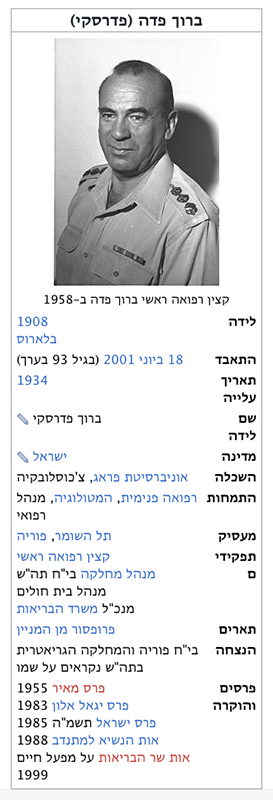
Dr, Baruch Pedarsky (later Dr. Baruch Pada) was born in the town of Radeshkovichi in Belarus. His mother, Chaya-Ribka, was the older sister of the writer Deborah Baron. He was a member of the "Hechaluts" movement. He studied medicine at Charles University in Prague and upon completing his studies in 1934, he immigrated to Israel. He was a physician for the "Israeli Potash Company" in Sodom, as well as a general practitioner in Afula, the Galilee and the Jordan Valley. In 1938 he traveled to the United States and trained in hematology there. Upon his return two years later, he served as a physician in the Upper Galilee and later at Afula Hospital. Around 1942, he met his future wife, Tahya bat Moshe Talmi, from Kfar Yehezkel, a graduate of the Teachers' Seminary in Jerusalem and a teacher at the Kaduri Agricultural School, in Degania. The two were married in Kfar Yehezkel.
In the Haganah, Feda served as the district physician in the Negev region. As part of his role, Feda established a military hospital - "Hospital No. 1" which was set up in tents on Kibbutz Nir-Am[1].
In 1948, he enlisted in the IDF and served as deputy chief medical officer in addition to his duties as medical officer for the Southern Front and operations officer of the Medical Service (later the Medical Corps). In 1949, he retired from the army and was appointed director of the internal medicine department at Tel Hashomer Hospital (later Sheba Hospital). In the early 1950s, the couple were among the first settlers in the Tzahala neighborhood of Tel Aviv. In 1955, he was also appointed deputy director of the hospital. In 1956, he was appointed chief medical officer and served in this position during the Sinai War until the end of 1962. Upon assuming the position of chief medical officer, he decided to abolish military hospitals and to hospitalize soldiers in government hospitals. Routine care was provided in the outpatient clinics attached to these hospitals by specialist physicians[2]. Professor Feda founded the Genetic Institute at Tel Hashomer and was one of the first geneticists in the country.
After retiring from the army, he held teaching, research, and management positions. Among other things, he served as Director General of the Ministry of Health from 1971 to 1974.[3] Among the reasons for his retirement from his position were his feeling of distance from the younger generation of doctors. Added to this were slanders about the ministry's activities that were published in the press at the time in an attempt to present professional achievements as failures. In 1972, he was appointed a member of the Atomic Energy Committee.
In 1974–1976, he was appointed director of the Poriya Hospital (which now bears his name). Upon his retirement, he moved with his wife to live in Hatzor HaGlilit. There he served as a general practitioner and his wife worked as a teacher. Later, he opened an institute for diabetics in Kiryat Shmona and worked at the Katzrin settlement clinic. In their last years, the couple established the Golan Archives.
During his professional life, he was highly regarded by his colleagues and the state and medical establishment, and was, among other things, a winner of the Meir Prize (1955), a winner of the Yigal Prize Alon (1983), winner of the 1985 Israel Prize for Medicine, decorated with the President's Volunteer Medal (1988), and the Minister of Health Medal for Lifetime Achievement (1999).
Professor Baruch Feda suffered from cancer. His wife, Tahya nee Talmi (sister of physicist Yigal Talmi), had a heart condition and was hospitalized for a long time during 2001. Following the deterioration of his condition, he and his wife decided to end their lives. Baruch Feda died at his home in the Tzahala neighborhood from an overdose of medications that he and his wife were taking. The two left behind a farewell letter. His wife, Tahya, remained in serious condition and died about a week later. The couple were buried in the cemetery in Kfar Yehezkel. They left behind three children and grandchildren.
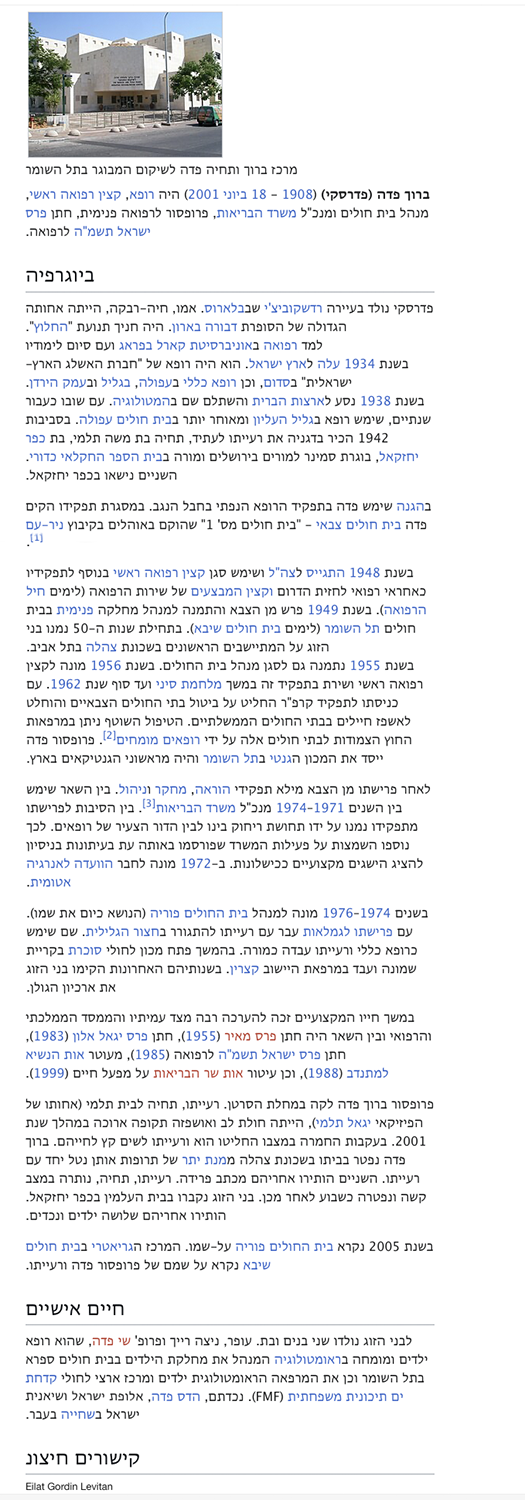
In 2005, Poriya Hospital was named after him. The Geriatric Center at Sheba Hospital is named after Professor Feda and his wife.
Personal life
The couple had two sons and a daughter. Ofer, Nitza Reich and Prof. Shai Feda, who is a pediatrician and rheumatologist who directs the pediatric department at Safra Hospital in Tel Hashomer as well as the Pediatric Rheumatology Clinic and the National Center for Familial Mediterranean Fever (FMF) patients. Their granddaughter, Hadas Feda, is an Israeli champion and former Israeli record holder in swimming.
External links
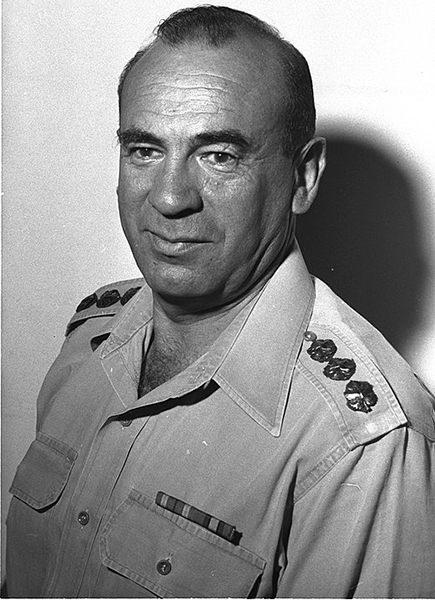
Prof. Baruch Padeh (Padersky) MP
Gender:
Male
Birth:
1908
Radoshkovichi near Minsk, Belarus
Death:
June 18, 2001 (92-93)
Immediate Family:
Son of Moshe Padersky and Chaya Rivka Padersky
Husband of Tchiya Padeh
Father of <private> Padeh and <private> Reich (Padeh)
Brother of Eliyahu Paderski; Dvora Shapira and Sima Lev-Man